
Golf Skins Game Rules: Carryovers, Validation, and What Actually Wins a Skin
Nobody wins the hole 62.6% of the time in a scratch foursome. The carryover math, the validation variants, and the score that actually takes the skin.
Quick answer
A skin goes to the sole lowest score on a hole. Ties win nothing and normally carry over, so the pot builds until somebody breaks clear. The Rules of Golf do not define skins, so your group writes the terms — gross or net, the allowance, validation, and what happens to money left after the last hole. Most holes produce no winner at all.
The six terms your group has to settle
| Term | Options in common use |
|---|---|
| Gross or net | Actual scores, or scores after allocated handicap strokes |
| Handicap allowance | Full Course Handicap, 90%, 85%, or half — no official figure exists |
| Stake structure | Per-hole ante from each player, or one buy-in divided by skins won |
| Carryover | Tied value rolls to the next hole, or the tied skin is unclaimed |
| Validation | None, par or better, repeat your score, or win the next hole too |
| Money left after 18 | Playoff, split among those tied low on 18, refund, or roll to next round |
Every row is a local decision. None of them has a governing-body answer, and each one has produced an argument in a car park somewhere.
A skin needs the only low score in the group
The whole format rests on one word. The player with the sole lowest score on a hole wins that hole’s skin (Golf Digest’s rundown of the game states it the same way). Make 3 while everyone else makes 4, and the skin is yours. Make 3 while one other player also makes 3, and neither of you gets anything — and neither does anybody else in the group.
That last part surprises people. The usual shorthand is two tie, all tie: a shared low score voids the hole for everyone, and the players who made 5 stay every bit as eligible for the money on the next hole (Golf Monthly). Nobody is knocked out of a skins game. That is what separates it from match play, where holes accumulate into a lead — in skins every hole is its own settled contest, and the running total is money rather than position.
Skins is not a format the governing bodies define. The Rules of Golf recognise match play and stroke play, gross and net, and leave everything else to the group or the Committee. On the wagering itself, the USGA’s amateur-status guidance permits informal betting where the players generally know each other, participation is optional, and all the money comes from the participants — which describes an ordinary Saturday skins game.
The tie tax: most holes have no winner
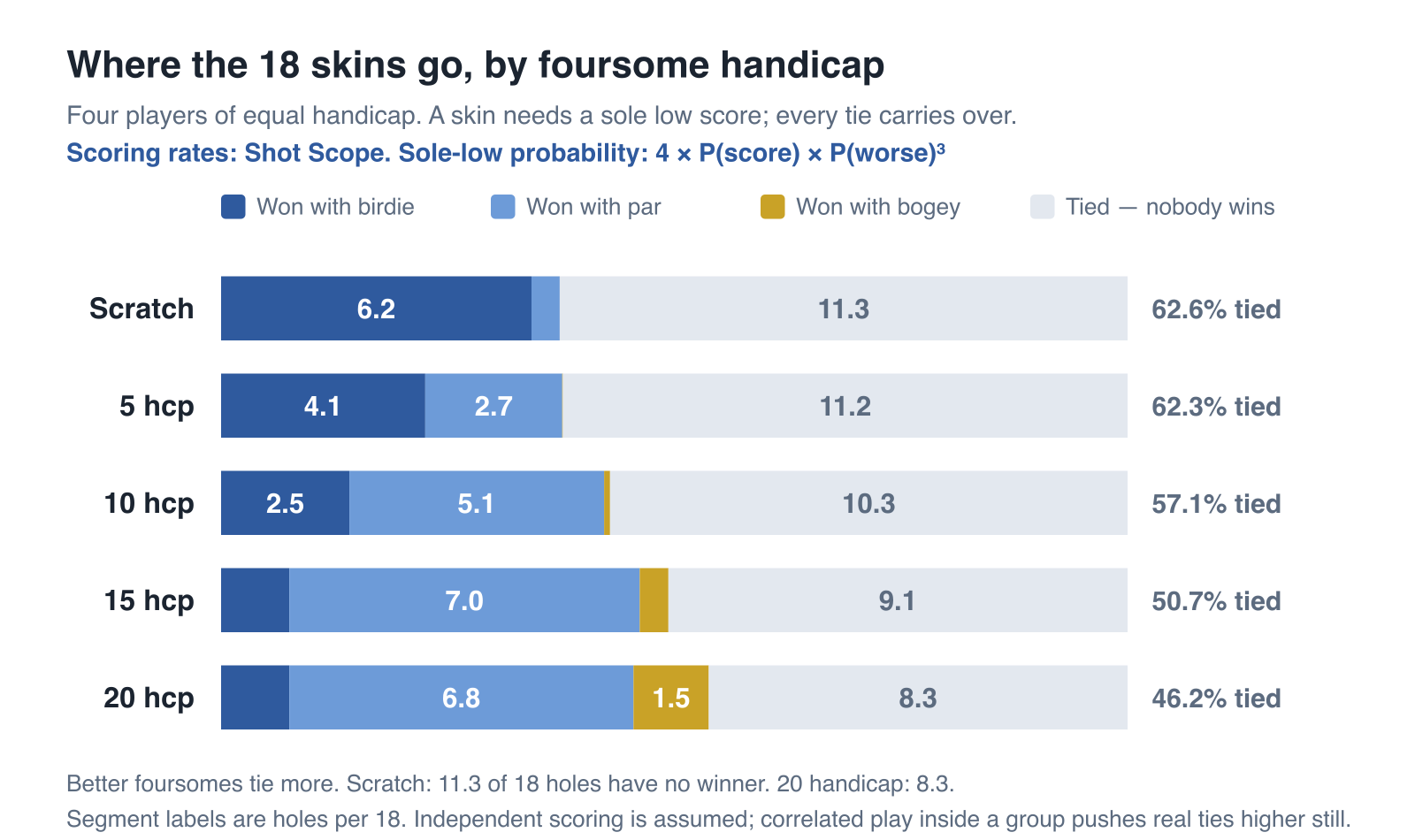
In a foursome, the modal outcome of a hole is that nobody wins it. No rules page prints that number, and it changes how the whole game should be read.
Treat four players of equal handicap as scoring independently, with per-hole rates taken from Shot Scope’s scoring averages by handicap. A category wins the hole when exactly one player scores it and the other three all score worse, which is 4 × P(score) × P(worse)³ summed across birdie, par and bogey. Double bogey and worse sit in the floor bucket, so they can never be uniquely low here, which pushes the modelled win rates down and the tie shares up.
| Foursome | Skins awarded per 18 | Holes tied | Average holes a skin carries |
|---|---|---|---|
| Scratch | 6.7 | 62.6% | 2.68 |
| 5 handicap | 6.8 | 62.3% | 2.65 |
| 10 handicap | 7.7 | 57.1% | 2.33 |
| 15 handicap | 8.9 | 50.7% | 2.03 |
| 20 handicap | 9.7 | 46.2% | 1.86 |
Two things fall out of that table.
Roughly half of every skins game is carryover. Even the group that resolves the most holes leaves 8.3 of 18 unclaimed. Any mental model in which each hole is a fresh, winnable event is wrong by a factor of about two.
Better foursomes tie more. A scratch group ties 62.6% of its holes; a 20-handicap group ties 46.2%. Good players pile up on par, and four players stacked on the same number is exactly the shape that produces no winner. Widen the scoring distribution and somebody breaks clear more often. The format rewards separation from the field, and separation is easier to find in a group that scatters.
That independent model has outside corroboration. Roland Minton’s American Statistical Association paper on golf variance simulates mixed foursomes and reports per-hole tie probabilities between 43% and 60.4%, arrived at from a different direction. The 46.2%-to-62.6% band above sits alongside it. Real groups will tie somewhat more than either model says, because four players share one wind and one pin, and correlated scoring makes matching numbers more likely.
Par wins more skins than birdie does
The received advice is that you need a birdie to win a skin. That holds at the top of the handicap range and collapses below it.
Splitting the awarded skins by the score that won them:
| Foursome | Won with birdie or better | Won with par | Won with bogey |
|---|---|---|---|
| Scratch | 91.7% | 8.3% | 0.0% |
| 5 handicap | 59.7% | 40.1% | 0.2% |
| 10 handicap | 33.0% | 65.5% | 1.5% |
| 15 handicap | 15.3% | 78.3% | 6.4% |
| 20 handicap | 14.0% | 70.6% | 15.4% |
Derived from the Shot Scope rates above; the script that computes both tables is committed at scripts/blog-figures/golf-skins-game-rules-tie-tax.mjs.
Among scratch players, 91.7% of skins are won with a birdie, and the advice is sound. In a 15-handicap foursome, 78.3% of skins are won with a par and only 15.3% with a birdie. In a 20-handicap group, bogey takes 15.4% of the skins that get won, ahead of birdie on 14.0%.
That reframes the strategy question. A mid-handicapper who fires at every flag chasing the birdie the format supposedly demands is hunting the outcome that wins 15% of the skins, while the outcome that wins 78% of them is a green in regulation and two putts. The greens-in-regulation benchmarks by handicap are the more useful target for that player, and ordinary course-management discipline — middle of the green, take your par, let the other three make a mess — wins the majority of the money in any group above about 10.
The birdie-or-nothing instinct does have a real basis, and it is worth naming precisely. Minton’s paper gives its consistent and erratic golfers the same chance of an excellent shot as of a bad one, which is Hardy’s “equal ability” setup rather than an equal scoring average — over 18 holes the erratic player still averages 73.8 against 72.9. He wins more individual holes anyway, because a double bogey costs nothing beyond the current hole while an exceptional score takes the whole pot. In his published example, three consistent golfers each won 8.2% of holes against the erratic golfer’s 15.1%. Variance is an asset in skins the way it is not in a head-to-head stroke-play match, where Minton has the consistent player winning 53% against 38% losses. A one-round tournament flips it again: he gives the erratic cohort a 71% chance of producing the single lowest score. The mistake is assuming variance means aggression on every shot rather than on the shots where it pays.
When aggression earns its place
- A large carryover is sitting on the hole. Three tied holes make the fourth worth four base skins, and par is unlikely to be uniquely low four times running.
- The miss is not penal. A short-side bunker is a different proposition from water. Mark Broadie’s risk-and-reward framing in Every Shot Counts treats the pin-hunting decision as an expected-value calculation, and for ordinary score minimisation he lands on the middle of the green.
- Somebody in the group is already stiff. Par cannot beat a player with three feet left. Once the hole cannot be won conservatively, the conservative play is worth nothing.
- It is late and you are down. A tie preserves the deficit. Only a win reduces it.
Outside those cases, the arithmetic in the table above says take the par.
What a carryover is worth
A tied hole adds its value to the next one. Two ties in a row make the third hole worth three base skins, and after an outright win the following hole resets to one (the PGA of America’s rundown of on-course games describes the mechanic).
The long-run value of the game is unchanged by them. If every hole contributes the same base amount and holes tie with probability q, the wait for a resolution is geometric: a skin resolves after an average of 1/(1 − q) holes and pays an average of base ÷ (1 − q). Divide the payout by the wait and every base skin is still worth exactly one base skin over the long run. Carryovers bundle several of them into a less frequent, larger award. In a symmetric four-player game where all the money eventually gets paid, each player’s expected share before the first tee shot is 25%, with or without carryovers.
Run it on the standard stake. Golf Digest’s worked example uses a dollar per player per hole: each hole is worth $4, each player is exposed to $18, and the funded pot is $72. Applying the carry rates from the table above, the average skin that gets won is worth about $10.71 in a scratch foursome and about $7.43 in a 20-handicap group — the weaker group resolves holes faster, so its money arrives in smaller, more frequent pieces.
The practical consequence is about temperament rather than edge. Carryovers make the game swingier without making it more profitable, so the stake should be set against the swings and not the per-hole number. A player comfortable risking a dollar a hole may be much less comfortable watching a single putt decide $30 of it.
The no-carryover option exists and is underused. A tied hole is a push, the skin is unclaimed, and the next hole starts at its normal value. In prepaid tournament pools the buy-in is then divided only among the skins won (Golf Genius documents the tournament version). Given that about half of all holes tie, no-carryover is the sensible default for a group that wants the money spread around rather than concentrated.
Validation, and the ambiguity that ruins it
Validation makes a hole win provisional. The player has to do something on the following hole to keep the money.
| Validation rule | What the winner must do next hole | Where it shows up |
|---|---|---|
| None | Nothing. The skin is settled when the hole ends. | Most casual games |
| Score threshold | Meet a stated score, usually par or better | Configurable in Golf Genius at par, birdie or eagle |
| Match or better your score | Repeat the number you just made | Described by Golf Digest |
| Win or halve the next hole | Be low or tied for low again | The 2001 televised event used this principle |
The idea is to stop one fluke hole from taking a large accumulated pot, which is a reasonable thing to want when four holes have carried.
The trap is the word par. A group that agrees “you have to par the next hole to validate” has agreed to almost nothing. Gross par or net par? Par on the hole you won, or on the hole after it? A 15-handicapper receiving a stroke on the next hole reads that sentence very differently from the scratch player who proposed it. Write the threshold as a specific score type on a specific hole, or leave validation out entirely — a rule that produces an argument at settlement has done more harm than the fluke it was meant to prevent.
Net skins: the allowance nobody publishes
Mixed-ability groups need handicaps, and this is where skins is least well served by the rulebook.
Appendix C of the Rules of Handicapping publishes recommended allowances for individual stroke play, four-ball, foursomes, scrambles and more. Skins is not on the list, and the recommendations were developed and validated against millions of scores for the formats that are on it. Anyone quoting a USGA percentage for skins is borrowing a number from a different game.
What is well defined is everything underneath the allowance:
- Course Handicap = Handicap Index × (Slope ÷ 113) + (Course Rating − par) (USGA).
- Playing Handicap = the unrounded Course Handicap × the allowance the group picked, rounded to the nearest whole number only at that final step. Rounding the Course Handicap first and the product again can hand out a stroke nobody is owed (USGA).
- Stroke allocation follows the card’s stroke index in ascending order. A Playing Handicap of 10 gets a stroke on index 1 through 10; above 18 the second strokes start again at index 1; plus players give strokes back beginning at the easiest index (Appendix E).
The full arithmetic behind step 1 is in Golf Handicap Explained, and step 3 is the same allocation that drives a net score on an ordinary card.
The allowance itself is a negotiation. Full Course Handicap is the common recreational default. Former USGA handicap director Dean Knuth recommended 90% for net skins on the grounds that a mid-handicapper receiving strokes has more chances at a net birdie than a low-handicapper has at a natural one; published leagues run 85%, and half-handicap skins exist too.
The tables above explain why that objection has teeth. At full allowance, a stroke received turns a bogey into a net par and a par into a net birdie — and among the 15- and 20-handicap groups, par and bogey together account for 84.7% and 86.0% of all skins won. Handicap strokes are landing directly on the scores that win holes in those groups, which is a much bigger effect than it is at the scratch end, where 91.7% of skins need a real birdie.
For a large field, separate gross and net pools, or flighting, is more defensible than one allowance nobody can justify.
Variants worth naming before you play
| Variant | How it works |
|---|---|
| Gross skins | Sole lowest actual score wins |
| Net skins | Sole lowest score after allocated strokes wins |
| Split pool | Half the buy-in funds gross skins, half funds net |
| Team skins | Partners each play a ball; the side’s lower score is its hole score, sole low team score wins |
| Two-person scramble skins | Each team plays a scramble; team scores are compared hole by hole |
| Greenie | Closest tee shot on a par 3, often requiring par or better to collect |
| Sandie | Par or better after playing from a greenside bunker |
| Barkie | Par or better after hitting a tree |
The last three are junk, tracked as independent units alongside the main game rather than folded into it. They are worth adding for one specific reason: with half the holes tying, junk gives the group something to win on the holes skins cannot settle.
If the underlying game is a two-person scramble, the scramble allowance of 35% and 15% applies to the scramble itself — it covers the scramble only, and the skins layer still needs its own terms.
The televised Skins Game, and what its ladder teaches
The made-for-TV event is where most people first met the format. Television producer Don Ohlmeyer conceived it with IMG’s Barry Frank and bought the network time himself (Golf Digest’s obituary of Ohlmeyer). The first edition was played on 27 November 1983 at Desert Highlands with Jack Nicklaus, Arnold Palmer, Gary Player and Tom Watson; Player won it with $170,000. It ran as an unofficial-money event for 26 consecutive years through 2008, four players over two nine-hole days.
Its final-era value ladder is the part worth stealing:
| Holes | Value per skin |
|---|---|
| 1–6 | $25,000 |
| 7–12 | $50,000 |
| 13–17 | $70,000 |
| 18 | $200,000 Super Skin |
Those figures sum to exactly the $1,000,000 scheduled purse (Los Angeles Times, 2006), which is the arithmetic check any group should run on its own escalating ladder. The 2025 revival at Panther National ran the same carryover structure over a $4 million purse, and its final split is its own arithmetic check: Keegan Bradley $2.1 million, Tommy Fleetwood $1.7 million, Shane Lowry $200,000 and Xander Schauffele nothing — four numbers that total the purse exactly, because every dollar in a skins game comes from the pot.
An escalating ladder does something a flat one cannot: it keeps a player who has won nothing through twelve holes mathematically alive. Given that half the holes tie anyway, front-loading the value would leave most groups with the game decided before the turn.
A few results from the historic run, since they come up:
- Fred Couples won a record five titles — 1995, 1996, 1999, 2003 and 2004. His 2004 win paid $640,000, including $340,000 for three skins settled in a four-hole playoff against Tiger Woods (ESPN).
- Greg Norman swept the entire $1 million purse in 2001, the only outright sweep in the event’s history, validating a large carryover under that year’s win-or-halve rule (Golfweek).
- Tiger Woods played six times and never won it — 1996, 1997, 2001, 2002, 2004 and 2005 (Golf Digest). The best player of the era going 0-for-6 in this format is the clearest illustration available of what the tie tax does to a favourite.
- K.J. Choi won the last one in 2008 with six skins worth $415,000. The event ended when title sponsor LG left and no replacement was found (Fox Sports).
Common skins mistakes
- Assuming a birdie is required. Above a 10 handicap, par wins the clear majority of skins and bogey wins more than birdie does at 20.
- Playing every hole aggressively. Variance pays on the holes carrying real money and on the holes already lost to a stiffed approach. On the other twelve it donates skins to whoever made a routine par.
- Agreeing to “validation” without defining par. Gross or net, this hole or the next — an undefined threshold is a settlement argument with a delay fuse.
- Setting the allowance after someone has won a hole. Playing Handicaps get calculated on the first tee or they get calculated by whoever is currently losing.
- Leaving the eighteenth-hole carryover undecided. It happens in roughly half of all rounds, and no rule covers it.
- Confusing the two stake structures. A per-hole ante and a divided buy-in pay out very differently when only five or six skins are won.
- Forgetting that nobody is eliminated. Players who are five over after three holes still hold a full claim on the accumulated pot, which is exactly what keeps the game alive for them.
- Playing slowly because there is money on the line. Skins invites everyone to hole out on every hole; the ready-golf audit earns more here than it does in a casual round.
Next step
The tables above say something uncomfortable for most golfers: the skin you keep failing to win is usually a par. That is a green-in-regulation problem and a two-putt problem, and both are practisable.
Build a free practice plan — the free forever plan needs no credit card, and AI-generated plans built around your logged leaks are a Pro feature with a 3-day free trial.
Related reading
- Strokes Gained Explained for Amateurs — the framework behind knowing which shots are costing you the holes you keep tying.
- Golf Scramble Rules and Strategy — the other team format, its 25/20/15/10 allowance, and the probability logic behind four attempts at one shot.
- Match Play vs Stroke Play — the format skins is most often confused with, and the per-hole refund that makes aggression rational there.
- Stableford Scoring Explained — the third scoring system that caps what a bad hole costs, compressed to one formula.
- Golf Handicap Explained — the Course Handicap arithmetic every net skins allowance gets applied to.
- How to Keep Score in Golf — the stroke-index allocation that decides which holes you get your net skins strokes on.
- Greens in Regulation Explained — the benchmark behind the pars that win most skins above a 10 handicap.
- Golf Rules for Beginners — the rulings that still apply underneath any side game’s local terms.
- Golf Practice Plan by Handicap — practice weighting for every Index band.
Key takeaways
- A skin needs a sole low score. Two tie, all tie — a shared low voids the hole for the whole group, and nobody is ever eliminated.
- Most holes have no winner. Modelled on Shot Scope’s scoring rates, equal-handicap foursomes tie between 46.2% and 62.6% of holes, which overlaps Minton’s independently modelled 43% to 60.4%.
- Better foursomes tie more. Scratch groups stack up on par and tie 62.6% of holes; 20-handicap groups scatter and tie only 46.2%.
- Par wins most skins above a 10 handicap — 78.3% of them at 15, where birdie takes only 15.3% and bogey takes 6.4%.
- A carryover concentrates the same money into fewer, larger awards. A skin resolves after
1/(1 − q)holes and paysbase ÷ (1 − q); every base skin is still worth one base skin, and each of four players expects 25% of the pot. - The World Handicap System publishes no skins allowance. Appendix C covers stroke play, four-ball, foursomes and scrambles; full Course Handicap and 90% are group conventions borrowed from other formats.
- Define validation precisely or skip it. “Par the next hole” is ambiguous between gross and net, and the ambiguity always surfaces at settlement.
- Decide the eighteenth-hole carryover in advance. No rule covers it, and with about half the holes tying it comes up constantly.
- Escalating ladders keep the game alive. The televised event’s $25k/$50k/$70k/$200k structure summed exactly to its $1m purse; the 2025 revival’s ladder summed exactly to $4m.
Frequently asked questions
What are the rules of a skins game in golf?
Each hole is worth an agreed amount, and the player with the sole lowest score on that hole wins it. If two or more players tie for low, nobody wins and the value usually carries over to the next hole. Skins is a side game rather than a format the Rules of Golf define, so the group sets the stake, the handicap treatment, the carryover rule and the settlement method before the first tee shot.
What happens when two players tie a hole in skins?
The hole is tied and no skin is awarded. The convention is often stated as two tie, all tie: players who scored higher are not eliminated from anything, and everyone in the group remains eligible for the accumulated money on the next hole. In a carryover game that hole’s value is added to the following hole, so two consecutive ties make the third hole worth three base skins. In a no-carryover game the tied skin is unclaimed.
What does it mean to validate a skin?
Validation makes a hole win provisional until the winner meets a condition on the following hole. Published variants require par or better, matching or bettering the score just made, or winning or tying for low again. Golf Genius lets tournament organisers configure the threshold at par, birdie or eagle. Groups should state whether par means gross or net par, because the ambiguity is the source of most validation disputes.
How do handicaps work in a net skins game?
Each player’s hole score is adjusted by the strokes they receive on that hole, and the sole lowest net score wins. Strokes are allocated by the scorecard’s stroke index in ascending order. There is no official answer for how many strokes to give: Appendix C of the Rules of Handicapping publishes allowances for stroke play, four-ball, foursomes and scrambles, but not for skins. Groups commonly use full Course Handicap or 90 percent by agreement.
How much should you bet in a skins game?
A dollar per player per hole is the standard recreational stake. In a foursome that makes each hole worth four dollars, each player’s total exposure eighteen dollars, and the funded pot seventy-two dollars. Carryovers do not change those totals; they concentrate the same money into fewer, larger awards. Set the number by what the least comfortable player in the group is happy to lose outright, since a bad run can take most of it.
What happens to the carryover money after the 18th hole?
There is no universal rule, which is why this argument happens so often. The four workable choices are a sudden-death playoff, splitting the unresolved amount among the players who tied for low on the last hole, refunding it to everyone, or carrying it into the group’s next round. The televised Skins Game used playoffs. Whichever the group picks, it has to be agreed before the round rather than negotiated on the eighteenth green.