
Golf Scramble Rules and Strategy: The Format, the Allowance, and the Math
The USGA recognises the format and leaves the details to your Committee. The 25/20/15/10 allowance, and why the fourth player's attempt earns least.

Quick answer
Everyone tees off, the team picks the best shot, everyone plays again from that spot, and the loop repeats until the ball is holed. The USGA and R&A recognise the structure but leave placement, putting and penalty details to the Committee, so the club-length rule is local, not official. The published four-player handicap allowance is 25/20/15/10 of Course Handicap.
What’s official and what your event decides
| Element | Status |
|---|---|
| Best shot selected after every stroke | Described by the USGA and R&A in Committee Procedures, Section 9 |
| Rules of Golf apply where compatible | Rule 21.5 permits the adaptation |
| One club-length placement | Local convention |
| “Same condition” (rough stays rough) | Local convention |
| Putting-green allowance | Local, and it varies from the exact spot to six inches |
| Minimum drives per player | Local, typically 3 or 4 in a Texas Scramble |
| Team handicap allowance 25/20/15/10 | Published in Appendix C of the Rules of Handicapping as a recommendation |
| Whether the round counts for handicap | Official, and the answer is no |
Half of the arguments on a scramble tee box are about the second column. The format’s basic shape is recognised by the governing bodies; almost every detail people argue over is written by whoever printed the rule sheet.
What the Rules of Golf actually say about a scramble
Three instruments get cited on scramble rule sheets, and only two of them actually govern the format.
Rule 21.5 covers other forms of play and states that golf may be played in formats such as scrambles, and that the Rules may be adapted to govern them. Section 9 of the Committee Procedures then describes the basic mechanics and hands the specifics to the Committee. There is no national scramble rulebook underneath that.
Rule 20 is often cited on outing sheets as though it supplies scramble procedure. It does not. Rule 20 governs how rules questions get resolved during a round and makes a Committee or referee ruling binding, which is a different job entirely.
So the working order for any dispute is: the event’s written terms first, then the ordinary Rules of Golf where they still fit, then a consistent Committee decision for whatever is left. Print the terms. Photograph them on the first tee if the organiser did not. The 12 rulings that arrive in an ordinary round still apply underneath the scramble layer, because penalty areas, out of bounds and unplayable lies do not stop existing because four people are sharing a ball.
The five procedures your event has to define
A rule sheet that leaves any of these blank will produce an argument by the fourth hole.
1. Marking the spot. Before the selected ball is lifted, its position gets a tee in the general area or a ball-marker on the green. Skipping this is the most common procedural error in charity events, and it quietly improves the team’s lie every time.
2. Placement distance. The PGA of America and the Southern California Golf Association both describe one club-length, no nearer the hole, as the standard American convention. Other published sheets use a scorecard length or the exact spot. Any of them is legitimate once written down.
3. Same condition. The usual term keeps the ball in the cut it was selected in. Rough stays rough, fringe stays fringe, and a bunker ball stays in the bunker. The club-length cannot be used to escape onto the green.
4. The putting allowance. Published events run the full range: the exact marked spot, one putter-head, a scorecard, three inches, six inches. There is no default, so a team that assumes one is guessing.
5. Holing out and order. The first ball holed finishes the hole for the team, which creates a real trap covered further down. Some events also require the player whose shot was selected to play first, or fix an order for the round.
Scramble vs best ball vs shamble: the formats people mix up
| Format | What happens | Status |
|---|---|---|
| Scramble | Best shot selected after every stroke; everyone plays from that one spot | Committee Procedures, Sec. 9 |
| Texas Scramble | A scramble with a minimum number of selected tee shots per player, usually 3 or 4 over 18 holes | Local term |
| Ambrose | The Australian name for a scramble, usually with its own fractional handicap formula | Local, mostly Australian |
| Florida / Step-Aside | The player whose shot was selected sits out the next stroke | Described in Committee Procedures |
| Las Vegas Scramble | A die roll decides whose tee shot the team must use; play continues as a scramble | Purely a local game |
| Shamble / Bramble | Best drive selected, then every player plays their own ball to completion; one or two scores count | Local hybrid |
| Best ball (Four-Ball) | Each player plays their own ball and the lowest score counts; Rule 23 is two partners, outings run three or four | Rule 23 |
The scramble-versus-Four-Ball line is the one worth memorising. A scramble selects the best shot after every stroke. Four-Ball selects the better completed score of two partners, and the four-player best ball most outings run does the same across four separate balls. “Best ball” gets used loosely for both at outings, which is how a foursome ends up halfway down the first fairway disagreeing about whether to pick up.
“Bramble” and “shamble” are treated as synonyms in some places and as distinct formats in others, and “Las Vegas Scramble” has at least three published meanings. Describe the mechanics on the sheet rather than trusting the name.
Handicapping a scramble: the 25/20/15/10 allowance
Appendix C of the Rules of Handicapping publishes scramble allowances by team size:
| Team size | Allowance, lowest Course Handicap first | Formula |
|---|---|---|
| 4 players | 25% / 20% / 15% / 10% | 0.25A + 0.20B + 0.15C + 0.10D |
| 3 players | 30% / 20% / 10% | 0.30A + 0.20B + 0.10C |
| 2 players | 35% / 15% | 0.35A + 0.15B |
Apply the percentages to unrounded Course Handicaps, add the components, and round once at the end. The USGA’s worked four-player example runs Course Handicaps of 10.335, 15.353, 28.255 and 37.574 through the formula for a team Playing Handicap of 14:
0.25 × 10.335 =  2.584
0.20 × 15.353 =  3.071
0.15 × 28.255 =  4.238
0.10 × 37.574 =  3.757
                ------
                13.650  →  14
The Course Handicap arithmetic feeding that first column is in Golf Handicap Explained. Rounding each component before adding is the usual error, and on a spread like this one it can move the team number by a full stroke.
The 20/15/10/5 you have seen on a hundred outing sheets is a legacy formula. It circulated widely through a Golf Digest column by former USGA handicap director Dean Knuth and it still appears on charity rule sheets today. A Committee is free to keep using it, but it should be labelled as the event’s own formula rather than as the USGA recommendation, because the two produce meaningfully different team numbers.
Two more things a Committee should know. The allowances are recommendations, and the USGA’s handicap-allowance guidance says they were developed and validated using millions of scores and simulations. And no scramble round is acceptable for handicap purposes, because it never produces an individual hole-by-hole score played under the Rules for each player (USGA acceptability of scores). Your Index sits out the day.
Why scramble scores run so low
A scramble takes the best of four outcomes at every stroke instead of adding four ordinary scores. In statistical terms the team keeps an order statistic, and the effect compounds across roughly 60 to 70 strokes.
The size of it has been measured. A.J. Lewis’s paper “Handicapping in group and extended golf competitions”, published in the IMA Journal of Management Mathematics in 2005, applies elementary probability to the Texas Scramble and finds that a foursome of scratch golfers holds roughly a two-stroke average advantage over three scratch golfers and about a six-stroke advantage over two. Team size alone is worth that much before anyone talks about strategy.
For a practical benchmark on a par-72 course with no mulligans, a mixed amateur four-player team in the low 60s has had a good day. Winning charity totals cluster lower: published outings in 2024 and 2025 show gross winners at 54, 55, 56 and 58. Treat those as observed results rather than a national average, because mulligan sales, forward-tee purchases, drive quotas and net-versus-gross scoring all shift the number by several strokes. Any published scramble result without those conditions attached is uncomparable.
The fourth attempt is worth 22% of the first
The arithmetic behind a scramble putt is simple enough to do on the tee box, and it says something most scramble advice misses.
If every player independently converts a putt with probability p, the team’s chance of holing at least one is 1 − (1 − p)⁴. That closed form is well known. The useful version is its decomposition: attempt n contributes p(1 − p)ⁿ⁻¹, a geometric decay in which every successive try is worth less than the one before it.
Run it on a real make rate. Shot Scope’s by-handicap putting data puts a 15-handicap at 39.6% from 6 to 12 feet. Four of them:
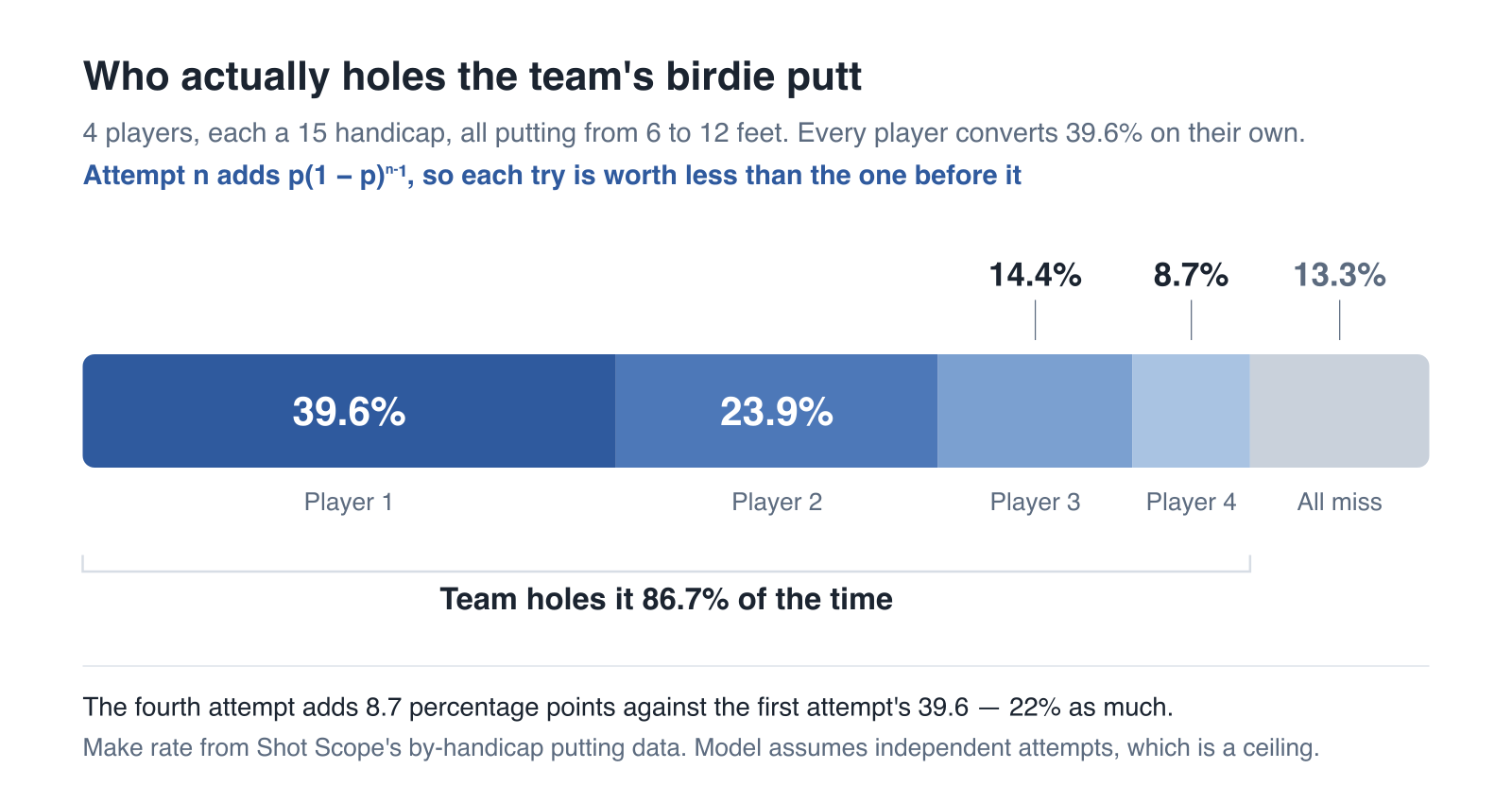
The team holes 86.7% of those putts, which is the number everyone quotes. The number nobody quotes is 8.7 — the fourth player’s marginal contribution, 22% of what the first player’s attempt was worth.
That has a direct consequence. The last attempt is the cheapest thing the team owns, so spending it on a carbon copy of the first putt is the single largest waste in the format. Give it a different read, a different pace, or the high side. The independence model above is a ceiling anyway: four players share one green, one wind and usually one read, so real attempts are positively correlated and the true team rate sits below 86.7%. Varying the line is the only lever a team has against that correlation.
The same logic runs the other way on approach shots. Once one ball is safely on the green, the remaining attempts cost almost nothing in expectation, which is exactly when a tucked pin becomes worth attacking.
Proximity is worth more to a team than to a solo player
Running the same Shot Scope rates through the team formula at every distance band produces the most useful table in this post, and it argues for tighter approach play than the usual “four tries, just find the green” advice.
| Distance band | 15-handicap solo | Four-player team | Gain from moving up one band | Team gain ÷ solo gain |
|---|---|---|---|---|
| 30 ft+ | 3.2% | 12.2% | — | — |
| 24–30 ft | 7.8% | 27.7% | solo +4.6, team +15.5 | 3.4× |
| 18–24 ft | 11.2% | 37.8% | solo +3.4, team +10.1 | 3.0× |
| 12–18 ft | 20.2% | 59.4% | solo +9.0, team +21.6 | 2.4× |
| 6–12 ft | 39.6% | 86.7% | solo +19.4, team +27.3 | 1.4× |
| 0–6 ft | 84.4% | 99.9% | solo +44.8, team +13.2 | 0.3× |
Solo make rates from Shot Scope’s by-handicap data; team column is 1 − (1 − p)⁴ applied to four equal players. The independence assumption makes the team column a ceiling.
Read the last column. Moving a team’s ball from 25 feet to 20 feet is worth three times what the same five feet are worth to a solo golfer. Moving it from 9 feet to 4 feet is worth less than a third, because the team already converts the 9-footer 87% of the time.
The crossover sits between the last two rows. An approach that finishes outside 6 feet is amplified by the format; one that finishes inside 6 feet is damped, because four players already convert from there. That rewrites the approach-shot brief. Firing at a tucked flag to turn a likely 12-footer into a likely 4-footer buys the team almost nothing it did not already have. Playing at the fat of the green to turn a likely 30-footer into a likely 18-footer is worth roughly triple its solo value. Aim for the middle and let the format compound it — which is the same conclusion strokes-gained thinking reaches for individual play, arrived at from a different direction and with a steeper slope.
It also explains why a team’s long-lag skill matters more than its short-putt skill. From 30 feet and out, four amateurs convert 12.2% between them, so the realistic goal is a tap-in second putt rather than a make. Calibrated lag work is the practice that moves that number.
Order of play, hole by hole
One ranking for the whole round is a mistake, because the best overall golfer is rarely the best driver, the best wedge player and the best putter. GolfWRX’s scramble guide recommends naming a separate anchor for each phase.
Tee shots. The most reliable fairway finder goes early. The SCGA’s tournament strategy piece puts the longest hitter last, once a playable ball already exists and the swing carries no consequence. If nobody has found short grass by the fourth player, the hero line is finished and the job is a ball in play.
Approaches. Same shape. First player takes the centre of the green or a clean short-side-free miss. Later players attack. Amateur dispersion is heavily short-biased, which matters here: Arccos’s own shot-data write-up has 10-handicappers missing short of a front pin 39% of the time from 150 yards in the fairway, against long by only 9%. Club for the carry that actually happens, not the flush one.
Putting. The PGA of America’s scramble advice puts the best putter last, so they read three previous attempts before striking. That only works if the earlier attempts were informative, which means the first putt must be struck at hole speed on a committed line. A tentative first putt teaches the anchor nothing and wastes the format’s most valuable attempt.
Long lags specifically. Put the best speed-control player first even if that costs you the conventional order. On a 40-footer the team is not realistically holing anything, so the first roll’s job is to price the green for everyone behind it.
Managing a minimum-drive requirement
Texas Scrambles and most Ambrose events require each player’s tee shot to be selected a set number of times, commonly three or four over 18 holes (Golf Monthly on the format). Teams routinely ignore the quota until the closing stretch and then get forced into the shortest hitter’s drive on the hardest remaining hole.
Track it on the card from hole 1. Spend the weaker players’ required drives on short par 4s, wide fairways, downwind holes and downhill tee shots, and on par 3s if tee shots there count toward the quota. A required drive taken voluntarily on hole 3 costs a fraction of the same drive taken under duress on hole 17.
Common scramble mistakes
- Assuming one club-length is a Rule. It is a convention. The event may use a scorecard, the exact spot, or six inches on the green.
- Lifting the selected ball before marking it. The reference point becomes an opinion, and the lie quietly improves.
- Changing condition. Rough to fairway, fringe to green, bunker to grass. All of it improves the next shot and all of it is usually prohibited.
- Tapping in a miss too early. The first ball holed can complete the hole and delete the team’s remaining attempts. Mark the miss and wait.
- Four identical putts. The fourth attempt is worth 22% of the first, and a copy of a line that already missed is worth less than that.
- Four identical hero shots. Without a backup in play, the aggressive attempt stops being free. Secure one usable ball, then escalate.
- Selecting the longest drive automatically. Compare the second shot from each candidate: yardage, lie, angle and tree interference. A ball 12 yards shorter in the fairway usually wins. This is ordinary course management with four options instead of one.
- Burning mulligans early. The PGA’s guidance is to save them for putts inside 10 feet and shots inside 100 yards that failed to produce a look.
- Playing slowly because there are four balls. A scramble puts four players on the same spot repeatedly, which is fast if the team is ready and glacial if it is not. The ready-golf audit applies with four times the effect.
Next step
A scramble hides your worst shots behind three teammates for one afternoon. Your own card on Saturday does not.
If your drive is the one nobody selects, or your wedge is the one that keeps missing short, that is a specific leak with a specific practice fix. Build a free practice plan — the free forever plan needs no credit card, and AI-generated plans built around your logged leaks are a Pro feature with a 3-day free trial.
Related reading
- Best Ball vs Scramble — the format this one gets confused with, why Rule 23 codifies it and not the scramble, and the modelled 71.5 four 10-handicaps post in best ball.
- Strokes Gained Explained for Amateurs — the framework behind the “compare the next shot, not the current one” selection rule, with strokes-lost figures by handicap.
- Golf Handicap Explained — the Course Handicap arithmetic every scramble allowance is applied to, unrounded.
- Stableford Scoring Explained — the other format that changes what a bad hole costs, compressed to one formula.
- Golf Rules for Beginners — the 12 rulings that still apply underneath a scramble’s local terms.
- Strokes Gained: Putting Explained — the make-rate data the team-probability tables above are built from.
- Lag Putting Drills — eight drills for the speed control that decides your team’s first putt from 40 feet.
- Golf Course Management Tips — the hole-by-hole decision layer, which a scramble multiplies rather than replaces.
- How to Hit a Driver — the swing behind the aggressive fourth tee shot, once a safe ball is already in the fairway.
- Golf Practice Plan by Handicap — practice weighting for every Index band.
Key takeaways
- A scramble is a Committee format. Rule 21.5 permits it and Committee Procedures Section 9 describes it; everything about placement, putting and penalties comes from the event’s written terms.
- One club-length is a local convention. Published events use a scorecard, a putter-head, three inches, six inches or the exact spot. Read the sheet.
- The published four-player allowance is 25/20/15/10 of unrounded Course Handicap, lowest first, rounded once. The 20/15/10/5 on old outing sheets is a legacy Golf Digest formula.
- A scramble never counts toward your Handicap Index, because it produces no individual hole-by-hole score under the Rules.
- Four scratch players beat three by about two strokes and two by about six, per Lewis’s 2005 analysis in the IMA Journal of Management Mathematics.
- Attempt n is worth
p(1 − p)ⁿ⁻¹. For four 15-handicaps from 6 to 12 feet, the fourth try adds 8.7 points against the first try’s 39.6 — 22% as much. - Proximity is worth more to a team than to a solo player on every approach that finishes outside 6 feet, up to 3.4× at long range, and less than a third of solo value once the ball is inside 6 feet.
- Name a separate anchor for driving, approach and putting. Accurate first off the tee, longest last; best putter last, but only if the first putt was struck at hole speed.
- Spend the weak players’ required drives early, on short and wide holes, rather than being forced into one on hole 17.
Frequently asked questions
What are the basic rules of a golf scramble?
Every player on the team tees off. The team picks the best of those tee shots, marks its position, and all players then play their next shot from that spot. The process repeats until the ball is holed, and the team records one score for the hole. The USGA and R&A describe this basic structure in Section 9 of the Committee Procedures, but the detailed placement, putting and penalty conditions are set by the tournament Committee rather than by the Rules of Golf.
How far can you move the ball in a scramble?
There is no universal answer, because no Rule of Golf sets the distance. The most common United States convention is one club-length from the marked spot, no nearer the hole, and in the same condition, so rough stays rough and a bunker ball stays in the bunker. On the putting green, published events use anything from the exact spot to a putter-head, a scorecard, three inches or six inches. Read the event’s rule sheet before the first tee shot.
What is the handicap allowance for a four-person scramble?
Appendix C of the Rules of Handicapping recommends 25 percent of the lowest Course Handicap, 20 percent of the second lowest, 15 percent of the third and 10 percent of the highest. Apply the percentages to unrounded Course Handicaps, add the four components, then round once. Three-player teams use 30, 20 and 10 percent; two-player teams use 35 and 15. The older 20/15/10/5 formula still printed on many outing sheets is a legacy figure, not the current recommendation.
What is the difference between a scramble and a best ball?
In a scramble the team selects the best shot after every stroke and everyone plays their next shot from that one location. In best ball, more precisely Four-Ball under Rule 23, each player plays their own ball and the lowest individual score counts as the side’s score, and Rule 23.2a lets a partner stop once their score cannot help. No player relocates their ball to a teammate’s spot in Four-Ball, though normal relief procedures still apply. The distinction matters because a scramble compounds four attempts at every shot, while best ball compounds whole-hole attempts, two of them under Rule 23.
What is a good score in a golf scramble?
For a four-player team on a par-72 course with no mulligans, anything in the low 60s is a solid round and the mid-to-high 50s is usually competitive in a charity field. Published 2024 and 2025 outings show winning gross totals of 54 to 58. Comparing across events is unreliable because mulligans, forward-tee purchases, minimum-drive requirements, team size and net-versus-gross scoring all move the number by several strokes.
Do you have to hole out in a scramble?
Unless the Committee says otherwise, yes. The selected ball must be holed for the team to complete the hole, and gimmes are not automatic in a scramble. Watch the order: once a ball is holed, the hole is finished, so a player who taps in a miss before teammates have attempted the original putt can end the team’s remaining attempts. Mark any miss and let every eligible player try the original putt first.
Does a scramble count toward your handicap?
No. A scramble does not produce an individual hole-by-hole score played under the Rules of Golf for each team member, so the round is not acceptable for handicap purposes under the World Handicap System. Your Handicap Index is unaffected by a scramble, win or lose. The same applies to the team score, which belongs to the team rather than to any individual player and has no posting route.