
Match Play vs Stroke Play: Rules, Scoring, and the Strategy Gap
Match play refunds every stroke past one worse than your opponent. A worked card where an 80 beats a 77, plus the rule and allowance differences.

Quick answer
Stroke play counts every stroke. Match play counts holes won, so anything past one worse than your opponent on a lost hole is refunded. That refund is the whole difference. Rule 1.3c(2) splits the general penalty too: loss of hole in match play, two strokes in stroke play. Concessions exist only in match play; stroke play requires you to hole out.
The differences that change how you play
| Situation | Match play | Stroke play | Rule |
|---|---|---|---|
| General penalty | Loss of hole | Two strokes | 1.3c(2) |
| Conceding a stroke, hole or match | Allowed, and final once made | Not permitted | 3.2b(1) |
| Holing out | Not required after a concession | Required, disqualification if not corrected | 3.3c |
| Playing out of turn | No penalty; opponent may cancel the stroke | No penalty; ready golf encouraged | 6.4a / 6.4b |
| Agreeing to play out of turn | Allowed, to save time | Allowed to save time; the general penalty applies if the agreement is made to give someone an advantage | 6.4b(1) |
| Unsure how to proceed | Play on, request a ruling in time | May complete the hole with two balls | 20.1b / 20.1c(3) |
| Scorecard | Not required by Rule 3.2 | Required and certified under Rule 3.3b | 3.3b |
| Singles handicap allowance | 100% of Course Handicap | 95% of Course Handicap | Appendix C |
Rule 3 of the Rules of Golf recognises the two forms as fundamentally separate competitions. In match play a player competes against one opponent on each hole, and the result is reckoned in holes won, lost or tied. In regular stroke play every player competes against the whole field on total strokes, penalties included. The governing text is the 2023 Rules of Golf; later USGA and R&A clarifications amend that edition rather than replacing it.
The match-play refund, and its exact size
Match play caps what a hole can cost you. Once your opponent is in the hole and you cannot equal their score, every additional stroke you take is free — a 12 against their 4 loses the same single hole as a 5 against their 4. The USGA states this plainly in its match-play basics: a player who has already lost the hole can pick up, because the eventual total no longer matters.
That cap has a measurable size on any given round. Call it the match-play refund:
Refund = Σ (your score − opponent’s score − 1) across every hole you lose
On a hole you lose by exactly one, the refund is zero. On a hole you lose by five, four strokes vanish. Stroke play banks all of them.
The refund is the only reason the two formats ever disagree about who played better. If your stroke-play deficit is smaller than your refund, you can post the higher number and still win the match.
One card, scored both ways
Here is that arithmetic on a full round. Same course, same par-72, two players, every gross score honest.
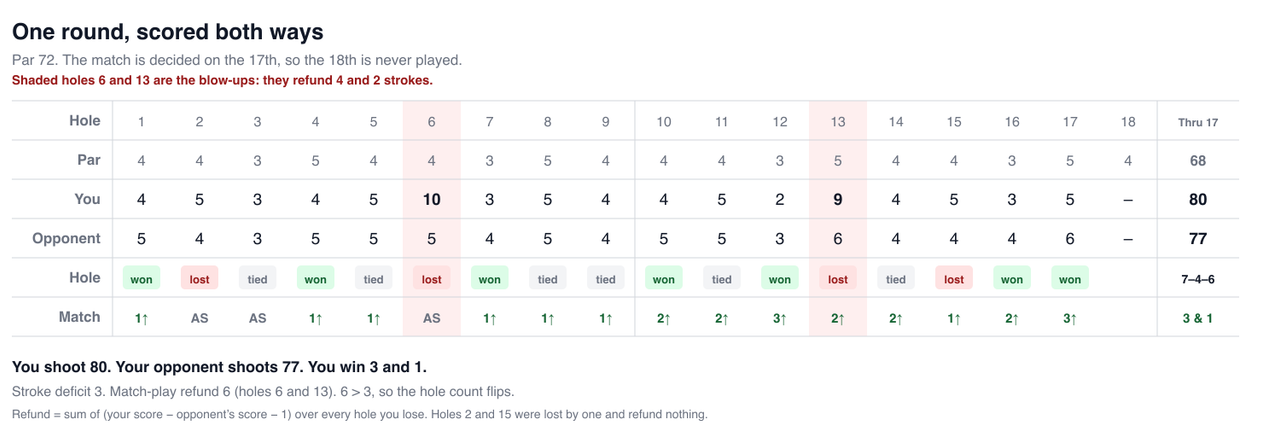
Player A shot 80 through 17 holes. Player B shot 77. Player A won the match 3 and 1.
The refund explains all of it, and the two highlighted holes carry it:
| Hole lost | Your score | Opponent | Refund |
|---|---|---|---|
| 2 | 5 | 4 | 0 |
| 6 | 10 | 5 | 4 |
| 13 | 9 | 6 | 2 |
| 15 | 5 | 4 | 0 |
| Total | 6 |
Player A’s stroke deficit was 3. The refund was 6. Six is larger than three, so the hole count flipped: 7 holes won, 4 lost, 6 tied, a lead of three with one hole left. That is what “3 and 1” encodes — the margin, then the holes never played.
Holes 2 and 15 are worth noticing for the opposite reason. Losing by exactly one stroke refunds nothing at all, which means a match is decided by tidy one-shot losses just as firmly as stroke play is. The format forgives catastrophe. It does not forgive drift.
Reading a match score
Match play reports two numbers because the match usually ends early.
| Term | What it means |
|---|---|
| 1 up | One more hole won than the opponent |
| All square / tied | Both sides have won the same number of holes |
| Halved hole | A hole completed in the same number of strokes by both |
| Dormie | The lead equals the holes remaining, for example 2 up with 2 to play |
| 3 and 2 | Three holes ahead with two holes left, so the result was settled after 16 |
Under Rule 3.2a(3) a match ends the moment a lead is greater than the number of holes remaining, and the rest of the holes are never played. Dormie is the edge case: the lead equals the holes remaining, so the trailing player can still win every one of them and tie. The USGA removed “dormie” and “halved” from official terminology in 2019 in favour of plainer wording, though broadcasters and club golfers kept using both.
If a match is tied after the final hole, Rule 3.2a(4) extends it one hole at a time until somebody wins, unless the terms of the competition allow a tie. Team events set their own terms — the Ryder Cup awards half a point each after 18.
What the evidence says about playing differently
The strategy advice attached to match play is usually louder than the evidence behind it. Two peer-reviewed sources are worth reading before you change anything.
Trailing players do take more risk. Ozbeklik and Smith analysed 579 WGC-Accenture Match Play matches and more than 18,000 player-hole observations from 2003 to 2013 using ShotLink data. Players who were behind took greater risks, particularly late in matches, and leaders grew more conservative as their leads widened. Their model estimated roughly a 3.0% increase in score standard deviation for a player ranked 66th facing the world number one, and about a 5.4% increase for a player three holes down. Those are behavioural estimates from one tournament sample rather than universal constants.
The gains from opponent-aware play are small. A 2025 Computational Statistics study by Wajge and Stauffer modelled optimal match-play decisions and found that accounting for an opponent’s strategy produced only modest improvements, largely because accurate opponent-specific probabilities are hard to obtain. Their recommendation was to retain an optimal stroke-play strategy except where the match situation clearly changes the objective.
Put those together with the refund and the practical rule is narrow. Your real objective in match play is the probability of winning the match, and hole-win probability is the working proxy for it — a good one in the middle of a match, a poor one when the match is nearly decided and a half is worth as much as a win. Either way that objective differs from minimising expected strokes, and the two give the same answer on most shots. They diverge when a high-variance line has a real chance of beating an opponent who is already safe, and when the downside of that line would mostly be refunded anyway.
The mirror case matters more for scoring. When the opponent has hit into serious trouble, the high-probability route that keeps your ball in play wins the hole often enough that anything else is a donation.
One caution on sources: Mark Broadie’s strokes-gained framework values a shot against an expected-strokes benchmark, which makes it an excellent baseline for shot selection but not a hole-win-probability model. Broadie has discussed Ryder Cup analytics as a pairing and portfolio problem. Treat any claim that Every Shot Counts prescribes a match-play risk formula as unsupported — it doesn’t. For the underlying framework, start with Strokes Gained Explained for Amateurs.
There is also no defensible universal upset rate for match play. Upset frequency moves with field strength, seeding, pool play versus knockout, and match length. The academic work supports an underdog incentive to raise variance; it does not license a headline percentage.
Handicaps: the step club golfers skip
Both formats start identically. Course Handicap is Handicap Index × (Slope ÷ 113) + (Course Rating − par), and the full arithmetic lives in Golf Handicap Explained.
The formats then split three ways, all governed by Appendix C of the Rules of Handicapping.
The allowance differs. Singles match play recommends 100%; individual stroke play recommends 95% for a medium net field of 30 to 100 players, with 100% worth considering below 30. Four-ball splits the same way: 90% for match play, 85% for stroke play.
The low player goes to scratch. Apply the allowance, then set the lower Playing Handicap to zero and give the other player the difference. Playing Handicaps of 7 and 13 become 0 and 6. The USGA explains why: stroking off the low player concentrates the receiving player’s shots where they work as equalisers. Giving both players their full figures would hand the better player strokes on the hardest holes too and distort hole-by-hole equity. Ordinary net stroke play does the opposite — everyone keeps their own number, because the comparison is against the whole field.
Where the strokes land matters more. Six strokes means one shot on stroke index 1 through 6. Appendix E recommends spreading the low indexes through the round precisely so a player can use most of them before a match ends early. A stroke on the 18th is worth nothing in a match that finished on 16.
Posting the round is its own question. Concessions and pick-ups are legal, so Rule of Handicapping 3.3 applies the most likely score procedure to any hole you started but did not finish, capped at net double bogey. The USGA has dedicated guidance on posting a match-play round, including the holes a shortened match never reached.
Where each format actually gets played
| Event | Format | Note |
|---|---|---|
| Ryder Cup | Team match play | Foursomes and four-ball, then 12 singles; 28 points. First played June 1927 |
| Presidents Cup | Team match play | 30 matches; began 1994 |
| Solheim Cup | Team match play | Inaugural event November 1990 |
| U.S. Amateur | Both | 36 holes of stroke-play qualifying cuts to 64, then six rounds of match play |
| U.S. Open | Stroke play | 72 holes; extended to 72 in 1898 |
| Masters | Stroke play | 72 holes; first played March 1934 |
| PGA Championship | Stroke play since 1958 | Match play from 1916 to 1957 |
| WGC-Dell Match Play | Discontinued | Ran 1999 to 2023; dropped from the 2024 calendar |
The U.S. Amateur is the instructive one. It asks for both skills in the same week: 36 holes where every stroke counts, then six rounds where none of them do beyond the hole.
Six things club golfers get wrong
- “A two-footer is automatically good.” Nothing is automatic. The opponent has to concede the next stroke, clearly. Once conceded it cannot be withdrawn or refused.
- “You can take back a gimme after they miss it.” A valid concession is final. Putting afterwards is practice, and in four-ball it can cost your partner’s score if it helps show the line.
- “Playing out of turn loses the hole.” Rule 6.4a has no penalty. The opponent may cancel the stroke promptly; if they don’t, it stands.
- “Ready golf works the same in both.” Stroke play encourages it. Match play normally preserves order, because the opponent holds that cancellation right — though opponents may agree to play out of turn to save time. More on the time this actually saves in Golf Etiquette and Pace of Play.
- “If we’re unsure, play two balls.” That procedure is stroke-play only, under Rule 20.1c(3). In match play, play what you believe is right and make a timely request for a ruling.
- “We can waive a rule between us.” Opponents may resolve honest uncertainty, but knowingly agreeing to ignore a Rule or penalty can disqualify both under Rule 1.3b.
Next step
The refund is generous about the hole that explodes and silent about the four holes you lose by one. Those one-shot losses are where matches actually go, and they trace back to the same leaks that inflate a medal card: a wedge that comes up 15 yards short, a lag putt that leaves five feet, a tee shot that removes the green from the equation.
Build a free practice plan — the free forever plan needs no credit card, and AI-generated plans built around your logged leaks are a Pro feature with a 3-day free trial. Pricing details are on the pricing page.
Related reading
- Strokes Gained Explained for Amateurs — the expected-strokes framework this post leans on, and the reason it isn’t a hole-win model.
- Golf Rules for Beginners — the 12 rulings that arrive every round, quoted at their stroke-play penalties, which this post converts to match play.
- Stableford Scoring Explained — the other format built on a per-hole cap, with the zero-point discount that works the same way as the refund here.
- Golf Scramble Rules and Strategy — the team format most amateurs actually play, and the 25/20/15/10 allowance behind it.
- Golf Handicap Explained — the Course Handicap arithmetic every allowance in this post depends on.
- Golf Course Management Tips — the hole-by-hole decision layer that still applies when the two formats agree, which is most shots.
- Golf Mental Game: Pressure, Routine and Focus — match play puts an opponent 10 feet away for four hours; this is the routine work that survives it.
- Golf Practice Plan by Handicap — practice weighting for every Index band.
Key takeaways
- The refund is the whole difference. Σ (your score − opponent’s − 1) across lost holes. Beat your stroke deficit with it and you win the match while posting the higher number.
- Losing by one refunds nothing. The worked card loses four holes; two of them return zero strokes. Matches are decided by tidy one-shot losses.
- Rule 1.3c(2) splits the general penalty — loss of hole against two strokes — and that split propagates through wrong ball, wrong place and most other breaches.
- Concessions are match-play only and final under Rule 3.2b(1). Stroke play requires holing out under Rule 3.3c, with disqualification for an uncorrected failure.
- Singles allowance is 100%, not 95%, and then the low Playing Handicap goes to zero and the other player receives the difference.
- “3 and 2” means three holes up with two to play. The match ended after 16 because the lead exceeded the holes remaining, per Rule 3.2a(3).
- Trailing players measurably raise variance — about 5.4% higher score standard deviation three holes down in the Ozbeklik and Smith sample — but a 2025 study found opponent-aware play adds only modest value overall.
- There is no credible universal upset percentage for match play. Variance incentives are documented; a headline number is not.
Frequently asked questions
What is the difference between match play and stroke play?
Match play scores hole by hole: you win, lose or tie each hole, and the match score is expressed in holes up rather than strokes. Stroke play adds every stroke and penalty stroke across all holes and rounds, and the lowest total wins. Rule 3 of the Rules of Golf defines both forms. The practical consequence is that a disaster hole costs one hole in match play and every single stroke in stroke play.
What does 3 and 2 mean in match play?
The winner was three holes ahead with two holes left to play, so the result became mathematically certain after the 16th hole of an 18-hole match. Three is the winning margin in holes; two is the number of scheduled holes that were never played. Under Rule 3.2a(3) a match ends as soon as one player’s lead is greater than the number of holes remaining, which is why match-play results carry two numbers instead of a score.
Can you concede a putt in stroke play?
No. Concessions exist only in match play, under Rule 3.2b(1). In regular stroke play Rule 3.3c requires every player to hole out on every hole, and failing to do so means disqualification unless the mistake is corrected before teeing off on the next hole, or before returning the scorecard on the final hole. A gimme in a stroke-play competition is not a valid score, however short the putt looked.
Is the penalty different in match play and stroke play?
Yes, for most substantial breaches. Rule 1.3c(2) sets the general penalty at loss of hole in match play and two strokes in stroke play. Playing a wrong ball, playing from a wrong place, and several other breaches follow that split. Stroke play adds correction procedures that match play has no use for, including the serious-breach rule for a wrong place and the two-ball procedure under Rule 20.1c(3).
What handicap allowance is used for match play?
Appendix C of the Rules of Handicapping recommends 100 percent of Course Handicap for individual match play, against 95 percent for individual stroke play. After the allowance, the player with the lower Playing Handicap is set to zero and the other receives the difference on the lowest-numbered stroke index holes. Four-ball match play uses a 90 percent allowance, applied to the differences after the low player is set to scratch.
Does playing out of turn cost you the hole in match play?
No. Rule 6.4a carries no penalty for playing out of turn in match play. The opponent’s only remedy is to cancel the stroke promptly, before either player makes another stroke, and require it to be replayed in the correct order. Opponents may also agree to play out of turn to save time. Stroke play goes further and expressly encourages safe, responsible ready golf under Rule 6.4b.
Should you play more aggressively in match play?
Sometimes, and the trigger is the opponent’s position rather than the format itself. Ozbeklik and Smith’s study of 579 WGC-Accenture Match Play matches found trailing players took measurably more risk, especially late. A 2025 Computational Statistics analysis concluded the gains from opponent-aware play are modest, and recommended keeping an optimal stroke-play strategy except when the match situation clearly changes the objective. Attack when the aggressive line’s stroke cost is smaller than the strokes match play would refund anyway.