
Stableford Scoring Explained: Points, Strokes, and Strategy
Stableford points are max(0, par + 2 minus your net score). Rule 21.1b's table, the 95% allowance, and the exact size of the blow-up-hole discount.

Quick answer
Stableford is stroke play scored in points. Each hole pays max(0, par + 2 − your net score): 2 points for net par, 3 for a net birdie, 1 for a net bogey, and zero for net double bogey or worse. Because the floor is zero, a blow-up hole costs nothing beyond the points already gone. 36 points is the rough playing-to-handicap line.
The Rule 21.1b points table
| Your net score vs. par | Common name | Points |
|---|---|---|
| Two or more over | Net double bogey or worse | 0 |
| One over | Net bogey | 1 |
| Level | Net par | 2 |
| One under | Net birdie | 3 |
| Two under | Net eagle | 4 |
| Three under | Net albatross | 5 |
| Four under | Net condor | 6 |
That table is the whole format. It comes straight from Rule 21.1b of the Rules of Golf, which defines Stableford as stroke play where “points are awarded to a player for each hole by comparing the player’s score to the fixed target score for the hole, which is par unless the Committee sets a different fixed target score.” Most published summaries stop at 5 points for an albatross. The Rule itself goes one further and pays 6 for four under.
Who invented Stableford scoring, and why
Dr Frank Barney Gorton Stableford, a physician and Army surgeon, tested an early points system at The Glamorganshire Golf Club in Penarth, Wales, at an autumn meeting beginning 30 September 1898. That prototype gave 1 point for losing a hole to bogey by one, 2 for a half, 3 for winning by one, and 4 for winning by two, with a third of the player’s handicap added on top.
The version clubs actually play was worked out three decades later. Wallasey Golf Club, where Stableford was a member, still displays his own account:
“I was practising on the 2nd fairway at Wallasey Golf Club one day in the latter part of 1931 … when the thought ran through my mind that many players in competitions got very little fun since they tore up their cards after playing only a few holes and I wondered if anything could be done about it.”
The first competition under the modern system was played at Wallasey on 16 May 1932. Frederick Lister, a 5-handicapper, won it with 36 points — the same number that still marks a par round today.
The design goal was retention. Wallasey’s exposed links and long par 4s meant two bad holes into a wind could end a card, and a golfer with a dead card has no reason to keep playing. Capping the damage at zero keeps the round alive.
The one formula that replaces the table
Every row in the Rule 21.1b table is a special case of one expression:
Points = max(0, par + 2 − net score)
where net score is your gross score minus the handicap strokes you receive on that hole.
Run it. Par 4, net 4: 4 + 2 − 4 = 2. Par 5, net 4: 5 + 2 − 4 = 3. Par 3, net 6: 3 + 2 − 6 = −1, floored to 0. It reproduces the albatross row (par + 2 − (par − 3) = 5) and the condor row (6) without a lookup.
The + 2 term is doing quiet work. It says the zero-point threshold sits exactly two strokes above your net par, which is the definition of net double bogey — and that is not a coincidence. Rule 3.1b of the Rules of Handicapping states it in reverse: “A net double bogey is equal to the lowest score on a hole for which the player would achieve zero Stableford points.” The World Handicap System’s maximum hole score and Stableford’s zero were built to line up.
How handicap strokes are allocated: stroke index and the 95% allowance
Two steps sit between a Handicap Index and the strokes on the card, and club golfers skip the second one constantly.
Step one: Course Handicap. Index × (Slope ÷ 113) + (Course Rating − par). A 15.2 Index on tees rated 71.4 with a Slope of 131 on a par 72 gives an unrounded 17.02. The full arithmetic lives in Golf Handicap Explained.
Step two: the allowance. Appendix C of the Rules of Handicapping recommends 95% of Course Handicap for individual Stableford, applied to the unrounded figure and then rounded. So 17.02 × 0.95 = 16.17, and the Playing Handicap is 16 — one stroke fewer than a casual round.
| Format | Recommended allowance |
|---|---|
| Individual Stableford | 95% |
| Individual stroke play | 95% |
| Four-Ball Stableford | 85% |
| Four-Ball Par/Bogey | 90% |
| Individual match play | 100% |
The USGA qualifies the 95% figure by field size rather than treating it as fixed. Fields under 30 players may use 100%; a field weighted toward high handicaps may drop to 90%. The Committee sets the number in the terms of the competition, so read them before you count your strokes.
Where the strokes go. Handicap strokes follow the stroke index row printed on the scorecard. A Playing Handicap of 16 receives one stroke on the holes marked stroke index 1 through 16, and nothing on 17 and 18. Above 18, the allocation wraps: a 22 gets a stroke everywhere plus a second stroke on stroke index 1 through 4. The USGA’s stroke index FAQ and Appendix E govern the allocation. A plus-handicap player gives strokes back, starting at stroke index 18.
Six holes, worked
Take that 16 Playing Handicap through the front six of a par-72 card.
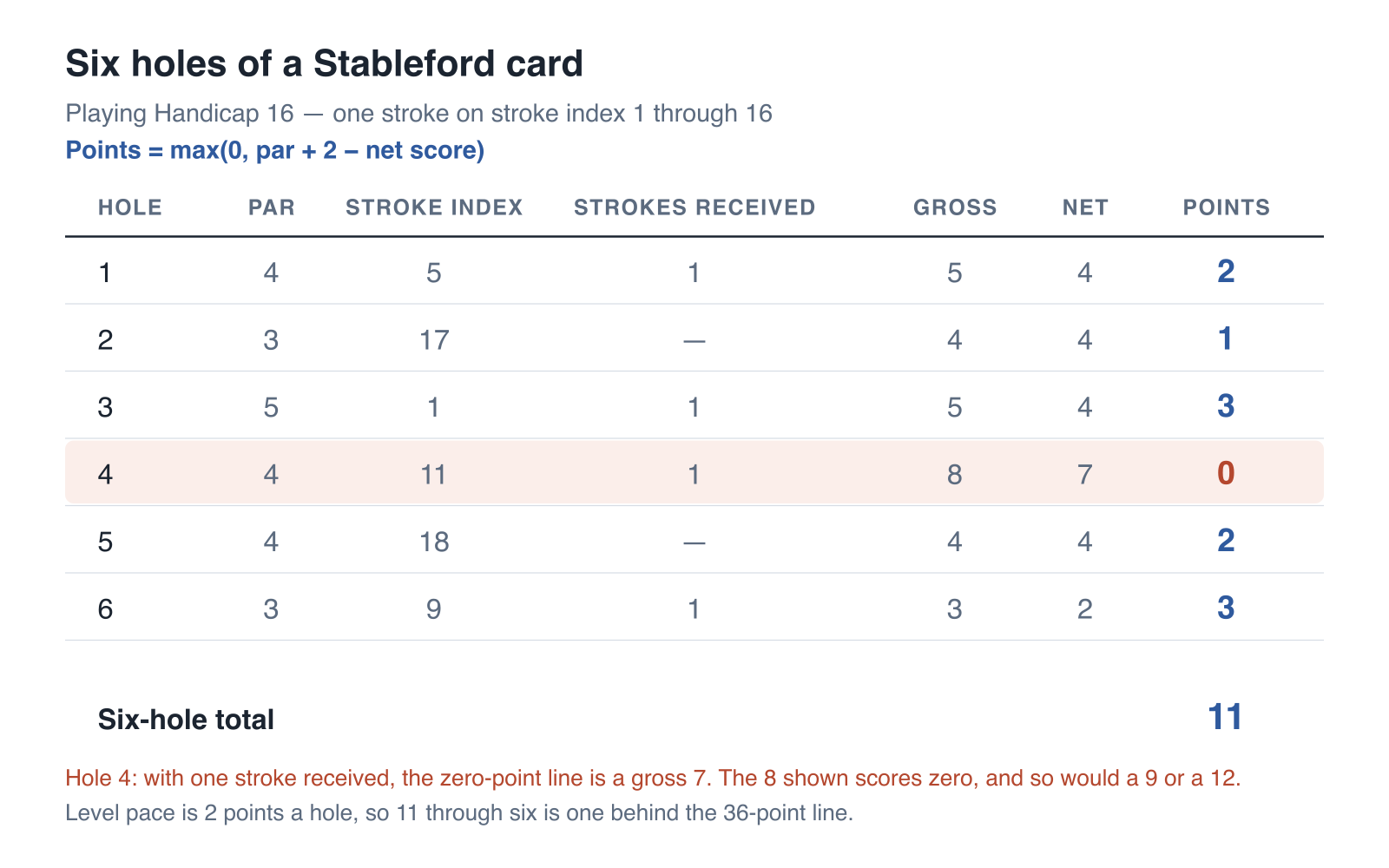
Two holes are worth pausing on.
Hole 4 is the format’s entire argument. With one stroke received, the zero-point line on that par 4 sits at a gross 7 (net 6, net double bogey). The gross 8 shown is a net triple bogey, and it scores the same zero. So does a gross 9, and so does a gross 12. In stroke play those scores are separated by five shots; in Stableford they are identical, and the player who picks up after the second penalty drop loses nothing and saves the group two minutes.
Hole 5 is stroke index 18, so no stroke arrives. Gross 4 on a par 4 is a plain par and scores the same 2 points as the net par on hole 1. Points read the net result and nothing else.
Six holes, 11 points. Level pace is 2 per hole, so this card is one behind the 36-point line.
What Stableford actually does to strategy
Stableford’s effect on strategy has an exact size, and it falls straight out of the formula.
Since points are max(0, T − gross) where T = par + 2 + strokes received, expected points work out to:
E[points] = T − E[gross] + E[strokes beyond T]
The first two terms are stroke play with the sign flipped: minimising expected strokes maximises expected points. The third term is the entire difference between the two formats. Stableford credits you back exactly the strokes you would have taken past net double bogey. Call it the zero-point discount.
That gives a clean test for any go-or-lay-up decision:
Take the aggressive line when its cost in expected strokes is smaller than its expected overrun past net double bogey.
Worked, on a par 4 where you receive a stroke (so T = 7). The outcome probabilities below are illustrative figures chosen to show the mechanism. No measured shot data stands behind them.
| Line | Outcomes (gross) | Expected gross | Expected overrun past 7 | Expected points |
|---|---|---|---|---|
| Lay up short of the water | 4 (20%), 5 (55%), 6 (25%) | 5.05 | 0.00 | 1.95 |
| Driver at the green over water | 3 (20%), 4 (40%), 9 (40%) | 5.80 | 0.80 | 2.00 |
Stroke play prefers the lay-up by 0.75 shots. Stableford prefers the driver by 0.05 points. The discount, 0.80, is larger than the 0.75-stroke penalty, and that gap is the whole edge.
The sharper observation is what happens when the disaster gets worse. Change the water outcome from a 9 to a 10 and the driver line loses another 0.40 expected strokes — while its expected points stay at exactly 2.00. Past net double bogey, Stableford stops keeping score. Which is why the format changes the decision on all-or-nothing shots (forced carries, tucked pins over bunkers) and leaves ordinary risk-management decisions where strokes-gained thinking already put them. Inside the uncapped range, points move one-for-one with strokes, so good course management is still good course management.
Modified Stableford: the Tour version that punishes bogeys
The PGA Tour’s Barracuda Championship uses a different scale entirely, applied to gross scores relative to par with no handicap involved:
| Barracuda score | Points |
|---|---|
| Albatross | +8 |
| Eagle | +5 |
| Birdie | +2 |
| Par | 0 |
| Bogey | −1 |
| Double or worse | −3 |
The Tour’s own explainer sums up the strategy as “go for it,” and the asymmetry is why: a birdie pays twice what a bogey costs. Standard Stableford is linear inside its range, with each stroke worth exactly one point. Modified Stableford is deliberately convex, which pushes aggression far harder than the club format does. Rule 9 of the Committee Procedures recognises Modified Stableford as a distinct variation, so a Committee can adopt a custom scale for a club event too.
Peer-reviewed work exists on the question — Garcia and Stephenson’s “Does Stableford Scoring Incentivize More Aggressive Golf?” in the Journal of Sports Economics (2015) — but the full text is paywalled. Verify any effect size quoted from it against the paper itself.
Picking up, penalties, and what the card has to show
Rule 21.1 rewrites several stroke-play mechanics:
- No holing out required. A hole you do not finish scores zero points, and you stay in the competition. Rule 21.1b encourages stopping once zero is locked in.
- A blank hole is legal. The card may show no score, or any score that results in zero points. A hole that earns points must show the actual score.
- The Committee does the arithmetic. Points are calculated by the Committee, which also applies your handicap strokes. Entering the points yourself is optional.
- Most disqualification breaches shrink to zero points. Under Rule 21.1c, failing to correct a wrong ball (Rule 6.3c), playing from outside the teeing area (Rule 6.1b(2)), or a serious wrong-place breach (Rule 14.7b) costs the hole’s points rather than the competition. Other disqualification breaches still disqualify.
- A hole can never go negative. Ordinary penalty strokes add to your gross in the usual way. The hole’s result still floors at zero.
The 2023 revision cleaned this up further: the old special deductions from the round total for club, starting-time, and undue-delay breaches were removed, and those penalties now apply to the hole as in ordinary stroke play, per the USGA’s 2019-to-2023 outcome comparison.
Posting the round for handicap
A qualifying Stableford round counts toward your Handicap Index like any other acceptable score. Rule 4.1a of the Rules of Handicapping permits submission as hole-by-hole scores, an adjusted gross score, or Stableford points, and strongly recommends hole-by-hole.
The wrinkle is the hole you picked up on. There is no gross score to enter, so Rule 3.3 applies the most likely score procedure: strokes already taken, plus penalties, plus the strokes you would most likely need to finish — capped at net double bogey. USGA guidance is to add one from inside five feet, two or three from five feet to 20 yards, and three or four from beyond. Hole-by-hole posting software applies the cap for you.
One asymmetry to hold onto: the competition uses your Playing Handicap (95%), while the posting cap uses your Course Handicap (100%). On a hole where the allowance removed your stroke, the first gross score worth zero points in the competition can sit one shot below the score the handicap system caps you at.
Common misconceptions
- “Points come off gross par.” In a handicap Stableford, apply the stroke you receive first. A gross bogey on a stroke hole is a net par and pays 2 points.
- “Stroke index 1 means hole 1.” Stroke index 1 marks the hardest hole in the allocation, wherever it sits on the course. The row is printed on the scorecard under the yardages.
- “My Index is the number of strokes I get.” Convert to Course Handicap for the tees, then apply the allowance. A 15.2 Index can play off 16 in one competition and 17 in a casual round on the same course.
- “Picking up disqualifies me.” Failing to hole out costs the hole’s points and nothing more.
- “Double bogey is always zero.” Only net double bogey. A gross double bogey on a hole where you receive two strokes is a net par worth 2 points.
- “36 points means I played to my handicap.” A useful benchmark, and an approximate one. With a 95% allowance you reached 36 off fewer strokes than your full Course Handicap, which means you played better than your Index suggests. Rounding, the Playing Conditions Calculation, and the net-double-bogey cap all shift the true line. And a golfer only produces a differential at or better than their Index about once in five rounds, so 36 is a good day by design.
Does Stableford actually speed up play?
The governing bodies say yes, and the measured evidence is suggestive rather than conclusive.
Rule 21.1b encourages players to stop when zero is inevitable. The R&A’s Pace of Play Manual states that Stableford, Maximum Score, and Par/Bogey “tend to be quicker” than ordinary stroke play because a valid score survives an unfinished hole. The USGA’s pace resource centre recommends Stableford on the same grounds.
For numbers, the best available source is a Golf Australia national club survey sent to 1,600 clubs, with 312 administrators responding on behalf of roughly 150,000 members. Reported averages for a group of four:
| Format | Average round time | Clubs reporting high pace concern |
|---|---|---|
| Par | 4:12 | — |
| Stableford | 4:15 | 4:25 |
| Stroke / Medal | 4:29 | 4:41 |
That is a 14-minute gap overall and 16 minutes at the clubs already worried about pace. The honest read: format was not randomly assigned and the times are survey-reported, so this is associative evidence about a format that clubs choose for their own reasons. The mechanism is at least plausible — a 4-hour round has roughly 26 minutes of slack in it by the reckoning in Golf Etiquette and Pace of Play.
Next step
Stableford changes what your bad holes cost on the day. It changes nothing about why they happen. If your card keeps showing three or four zeros a round, the leak is in a specific part of the game, and the fix is a structured practice block rather than a different scoring format.
Build a free practice plan — the free forever plan needs no credit card, and AI-generated plans built around your logged leaks are a Pro feature with a 3-day free trial.
Related reading
- Strokes Gained Explained for Amateurs — the framework that names which part of your game is producing the zero-point holes, with strokes-lost figures by handicap.
- Golf Handicap Explained — the Course Handicap arithmetic this post depends on, plus the net-double-bogey cap and the spread diagnostic.
- Golf Rules for Beginners — the 12 rulings that arrive every round and what each one costs, including the hole-out requirements Stableford relaxes.
- Golf Etiquette and Pace of Play — where the other 26 minutes of a four-hour round actually hide.
- Golf Course Management Tips — the hole-by-hole decision layer that still applies inside Stableford’s uncapped range.
- How to Break 90 in Golf — the per-hole arithmetic behind the score, and the three leaks that produce zeros.
- Golf for Beginners — the onboarding path if this is your first season of competitive club golf.
- Golf Practice Plan by Handicap — practice weighting for every Index band.
Key takeaways
- Points = max(0, par + 2 − net score). One expression reproduces every row of Rule 21.1b, including the 6 points for four under that most summaries omit.
- Net double bogey and zero points are the same threshold by design. Rule 3.1b of the Rules of Handicapping defines net double bogey as the lowest score earning zero Stableford points.
- Individual Stableford uses a 95% allowance under Appendix C, applied to the unrounded Course Handicap. An unrounded 17.02 becomes a Playing Handicap of 16. Four-Ball Stableford drops to 85%.
- Strokes follow the stroke index row. A 16 gets one stroke on stroke index 1 through 16 and nothing on 17 and 18.
- The format’s strategic edge equals your expected strokes past net double bogey. Take the aggressive line only when that discount exceeds its cost in expected strokes.
- Modified Stableford is a different animal. Barracuda pays +2 for a birdie and −1 for a bogey on gross scores, which rewards risk far harder than the club format.
- You never have to hole out, and a blank hole scores zero rather than voiding the card. Rule 21.1c shrinks most disqualification breaches to zero points for the hole.
- 36 points is the working benchmark, set by Frederick Lister’s winning total at Wallasey in May 1932, and it remains approximate under the 95% allowance.
Frequently asked questions
What is Stableford scoring in golf?
Stableford is a form of stroke play in which each hole is scored in points rather than strokes. Under Rule 21.1b, points are awarded by comparing your score against a fixed target, which is par unless the Committee sets something else. Net par earns 2 points, net birdie 3, net eagle 4, net bogey 1, and net double bogey or worse earns nothing. The player with the most points wins, and in a handicap event your strokes are applied before the points are calculated.
How many points is a birdie in Stableford?
A net birdie is worth 3 points. The full Rule 21.1b scale runs 0 for net double bogey or worse, 1 for net bogey, 2 for net par, 3 for net birdie, 4 for net eagle, 5 for net albatross, and 6 for four under the fixed target. The word net matters: if you receive a handicap stroke on the hole, a gross par becomes a net birdie and scores 3. A gross birdie on a hole where you get no stroke also scores 3.
What is a good Stableford score?
Thirty-six points is the working benchmark, because 2 points per hole across 18 holes equals net par all the way round. Anything above 36 is a round better than your handicap suggests. The benchmark is approximate rather than exact: most competitions apply a 95 percent allowance, so 36 competition points typically represents play better than your raw Course Handicap. Rounding, the Playing Conditions Calculation, and hole-by-hole adjustments all move the true line slightly.
Do you have to hole out in Stableford?
No. Rule 21.1b removes the ordinary stroke-play requirement to hole out. A player who does not complete a hole simply scores zero points for it and stays in the competition, and the Rule expressly encourages players to stop once their score will result in zero points. Leaving a hole blank on the card does not invalidate the round; that hole scores zero. Most breaches that would mean disqualification in stroke play cost only the hole’s points under Rule 21.1c.
What handicap allowance is used for Stableford?
Appendix C of the Rules of Handicapping recommends 95 percent of Course Handicap for individual Stableford, the same allowance used for individual stroke play. Four-Ball Stableford drops to 85 percent. The USGA guidance qualifies the 95 percent figure by field size: 100 percent may be considered for fields under 30 players, and a lower allowance such as 90 percent may suit a field skewed toward high handicaps. The Committee sets the allowance in the terms of the competition.
Can you post a Stableford round for your handicap?
Yes, provided the round meets the ordinary acceptability requirements. Rule 4.1a of the Rules of Handicapping allows a score to be submitted as hole-by-hole scores, an adjusted gross score, or Stableford points, with hole-by-hole entry strongly recommended. For any hole you started but did not finish, record your most likely score, capped at net double bogey. The handicap software derives the Adjusted Gross Score and Score Differential from there.
Is net double bogey the same as zero points?
Net double bogey is the lowest score that earns zero Stableford points. Rule 3.1b of the Rules of Handicapping states the relationship directly. The two are not interchangeable in every direction: net triple bogey and anything worse also score zero, so a whole range of scores collapses onto the same result. There is also a subtle mismatch in competition, because the handicap posting cap uses Course Handicap while competition points normally use Playing Handicap after the allowance.