
How to Keep Score in Golf: The Card, the Terms, and Net Scoring
Par is the target, gross is what you took, net subtracts your stroke-index strokes. Rule 3.3b decides who owns the card and what a wrong score costs.

Quick answer
Keep score by writing your gross score in each hole’s box: every stroke you made plus every penalty stroke. Compare it to the printed par to name the result, where birdie is one under and bogey one over. Your net score subtracts the handicap strokes the card’s stroke index row allocates. For handicap posting, no hole counts higher than net double bogey.
The scoring terms at a glance
| Term | Versus par | On a par 4 | Status |
|---|---|---|---|
| Condor | −4 | — | Unofficial, no Rules standing |
| Albatross / double eagle | −3 | 1 | Both names, same score |
| Eagle | −2 | 2 | Standard |
| Birdie | −1 | 3 | Standard |
| Par | 0 | 4 | The printed target |
| Bogey | +1 | 5 | Standard |
| Double bogey | +2 | 6 | Standard |
| Triple bogey | +3 | 7 | Standard |
Every term is measured against the par of the hole in front of you, never against the course total. The same score of 3 is a birdie on a par 4 and an eagle on a par 5.
What goes in each box on a golf scorecard
A scorecard has three rows that matter before you make a swing, and one you fill in.
The yardage row gives the measured length of each hole from each set of tees. The par row gives the target. The stroke index row, usually printed as “handicap” or “HCP”, ranks the 18 holes from 1 to 18 by where a handicap stroke does the most good — stroke index 1 is the hole the Committee has judged hardest to make par on relative to the field, wherever it sits on the routing.
Then there is your row. What goes in it is the gross score: the strokes you made plus the penalty strokes you incurred, as the Rules of Handicapping define it. A drive out of bounds, replayed from the tee, then three more shots to hole out is a 6 — one stroke for the drive, one for the penalty, one for the replayed tee shot, three to finish. Penalty strokes are ordinary strokes for scoring purposes and go in the same box.
How par gets assigned to a hole
Par is set by the course, from measured length, before anyone tees off. The USGA’s definition is the score a scratch player would generally be expected to make under normal conditions, allowing two strokes on the putting green — which is why the par of a hole is roughly its “get there” strokes plus two putts.
Appendix F of the Rules of Handicapping publishes the recommended yardage bands:
| Par | Men | Women |
|---|---|---|
| 3 | Up to 260 yards | Up to 220 yards |
| 4 | 240 to 490 yards | 200 to 420 yards |
| 5 | 450 to 710 yards | 370 to 600 yards |
| 6 | 670 yards and up | 570 yards and up |
The bands deliberately overlap, and they assume an elevation below 2,000 feet. A 470-yard hole can be a par 4 or a par 5, and the Authorized Association or club decides using forced lay-ups, prevailing wind, elevation change and how the architect meant the hole to be played. Par is a property of the hole and the tee set. It never moves because of who is playing.
Why golf scores are named after birds
The terminology arrived backwards. Bogey came first and originally meant the good score.
Hugh Rotherham introduced a fixed “ground score” at Coventry in 1890 — a target number for each hole that a player competed against instead of another golfer. Great Yarmouth adopted it while the music-hall song “The Bogey Man” was everywhere, and Major Charles Wellman reportedly told the club secretary Dr Thomas Browne that this invisible opponent was a regular Bogey Man. At the United Services club in 1892 the phantom was commissioned, and Colonel Bogey was born. Only in the early 20th century, as the American “par” standard tightened, did bogey slide down to mean one over. The USGA Museum’s history FAQ and Gosport and Stokes Bay Golf Club both carry the Colonel Bogey account.
Birdie came from American slang, where “bird” meant something excellent. A.B. “Ab” Smith, playing at Atlantic City Country Club, called his approach a bird of a shot, holed it for one under, and the name stuck. Two USGA pages disagree on when: the terminology history cites the club plaque’s date of 1903, while the New Jersey chapter of the USGA’s 125-year history puts the same foursomes match in 1899. Same people, same club, two dates. Treat the year as approximate.
Eagle followed as the grander bird, though USGA history notes it was not universally accepted until the 1930s. Albatross is the British contribution, with the earliest printed references currently identified in 1929 and no known inventor; American usage kept “double eagle” for the same score. Condor, for four under, is a folk extension with no standing in the Rules and no reliable first-use account — published origin stories for it conflict, so it belongs in a pub argument rather than a citation.
Gross, net, and the stroke index row
Net scoring is what lets a 20-handicap play a 4-handicap for something meaningful. It works in two moves.
First, convert your Handicap Index into strokes for these tees. The World Handicap System formula is:
Course Handicap = Handicap Index × (Slope Rating ÷ 113) + (Course Rating − par)
A 15.2 Index on tees rated 71.4 with a Slope of 131 on a par 72 gives 15.2 × (131 ÷ 113) + (71.4 − 72) = 17.0. The full derivation, including why that Course Rating minus par term was added in 2020, is in Golf Handicap Explained.
Second, spend those strokes down the stroke index row. The USGA’s allocation guidance is mechanical: a Course Handicap of 14 receives one stroke on the holes ranked stroke index 1 through 14, and nothing on 15 through 18. A handicap above 18 wraps around, so a 22 gets a stroke everywhere plus a second stroke on stroke index 1 through 4. A plus-handicap player gives strokes back, starting at stroke index 18 and working down.
| Hole | Par | Stroke index | Strokes received (14 CH) | Gross | Net | Result |
|---|---|---|---|---|---|---|
| 1 | 4 | 5 | 1 | 5 | 4 | Net par |
| 2 | 3 | 17 | — | 4 | 4 | Bogey |
| 3 | 5 | 1 | 1 | 6 | 5 | Net par |
| 4 | 4 | 16 | 1 | 4 | 3 | Net birdie |
Hole 2 is the one that catches people. Stroke index 17 sits outside a 14 handicap’s allocation, so the gross 4 on a par 3 is a plain bogey. Handicap strokes land exactly where the stroke index row puts them.
In a competition the allowance layer sits on top of this — most individual formats apply 95% of Course Handicap to get a Playing Handicap. Stableford Scoring Explained works through that step, and through the points format built directly on net scores.
What is the maximum score you can take on a hole
For handicap purposes, no hole counts higher than net double bogey: par + 2 + the handicap strokes you receive on that hole. On a par 4 with stroke index 10 and a Course Handicap of 15, the ceiling is 7, per the USGA. Make 9 and you post 7. A player who has not yet established a Handicap Index uses a flat par + 5 instead.
This replaced Equitable Stroke Control when the World Handicap System took effect on 1 January 2020. ESC used a single ceiling for the whole round based on your Course Handicap — double bogey for a 9 or less, 7 for 10 to 19, 8 for 20 to 29, 9 for 30 to 39, 10 for 40 and above — which meant a 12-handicap could post a 7 on a short par 3 where the hole-specific cap would have held them to 5. The USGA’s change summary sets out the swap. The hole-specific cap varies with both the par and the stroke index, so the same 12-handicap is capped at 6 on a par 3 ranked inside stroke index 12 and at 5 on one ranked outside it.
One distinction worth being exact about, because clubs get it wrong constantly: net double bogey caps only the number you post for handicap. In ordinary stroke play the full gross counts, and the trophy goes to the person who took fewest strokes. A competition score is capped only if the Committee has adopted the separate Maximum Score format under Rule 21.2 and announced the limit in the terms of the competition.
The penalty strokes that land on amateur cards
Four situations produce most of the penalty strokes an amateur writes down.
Lost ball. You get three minutes to search from when you or your caddie starts looking. After that the ball is lost and Rule 18.2 sends you back to where you played from, plus one penalty stroke. A lost tee shot means you are playing your third from the tee.
Out of bounds. A ball is out of bounds only when all of it lies beyond the boundary — touching the line counts as in. Relief is the same stroke and distance, which is why this is the most expensive rule in golf.
Penalty areas. Rule 17 gives one penalty stroke and, from a yellow area, two relief options: stroke and distance, or back on the line from where the ball last crossed the edge. Red adds a third, lateral relief within two club-lengths of the crossing point, no nearer the hole. Playing it as it lies costs nothing.
Model Local Rule E-5. The two-stroke alternative to walking back for a lost or out-of-bounds ball, dropping in a fairway-referenced relief area. It exists, it works, and it is available only if the course or the Committee adopted it — the USGA recommends it for general play and considers it inappropriate for elite competition. The procedure is specific: use the reference points and relief-area boundaries the Local Rule defines, and confine it to a ball that is lost or out of bounds — an unplayable ball or a ball in a penalty area is outside its scope.
Golf Rules for Beginners walks each of these through with the drop procedure and what the mistake costs.
Who keeps the scorecard in a competition
Casual golf lets you scribble your own numbers. In competition, Rule 3.3b splits the job three ways:
- The marker enters your gross score for each hole, should confirm the number with you as you go, and certifies the scores after the round. A marker who believes a score is wrong may refuse to certify it, and the Committee then decides from the evidence available.
- You check the entries, resolve any doubt with the Committee before returning the card, certify it yourself and return it promptly. A marker’s entry can only be changed with the marker’s agreement or the Committee’s approval, and once the card is in, you cannot change it.
- The Committee adds the scores and applies the handicap strokes. Under the 2023 Rules the addition and the handicap application both sit with the Committee by default, so a card with a wrong total still stands on its hole scores. A Committee can hand the handicap back to the player with Model Local Rule L-2.
Two outcomes follow from returning a wrong score, and they are asymmetric. Return a hole score higher than what you took and the higher score stands — no way back once the card is in. Return one lower and you are disqualified, with one exception: if the score was too low only because you omitted penalty strokes you did not know about before returning the card, there is no disqualification, and the Committee adds the penalty if it comes to light before the competition closes.
That exception has a history worth knowing. It arrived in 2016, and in its original form it added the missed penalty plus an extra two-stroke scorecard penalty. The 2019 modernization kept the exception and dropped the extra two strokes, so today only the omitted penalty gets added. It does not cover a player who knew a penalty might apply, or who was unsure and failed to ask.
Picking up: what to write on the card instead
In ordinary stroke play you must hole out on every hole. Fail to correct that before teeing off on the next hole — or before returning the card, on the 18th — and Rule 3.3c disqualifies you. A conceded putt among friends is not a Rules-compliant score.
For handicap posting the system is explicitly designed to accept an unfinished hole. Rule 3.3 of the Rules of Handicapping uses a most likely score: strokes already taken, plus penalties, plus the strokes you would most likely need to finish, capped at net double bogey. The USGA’s guidance puts numbers on the estimate — add one from inside five feet, two or three from between five feet and 20 yards, three or four from beyond that. What Rule 3.3 requires is the most likely score or net double bogey, whichever is lower. Marking the estimate with an X on a paper card is a club convention rather than a Rules requirement, and it is a useful one, because it flags the number as an estimate rather than a hole-out.
If your group wants a cap that binds on the course rather than only at posting time, the Committee or organizer declares Maximum Score under Rule 21.2 and sets the limit. Setting that limit at net double bogey makes the on-course ceiling and the posting ceiling the same number, which removes an entire category of scorecard argument. It also helps the group behind you: Rule 5.6 recommends making a stroke within 40 seconds once it is your turn to play, and a hole the group cannot finish is where that budget goes to die. Golf Etiquette and Pace of Play has the rest of the arithmetic.
What the shape of your card says
A total tells you what you shot. The distribution of hole scores tells you what to practise, and the two point at different things. For reference on the total: the National Golf Foundation reports an average 18-hole score of 94 among the roughly 20 million U.S. golfers — 77% of them — who regularly keep score.
Arccos publishes the hole-score mix for its users at a 5 handicap and at a 10. Decomposing the gap between them — taking each category’s change in frequency and multiplying by what that hole type costs relative to par — gives a clean answer to what the 4.4 strokes inside those four published categories consist of.
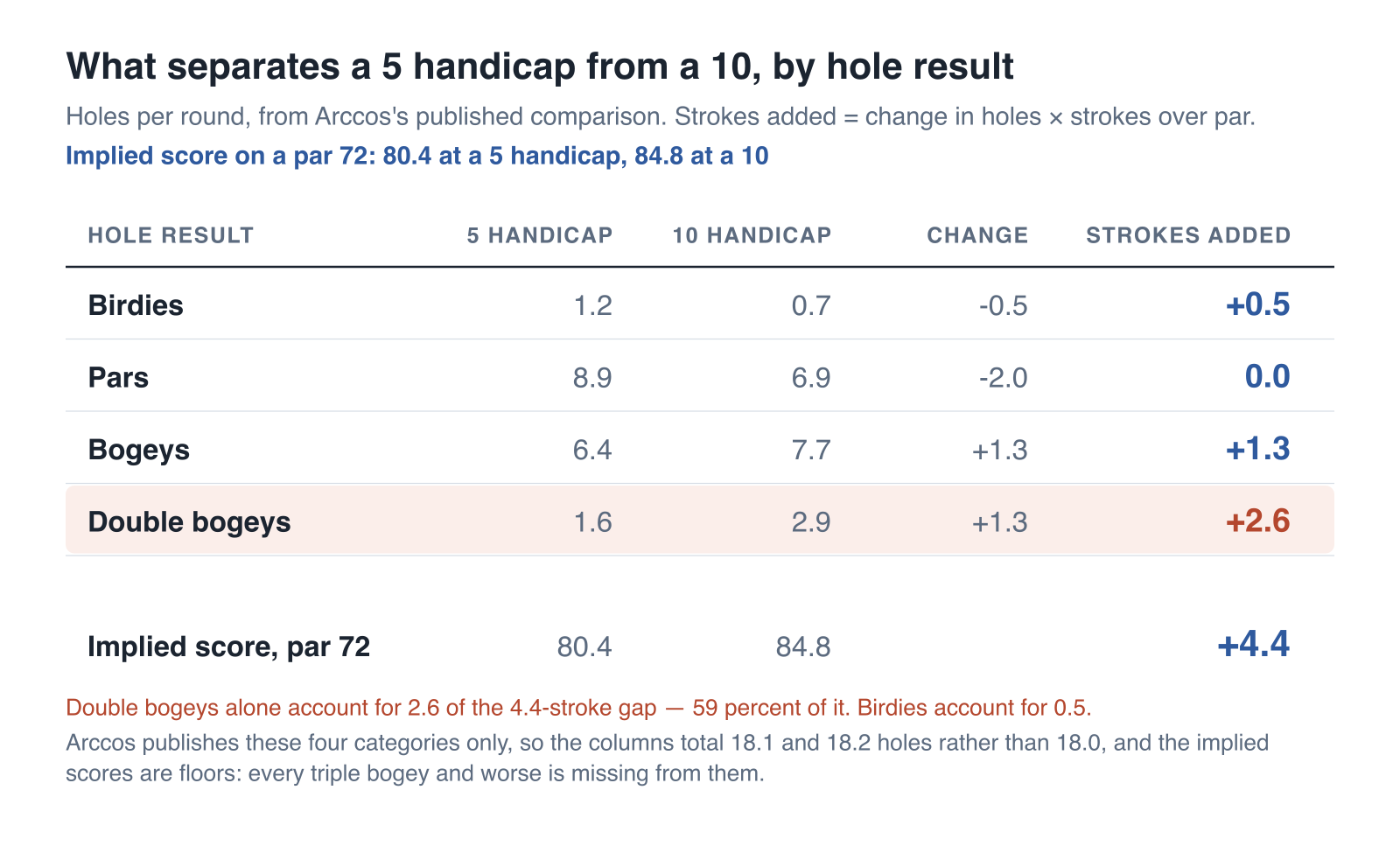
The decomposition reconstructs the gap exactly, and it is lopsided. Double bogeys alone account for 2.6 of the 4.4 strokes, roughly 60 percent of the difference. Birdies account for 0.5. The 10-handicap makes 1.3 more disasters per round than the 5-handicap, and each one costs double. Their birdie count barely moves.
Two honest caveats. Arccos publishes four categories, so the columns total 18.1 and 18.2 holes against a round of 18 — one-decimal rounding in their published figures, which can move the implied scores in either direction. Every triple bogey and worse is missing from the mix, and those only ever add strokes, so treat 80.4 and 84.8 as floors. A Handicap Index measures demonstrated potential, so a typical round for a 5-index golfer already sits some way above their Index. It is also Arccos-user data, a self-selecting population of golfers who bought shot tracking.
The practical read survives all of it. Count the doubles-and-worse on your last five cards. If that number is climbing while your par count holds steady, the leak is a specific recurring blow-up — one swing or one decision per round — and Strokes Gained Explained for Amateurs names which part of the game is producing them. How to Break 90 in Golf runs the same arithmetic at the other end of the handicap range.
Common misconceptions
- “Par is relative to my handicap.” Par is a property of the hole and the tee set, assigned from measured length under Appendix F. Handicap enters afterwards, when gross becomes net.
- “Bogey has always meant one over.” It started in 1890 as the target score. Colonel Bogey was the standard you were trying to beat.
- “A double eagle and an albatross are different scores.” Same score, three under, different sides of the Atlantic.
- “Net double bogey caps my competition score.” It caps only what you post for handicap. The full gross wins or loses the medal.
- “Stroke index 1 is the first hole.” Stroke index 1 is the hole ranked hardest for allocation purposes, anywhere on the course.
- “I have to add up my own card in a competition.” You are responsible for each hole score, certification and prompt return. The Committee does the addition and the handicap.
- “Picking up voids the round.” For handicap it does not — record a most likely score. In ordinary stroke play it does, which is why casual groups should have the Committee declare Maximum Score.
Next step
Keeping score accurately is the cheapest diagnostic in golf. It costs a pencil, and after five rounds it tells you whether you are losing shots to a leaky standard or to two disasters a round — problems with completely different practice prescriptions.
Build a free practice plan — the free forever plan needs no credit card, and AI-generated plans built around your logged leaks are a Pro feature with a 3-day free trial.
Related reading
- Golf Handicap Explained — the Course Handicap arithmetic this post depends on, the lowest-8-of-20 formula behind an Index, and the spread diagnostic hiding in your score record.
- Stableford Scoring Explained — the points format built directly on net scores, plus the 95% allowance step that separates a Course Handicap from a Playing Handicap.
- Golf Rules for Beginners — the 12 rulings that arrive every round, the drop procedure, and what each mistake costs.
- Strokes Gained Explained for Amateurs — the framework that names which part of your game is producing the doubles, with strokes-lost figures by handicap.
- How to Break 90 in Golf — the per-hole arithmetic behind a target score, and a three-column card audit for finding your leak.
- Golf Scramble Rules and Strategy — how scoring changes when a team plays one ball, including the handicap allowance most charity events get wrong.
- Golf Etiquette and Pace of Play — Rule 5.6’s 40-second recommendation and where the rest of a four-hour round goes.
- Golf for Beginners — the onboarding path if this is your first season keeping a card at all.
- Golf Practice Plan by Handicap — practice weighting for every Index band, once the card has told you where the strokes go.
Key takeaways
- Gross score is strokes plus penalties, written hole by hole. Net score subtracts the handicap strokes allocated down the stroke index row.
- Course Handicap = Index × (Slope ÷ 113) + (Course Rating − par). A Course Handicap of 14 receives one stroke on stroke index 1 through 14 and nothing on 15 through 18.
- Par comes from measured length, not from your ability. Appendix F puts a men’s par 4 at 240 to 490 yards and a women’s par 4 at 200 to 420.
- Net double bogey — par + 2 + strokes received — caps what you post, and nothing else. It replaced Equitable Stroke Control on 1 January 2020. Players without an Index use par + 5.
- Rule 3.3b splits the card three ways. The marker records and certifies, you check, certify and return, and the Committee adds the scores and applies the handicap.
- A returned score that is too high stands; too low is disqualification, unless you omitted a penalty you did not know about before returning the card.
- A lost ball gives you three minutes, then stroke and distance. Model Local Rule E-5’s two-stroke fairway drop applies only where a Committee has adopted it.
- Roughly 60 percent of the gap between a 5 and a 10 handicap is double bogeys — 2.6 strokes of 4.4 in the Arccos mix. Birdies account for 0.5.
Frequently asked questions
How do you keep score in golf?
Write your gross score in the box for each hole, meaning every stroke you made plus every penalty stroke you incurred. Compare that number to the printed par to name the result: level is a par, one over is a bogey, one under is a birdie. At the end of the round the hole scores are added for a total. In a competition a marker records and certifies your scores, and you check and certify them before returning the card.
What do the golf scoring terms mean?
They name a hole score relative to that hole’s par. Three under is an albatross, also called a double eagle. Two under is an eagle, one under a birdie, level is par, one over a bogey, two over a double bogey and three over a triple bogey. Four under is a condor, an unofficial term with no standing in the Rules. Each term is measured against the par of the hole you are playing, never against the course total, so the same score of 3 is a birdie on a par 4 and an eagle on a par 5.
Why is one under par called a birdie?
From American slang, where a bird meant something excellent. The traditional account has A.B. Smith at Atlantic City Country Club calling his approach a bird of a shot, holing it for one under, and the group adopting birdie for that score. The club plaque dates the round to 1903, though a separate USGA history places the same match in 1899. The people and the place agree across sources; the date does not, so treat it as approximate. Eagle followed as the grander bird, and albatross arrived from Britain in the 1920s.
What is the difference between gross score and net score?
Gross score is what you took on the hole, strokes plus penalties, and it is the number the marker writes on the card. Net score subtracts the handicap strokes you receive on that hole. Those strokes are allocated down the scorecard’s stroke index row, so a Course Handicap of 14 receives one stroke on the holes ranked 1 through 14 and none on 15 through 18. A gross 5 on a par 4 where you receive a stroke is a net 4, a net par.
Who is responsible for the scorecard in a competition?
Both the player and the marker, in different ways. Rule 3.3b makes the marker responsible for entering the gross score for each hole and certifying those scores after the round. The player must check the entries, resolve any doubt with the Committee, certify the card personally and return it promptly. The player is responsible for the accuracy of each hole score, and the Committee is responsible for adding the scores and applying handicap strokes. Once the card is returned the player cannot change it.
Can you pick up on a hole and still post the score?
For handicap purposes yes, using a most likely score. Add the strokes already taken, any penalty strokes, and the number you would most likely need to finish, capped at net double bogey. The USGA guidance is to add one stroke from inside five feet, two or three from between five feet and 20 yards, and three or four from further out. Ordinary stroke play is different: outside a format such as Maximum Score or Stableford you must hole out, or you are disqualified.
What is the average golf score?
The National Golf Foundation reports an average 18-hole score of 94 among the roughly 20 million U.S. golfers who regularly keep score, which it puts at 77 percent of all golfers. That figure covers a self-selecting group, since golfers who never write a score down are excluded, and scoring conventions vary in casual play. It is a broader population than the golfers who carry an official Handicap Index, so it should not be compared directly against handicap statistics.