
Best Ball vs Scramble: What Separates Them, and What It Scores
A scramble selects after every stroke; best ball selects once a hole. Four 10-handicaps average 71.5 best ball, and the allowances are nowhere near equal.
Quick answer
A scramble picks the best shot after every stroke and everyone replays from that spot. In best ball, every player plays their own ball and the lowest completed score counts. Only best ball has its own rule — Four-Ball, Rule 23; Rule 21.5 merely lets a Committee run a scramble and leaves the procedures to them. The allowances differ sharply: 85% each in four-ball stroke play against a weighted 25/20/15/10 team figure in a scramble.
The two formats side by side
| Best ball (Four-Ball) | Scramble | |
|---|---|---|
| Rules status | Rule 23 | Committee Procedures, Section 9 |
| Balls in play | One per player | One selected position, played by everyone |
| Selection happens | Once per hole, on the completed scores | After every stroke |
| Team size | 2 under Rule 23; outings run 3 and 4 | Commonly 2 to 4; the Committee sets it |
| Handicap allowance | 85% each (stroke play); 90% (match play) | 25/20/15/10 by rank, summed |
| Acceptable for your Index | Yes, when your own hole scores are recorded | No, per the USGA |
| Modelled gross, four 10-handicaps | 71.5 on a par 72 | Well below, see below |
| Carries a beginner | Poorly | Well |
Two of those rows do the real work. Selection frequency explains the scoring gap, and allowance structure explains why a team handicap calculated for one format is meaningless in the other.
Best ball, better ball, four-ball: which name is right
Rule 23 calls it Four-Ball: two partners, two balls, the lower score counts on each hole. Recreational golf calls the same thing best ball or better ball, and the PGA of America treats them as equivalent for practical purposes.
The Rules do carry a separate, older Best-Ball, and it is a different game: one player competes against the better score of a side of two or three partners. The R&A’s Rule 23 preserves that variation. Almost no member-guest means that version, so the safest phrasing at an event is “better ball” or “four-ball,” and the safest habit is describing the mechanics rather than trusting the label.
The confusion that costs money is the other one. A group told they are playing “best ball” that turns up expecting to select the best shot after every stroke has budgeted for a scramble score and will be looking at a number far closer to the 71.5 below than the mid-50s they were expecting.
What the Rules codify, and what they leave to you
Team play is only partly written down. Rule 22 defines Foursomes, where two partners alternate strokes on one ball. Rule 23 defines Four-Ball. Rule 21 covers the alternative scoring methods — Stableford at 21.1, Maximum Score at 21.2, Par/Bogey at 21.3 and Three-Ball match play at 21.4, which despite the name is three individuals playing separate matches rather than a team.
A scramble appears in none of those. Rule 21.5 permits a Committee to run other forms of play, and the scramble is described in the Committee Procedures rather than in the Rules themselves, which means the placement distance, the putting-green procedure, penalty handling and any drive quota are your event’s job to publish. Golf Scramble Rules and Strategy works through the five procedures a scramble sheet has to define and the 25/20/15/10 allowance in full.
Four-ball needs none of that. Rule 23 already answers order of play, which ball counts, what a partner may do, and how penalties apply to a side. A four-ball event fits on one line of a sheet; a scramble needs a paragraph.
Selection frequency is the whole scoring story
Best ball takes the minimum of completed hole scores. With independent play, the team’s chance of beating any threshold is one minus the chance that every player fails to beat it, so the format’s benefit is entirely an order-statistic effect — the same statistical shape a scramble uses, applied 18 times instead of 65.
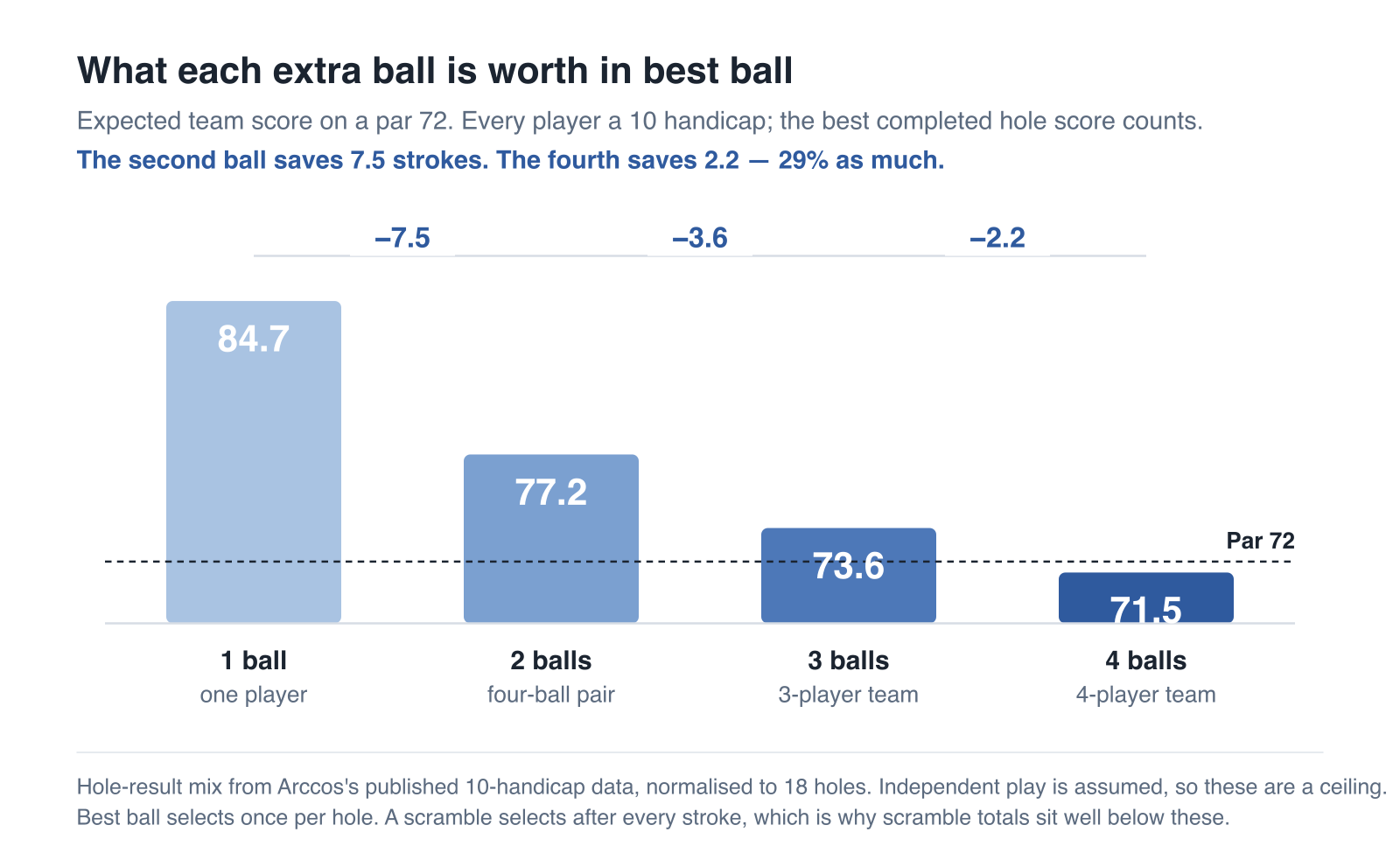
Run it on real amateur data rather than a toy distribution. Arccos publishes the hole-result mix for a 10-handicap: 0.7 birdies, 6.9 pars, 7.7 bogeys and 2.9 double bogeys per round. Normalise those four categories into a per-hole distribution, take the minimum across n players, and the ladder falls out:
| Balls in play | 5-handicap team | 10-handicap team | Strokes the added ball saves (10-hcp) |
|---|---|---|---|
| 1 (solo) | 80.4 | 84.7 | — |
| 2 (four-ball) | 73.3 | 77.2 | 7.5 |
| 3 | 70.2 | 73.6 | 3.6 |
| 4 | 68.4 | 71.5 | 2.2 |
Expected score on a par 72, derived from Arccos’s published hole-result mixes normalised to 18 holes. Independent play is assumed, which makes every team column a ceiling.
The fourth ball is worth 29% of what the second ball was worth. That is the number to carry into a captain’s decision, and it mirrors what happens inside a scramble at the shot level, where the fourth putting attempt contributes 22% of the first. Adding bodies to a team pays a shrinking dividend in both formats, for the same reason.
Two honest caveats. Independence is generous: four players share a course, a wind and a tee time, so real hole scores are positively correlated and the true team numbers sit above these. And Arccos publishes only four categories, so every triple bogey and worse is folded into the double-bogey row, which flatters the solo column more than the team columns.
Why a scramble scores so much lower than best ball
A scramble applies the same selection roughly 60 to 70 times a round instead of 18, and it applies it to shots rather than finished holes. Every bad drive, every chunked wedge and every missed putt is discarded the moment a teammate produces a better one, so an error only survives when all four players repeat it.
The observed results reflect it. Winning gross totals at published charity scrambles cluster in the mid-50s, against the 71.5 the same four 10-handicaps would model in best ball. That comparison is not like-for-like — scramble winners are the best team in the field, and mulligan sales and forward-tee purchases move the number further — but the direction is not in doubt.
For a team captain the practical consequence is a pacing one. In a scramble the round is decided by how often the team converts a good position, so the aggressive line is cheap once one ball is safe. In best ball the round is decided by how often somebody posts a par, which rewards a very different tee shot.
The Zurich Classic gives the cleanest professional read
The PGA Tour runs both a two-ball format and a one-ball format at the same event in the same week, which is as close to a controlled comparison as golf offers. In 2023 the Zurich Classic’s field scoring averages ran:
| Round | Format | Balls per side | Field scoring average |
|---|---|---|---|
| Thursday | Four-ball | 2 | 65.563 |
| Friday | Foursomes | 1 | 70.188 |
| Saturday | Four-ball | 2 | 64.971 |
| Sunday | Foursomes | 1 | 70.971 |
The two four-ball rounds averaged 65.267 against 70.580 in foursomes, a gap of 5.31 strokes. The comparison is imperfect: the weekend field is post-cut, and setup and conditions move between days. Even so, one extra ball is worth more than five strokes a round to the best players alive, which is a useful sanity check on the 7.5-stroke second-ball figure the amateur model produces — sharper players convert fewer of their own bad holes into a partner’s rescue.
Cantlay and Schauffele inverted it that week, going 15 under across two foursomes rounds against 11 under in four-ball, the first team to make the cut and score better in alternate shot since the format arrived in 2017. One pairing beating the trend by four strokes over two rounds is what a distribution looks like at the tails.
The allowances are not interchangeable
Appendix C of the Rules of Handicapping publishes a separate recommendation for every format, and swapping one in for another rewrites who wins.
| Format | Recommended allowance | Applied to |
|---|---|---|
| Individual stroke play (medium-sized net field) | 95% | Each player’s Course Handicap |
| Four-ball stroke play | 85% | Each player’s Course Handicap |
| Four-ball match play | 90% | Course Handicap differences, low player at scratch |
| Scramble, 4 players | 25 / 20 / 15 / 10% | Ranked lowest to highest, summed to one team figure |
| Scramble, 3 players | 30 / 20 / 10% | Ranked lowest to highest, summed |
| Scramble, 2 players | 35 / 15% | Ranked lowest to highest, summed |
The structural difference matters more than the percentages. A scramble produces one number for the whole team, because the team plays one ball. Four-ball gives each player their own figure, because each plays their own ball and either score can be the one that counts.
In match play the sequence is specific: apply the allowance, then set the lowest Playing Handicap to zero and give the others the difference. The R&A states that step explicitly in Appendix C. Match Play vs Stroke Play walks the same arithmetic through a singles match, and Golf Handicap Explained covers the Course Handicap conversion that feeds all of it.
Which format to run for your event
The choice usually resolves on one of five questions, and they are not equally weighted — the first two decide most events on their own.
| If your group… | Run | Because |
|---|---|---|
| Has two or more players who cannot break 100 | Scramble | Every bad shot is discarded on the spot |
| Needs the round to post for handicap purposes | Four-ball | A scramble produces no individual score |
| Is a league or member-guest of similar players | Four-ball | Everyone plays a full round and the scoring stays honest |
| Is a corporate or charity field with sponsors | Scramble | Shotgun-friendly, sociable, and the team posts one flattering number |
| Wants the driving relief without the babysitting | Shamble | Share the tee shot, then play your own ball in |
The shamble is the underused answer. Selecting one drive removes the single most demoralising shot for a weak player while keeping individual scoring intact, which is why it works for a mixed-ability group that still wants real cards. Golf Scramble Rules and Strategy has the full variant map, including where “bramble” means something different depending on who printed the sheet.
The strategy flips, and the flip is not symmetric
In a scramble, order of play is the lever. The reliable driver goes first, the aggressive one goes later, and the PGA of America recommends the best putter putts last so they read three live attempts before striking. That advice depends on the earlier putts being struck at hole speed on a committed line.
In best ball, order of play is still a lever, and a subtler one. Rule 23.6 lets partners play in whatever order the side considers best, so the sequence is yours to set on every shot. Golf.com’s fourball guide sends the wild card first for exactly that reason: their result tells the steadier partner whether to play conservatively or swing away too.
Rule 23.2a supplies the other half. A partner does not have to hole out once their score can no longer help the side, so a player who is out of the hole should pick up rather than grind out an 8 that will never be written down. The trap is treating “one safe, one aggressive” as a fixed assignment for the whole round; the roles get reassigned on every hole from where the balls are.
Both formats reward the same underrated trait. A player who alternates birdies with disasters helps a team more than a metronomic bogey machine of the same handicap, because the team keeps the birdies and discards the disasters. Tim Swartz’s work on net best-ball team composition models exactly that: the expected minimum of two net hole scores falls further below the players’ shared mean as their combined variance rises. Equal handicaps do not imply equal team strength.
Common mistakes
- Calculating a team handicap with the wrong format’s allowance. A 25/20/15/10 team figure applied to a four-ball event, or 85% each applied to a scramble, produces a number that means nothing. The two allowances are built for different ball counts.
- Assuming a four-player best ball is Rule 23. It is a valid format and a common one, but Four-Ball is two partners. Say “four-player best ball” on the sheet so no one looks up the wrong rule mid-round.
- Budgeting a scramble score for a best ball event. The gap between the two on the same four players runs to double figures. A prize structure set on scramble expectations will look absurd against four-ball cards.
- Loading a best ball team with four steady players. Four bogey machines of the same handicap post a worse team score than two steady players and two streaky ones, because best ball keeps outliers on only one side.
- Leaving the scramble sheet unwritten. Placement distance, same-cut-of-grass, the green procedure and the drive quota all have to be stated. The Rules do not supply them, and the third fairway is a bad place to negotiate.
- Skipping the pace budget. Neither format is reliably fast. A full shotgun field should be planned at four and a half to five hours whichever one is on the card; pace of play is set by field size and readiness more than by format.
Next step
Team formats are generous to your weaknesses, which is exactly why they hide them. A scramble discards your worst shot before anyone writes it down, and best ball discards your worst holes. Neither leaves you with a record of what to practise on Tuesday.
Build a free practice plan and log the rounds you play under your own ball, not the team’s. PracticeCaddie’s free-forever plan needs no credit card; AI-generated plans biased to your assessment leaks are a Pro feature with a 3-day free trial, and pricing has the rest.
Related reading
- Golf Scramble Rules and Strategy — the five procedures your scramble sheet has to define, the 25/20/15/10 allowance in full, and why proximity is worth up to 3.4 times more to a team than to a solo player.
- Match Play vs Stroke Play — the per-hole refund that lets an 80 beat a 77, and the allowance and penalty splits between the two forms.
- Golf Handicap Explained — the Course Handicap conversion every allowance in this post is applied to, plus what your scoring spread says about where to practise.
- Strokes Gained Explained for Amateurs — the framework for finding the leak a team format covered up.
- Stableford Scoring Explained — the other scoring method a Committee can run, and the strategy edge its zero-point floor creates.
- Golf Skins Game Rules — the betting-format sibling, where a carryover changes what a hole is worth rather than who plays the ball.
- How to Keep Score in Golf — where the Arccos hole-result mix behind this post’s model comes from, and what the same data says about double bogeys.
Key takeaways
- A scramble selects a shot after every stroke; best ball selects one score per hole. Roughly 60 to 70 selections against 18 is the entire reason scramble totals sit lower.
- Only best ball has its own rule. Four-Ball is Rule 23; Rule 21.5 lets a Committee run a scramble and the Committee Procedures describe it, so placement, putting and quota rules are your event’s to publish.
- Four 10-handicaps model at 71.5 on a par 72 in best ball, against 84.7 for one of them alone. Winning charity scramble totals sit in the mid-50s.
- The fourth ball is worth 2.2 strokes against the second ball’s 7.5 — about 29%. Team size pays a shrinking dividend.
- The Zurich Classic’s 2023 field averaged 65.267 in four-ball and 70.580 in foursomes, a 5.31-stroke gap for one extra ball at tour level.
- The allowances are structurally different. Four-ball gives each player 85% of their own Course Handicap in stroke play and 90% in match play; a scramble sums 25/20/15/10 into one team number.
- Variance is an asset in best ball. Swartz’s modelling shows a team’s expected minimum falls further below the shared mean as combined variance rises, so equal handicaps do not mean equal teams.
- A shamble splits the difference — one shared drive, then every player’s own ball — and suits mixed-ability groups that still want real cards.
Frequently asked questions
What is the difference between best ball and a scramble?
In a scramble the team picks the best shot after every stroke and everybody plays their next shot from that one spot, so only one ball is in play after the tee. In best ball each player plays their own ball and the lowest completed score counts as the team’s score for that hole. A scramble selects roughly 60 to 70 times a round; best ball selects 18 times. That difference is why scramble totals sit far lower.
Is best ball the same as four-ball?
In ordinary usage, yes. Four-Ball under Rule 23 is two partners each playing their own ball with the lower score counting, and that is what almost every outing means by best ball or better ball. The Rules do carry a separate historical Best-Ball, in which one player competes against the better score of a side of two or three partners, so the terms are not perfectly interchangeable. Recreational events are describing Four-Ball whatever they call it.
How many players can be on a best ball team?
Four-Ball under Rule 23 is strictly two partners. Club and charity events routinely run three- and four-player best ball anyway, counting the lowest of three or four completed scores, which is a valid format but not the one Rule 23 defines. The extra balls buy less than people expect: modelling four 10-handicaps, the second ball is worth 7.5 strokes across 18 holes and the fourth only 2.2, about 29 percent as much.
What handicap allowance is used for best ball?
Appendix C of the Rules of Handicapping recommends 85 percent of Course Handicap for each player in four-ball stroke play, and 90 percent for four-ball match play. In match play the lowest Course Handicap is set to scratch and the others receive 90 percent of their difference from it. Both figures are recommendations that a Committee may vary in the terms of the competition. Apply percentages to unrounded Course Handicaps and round once at the end.
Which format is better for a charity outing?
A scramble, in almost every case. It carries beginners, discards their bad shots immediately, keeps every player socially engaged, and lets a weak golfer contribute one selected drive or putt that the team actually uses. Best ball suits leagues, member-guests and match-play events where every player is expected to play their own ball. The deciding question is usually how many people in the field have never broken 100.
Does a best ball round count toward your handicap?
Your own score from a four-ball round is acceptable for handicap purposes when your individual hole scores are recorded and the round is played under the Rules, using a most likely score capped at net double bogey for any hole you did not finish. A scramble is never acceptable, because it produces no individual hole-by-hole score for anyone, per the USGA’s guidance on acceptability of scores. Check your club’s posting policy, since the Committee sets the terms of the competition.
What is a shamble, and where does it fit?
A shamble sits between the two formats. Everyone tees off, the team selects the best drive, and from that point every player plays their own ball to the hole, with the lowest one or two completed scores counting. Only the tee shot is shared, so the format buys the driving benefit of a scramble and keeps the individual scoring of best ball. Bramble is used as a synonym in most places and as a different game in a few, so read the mechanics rather than the name.