Cavity Back vs Blade Irons: The Toe Miss Decides It
Sixteen current #6 iron heads. Blades and cavity backs overlap on MOI, and the spec that separates them is how far the centre of gravity sits from the hosel.
Quick answer
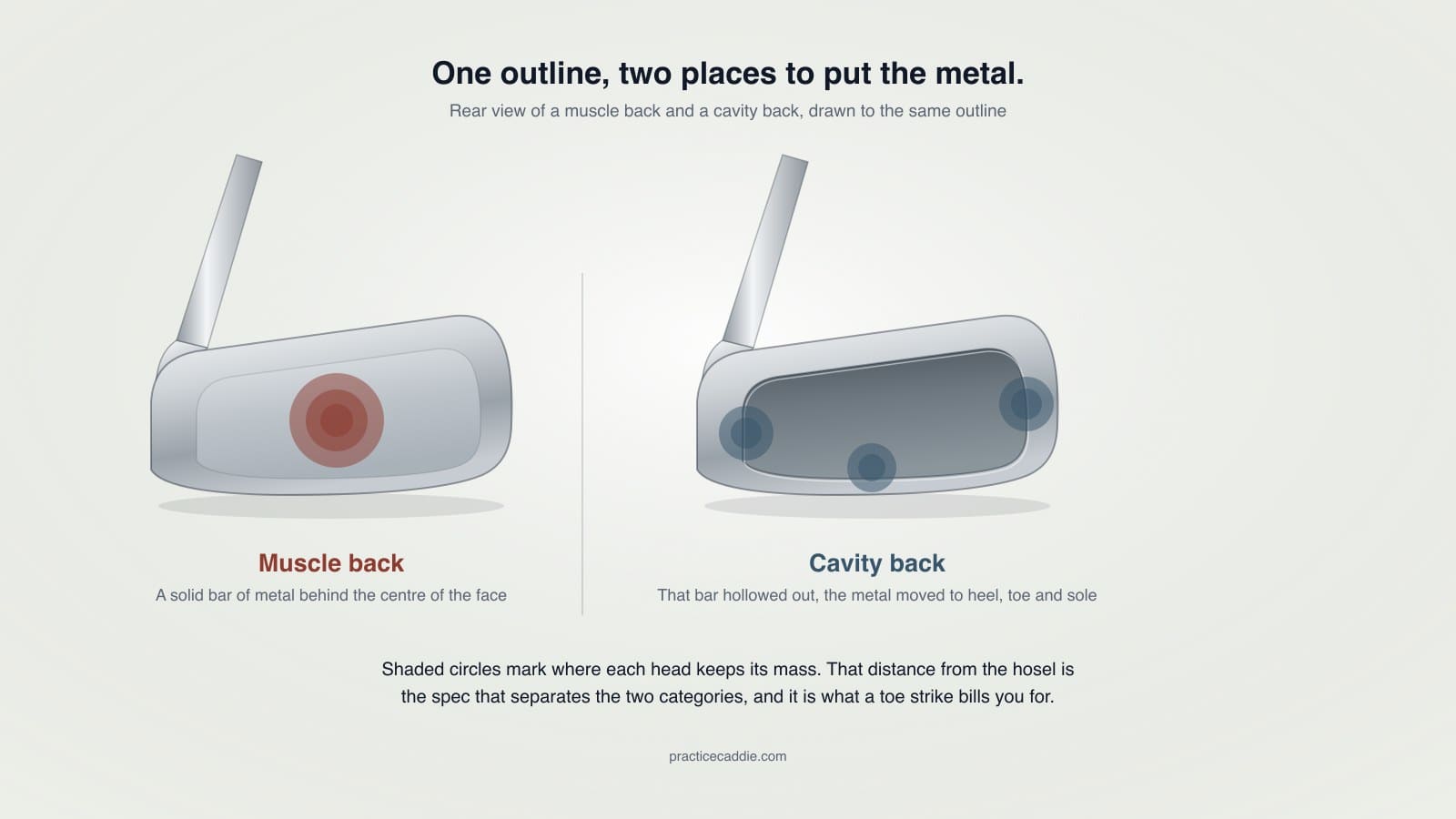
A blade and a cavity back are equal on a centred strike. They separate on the toe miss, where a 2022 robot test had the blade losing 10 and 17 yards at half an inch and three-quarters against 7 and 10 for the cavity. The spec that predicts it is how far the centre of gravity sits from the hosel.
The four iron categories, and what each one moves
| Category | What it is | Typical #6 CG from hosel | Maltby playability points | What you buy |
|---|---|---|---|---|
| Muscle back (blade) | Solid bar of mass behind the face centre | 1.087–1.210 in | 321–426 | The smallest head and the least offset |
| Players cavity | Perimeter weighting in a compact shape | 1.217–1.281 in | 505–576 | Toe protection without the size |
| Hollow body / players distance | Thin flexible face over an internal cavity | 1.228–1.373 in | 480–676 | Ball speed at a stronger loft |
| Game improvement | Wide sole, deep cavity, long blade length | 1.412–1.537 in | 730–856 | The largest miss window |
Ranges are computed from the sixteen 2023-to-2026 #6 iron heads charted below, each read out of its brand’s Maltby Playability Factor head catalog at The GolfWorks — six PDFs in all, of which PING’s is representative. The playability column is Maltby’s own composite score, which combines head MOI, the vertical centre of gravity and the horizontal CG distance into one number. The construction bucket in the first column is each head’s design type; Maltby’s own Classic, Conventional and Game Improvement labels are playability tiers, so they cannot answer a construction question without circularity.
Where a blade separates from a cavity back
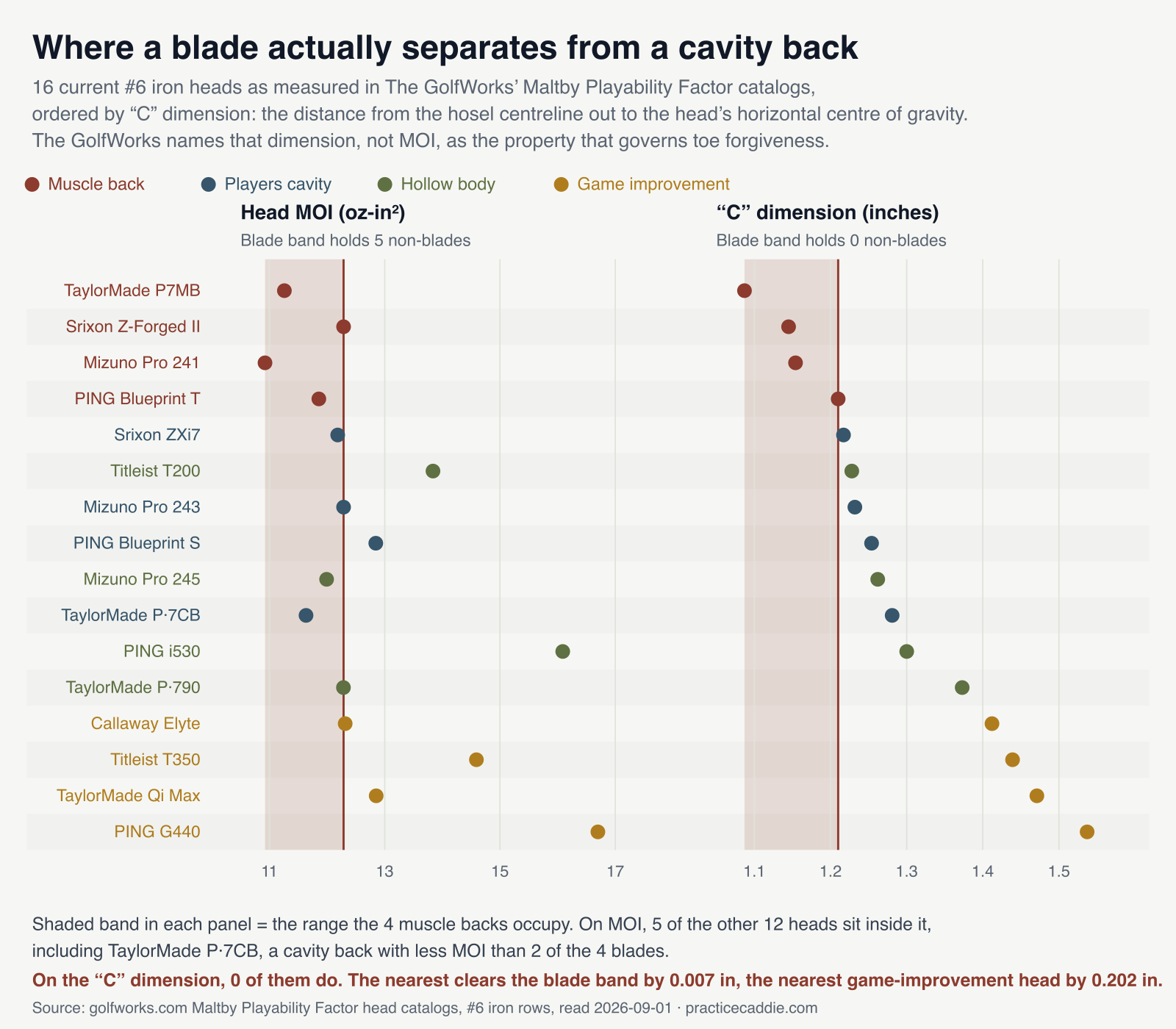
Head MOI is the number every iron review quotes, and it sorts these categories badly. The four muscle backs occupy a band from 10.9245 to 12.2878 oz-in², and five other heads sit inside it: three players cavities and two hollow bodies. TaylorMade’s P·7CB, a players cavity back, measures 11.6368 oz-in² — less than two of the four blades. Callaway’s Elyte, a game-improvement head, sits at 12.3153, barely clear of the top blade.
The horizontal CG distance behaves completely differently. Maltby calls it the “C” dimension: the straight-line distance from the hosel centreline out to the head’s horizontal centre of gravity. The four blades run from 1.087 to 1.210 inches. Nothing else in the set lands inside that band. The nearest non-blade, Srixon’s ZXi7 players cavity, clears the blade ceiling by 0.007 inches, and the nearest game-improvement head clears it by 0.202.
That matters because The GolfWorks says so about its own data. Asked which MPF parameter governs toe forgiveness, its fitting staff answer the C dimension: the longer it runs, the more stable the design, best combined with a lower vertical centre of gravity. Ralph Maltby lists three properties behind every MPF score — basic vertical CG, the C dimension and MOI — and it is the middle one that sorts blades from everything else in this sample.
So the cavity is the means. Hollowing out the back is how a designer frees the mass to push the CG toward the toe and down toward the sole. A head can reach a blade-like MOI with a cavity in it, and one here does.
How much does a toe strike cost with each head?
Robot testing keeps landing on the same asymmetry.
GOLF’s ClubTest robot comparison, published 18 March 2022, struck a blade and a cavity back at centre and at 0.5 and 0.75 inches toward the heel and toe.
| Strike location | Blade carry loss | Cavity carry loss | Blade’s extra cost |
|---|---|---|---|
| Centre | Equal | Equal | 0 yd |
| Toe, 0.5 in | −10 yd | −7 yd | 3 yd |
| Toe, 0.75 in | −17 yd | −10 yd | 7 yd |
| Heel, 0.5 in | 0 yd | −3 yd | −3 yd |
| Heel, 0.75 in | 0 yd | −7 yd | −7 yd |
The right-hand column is PracticeCaddie’s arithmetic from the two published loss columns, and it says something most blade-versus-cavity writing skips: this blade was the more forgiving club on the heel side, at both distances, by the same margins it lost by on the toe. Forgiveness came with a direction attached.
The direction that hurts more is well established across a wider field. GOLF ran more than 40 current 7-irons through Golf Laboratories at 80 mph in 2024, six shots each at centre, toe and heel with the same shaft and attack angle. Averaged across the field, a heel strike cost 6.5 yards and a toe strike cost 12.3 — nearly double. GOLF’s separate toe write-up puts the all-model toe penalty at 12.5 yards, and against that average PING’s i530 gave up 7, the smallest delta in the field.
A peer-reviewed version of the same experiment exists, and it splits the answer by axis. Wallace and colleagues, publishing in the Proceedings of the Institution of Mechanical Engineers, Part P in 2021, fired 330 shots per head at two 5-irons matched to within 0.2 g of mass and 0.3 degrees of static loft, moving impact from −15 mm to +15 mm horizontally and down to −15 mm vertically. The cavity back’s centre of gravity sat 12.6 mm behind the face against the blade’s 10.0, and its moment of inertia was higher on all three playing axes.
At 40 m/s of clubhead speed, a 5 mm horizontal shift cost the cavity back 0.19 m/s of ball speed and the blade 0.23. A 5 mm vertical shift reversed it: 0.74 m/s for the cavity, 0.50 for the blade. The extra MOI bought heel-and-toe stability in this pair and handed some of it back low on the face, which is the same asymmetry the ClubTest robot found in yards.
Centred strikes: the blade has no distance edge
The oldest claim in the category is that a blade sends more mass through the ball and therefore hits it further when you catch it clean. Robot data says the two heads tie at centre. Human testing says the cavity wins.
MyGolfSpy’s lab test, published 17 December 2024, put ten golfers of 0 to 12 handicap on a TaylorMade P7MB blade and a Stealth game-improvement head, then rebuilt both to an identical 27-degree loft with the same shaft, length, grip and swingweight to remove the loft confound that ruins most of these comparisons.
| Normalised to 27° | P7MB blade | Stealth game improvement | Gap |
|---|---|---|---|
| Ball speed | 112.7 mph | 115.1 mph | 2.4 mph |
| Carry | 163.2 yd | 170.3 yd | 7.1 yd |
| Spin | 4,537 rpm | 4,043 rpm | 494 rpm |
| Total shot area | 777 yd² | 886 yd² | 109 yd² |
Same loft, same shaft, same golfers, and the flexible face was 2.4 mph and 7.1 yards ahead. The blade spun 494 rpm more and produced a shot area 109 yd² smaller across this particular group, which is a consistency result for ten golfers spanning scratch to 12 rather than proof that blades forgive better. A group that mostly finds the middle will always flatter the head that punishes the edges.
Modern lofts complicate the comparison further. A Cool Clubs robot found a 28.5-degree game-improvement 7-iron and a 34-degree blade launching at the same angle, because the lower, deeper CG recovers the launch that the stronger loft gives away. Distance bought that way arrives with less spin and a shallower descent, which is a stopping-power question the yardage number never shows.
A 102,244-shot comparison puts about 70 percent of that gain down to ball speed. MyGolfSpy matched 88 golfers against themselves across eight test years, counting only golfers who hit a players iron and a players-distance iron in the same year. The players-distance 7-iron carried 6.3 yards further on 2.51 mph more ball speed, and roughly 70 percent of the extra carry came from that speed, the rest from a flatter, lower-spinning flight. Mizuno’s own line shows the loft side of it: its hollow Pro 245 is a 30-degree 7-iron against 34 degrees for the Pro 241 muscle back. If you are reading a fitting sheet, the launch monitor guide covers which columns settle it.
Do blades work the ball more than cavity backs?
Blades are sold on the idea that they curve the ball on command. One test controlled the variables well enough to check.
Plugged In Golf had seven golfers hit irons matched for loft, lie, swingweight and shaft, ten shots each, then measured curvature against face-to-path on centre-face strikes only so gear effect could not muddy the comparison. The blade produced 7.2 feet of curve per degree. The cavity back produced 7.3. The super game-improvement head produced 6.0, which at a realistic 3-degree face-to-path works out at about 3 to 4 feet less shape than the blade across a full shot.
Wallace’s robot data adds the nuance without overturning it. That paper reports the cavity back giving “more consistent launch outcomes across a range of impact locations”, and its launch direction moved about half as much as the blade’s as impact position shifted: 0.022 degrees per millimetre against 0.040, or 0.66 degrees of side-angle change across the 30 mm from heel to toe against the blade’s 1.20. The compact head responds more to small changes in delivery, which a good player experiences as feedback and a poor one experiences as a penalty. Both descriptions are of the same physical property.
Neither number changes the hierarchy. Where the face points relative to the path does nearly all the work, which is why the ball flight laws predict shape from delivery rather than from the club in your hands.
Forged, cast, and where feel comes from
Forging is a manufacturing process, and it has been asked to carry a marketing claim it cannot support on its own.
Wicks and colleagues compared the dynamic properties of forged and cast clubheads at the 16th International Modal Analysis Conference in 1998 and found little difference in the natural frequencies of the assembled clubs or in the acoustic response of the heads. Roberts and colleagues, publishing in the Journal of Sound and Vibration in 2005, measured golf impact sound at 1 to 10 kHz reaching instantaneous levels up to 127 dB at the ear, and found that golfers’ ratings of a pleasant, lively strike tracked loudness and sharpness closely.
Feel is measurable. It arrives mostly through the ears. MyGolfSpy’s metallurgy review grants that forging and casting produce different grain structures with different vibration behaviour, then points out that geometry, alloy, face thickness, badging and damping all sit between that grain structure and your hands. A forged hollow iron can sound hard. A cast head with a tuned polymer insert can feel soft.
The same reasoning applies one component down the club. The steel versus graphite shaft testing found damping to be the one place material does something measurable, and the one place with the least consequence for where the ball ends up.
How many PGA Tour players use blades?
Karsten Solheim’s perimeter-weighting idea reached irons in 1969, when he moved mass away from the centre of the head toward heel and toe and adopted investment casting for consistency. The PING Eye arrived in 1978 and the Eye2 in autumn 1982, and the deep-cavity, wide-soled shape became the template every game-improvement iron still follows.
Forty-odd years later, the professionals have not gone back. An audit of the top 100 PGA Tour players last updated 21 August 2026 counted 16 in a full blade set, 67 using cavity backs, and 79 carrying at least one cavity back once mixed sets are included. Fifty-eight percent played two or more iron models, and more than a quarter carried a players-distance head.
Read that as a blended-set argument. A 4-iron and a 9-iron ask different things of a head, and the majority of the best players in the world answer them with different heads.
Who should play a blade, and how to tell
Handicap is the wrong input, and the research says why. Herder and Benoit put 49 golfers of 0 to 35 handicap on a GCQuad for 20 seven-iron shots each in 2022 and found handicap correlated with the error in estimating horizontal impact location at r = 0.675 and vertical at r = 0.534, both at p < 0.001. Better players know where they hit it. The study measures perception, and it publishes no millimetre strike radius per handicap band.
Nor will your shot tracker settle it. Arccos and Shot Scope record where shots start and finish, so they quantify proximity and distance dispersion and cannot see the face at all. What they do show is how fast distance control degrades: GOLFTEC’s 7-iron data, after discarding the worst 30 percent of shots, put front-to-back dispersion at 36 feet for scratch, 56 feet for an 8-handicap and 90 feet for a 13.
So measure the thing that decides it. Twenty shots, impact tape, every strike kept.
- Find your pattern. Impact tape or foot spray on a 7-iron, twenty shots on grass, mark the face centre first and keep the bad ones. A handicap number describes scoring; the club responds to millimetres.
- Score it against the published penalty. More than a fifth of strikes outside half an inch toward the toe means that 3-to-7-yard blade premium is landing on your card several times a round.
- Test both heads and keep the misses. Same shaft, same length, closest loft match, at least fifteen shots each. Deleting mishits is the edit that sells blades, because the two heads tie at centre.
- Check the heel side before concluding. The 2022 robot blade lost nothing on heel strikes while the cavity lost 3 and 7 yards. Pick the head that protects the miss you make.
If the pattern is scattered, the answer is upstream of the purchase. Strike quality responds to practice in a way it never responds to a receipt, and reading your divots is the free version of the same diagnosis.
Myths worth killing
- “Cavity backs are more forgiving.” On toe strikes, in that 2022 test, yes: 7 and 10 yards lost against 10 and 17. On heel strikes the blade lost nothing and the cavity lost 3 and 7.
- “Blades are longer from the middle.” Robot testing had centred strikes equal. At matched 27-degree loft, the game-improvement head was 2.4 mph and 7.1 yards longer.
- “Blades work the ball.” 7.2 feet of curve per degree of face-to-path against the cavity back’s 7.3.
- “Forged feels softer.” Natural frequencies of the assembled clubs and the acoustic response of the heads came back near-identical for forged and cast, and perceived feel tracks impact sound.
- “MOI tells you how forgiving an iron is.” Five non-blades in this sample sit inside the muscle backs’ MOI band, including a cavity back below two of the four blades.
- “Pros play blades.” 16 of the top 100 played a full blade set in 2026; 79 carried at least one cavity back.
Related reading
- How to Grip a Golf Club — the hub for everything between your hands and the clubhead, and where the setup work that changes your strike pattern begins.
- Steel vs Graphite Iron Shafts — the same shape of finding one component up: the label stopped predicting weight, torque and ball flight, and ten of twelve shafts share a 46.5-gram window.
- Golf Shaft Flex Chart — the other spec on the shaft, and the blind test that says whether flex is your problem at all.
- Launch Monitor Numbers Explained — how to read the carry, spin, descent and dispersion columns a head test hands you.
- How to Read Your Divots — free strike feedback left on the ground after every iron shot, and what low-point spread proves that divot position does not.
- How to Hit Irons — the ball-striking cornerstone; the forward low point and the descending strike a compact head demands.
- Golf Loft and Lie Explained — what one degree costs, and why a new set’s lie angle matters more than the shape of its back.
- Golf Club Distance Chart — what the yardages look like once modern iron lofts are in the picture.
- The practice plan guide — structuring the weeks either side of an equipment change so the comparison means something.
Key takeaways
- Centred strikes are a tie. The 2022 GOLF ClubTest robot found the blade and the cavity back equal at the middle of the face.
- The toe is where the blade pays. 10 and 17 yards lost against 7 and 10 at half an inch and three-quarters, a 3-to-7-yard premium computed from the published cells.
- The heel reverses it. That blade lost nothing on heel strikes at either distance; the cavity lost 3 and 7.
- MOI does not sort the categories. Five of the other twelve heads sit inside the four muscle backs’ 10.9245-to-12.2878 oz-in² band, including a players cavity below two of the blades.
- The C dimension does. The blades occupy 1.087 to 1.210 inches from hosel centreline to horizontal CG, and no other head in the set enters that band. The GolfWorks names that dimension as the driver of toe forgiveness.
- Blades are not longer. At a matched 27-degree loft, the game-improvement head averaged 115.1 mph and 170.3 yards against 112.7 and 163.2.
- Workability is a rounding error. 7.2 feet of curve per degree against 7.3; the super game-improvement head trailed by 3 to 4 feet at a normal face-to-path.
- Forging is a process, and feel comes from elsewhere. Forged and cast measured near-identical in club natural frequency and head acoustic response, and perceived feel tracks impact sound.
- Decide on your impact map. 16 of the top 100 tour players are on full blade sets and 58 percent play mixed sets, so even the best ball strikers mostly blend.
Frequently asked questions
Are cavity back irons easier to hit than blades?
On toe strikes, usually yes. The 2022 GOLF ClubTest robot comparison had the blade losing 10 yards at a half-inch toe strike and 17 yards at three-quarters, against 7 and 10 for the cavity back. On heel strikes that same blade lost nothing at either distance while the cavity lost 3 and 7 yards. On centred strikes the two clubs were equal. Forgiveness in an iron has a direction attached to it, so the honest answer depends on where your own misses land.
What is the difference between a cavity back and a blade iron?
A blade, or muscle back, carries its mass in a solid bar behind the centre of the face. A cavity back hollows that bar out and moves the metal to the perimeter, which pushes the centre of gravity farther from the hosel and lower in the head. Across sixteen current #6 heads in The GolfWorks’ Maltby catalogs, the muscle backs run 1.087 to 1.210 inches from hosel centreline to horizontal CG, and every cavity back, hollow body and game-improvement head measures higher.
Do blades give you more control or workability?
Barely, on the one test that measured it. Plugged In Golf had seven golfers hit irons matched for loft, lie, shaft and swingweight, and on centre-face strikes found 7.2 feet of curvature per degree of face-to-path with the blade against 7.3 feet with the cavity back. The super game-improvement head curved 6.0 feet per degree, about 3 to 4 feet less than the blade at a normal 3-degree face-to-path. Face-to-path creates the curve. The head shape adjusts it at the margins.
Are blades longer than cavity backs off the centre of the face?
No. The 2022 robot test found centred strikes equal between the two heads. MyGolfSpy normalised a TaylorMade P7MB blade and a Stealth game-improvement head to the same 27-degree loft, shaft, length and swingweight, and the game-improvement head still averaged 115.1 mph ball speed and 170.3 yards against 112.7 mph and 163.2 yards. Concentrated mass behind the face does not beat a thin, flexible face for ball speed.
What handicap do you need to play blades?
No study establishes a handicap cutoff, and the retail rule of thumb of five or better is a convention rather than a finding. Sixteen of the top 100 PGA Tour players used a full blade set in 2026 while 79 percent carried at least one cavity back, so even elite ball strikers mostly mix. Decide on impact location instead. If most of your 7-iron strikes stay within half an inch of centre horizontally and few sit low on the face, a blade is defensible.
Do forged irons feel softer than cast irons?
Feel tracks the sound of impact more than the manufacturing process. Wicks and colleagues compared the dynamic properties of forged and cast clubheads at the 1998 International Modal Analysis Conference and found little difference in the natural frequencies of the assembled clubs or in the acoustic response of the heads. Roberts and colleagues later showed in the Journal of Sound and Vibration that golfers’ ratings of feel track the loudness and sharpness of that sound closely. Geometry, alloy, face thickness and damping each move it more than forging does.
Are players distance irons a good middle ground?
They are a real third category rather than marketing. A hollow head puts a thin high-speed face on a compact shape with internal tungsten, and the loft comes down with it: Mizuno’s hollow Pro 245 is a 30-degree 7-iron against 34 degrees for its Pro 241 muscle back. MyGolfSpy matched 88 golfers against themselves across 102,244 shots and measured 2.51 mph more ball speed and 6.3 yards more carry from the players-distance 7-iron, against 412 rpm less spin and a shot pattern about 14 percent wider.