Steel vs Graphite Iron Shafts: What the Testing Actually Shows
Twelve current iron shafts, ten of them inside one 46.5-gram window. The word on the label has stopped predicting weight, torque or the ball flight.
Quick answer
Steel and graphite iron shafts now overlap by 46.5 grams, from 68.5 to 115. In a 2026 study of 40 golfers, a 72-gram graphite shaft and a 101-gram steel shaft produced the same 72 mph clubhead speed and carry within one metre. Fit weight, bend profile and torque. The material is how a maker reaches those numbers.
The four specs that matter, and where material sits among them
| Spec | Steel range today | Graphite range today | What it changes |
|---|---|---|---|
| Raw weight | 68.5–128.5 g | 48–115 g | Clubhead speed, tempo, swingweight, centre contact |
| Torque | ~1.5–3.0° | ~1.2–6.2° | Resistance to twisting; feel through the grip |
| Bend profile | Low to high kick, every tip stiffness | Low to high kick, every tip stiffness | Launch window and spin |
| Damping | Lower | Higher | Vibration reaching the hands |
| Cost per shaft | About $33–$65 | About $52–$125 | Seven-club build cost |
Weight ranges are read off the current spec pages at Nippon, Mitsubishi, KBS and The GolfWorks. Damping is the only row where the two materials separate cleanly, and it is the row with the least consequence for where the ball goes.
Where steel and graphite iron shafts sit
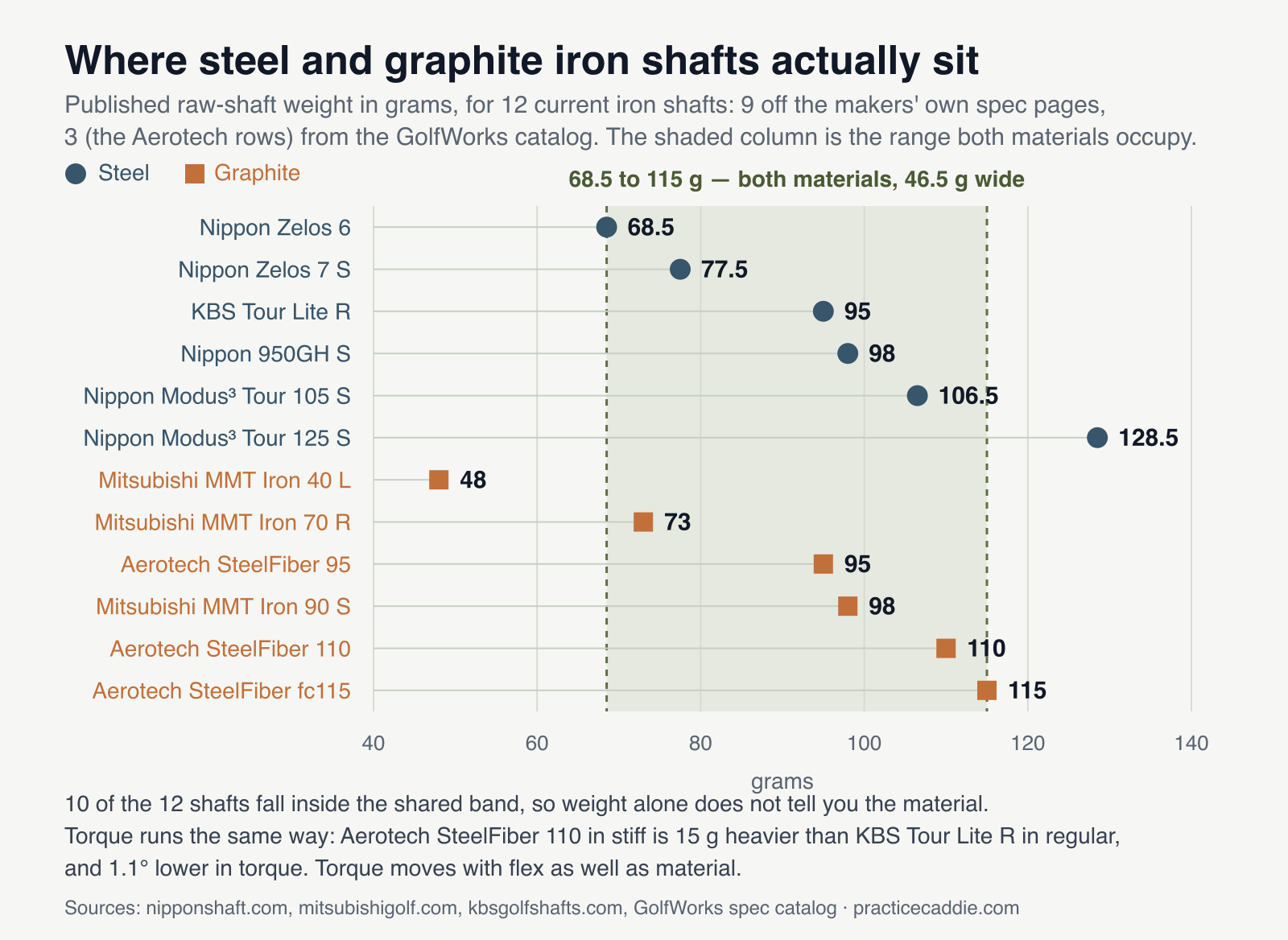
Twelve current iron shafts: nine weights off the makers’ own spec pages, and the three Aerotech rows from The GolfWorks catalog, since Aerotech publishes its numbers through a page that renders in the browser rather than in the HTML. Ten of the twelve land in the same 46.5-gram column. Nippon’s Zelos 6 is a 68.5-gram steel shaft, lighter than ten of the other eleven. Aerotech’s SteelFiber fc115 is a 115-gram graphite shaft, heavier than five of the six steel ones.
The torque column runs the same direction. The GolfWorks catalog lists KBS Tour Lite 95 steel in regular at 3.0 degrees and the 15-gram-heavier SteelFiber 110 graphite in stiff at 1.9 — heavier and stiffer in torsion, in the material that is supposed to be neither. Torque moves with flex as well as material, which is part of the point: the spec is a property of the individual shaft, not of the category.
One caution about reading catalogs at all. That same GolfWorks table lists Nippon’s N.S. Pro Modus³ Tour 120 in the graphite column at 111 grams, while Nippon publishes it under steel shafts at the same 111 grams for regular flex. The gram weight is right and the material label is wrong, which is a fair summary of how much work the material label is doing.
The one study that changed only the shaft
Most steel-versus-graphite comparisons change three things at once and report the result as a material finding. A 2026 prospective series in BMC Musculoskeletal Disorders did better. Forty golfers, mean age 51 and mean handicap 16, hit a PING i210 7-iron modified with a screw fitting so the shaft could be swapped without changing anything else. Both shafts were regular flex, both were exactly 37 inches, both wore the same Golf Pride Tour Velvet grip, and every shot was a Titleist Pro V1 measured on TrackMan.
The graphite was a PING Alta CB at 72 grams and 2.1 degrees of torque. The steel was a True Temper Dynamic Gold 105 at 101 grams and 1.8 degrees. A 29-gram gap is wider than the step between most adjacent models in a maker’s own line.
| Group | n | Clubhead speed | Carry | p-value, speed |
|---|---|---|---|---|
| All golfers | 40 | 72 mph graphite, 72 mph steel | 106 m graphite, 107 m steel | 0.113 |
| Men | 31 | 76 vs 76 mph | 115 m vs 115 m | 0.150 |
| Women | 9 | 61 vs 60 mph | 77 m vs 78 m | 0.594 |
| Amateurs, handicap ≥ 10 | 9 | 69 vs 69 mph | 97 m vs 98 m | 0.710 |
| Professionals, handicap < 10 | 31 | 85 vs 84 mph | 139 m vs 138 m | 0.011 |
One cell reached significance: the sub-10-handicap group swung the graphite shaft 1 mph faster. That group is 31 of the 40, so this is the bulk of the sample rather than a fringe of it. Their carry advantage was one metre, at p = 0.678. Every other row is a tie.
The honest read is that a 29-gram reduction, delivered by switching material, bought the better players 1 mph of clubhead speed that did not survive the trip to the landing area. Carry held level in every group the paper broke out.
Where the distance claim comes from
Lighter shafts do produce more speed for some golfers. That finding is real, and it was measured in 2024 using three steel shafts — Nippon Zelos 7 at 77 grams, N.S. Pro 950GH at 98, and Modus³ 120 at 114 — on a single PING G425 head with twenty male amateurs split into low- and high-handicap groups.
| Shaft weight | Low-handicap speed | Low-handicap carry | High-handicap speed | High-handicap carry |
|---|---|---|---|---|
| 77 g | 88.74 mph | 194.09 yd | 83.41 mph | 156.17 yd |
| 98 g | 87.84 mph | 189.40 yd | 83.22 mph | 157.66 yd |
| 114 g | 87.77 mph | 188.38 yd | 82.09 mph | 151.86 yd |
Average the two groups and the 37-gram drop from 114 to 77 grams is worth about 1.15 mph and 5.0 yards, which works out at roughly 0.31 mph per 10 grams. That arithmetic is PracticeCaddie’s, computed from the published group means, and it is a description of twenty golfers rather than a fitting constant — the study’s own launch-angle comparison came back at p = 0.363, and its three test clubs ran from C8 to D1 swingweight, a confound the authors name themselves.
Every shaft in that study was steel. The distance effect people attribute to graphite was measured without a single graphite shaft in the room. Graphite is one common way to buy a light shaft. Nippon’s Zelos 6 is another.
Is steel more accurate?
MyGolfSpy’s ten-golfer shaft test put one TaylorMade PSi 6-iron head at a fixed 37 inches and stiff flex behind five shafts: SteelFiber i95 and Recoil 95 in graphite, against KBS C-Taper 120, Project X 6.0 and Dynamic Gold S300 in steel.
The winners split by metric. SteelFiber graphite recorded the highest group ball speed, the longest carry and the smallest spin standard deviation. C-Taper steel produced the smallest overall shot area. Project X steel launched almost a degree higher than anything else. Among golfers swinging the 6-iron under 80 mph, C-Taper steel was more than 1 mph faster and longest.
Five shafts, four different winners. Dispersion tracked the individual shaft, and even then the slower group and the faster group crowned different ones. That result argues for a fitting.
Feel and vibration, the one place material does something measurable
Graphite damps more than steel. Composite shafts show lower modal amplitudes than steel under instrumented testing, which is the physical basis for the softer impact feel golfers report. How much of that reaches the hands depends on frequency as well as amplitude, and the hand-arm system’s own resonances sit low — around 20 Hz at the wrist on published measurements — so a shaft’s damping and what a golfer feels are two different measurements.
The 2026 study above also ran surface EMG on four forearm muscles in both arms across five swing phases. In the late follow-through, the graphite shaft produced lower activity in the lead arm’s flexor carpi ulnaris (p = 0.027) and pronator teres (p = 0.009). Grip style interacted with it: trail-arm FCU activity was higher with steel at p = 0.021.
That is a measured difference in muscular loading, in specific swing phases under specific conditions, from a 40-golfer series with no blinding and no injury outcome. Call it a comfort finding. Anyone weighing shaft material against a physical complaint should be talking to a clinician, not to a spec sheet.
What tour players put in their irons
Graphite irons remain rare at the top of the men’s game and ordinary in the women’s. An independent audit of 100 PGA Tour bags found one player in a full graphite iron set: Matt Kuchar, whose SteelFiber Private Reserve i110cw build runs 5-iron through pitching wedge in Srixon ZX7 MK II heads. The same audit puts Abraham Ancer on composite graphite-on-steel irons, so the honest count is one full set and one hybrid construction. Since then C.T. Pan moved into 90-gram KBS graphite and Rickie Fowler into SteelFiber 125cw.
The same publisher’s LPGA audit found 35 of 100 players in graphite iron shafts, Nelly Korda among them in SteelFiber i80cw.
Neither number is an official tour census, both were last updated in 2025, and both are snapshots that a mid-season switch can move. What survives the caveats is the shape: Fowler’s graphite build is a 125-gram shaft and Korda’s is an 80-gram shaft. Two tour players, the same material, a 45-gram spread. Each of them fitted a weight and a profile, and graphite was how the builder got there.
Manufacturing consistency, the old objection
Graphite’s reputation for shaft-to-shaft variance dates from a period when it was earned. The best modern comparison available is a Club Champion machine test of 36 iron shafts, 18 of them graphite, scored on Load Symmetry Index, where 100 means perfectly symmetric loading. Steel averaged 95.2. Graphite averaged 94.8.
Two caveats worth stating. That sample measures radial symmetry rather than weight, frequency and EI tolerance together, and the company that ran it owned the alignment service the test promotes. Separately, The GolfWorks’ own clubmaking guidance puts desirable tolerances near ±2 grams and ±2 CPM while declining to guarantee that every brand holds them. Tolerance is a property of the factory that built the shaft, and the modern numbers no longer sort by material.
What it costs
| Purchase route | Steel | Graphite |
|---|---|---|
| Common raw shafts at The GolfWorks | Dynamic Gold $32.99; KBS Tour $39.95; Project X LZ $53.99–$64.99 | Recoil $52–$69; SteelFiber $55–$63; Mitsubishi MMT $65 |
| Premium aftermarket | — | Fujikura Axiom $105–$125 per shaft |
| Factory set upcharge | Tour Edge 2026 Exotics seven-piece steel at $799.99 | Same set in graphite at $899.99 |
Prices from The GolfWorks and the Tour Edge 2026 Exotics release.
The two columns cross over. Project X LZ steel runs to $64.99 a shaft in that catalog, above every SteelFiber graphite listing. At factory level the premium is often around $100 across seven clubs, and on some heads there is no upcharge at all. The cost gap people remember lives at the top of the aftermarket, where a seven-shaft premium composite build runs several times a stock steel one before labour.
The “graphite for seniors” question
The heuristic is a proxy for three things that have nothing to do with carbon fibre: lower total weight, an easier launch window, and more damping. All three are now available in steel. KBS Tour Lite is a 95-to-105-gram steel shaft marketed for higher trajectory and spin, and Nippon’s Zelos 6 is lighter than most graphite in the same rack.
Weight preference also runs in both directions. Some slower swingers sequence better with more head awareness, which is one reading of the 2026 study’s amateur group showing no gain at all from its 29-gram reduction — though that group was only nine golfers. Tom Wishon’s fitting work puts an aggressive-transition golfer at roughly 10–20 grams heavier and two to three swingweight points heavier than a smooth-transition golfer at the same measured speed. Transition and tempo move the answer further than the year on the birth certificate does.
Impact sting is a real and measurable reason to test graphite. If the prompt is a number in a decade column instead, start from a swing-speed baseline and fit the weight.
Myths worth killing
- “Graphite is light, steel is heavy.” Ten of twelve current shafts share a 46.5-gram window. Steel goes as light as 68.5 g; graphite as heavy as 115.
- “Graphite has high torque.” Fujikura’s Axiom 125 publishes 1.2–1.6 degrees, under most steel. SteelFiber 110 in stiff sits at 1.9 against KBS Tour Lite 95 steel in regular at 3.0.
- “Graphite launches higher and spins more.” Project X steel launched highest in MyGolfSpy’s mixed-material test, and heavy graphite models are sold as mid-low and low profiles.
- “Graphite is longer.” Zero whole-cohort carry gain across 40 golfers on a 29-gram difference.
- “Steel is more accurate.” The smallest shot area belonged to steel; the most consistent spin belonged to graphite; the slower and faster groups had different winners.
- “Graphite is less consistent to build.” 95.2 against 94.8 on Load Symmetry Index across 36 shafts.
How to test it yourself
The 2026 comparison swapped the shaft and left everything else alone, which is why its answer is readable. The 2024 study matched head, length and grip but let swingweight follow the shaft weight, and said so itself. Copy the tighter of the two, take enough swings to see the spread, and add the blinding neither study used — the double-blind flex trials in the shaft flex work showed it matters once a golfer knows what they are swinging.
- Write down the two weights before you hit anything. Ask for raw-shaft grams, not the flex letter and not the material. A 95-gram steel option against a 72-gram graphite option is a 23-gram test wearing a material costume. Same weight, different material is the comparison that answers the material question.
- Match everything the shop can match. Same head, same loft, same playing length, same grip, swingweight held as close as the build allows. The 2024 study let swingweight drift from C8 to D1 and named it a limitation; the 2026 study held length at 37 inches and swapped only the shaft.
- Hit alternating blocks of five, and do not look. Have someone else hand you the clubs and record which is which. Five swings per shaft is the published volume. Alternating spreads warm-up and fatigue across both candidates, and tape over the shaft band removes the expectation that heavier ought to feel more stable.
- Read spread before averages. Compare standard deviation of carry and the width of the landing pattern first. Forty golfers produced identical 72 mph speed and a one-metre carry difference, so a bigger gap in eight shots is either a genuine personal response or a sample you have not filled out yet. Tie on spread, take the lighter or the cheaper one.
That last instruction is the one people skip. The ball flight laws run on where the face and path were at impact, so a shaft earns its place by making that delivery repeatable.
Related reading
- Golf Shaft Flex Chart: What Swing Speed Actually Tells You — the other axis of the same spec. Nine shafts that five makers recommended for one golfer measured 23 CPM apart, and the blind test that says whether flex is your problem at all.
- How to Grip a Golf Club — the hub for everything between your hands and the clubhead, and where the setup fundamentals live.
- Golf Grip Size Chart — the spec below the shaft, and why PING’s testing pinned the ball-flight change on club weight rather than grip width.
- Launch Monitor Numbers Explained — how to read the carry, spin and dispersion numbers a shaft test hands you.
- Golf Club Distance Chart — what the yardages look like by speed, once a shaft change has settled.
- Senior Golf Swing Tips — the speed and mobility side of the question the “graphite for seniors” heuristic is asking about.
- How to Hit Irons — strike quality is the variable a shaft can only support, and the one worth fixing first.
- The practice plan guide — structuring the weeks either side of an equipment change so the comparison means something.
Key takeaways
- Ten of twelve current iron shafts sit in a shared 68.5-to-115-gram window. Steel starts at 68.5 g in Nippon’s Zelos 6; graphite reaches 115 g in Aerotech’s SteelFiber fc115.
- A 29-gram material switch moved no carry for any group of the 40. Same 72 mph overall, one metre of carry, p = 0.113 and 0.657. The 31 sub-10 handicaps gained 1 mph of clubhead speed and no carry.
- The distance-from-lighter finding was measured in steel. Three steel shafts at 77, 98 and 114 g gave about 1.15 mph and 5.0 yards across 37 grams — a weight effect, tested without graphite.
- Torque overlaps and sometimes reverses. SteelFiber 110 graphite in stiff is listed at 1.9 degrees against KBS Tour Lite 95 steel in regular at 3.0, and brand-to-brand torque figures are not measured the same way.
- Dispersion belongs to shafts, not materials. Steel won smallest shot area, graphite won spin consistency, and the under-80-mph group had a different winner than the fast group.
- Damping is the one real material difference. Lower modal amplitudes and lower lead-arm forearm activity in the late follow-through — a comfort finding, not a medical one.
- Cost splits by route, not by material. About $100 across seven clubs at factory level; several hundred more for a premium aftermarket composite build.
- Fit weight first, then bend profile, then launch, then feel. Material is how a maker delivers those numbers, and the label has stopped predicting any of them.
Frequently asked questions
Are graphite iron shafts better than steel?
Neither material wins as a category. A 2026 study of 40 golfers hit a PING i210 7-iron at a fixed 37 inches with a 72-gram graphite shaft and a 101-gram steel shaft and measured 72 mph clubhead speed with both, plus 106 metres of carry against 107. The p-values were 0.113 and 0.657. Fit the weight, the bend profile and the delivered launch you want, then take whichever material supplies them.
Do graphite iron shafts add distance?
Not reliably. The direct 2026 comparison found no whole-cohort speed or carry gain despite a 29-gram difference between the two shafts. A separate 2024 study using three steel shafts at 77, 98 and 114 grams did find lighter to be faster, averaging about 1.15 mph and 5 yards across its two handicap groups for a 37-gram reduction. That is a weight effect measured entirely within one material, so it says nothing about graphite.
Is steel more accurate than graphite in irons?
The testing does not support it as a rule. MyGolfSpy put ten golfers on a single TaylorMade PSi 6-iron head with five shafts and found KBS C-Taper steel produced the smallest overall shot area, while the graphite SteelFiber i95 had the most consistent spin and the longest group carry. Project X steel launched highest. Different shafts won different metrics and different swing-speed groups, which is the pattern a fitting is meant to resolve.
What is the weight difference between steel and graphite iron shafts?
Much smaller than the reputation suggests, and often zero. Nippon’s current steel line starts at 68.5 grams in the Zelos 6, while Aerotech’s SteelFiber graphite runs to 110 and 115 grams. Across twelve current shafts in the makers’ and The GolfWorks’ published specs, ten sit inside a shared 46.5-gram window from 68.5 to 115 grams. A gram weight no longer tells you which material you are holding.
Does graphite have more torque than steel?
On average yes, but the ranges overlap and individual pairs reverse. Torque is the twist in degrees under a fixed torsional load, measured in the Dynacraft protocol by clamping two inches of butt and one inch of tip and applying one foot-pound. In The GolfWorks catalog, KBS Tour Lite 95 steel in regular is listed at 3.0 degrees while the heavier Aerotech SteelFiber 110 graphite in stiff is listed at 1.9. Torque figures are also not comparable between brands: Hireko moved one shaft’s reading from 3.20 to 2.54 degrees, a 20 percent swing, by changing the tip clamp alone.
Should seniors use graphite iron shafts?
The heuristic is a proxy for three things age does not determine: lower total weight, an easier launch window and more damping. All three can be bought in steel now. Nippon’s Zelos 6 is a 68.5-gram steel shaft, lighter than plenty of graphite. Start from the weight that produces repeatable centre contact rather than a demographic label, and treat material as one way of reaching it.
Do PGA Tour players use graphite iron shafts?
Very few, and far more women do. An independent audit of 100 PGA Tour bags found a single full-set graphite user, Matt Kuchar in Aerotech SteelFiber. Rickie Fowler switched into SteelFiber 125cw in 2025 and C.T. Pan into 90-gram KBS graphite in 2024. The same publisher’s LPGA audit found 35 of 100 players in graphite irons, including Nelly Korda in SteelFiber i80cw.