Wedge Loft Chart: Pitching, Gap, Sand, and Lob Wedge Lofts
A game-improvement pitching wedge can be 40 degrees, leaving 16 degrees of loft between it and a sand wedge. Three wedges fill that span, not one.
Quick answer
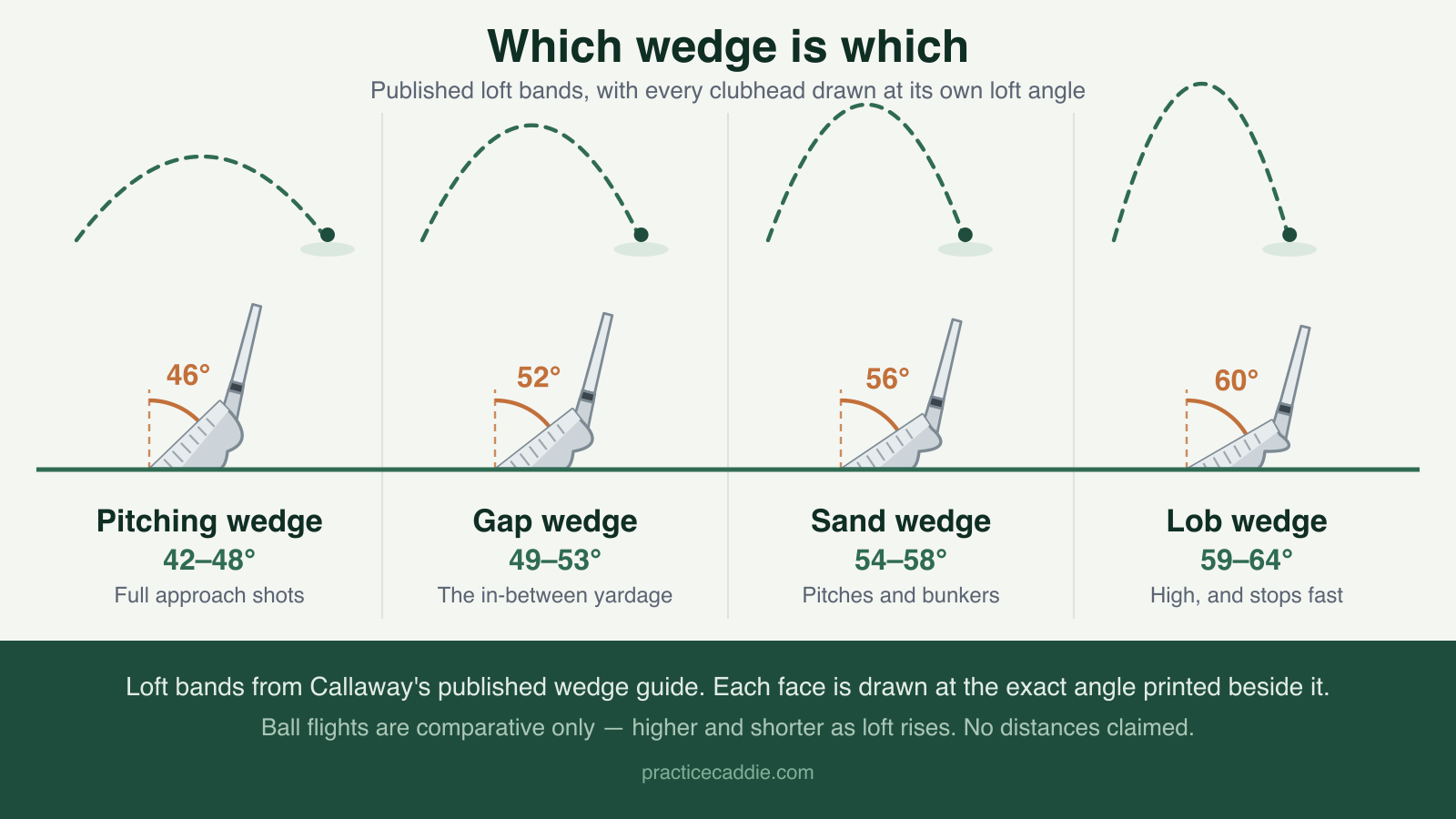
A pitching wedge is 42 to 48 degrees, a gap wedge 49 to 53, a sand wedge 54 to 58, and a lob wedge 59 to 64. Those are Callaway’s published bands. Your own pitching wedge is the number that matters, because game-improvement sets now ship it as strong as 40 degrees. Subtract yours from 56, divide by 6, round up — that is how many wedges belong under it.
A pitching wedge is 42 to 48 degrees, a gap wedge 49 to 53, a sand wedge 54 to 58, and a lob wedge 59 to 64 on Callaway’s published bands. Your own pitching wedge is the number that matters, because game-improvement sets now ship it as strong as 40 degrees. Subtract yours from 56, divide by 6, round up. That is how many wedges belong under it.
Wedge loft chart
| Wedge | Callaway’s published band | Typical specialty-wedge lofts | What it is for |
|---|---|---|---|
| Pitching wedge (PW) | 42–48° | 46°, 48° | Full approach shots; the club your set supplies |
| Gap / approach wedge (GW, AW, UW) | 49–53° | 50°, 52° | The hole between the set wedge and the sand wedge |
| Sand wedge (SW) | 54–58° | 54°, 56° | Full shots, greenside pitches, bunkers |
| Lob wedge (LW) | 59–64° | 58°, 60° | Short, high shots with little run |
Bands are Callaway’s wedge buying guide. The specialty-loft column is what wedge lines actually stock — Mizuno’s Pro T-3 sells 46 and 48 as pitching wedges, 50 and 52 as gap wedges, 54 and 56 as sand wedges, and 58 and 60 as lob wedges.
Notice what the table cannot tell you. The names overlap at every boundary, they are conventions rather than regulated categories, and no rule anywhere requires a 56-degree club to be called a sand wedge. Publish the loft first and the name second, and most of the confusion disappears.
The one number the chart does not contain is your own pitching wedge.
Why is my pitching wedge so strong? Loft jacking in numbers
Because manufacturers have been strengthening iron lofts for decades, and the wedge at the bottom of the set moved with them. Callaway’s own band starts at 42 degrees, already stronger than the wedge racks, and current iron sets go further:
| Iron set | Category | Pitching wedge | Source |
|---|---|---|---|
| Ping G740 | Super game improvement | 40° | Ping specification table |
| Callaway Elyte X | Game improvement | 41° | Callaway specification table |
| Ping G440 | Game improvement | 42° (41° Power Spec) | Ping specification table |
| TaylorMade P7CB | Players cavity | 46° | TaylorMade specification sheet |
| Ping Eye2 | Classic perimeter-weighted | 50.5° | Archived specification listing |
Ten and a half degrees separate the top of that column from the bottom. Every one of those clubs is stamped with the same letter.
Golf Digest calls the trend loft jacking: iron lofts strengthened over time so each numbered club carries farther (Golf Digest). Thin faces and low centres of gravity let a stronger head launch high enough to hold a green, so a 41-degree modern club stops a shot that a 41-degree blade of the 1990s would have run through the back. The added yards come from the head design.
What that strengthened loft costs sits at the other end of the bag, and it rarely comes up at the point of sale.
Two Ping sets, and the gap the wedges have to fill
Hold the brand constant and the size of the change is easier to read.
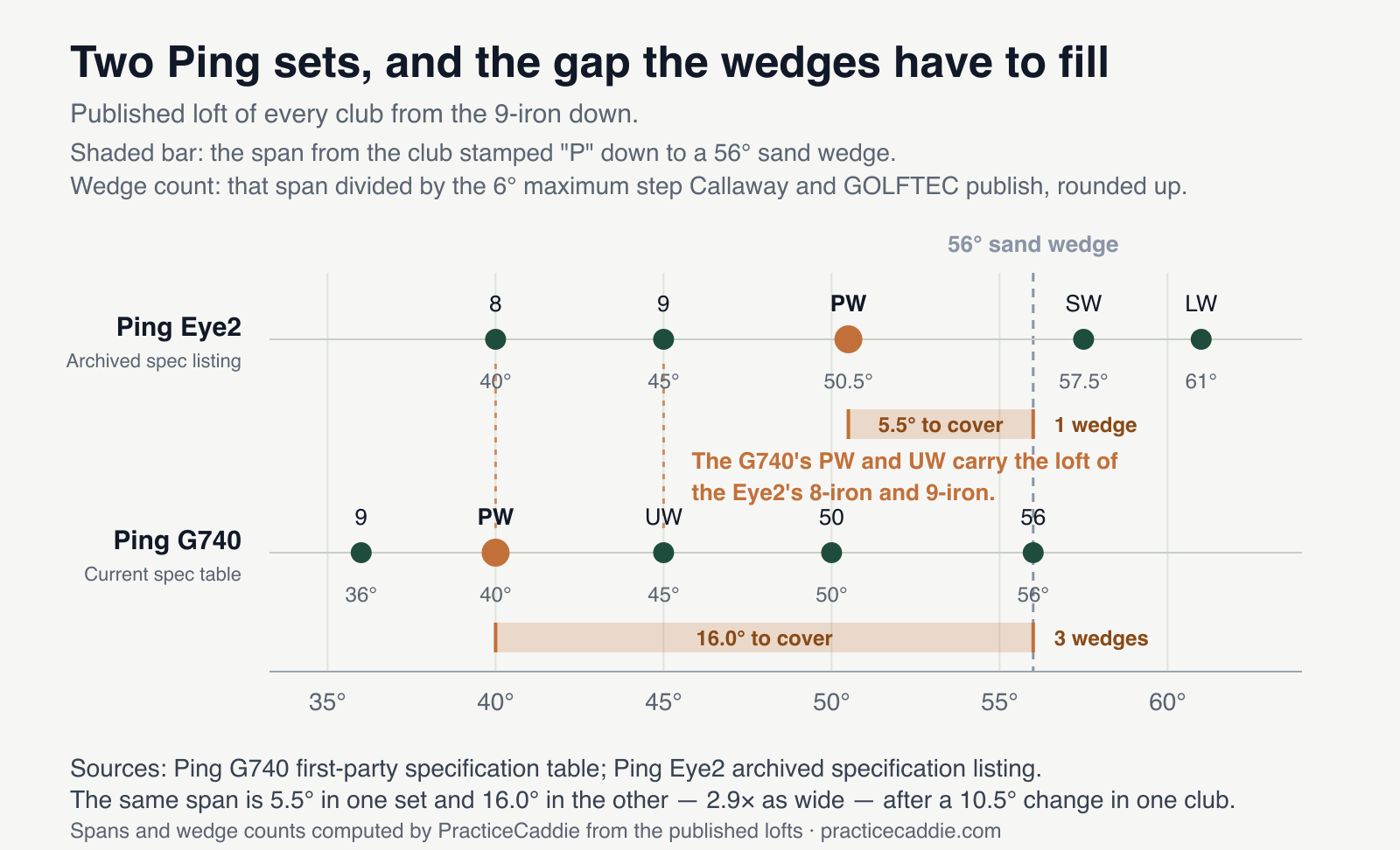
The Ping Eye2’s pitching wedge is 50.5°. The current Ping G740’s is 40°. Both are Ping, both are the club stamped P, and the loft between them differs by more than a full club.
Two lofts line up exactly across the two sets. The G740’s pitching wedge sits at 40 degrees, which is the Eye2’s 8-iron. The G740’s utility wedge sits at 45, which is the Eye2’s 9-iron. A golfer moving between those two sets is holding a middle iron with a wedge stamped on the sole.
Now measure what the wedges below it have to cover. Fix a traditional 56-degree sand wedge as the destination and the two spans read:
- Ping Eye2: 50.5° to 56° is 5.5°. One club closes it.
- Ping G740: 40° to 56° is 16.0°. That is 2.9 times as wide.
At the four-to-six-degree interval every gapping source publishes, 5.5 degrees is a single step. Sixteen degrees is three.
How many wedges do you need? The span test
Both Callaway and GOLFTEC put wedge separation at 4 to 6 degrees. Take six as the widest acceptable step and the arithmetic becomes a lookup:
Wedges needed below the pitching wedge = (56 − your PW loft) ÷ 6, rounded up.
| Your set’s PW | Degrees to a 56° sand wedge | Wedges below the PW | A ladder that works |
|---|---|---|---|
| 40° | 16° | 3 | 40 / 45 / 50 / 56 |
| 42° | 14° | 3 | 42 / 47 / 52 / 56 |
| 44° | 12° | 2 | 44 / 50 / 56 |
| 46° | 10° | 2 | 46 / 51 / 56 |
| 48° | 8° | 2 | 48 / 52 / 56 |
| 50° | 6° | 1 | 50 / 56 |
This is PracticeCaddie’s arithmetic on the published 4-to-6-degree interval, not a formula any manufacturer prints. Every step in the right-hand column is six degrees or less; check yours the same way.
Two rows deserve a second look. The 40-degree ladder — 40, 45, 50, 56 — is exactly the lineup Ping offers in the G740 line, whose spec table reads “Available 5-9, PW, UW, 50°, 56°”. The 42-degree ladder matches the 47, 52 and 56 Ping lists for the G440. Neither arrives in a stock set; both are clubs you add. The manufacturers have already solved this. The solution is three extra clubs, and it is sitting in a different part of the catalogue from the irons.
Buy by name and you buy the hole
The failure mode is ordinary. A golfer with a 40-degree pitching wedge walks into a shop and buys the wedges everyone recommends: a 52, a 56, and a 60.
That bag now has a 12-degree step between the pitching wedge and the 52. At the three-yards-per-degree rule of thumb MyGolfSpy publishes — “one degree of loft typically works out to about three yards of carry distance” — that is roughly 36 yards with no club in it. Meanwhile the 56 and the 60 sit four degrees apart at the bottom, doing nearly the same job.
GOLFTEC flags the milder version of this directly, warning about “a modern 46° pitching wedge… paired with a traditional 56° sand wedge, creating a 10-degree gap with no club in between.” The 40-degree case is worse by two degrees and GOLFTEC has not extended its chart to cover it: the pitching-wedge rows run 44, 46, 48 and 50 degrees, with nothing for the 40-to-43-degree clubs that game-improvement sets currently ship.
Read a wedge chart indexed on a pitching wedge you do not own and it answers somebody else’s question.
How many yards is one degree of wedge loft?
Every source lands on 4 to 6 degrees. Then they part company on what that buys:
| Source | Loft step | Carry gap | Yards per degree |
|---|---|---|---|
| Callaway | 4–6° | 10–15 yards | 1.7–3.8 |
| GOLFTEC | 6° | 10–15 yards | 1.7–2.5 |
| Mitchell Golf | 4–6° | 12–18 yards | 2.0–4.5 |
| MyGolfSpy | 1° | ~3 yards | 3.0 |
The yards-per-degree column is division on each source’s own stated range, done here rather than published by any of them. Across the four it runs from 1.7 to 4.5 — a factor of 2.6 between the lowest and highest published conversion.
Mitchell Golf’s chart is the interesting one, because it also prints the carry distances the rule is supposed to produce:
| Loft | Wedge | Men’s carry | Women’s carry | Men’s yards per degree | Women’s yards per degree |
|---|---|---|---|---|---|
| 46° | Pitching wedge | 95–108 yds | 60–80 yds | — | — |
| 52° | Gap wedge | 80–92 yds | 50–68 yds | 2.5–2.7 | 1.7–2.0 |
| 56° | Sand wedge | 65–78 yds | 40–58 yds | 3.5–3.8 | 2.5 |
| 60° | Lob wedge | 50–62 yds | 30–46 yds | 3.8–4.0 | 2.5–3.0 |
Distances are Mitchell Golf’s, which describes them as carry for a mid-handicap golfer at roughly 85 mph of driver speed; the two right-hand columns are that table’s own yardages divided by its own loft steps. Read the shape of those columns rather than the absolute yardages, and note that most amateur datasets publish total distance rather than carry. On its own numbers a degree buys a men’s golfer about 2.6 yards between the pitching wedge and the gap wedge, and about 3.9 yards between the sand wedge and the lob wedge. The women’s column climbs the same way, from about 1.9 to about 2.8. The same chart prescribes a flat rule and then declines to follow it, in either column.
The practical read: use degrees to build the ladder, use a launch monitor to size the gaps. The loft steps tell you where clubs belong. Only measured carry tells you whether a gap is a problem. The golf club distance chart covers the yardage half of this audit, including the wedge overlaps that show up in real amateur bags.
How many wedges should you carry inside 14 clubs?
USGA Rule 4.1b allows fourteen clubs. That limit is where the strong-lofted set sends its bill.
A 48-degree pitching wedge with a 52 and a 56 uses three slots. A 40-degree pitching wedge running 40, 45, 50 and 56 uses four, and adding a 60 makes five. The distance the strengthened lofts bought at the top of the bag is partly paid for by a club at the bottom — usually a hybrid or the longest fairway wood, which is the club a slower swinger can least afford to drop.
That trade is defensible. Make it with the specification sheet open, so you know which slot you are spending.
When to skip the whole exercise. If every consecutive wedge in your bag is inside six degrees of the next and your measured carries step down by ten yards or more, the setup is already right and no purchase improves it. Two wedges producing the same yardage is the signal to act on, and that shows up in carry data rather than in loft stamps.
Bounce is a separate fitting
Fit the loft ladder first, then fit each wedge’s sole to the job it does. A wedge’s bounce and grind determine how it interacts with turf and sand, and current 58-to-60-degree wedges span roughly 4 to 14 degrees of bounce, so the name on the sole predicts nothing about it. Wedge bounce explained covers the two-lie test and why three published bounce charts give three different answers.
One interaction is worth knowing before a fitter bends anything: strengthening a wedge’s loft reduces its bounce by roughly the same amount (Mizuno). Bending a 52 to 51 to tidy a gap changes how it enters the turf. Golf loft and lie explained covers what a single degree does across the rest of the set.
Turn the audit into practice
Loft gaps are a one-afternoon problem. The wedge distances that fill them are a season-long one, and they only get sharp with repetition at known yardages. PracticeCaddie builds practice around the numbers your own shots produce — start with a free plan, free forever, no credit card. Pro adds AI-generated plans biased toward the leaks your assessment finds, with a 3-day free trial.
For the session itself, the driving range practice plan has the structure to measure four wedges properly in one bucket.
Related reading
- How to Grip a Golf Club — the pillar for this cluster; the hold that squares the face no loft spec substitutes for.
- Golf Club Distance Chart — the yardage half of this audit, with the Shot Scope wedge overlaps that show what a bad loft ladder produces on the course.
- Wedge Bounce Explained — the second fitting, and the three charts that give three answers on the same wedge.
- Golf Loft and Lie Explained — what one degree does to a shot, and why the four-yards-per-degree rule fails.
- Driver Loft Chart — the same spec question at the other end of the bag, where attack angle moves the answer.
- How to Hit a Pitch Shot — the shot the gap wedge and sand wedge exist to play.
- Chipping vs Pitching — which wedge belongs in your hand around the green, and why loft is the wrong first question there.
- How to Hit a Bunker Shot — the shot the sand wedge is named for, which loft alone does not deliver.
- Golf Shaft Flex Chart — the other spec a chart claims to settle, and the 23 CPM spread that says it does not.
- Driving Range Practice Plan — the session structure to measure four wedge carries inside.
Key takeaways
- The published bands are 42–48, 49–53, 54–58 and 59–64 degrees for pitching, gap, sand and lob wedges. Names overlap at every boundary and none of them is a regulated category.
- Your set’s pitching wedge is the load-bearing number. Ping’s G740 lists 40 degrees, Callaway’s Elyte X 41, TaylorMade’s P7CB 46, and the Ping Eye2 50.5 — a 10.5-degree spread under one letter.
- The G740’s pitching wedge carries the Eye2’s 8-iron loft, and its 45-degree utility wedge carries the Eye2’s 9-iron loft. Both figures come from Ping’s own specifications.
- The span from the pitching wedge to a 56-degree sand wedge went from 5.5 to 16.0 degrees across those two sets — 2.9 times as wide, after a 10.5-degree change to one club.
- Run the span test: (56 − your PW loft) ÷ 6, rounded up, is how many wedges belong below the pitching wedge. A 48 needs two. A 40 needs three.
- Buying a 52, 56 and 60 behind a 40-degree pitching wedge leaves a 12-degree hole immediately under the P — roughly 36 yards at three yards per degree — while the two bottom wedges duplicate each other.
- Published guidance converts a degree into anywhere from 1.7 to 4.5 yards. Build the ladder in degrees; size the gaps with measured carry.
- Three wedges below the pitching wedge costs a bag slot under the 14-club limit, usually a hybrid or a fairway wood. Know which slot you are spending before you buy the fourth wedge.
Frequently asked questions
What loft is a pitching wedge?
Callaway’s published band is 42 to 48 degrees, and specialty wedge makers start their pitching wedges around 46 to 48. Your set pitching wedge is likely stronger than either. Current game-improvement irons ship it at 40 to 43 degrees, and the Ping G740 lists 40. Look up the specification sheet for your exact model rather than assuming a number, because everything else about your wedge setup is measured down from it.
What loft is a gap wedge?
A gap wedge, also sold as an approach wedge or utility wedge, runs 49 to 53 degrees in Callaway’s published band, and 50 to 52 in most specialty wedge lineups. The club exists because strengthening pitching wedges opened a hole between the set wedge and a traditional sand wedge. That is where the name comes from. On a strong-lofted set the gap wedge alone no longer closes it, and a second in-between club is needed.
What loft is a sand wedge?
Between 54 and 58 degrees, with 56 the most common single number and the one most gapping guidance measures against. Callaway publishes 54 to 58; GOLFTEC’s reference table pairs a sand wedge of 54 to 56 with most pitching wedges. The name is a convention: bounce and sole grind determine how a wedge performs out of sand, and both are fitted separately from loft.
What loft is a lob wedge?
Callaway publishes 59 to 64 degrees, and 60 is the standard retail number. Ping’s current s259 line tops out at 62. A lob wedge is worth carrying when the loft step from your sand wedge is 4 to 6 degrees and you have a bag slot to spare. On a strong-lofted set both conditions are harder to meet, because the wedges below the pitching wedge have already claimed the slots.
How many degrees should be between wedges?
Four to six degrees. Callaway, GOLFTEC and Mitchell Golf all publish that same interval, and it is the one figure the gapping sources agree on. What they disagree about is the carry gap it produces: Callaway and GOLFTEC say 10 to 15 yards, Mitchell Golf says 12 to 18. Use the degrees to build the ladder, then confirm the yardages on a launch monitor, because the conversion between them is not fixed.
Why is my pitching wedge so strong?
Iron lofts have been strengthened for decades so each numbered club carries farther, a practice known as loft jacking. The Ping Eye2’s pitching wedge was 50.5 degrees; the current Ping G740 lists 40. That 10.5-degree change means the modern club stamped P carries the same loft the older set gave its 8-iron. Thin faces and low centres of gravity let a stronger head still launch high, so the added distance comes from the head design as well as the loft.
How many wedges should I carry?
Callaway says most golfers carry three or four, counting the pitching wedge. The honest answer depends on your pitching wedge loft. Subtract it from 56, divide by 6 and round up, and that is how many wedges belong below it. A 48-degree pitching wedge needs two. A 40-degree pitching wedge needs three, and a lob wedge on top of that puts four clubs under the P inside a 14-club limit.