
Driver Loft Chart: What Loft Driver Should You Use?
Attack angle moves the driver loft you need as far as 25 mph of clubhead speed does, and almost every amateur hits down. Where to start, by the numbers.

Quick answer
Your club speed sets the starting range, and your attack angle moves it by as much as 25 mph of speed would. Near the average male amateur’s 94 mph, begin at 10.5 degrees and test 12 beside it. Under 85 mph, start at 12. Above 105 mph, start at 9 to 10.5. Then let measured launch angle pick the winner.
Club speed sets the starting range, and attack angle moves it by as much as 25 mph of speed would. Near the average male amateur’s 94 mph, begin at 10.5 degrees and test 12 beside it. Under 85 mph, start at 12. Above 105 mph, start at 9 to 10.5. Then let measured launch angle pick the winner.
Driver loft chart: where to start
| Your driver club speed | Who that is on TrackMan’s averages | You hit down (−2° or steeper) | You are near level (−2° to +1°) | You hit up (+2° or more) |
|---|---|---|---|---|
| Under 85 mph | Female 10-handicap 83, 15-handicap 79 | 12–14° | 12° | 10.5–12° |
| 85–96 mph | Average male golfer 94, LPGA Tour 96, male 10-handicap 95, bogey golfer 92 | 12° | 10.5–12° | 10.5° |
| 97–104 mph | Male 5-handicap 101 | 10.5–12° | 10.5° | 9–10.5° |
| 105 mph and up | Male scratch 110, PGA Tour 115 | 10.5° | 9–10.5° | 8–9° |
Club speeds are TrackMan’s published averages by playing level. The loft columns are a starting point for testing, assembled here from those averages and TrackMan’s own optimizer, not a specification any manufacturer publishes. Nothing in the table survives contact with a launch monitor that disagrees with it.
Most amateurs never get that far. They read a loft chart indexed on swing speed, buy the number it returns, and never check whether the head produced the launch the chart was solving for. The chart was answering a different question.
Static loft vs dynamic loft
TrackMan defines dynamic loft as the amount of loft on the clubface at impact, measured relative to the horizon — and lists attack angle, how the head is released, and where the ball meets the face as three things that all move it (TrackMan, “What is Dynamic Loft?”). Static loft, the number stamped on the sole, is measured with the club sitting on the ground and nobody swinging it.
Those two numbers separate by several degrees in a real swing. Forward shaft lean subtracts loft. Shaft bend at impact adds it back. An open face adds loft as well as pushing the start line right. Contact above the center of the face raises delivered loft and drops spin; contact below does the reverse.
Every optimizer chart worth citing prescribes dynamic loft. TrackMan’s driver fitting chart has a dynamic-loft column and no static-loft column at all. A chart that promises to hand you a head number is converting between two things nobody has published a conversion for.
What the TrackMan optimizer actually asks for
TrackMan’s Driver Fitting Chart solves for optimal launch, spin, carry and dynamic loft at club speeds from 75 to 120 mph, and it solves each speed three separate times — once at a −5° attack angle, once at 0°, once at +5°.
Those three answers sit up to 4.5 degrees apart.
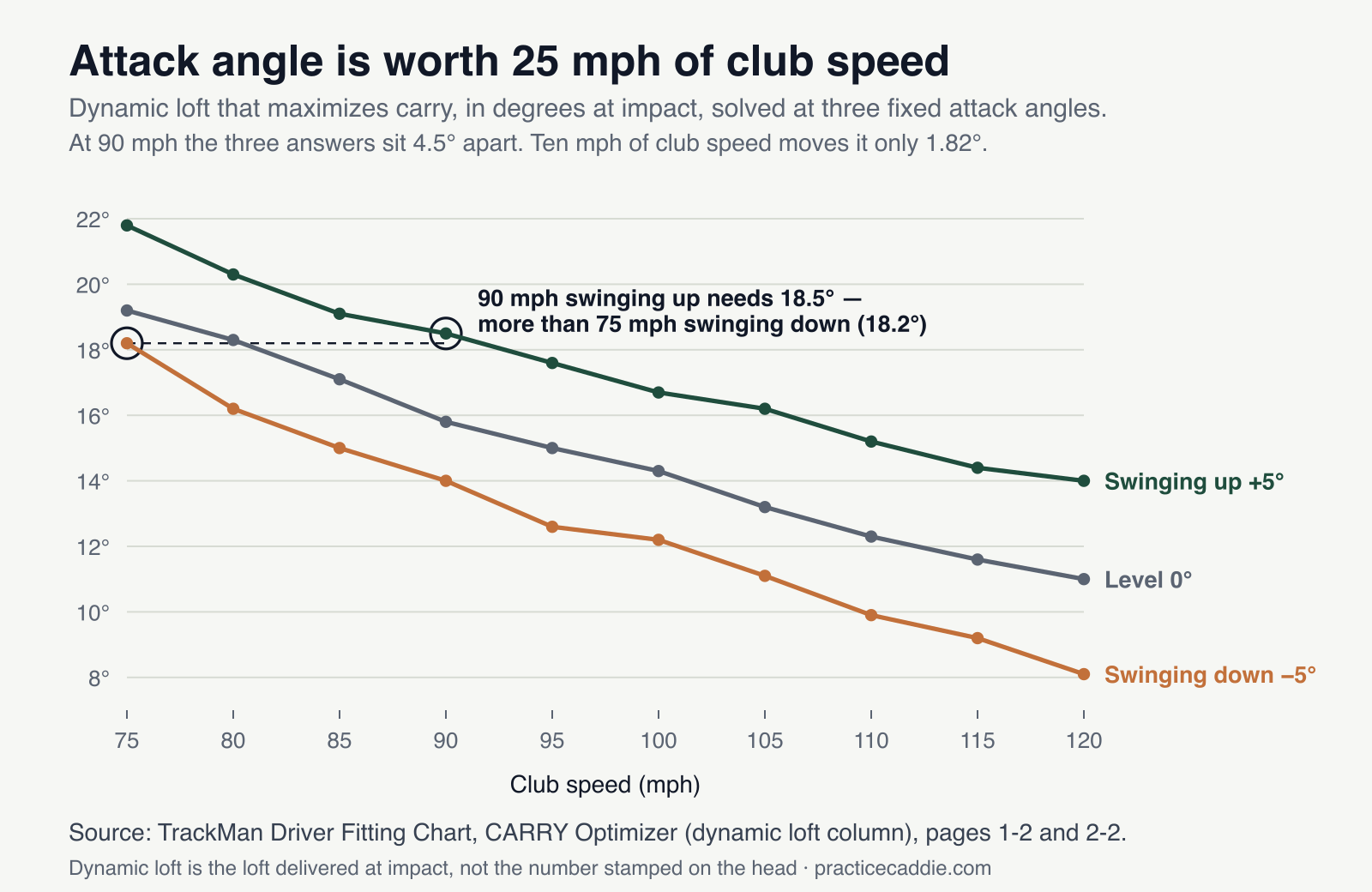
At 90 mph, the carry optimizer asks for 14.0° of dynamic loft from a golfer hitting 5 degrees down, 15.8° from a level striker, and 18.5° from one hitting 5 degrees up. That is a 4.5° spread at a single club speed.
Now run the same comparison across speed. Along the level-strike line, dynamic loft falls from 19.2° at 75 mph to 11.0° at 120 mph — 8.2 degrees across 45 mph of club speed, or about 1.8 degrees per 10 mph. Divide the attack-angle spread by that rate and the whole −5° to +5° range is worth roughly 25 mph of club speed.
So a 90 mph golfer hitting up needs more delivered loft (18.5°) than a 75 mph golfer hitting down (18.2°). Speed alone ranks those two golfers backwards.
The distance sitting in that column
The same three rows carry the cost. At 90 mph, TrackMan’s carry optimizer produces 191 yards of carry at −5°, 203 at 0°, and 214 at +5° — a 23-yard carry gap between the two extremes, with spin falling from 3,689 rpm to 2,633 rpm along the way. That works out to roughly 2.3 yards of carry per degree of attack angle at that speed.
No loft change buys 23 yards. Loft is how you fit the club to the strike you have; attack angle is the strike itself.
Almost every amateur hits down on the driver
Which column of the chart above you belong in comes down to one number, and TrackMan’s attack angle averages make the answer uncomfortable:
| Player group | Average driver attack angle |
|---|---|
| LPGA Tour | +2.8° |
| PGA Tour | −0.9° |
| Male scratch or better | −0.9° |
| Male 5-handicap | −1.1° |
| Male 10-handicap | −1.2° |
| Average male golfer (14.5) | −1.8° |
| Male bogey golfer | −2.1° |
| Female 15-handicap | −2.3° |
Every male bracket on that list is negative, the PGA Tour average included. The LPGA Tour is the one positive number in the set, which is a large part of why LPGA players carry the ball as far as they do on 96 mph of club speed.
For a chart-reading amateur that means one thing: assume you hit down until a launch monitor says otherwise, and read the left column. A golfer at 94 mph with a −1.8° attack angle sits between the “hits down” and “near level” columns, which is exactly why 10.5° and 12° both deserve a hit.
Why a downward strike needs more loft
The instinct with a downward strike is to reduce loft, because the miss looks like too much spin. That reads the mechanism backwards.
TrackMan defines spin loft as approximately the angle between dynamic loft and attack angle (TrackMan, “What is Spin Loft?”). Spin loft is the main driver of spin rate. So a golfer delivering 15° of dynamic loft with a −3° attack angle has 18° of spin loft, while the same 15° delivered with a +3° attack angle has 12°.
The downward striker is already carrying more spin loft at the same delivered loft. Taking loft off the head lowers launch and spin together, and the launch usually runs out first — which is how a golfer ends up with the worst combination available: a low, spinny drive that climbs, stalls, and lands short. TrackMan’s own worked driver example reads the same way: diagnosing a low launch and high spin, it lists a static loft set too low, vertical gear effect from contact low on the face, and a shaft delivering too little loft at impact as the three candidate causes (TrackMan Shot Optimizer).
The lofts tour players choose
Nine degrees is the most common driver loft among the top 100 PGA Tour players, at 37 percent, with 10.5° second at 15 percent and 8° at 9 percent (Golfing Focus, 2026 count).
The rows below that headline matter more than it does. Only 9 percent of the top 100 play an 8-degree head, while 15 percent play 10.5 degrees — more tour players carry a loft an amateur would recognize from a retail rack than carry the sub-9 head the myth describes.
Then there is the speed gap. The PGA Tour averages 115 mph; the average male amateur is at 94 mph. That is a 21 mph difference, and at the rate above, worth close to 4 degrees of dynamic loft on its own. Copying a tour loft is copying the answer to somebody else’s arithmetic.
The adjustable hosel moves face angle and spin too
Adjustable sleeves let you move loft roughly 1.5 to 2 degrees either way. What the marketing tends to leave out is what else moves with it.
TaylorMade publishes the full grid for its 4-degree loft sleeve in the M5 tuning guide:
| Sleeve setting | Loft change | Face angle | Spin change |
|---|---|---|---|
| Lower (max) | −2° | 4° open | −400 rpm |
| Lower | −1.5° | 3° open | −300 rpm |
| Stated loft | 0° | Square | ±0 rpm |
| Higher | +1.5° | 3° closed | +300 rpm |
| Higher (max) | +2° | 4° closed | +400 rpm |
Across the sleeve’s full travel that is 8 degrees of face angle and 800 rpm of spin, alongside the 4 degrees of loft. TaylorMade’s own guide states each click moves face angle by 1 to 2 degrees and lie by 0.5 to 0.75 degrees.
For a slicer, that coupling is a gift: adding loft closes the face at the same time. For a golfer who already draws the ball too much, adding loft to raise launch can hook it into trouble, and the fix is a different head rather than a different setting. Manufacturers differ here, so use the chart that shipped with your club rather than a generic one.
Does more loft fix a slice?
More loft reduces how far a slice curves, and changes nothing about why it curves.
The mechanism is spin axis. TrackMan defines spin axis as the tilt of the ball’s rotational axis as it leaves the face, and that tilt is what bends the flight. Raise backspin relative to the sideways spin component and the axis sits closer to level, so the same face-to-path error curves less ground. Lower the loft and spin loft falls, the axis tilts more easily, and the curve grows — which is why MyGolfSpy’s advice on cutting driver spin comes with a curvature warning attached (MyGolfSpy).
A slice with an open face and an out-to-in path is still a slice at 12 degrees. It is a shorter one. Pair the added loft with a heel-side weight setting or a draw-biased head, and work the path itself in practice — the protocol in How to Fix a Slice in Golf treats the cause rather than the radius.
Driver loft for slow swing speeds: 12 degrees and up
True Spec Golf’s preferred parameters, published via Golf.com, put the 72 to 83 mph bracket at a 14 to 19 degree launch with 2,600 to 2,900 rpm of spin (Golf.com). A 9 or 10.5 degree head, delivered by a golfer at that speed with a mildly negative attack angle, does not reach a 14 degree launch.
| True Spec bracket | Preferred launch | Preferred spin |
|---|---|---|
| Above 105 mph | 10–16° | 1,750–2,300 rpm |
| 97–104 mph | 12–16° | 2,000–2,500 rpm |
| 84–96 mph | 13–16° | 2,400–2,700 rpm |
| 72–83 mph | 14–19° | 2,600–2,900 rpm |
Two cautions come with this band. Spin below about 2,000 rpm is a liability rather than a prize when there is not enough ball speed to hold the ball up. And carry is the number to fit on, not total, since a slower player collects little rollout on anything softer than mid-summer fairways. Our senior golf swing tips cover the rest of the setup that comes with a slower speed.
Common driver loft myths
“Lower loft goes farther.” Lower loft goes farther only from a launch that was already too high. The optimizer’s target launch rises as speed falls, and most amateurs sit under it.
“Pros play low loft, so I should.” Tour players average 21 mph more club speed than the average male amateur and play individually measured heads. The starting range moves with speed, and theirs is not yours.
“A low-spin head fixes high spin.” Low launch paired with high spin usually points at a downward attack angle or contact low on the face. A low-spin head applied to that combination lowers launch further and leaves the cause running.
“The stamp is the spec.” Head lofts carry a manufacturing tolerance, and the sleeve setting, shaft, and your own delivery all move the number that reaches the ball. Two 10.5° heads from different brands need not be the same club.
“Loft is the fitting.” Shaft weight and profile, head center of gravity, face height, movable weights, lie, and ball model all move launch and spin. A large PING fitting sample reported an average gain of about 11 yards of total distance and 9.5 yards of carry over the golfer’s own gamer (MyGolfSpy) — a whole-fitting number, not a loft-only one.
Find your loft in one range session
No launch monitor required for the first pass.
- Measure your attack angle before you touch a loft chart. Tee a ball on level turf and place a second ball two clubhead-widths behind it on the ground. Swing at the teed ball. Clipping or thumping the trailing ball means you are descending; missing it cleanly means the low point is behind the ball and you are ascending. Most male amateurs come in negative, so assume a downward strike until a launch monitor tells you otherwise.
- Hit ten drives with your current head and count the low ones. Ignore the two best and the two worst. Watch the remaining six for peak height. Drives that climb, stall, and drop steeply carry too much spin. Drives that never get above the treeline and fall out of the air short are launching too low. Note which pattern dominates, since that is the direction your loft needs to move.
- Test one head two degrees apart and compare average carry. Borrow or demo a head 2 degrees higher if your drives run low, or 1.5 degrees lower if they balloon. Hit ten with each, alternating in blocks of five, and compare the average carry of the middle six rather than the single longest shot. Keep whichever wins the average, because dispersion and carry are what score, not one outlier.
Alternating in blocks matters. Hitting all ten of one head and then all ten of the other bakes fatigue and warm-up into the comparison, and the second head wins or loses for reasons that have nothing to do with loft.
Build the session that answers this
A loft test is worth running once and then leaving alone. The strike that decides which loft you need is worth working on every week. PracticeCaddie builds practice plans around the specific things your ball flight says are costing you — start with a free plan, free forever, no credit card. Pro adds AI-generated plans biased toward the leaks your assessment finds, with a 3-day free trial.
If you want the structure without the app first, the driving range practice plan lays out a session you can run tomorrow.
Related reading
- How to Grip a Golf Club — the pillar for this cluster; the hold that sets face angle, which no loft setting substitutes for.
- How to Hit a Driver — the setup that builds the positive attack angle this whole chart is indexed on.
- Launch Monitor Numbers Explained — spin loft, attack angle and smash factor decoded, so the fitting bay’s screen means something.
- Golf Loft and Lie Explained — what a single degree costs on the irons, and why the four-yards-per-degree rule fails.
- Golf Swing Speed Chart by Age and Handicap — where your speed falls before you bring it to a loft chart.
- Golf Shaft Flex Chart — the other spec a swing-speed chart claims to settle, and the 23 CPM spread that says it does not.
- How to Fix a Slice in Golf — the path and face work that added loft only masks.
- How to Increase Golf Swing Speed — for when the honest answer is more speed rather than a different head.
- Driving Range Practice Plan — the session structure to run a blind loft comparison inside.
Key takeaways
- Club speed sets the range; attack angle moves it. TrackMan’s carry optimizer asks for 14.0°, 15.8° and 18.5° of dynamic loft from the same 90 mph golfer at −5°, 0° and +5° attack angles.
- That 4.5° spread is worth about 25 mph of club speed, since speed itself moves the requirement only about 1.8 degrees per 10 mph along the level-strike line.
- A 90 mph golfer hitting up needs more delivered loft (18.5°) than a 75 mph golfer hitting down (18.2°). Speed alone ranks them backwards.
- Almost every amateur hits down on the driver. The average male golfer sits at −1.8° and the bogey golfer at −2.1°; the LPGA Tour’s +2.8° is the outlier in TrackMan’s table.
- A downward strike usually needs more loft. Spin loft is already high, and cutting head loft costs launch before it costs spin.
- The tour is less low-lofted than the myth says. Nine degrees leads the top 100 at 37 percent, 10.5 degrees takes 15 percent, and only 9 percent play an 8-degree head.
- The sleeve moves more than loft. TaylorMade’s own grid swings face angle 8 degrees and spin 800 rpm across the full range.
- Fit on measured launch and average carry, not the longest shot and not the number on the sole. A large PING sample gained about 11 yards of total distance from a full fitting.
Frequently asked questions
What loft driver should I use?
Start from your club speed, then adjust for how you strike it. Near the average male amateur speed of 94 mph, begin at 10.5 degrees and test 12 alongside it. Under 85 mph, start at 12 and test 14. Above 105 mph, 9 to 10.5 degrees is the sensible opening range. Then move up a head if your attack angle is negative and your launch comes in low, and down a head only if measured launch and spin are already high.
Does a higher loft driver go farther?
It does when your current launch is too low for your speed, which describes most amateurs. TrackMan’s carry optimizer asks for a 15.7 degree launch at 95 mph with an upward strike, and higher still at slower speeds. More loft loses distance only when launch and spin were already inside the optimal window, at which point the extra spin costs more than the extra height gains. The measured launch number decides it, not the stamp on the sole.
What is the difference between static loft and dynamic loft?
Static loft is the number stamped on the head, measured with the club soled. Dynamic loft is the loft actually presented at impact, measured relative to the horizon. TrackMan lists shaft lean, how the club is released, and where the ball meets the face as three things that move dynamic loft away from static loft. The optimizer prescribes dynamic loft, so no chart can convert it back into a head number for you.
What loft driver do most PGA Tour players use?
Nine degrees is the most common, at 37 percent of the top 100 in a 2026 count, with 10.5 degrees second at 15 percent and 8 degrees at 9 percent. More of that group plays 10.5 degrees than plays 8, so the sub-9 head most amateurs picture is the exception on tour rather than the norm. Tour players also average 115 mph of club speed, roughly 21 mph more than the average male amateur, so their choice is a poor template.
Should a slicer use more driver loft?
More loft usually reduces how far a slice curves, because higher backspin relative to the sideways spin component leaves the ball’s spin axis less tilted. It does not close an open face or straighten an out-to-in path, so the slice remains a slice with a smaller radius. Pairing added loft with a heel-side weight setting or a draw-biased head addresses face closure directly, which is the actual cause.
What driver loft is best for slow swing speeds?
Below 85 mph, 12 degrees is a genuine starting point rather than a marketing label, and 14 degrees deserves a test. True Spec Golf’s preferred window for 72 to 83 mph is a 14 to 19 degree launch with 2,600 to 2,900 rpm of spin, which a 9 or 10.5 degree head rarely produces at that speed. Carry is the only number that matters here, since slower players collect little rollout.
How much does an adjustable hosel change driver loft?
Around 1.5 to 2 degrees either way on most systems. TaylorMade’s own M5 tuning guide documents a 4 degree loft sleeve running from minus 2 to plus 2 degrees across 12 positions, and each click moves lie by 0.5 to 0.75 degrees and face angle by 1 to 2 degrees at the same time. Across the full range that is 8 degrees of face angle and roughly 800 rpm of spin, so the sleeve is never a loft-only control.