
How to Hit a Pitch Shot in Golf: Setup, Distance, and Technique
The pitch shot flies about as far as it rolls: golf's 30-to-80-yard scoring wedge. A backswing-length distance system, and the faults that wreck contact.

Quick answer
A pitch shot is golf’s 30-to-80-yard scoring wedge: it flies higher than a chip and carries about as far as it rolls. Set up with the ball just ahead of center, weight on the lead side, and hands even with the ball to keep the loft. Control distance with backswing length and a steady tempo, turn your chest through with quiet hands, and let the bounce brush the turf. Play it to carry trouble with green to stop on.
The short-game shot ladder (where the pitch fits)
Every greenside shot is a trade of carry for roll. The pitch sits in the middle: enough height to carry trouble and land soft, enough control to be repeatable. Read the ladder top to bottom and stop at the first row that fits your ball; the higher rows are lower-risk.
| Shot | Carry : roll (medium green) | Trajectory | Play it when |
|---|---|---|---|
| Putt (Texas wedge) | 0 : all | on the ground | a clean path on or just off the green |
| Bump and run | ~1 : 3–5 | low, runs out | clean lie, little to carry, green to roll across |
| Pitch | ~1 : 1 | medium-high, lands soft | must carry rough, a bunker, or an upslope with green to stop on |
| Flop | ~4 : 1 | high, stops fast | short-sided over trouble, ball sitting up |
Why the wedge zone is where amateurs quietly bleed strokes
The pitch matters because you hit it constantly. Dave Pelz’s research in his Short Game Bible has long put 60 to 65 percent of all golf shots inside 100 yards of the hole. Most of those are wedges and putts, and the wedge half is where the average golfer is far worse than they think.
The proximity data makes the gap concrete, and it shows how much the lie costs you. In Arccos’s analysis of the 50-yard wedge shot, tracked across real rounds, a 3-handicap playing from a fairway bunker and an 18-handicap playing from the fairway leave the ball almost identically close, 43.87 feet and 44.01 feet on average. A good player out of sand pitches it about as close as a high-handicapper off clean grass; the lie alone is worth a stack of handicap strokes. And both of them sit more than 26 feet behind the 17.65-foot average PGA Tour pros post from 50 to 75 yards, which is the distance almost no amateur ever closes.
The pitch still ranks behind the long game as a scoring lever. Mark Broadie’s strokes-gained research, the framework the PGA Tour now runs on, is blunt about priorities: approach play separates amateurs from scratch more than the short game does. As Golf Magazine’s profile of Broadie put it, “in a battle of importance, ball-striking reigns supreme.” The pitch earns practice for a different reason: it is high-frequency, cheap to improve, and most golfers waste easy up-and-downs by mishandling it.
How easy? Shot Scope’s benchmark data, compiled from hundreds of thousands of tracked rounds, shows scratch players get up and down 54 percent of the time from inside 50 yards with an 11-foot average leave, a 5-handicap 47 percent from 14 feet, and a 10-handicap 39 percent from 15 feet. Trim your average leave by a few feet from pitch range and the up-and-down rate climbs with it. That is the return the pitch pays.
What a pitch shot actually is
A pitch is the middle child of the short game. It carries higher and longer than a chip or bump and run, and it lands softer and shorter than a flop. On a medium-speed green, a stock pitch sits near a 1-to-1 carry-to-roll ratio: it flies most of the way, lands on the green, and releases a little toward the hole.
The distance band runs from about 30 to 80 yards, too long for a putting-style chip and too short for a full wedge swing. That partial-swing zone is exactly what makes it hard. A pitch falls between your two most-grooved motions, so it needs its own calibration: a scaled-down, repeatable version of the full swing, and dialing that in is the whole skill.
Green firmness bends the ratio more than your technique does. The same well-struck pitch releases far more onto a firm, fast green than onto a soft, receptive one, which is why the shot rewards picking a landing spot for the conditions instead of chasing one flight everywhere. Land it, then read the release like a putt.
The setup: preserve the loft, favor the lead side
Most of a good pitch is built at address. The setup for a pitch differs from a chip in one key way: it preserves the club’s built-in loft. A chip or bump and run leans the shaft hard forward and delofts the face for a low runner; a pitch keeps the handle roughly even with the ball so the wedge can launch the ball high and soft. Five fundamentals close most of the predictable error.
| Fundamental | What good looks like | What most amateurs do | First fix |
|---|---|---|---|
| Stance | Narrow, feet inside shoulder width | Full-shot stance width | Bring the feet closer together |
| Ball position | Just ahead of center | Way back (chip) or way forward (flop) | Play it a ball or two ahead of the low point |
| Weight | A little more than half on the lead side | Hanging back to “help” the ball up | Set the weight slightly forward and keep it there |
| Hands / shaft | Even with or barely ahead of the ball, loft preserved | Shoved forward, delofting the club | Let the handle sit even with the ball |
| Grip / length | Choke down an inch or two | Full grip, full length | Grip down to the bottom third of the grip |
The weight distribution is the subtle one. Hanging back to scoop the ball into the air is the instinct that produces most fat and thin pitches, because it moves the swing’s low point behind the ball. Setting a little more than half your weight on the lead side and keeping it there puts the low point at or just past the ball, which is where clean contact lives. James Sieckmann, the short-game coach to dozens of tour pros, anchors this on the chest: set your sternum slightly ahead of the ball, because the sternum marks the bottom of the arc, and let the loft of the club do the lifting while the hands stay quiet.
The stroke: body pivot, soft wrists, accelerate
A pitch is a small version of your full swing. The engine is the rotation of your chest, back and through, with the arms and club swinging in front of you. The difference from a chip is the wrists: on a pitch you let them hinge softly and naturally in the backswing, which adds the height and the speed the shot needs. That hinge comes on its own from a relaxed grip and a fuller swing.
Sieckmann’s core teaching in Your Short Game Solution is that the finesse wedge motion is repeatable precisely because the body runs it and the hands stay quiet. When the hands take over, the face angle and low point change shot to shot, and distance control disappears. When the chest turns through and the hands ride along, the same swing produces the same strike, which is the entire point of a scoring shot.
Accelerate through the ball. Deceleration, born from a fear of hitting the shot too far, is the single most common pitch fault and the cause of most fat and thin strikes. Keep your weight forward, keep your chest turning toward the target, and let the clubhead keep moving past the ball into a balanced finish.
Distance control: let the backswing length do the work
Here is the mechanic that separates good wedge players from bad ones: they control distance with the length of the backswing and keep their effort steady. Swinging harder or softer from one fixed backswing wrecks tempo and contact. Making the same calm, accelerating swing to different lengths keeps the strike identical and changes only the carry.
Dave Pelz’s Short Game Bible formalized this into the clock system: three repeatable backswing lengths, pictured as the lead arm swinging to roughly the 7:30, 9:00, and 10:30 positions of a clock face, each paired with a steady tempo. Three lengths across three or four wedges give you nine to twelve known, repeatable carry distances. That is why tour players talk in yardages instead of feel, and why they carry a wedge chart in their heads.
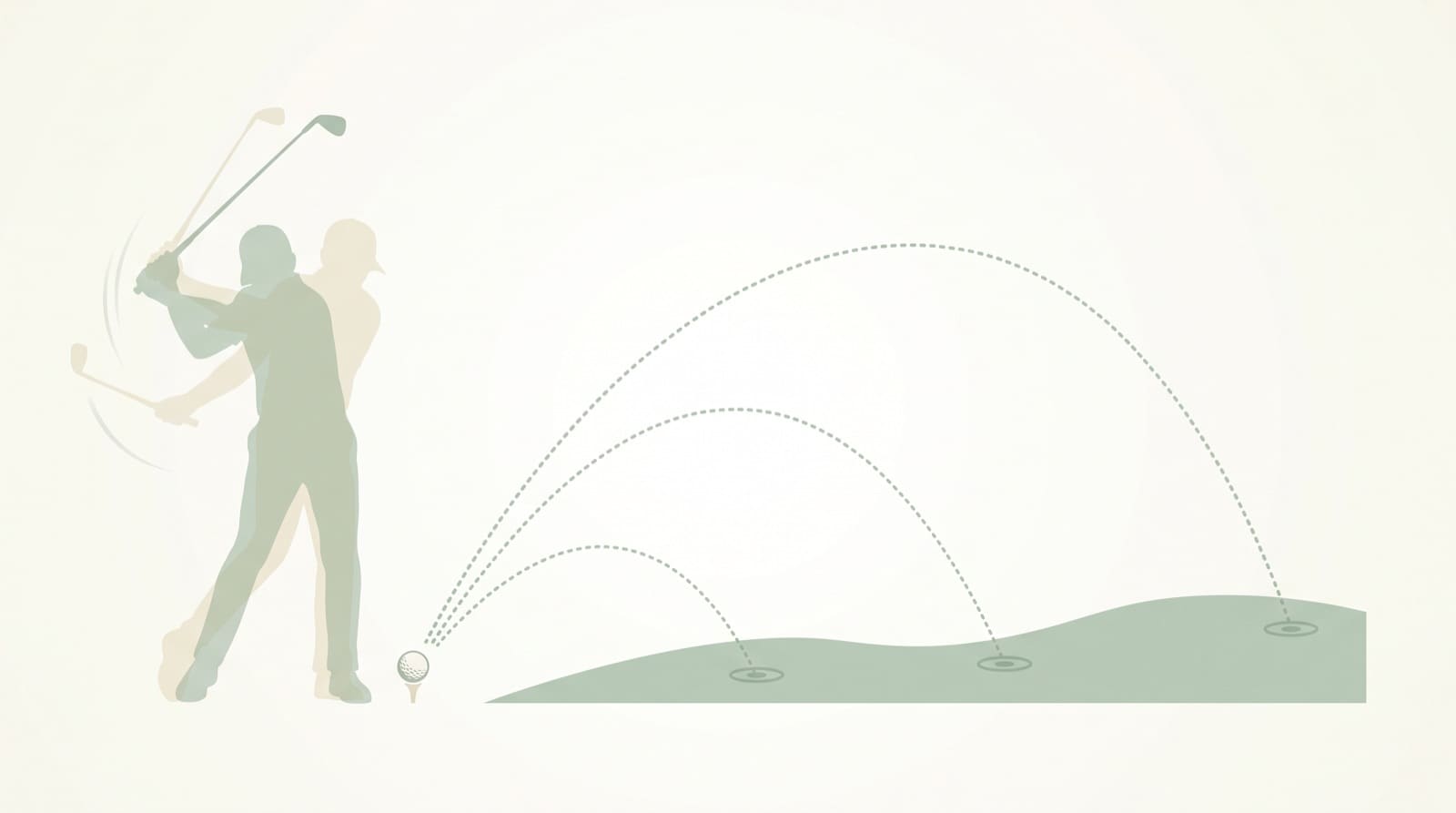
The catch is that the exact carry numbers are personal. Pelz’s own research is clear that arm length, flexibility, and swing plane make everyone’s clock positions carry different distances, so a generic yardage chart will lie to you. The fix is to build your own. Here is the calibration protocol:
- Pick one wedge and one backswing length (start with the 9:00 length, the middle one).
- Hit five to eight pitches with that length, same steady tempo every time, to an open target with a launch monitor, a range with yardage markers, or a marked landing area.
- Record the average carry, ignoring your best and worst.
- Repeat for 7:30 and 10:30, then repeat all three with each wedge.
- Write the grid down and carry it. Re-test every 6 to 8 weeks, because the numbers drift as your swing changes.
That grid, three lengths by three or four wedges, is the difference between guessing and knowing. On the course you read the yardage, match it to the nearest known number, and make the length you have rehearsed. PracticeCaddie’s plan builder can hold that matrix for you and schedule the re-tests, so the calibration becomes a maintained tool instead of a one-time range session you forget by the weekend.
Wedge and bounce selection
The club you pick sets the trajectory and the release, and the bounce decides how forgiving the strike is. A lower-lofted pitching or gap wedge flies lower and runs out more; a sand or lob wedge flies higher and checks faster. For a stock pitch off a fairway lie, a sand or gap wedge is the reliable default because it flies high enough to land soft without demanding the precision of a lob wedge.
Bounce is the more misunderstood spec. Titleist’s Vokey guide defines bounce as the angle between the leading edge and the sole that keeps the club from digging, and it gives the working ranges: low bounce is 4 to 6 degrees, mid bounce is 7 to 10 degrees, and high bounce is more than 10 degrees. Low-bounce wedges suit firm, tight turf and shallow swings but tend to dig for steeper players; high-bounce wedges glide through soft turf and fluffy lies and resist digging. Bob Vokey’s own summary of the shot is the one to remember: “bounce is your friend.” A mid-bounce wedge handles most conditions; match toward low bounce on hardpan and high bounce out of soft grass.
When to play a pitch
The pitch is the right call when a lower shot cannot carry the trouble and a higher shot is more risk than you need. The around-the-green order of preference is putt when you can, bump and run when you cannot putt, pitch when you must carry something with green to stop on, and flop only when you are truly short-sided. The pitch is the workhorse in the middle of that ladder, and it covers the most situations of any of the four.
Three conditions point to the pitch specifically:
- You must carry rough, a bunker, or an upslope, and there is green between the hazard and the pin to land on and stop.
- The lie is decent but not tight enough to trust a low runner cleanly through it.
- The flag sits more than a few paces onto the green, so a bump and run would need more roll than the surface reliably gives.
Walk down to a lower shot when the lie is clean and there is green to roll across, because a bump and run relies less on a perfect strike. Walk up to a flop only when you are short-sided over trouble with a ball sitting up and no green to work with. The honest read of the data is that most amateurs reach for a wedge and a full-ish swing when a simpler running shot was sitting right there. Treat the pitch as one tool on the ladder, played when the situation calls for it.
Common mistakes
- Scooping to lift the ball. Trying to help the ball into the air hangs your weight back, moves the low point behind the ball, and produces the fat-or-thin miss. Trust the loft and turn through with your weight forward.
- Decelerating into the ball. Slowing down out of fear of going long is the leading cause of chunks and skulls. Commit to a landing spot and accelerate with even tempo.
- Controlling distance with effort. Swinging harder or softer from one fixed backswing destroys tempo and contact. Change the length of the swing and hold your effort steady.
- Delofting the club like a chip. Shoving the hands hard forward turns your high, soft pitch into a low runner. Keep the handle roughly even with the ball so the loft survives to impact.
- Aiming at the flag instead of a landing spot. The release is part of the shot, so a vague target gives vague distance. Pick a specific spot to land the ball and read the roll from there.
- Ignoring the lie and green firmness. The same swing behaves differently from rough versus fairway and onto firm versus soft greens. Read the conditions before you pick the shot.
How to practice it
Two short sessions beat one long one, and a numeric target beats a vague one. Build the shot on a good lie, calibrate your carries, then add the variability the course throws at you. Log a number every rep, the way the chipping drills in the drill catalog are scored.
- Landing-spot ladder. Drop a towel or hoop as a landing zone and hit ten pitches trying to land the ball on the zone instead of at the hole. Score a point per landing-zone hit; target 6 of 10, then move the zone and repeat. This trains the land-it-there habit that distance control is built on.
- Clock calibration. Run the distance-matrix protocol above: five to eight pitches at each of three backswing lengths with each wedge, recording the average carry. The measurable outcome is a written grid of known yardages, re-tested every 6 to 8 weeks.
- Low-point control. Draw a line across the turf (or lay a tee) and set the ball just ahead of it. Hit ten pitches trying to brush the ground on the target side of the line every time. Target 8 of 10 clean, target-side strikes; a divot behind the line is the fat-shot pattern showing up.
- Random distance and lie. Once the first three feel reliable, change the yardage and the lie every rep, no two the same in a row. Performance dips at first, which is the contextual-interference effect doing its job: variable practice feels worse and transfers to the course far better than grooving one shot.
The progression from grooving one length on a good lie to randomizing distance and lie is the same block-to-random pattern that underlies all structured short-game practice. PracticeCaddie’s plan builder bakes that sequence in: it rotates distance, lie, and target across a session, sets a numeric success criterion per drill, holds your calibrated wedge matrix, and tracks your up-and-down rate across rounds so you can see whether the pitch is actually saving strokes.
Key takeaways
- The pitch is golf’s 30-to-80-yard scoring wedge. It flies higher than a chip and carries about as far as it rolls, sitting between the bump and run and the flop on the short-game ladder.
- You hit it constantly, and you are probably worse at it than you think. Pelz’s Short Game Bible research puts 60 to 65 percent of shots inside 100 yards, and from 50 yards a 3-handicap out of a fairway bunker (43.87 ft) and an 18-handicap from the fairway (44.01 ft) finish almost identically far from the hole, both more than 26 feet behind the tour’s 17.65 ft from 50 to 75 yards (Arccos).
- A frequent, cheap leak. Approach play separates players more than the short game does, per Broadie (Golf Magazine); the pitch earns practice because you hit it constantly and it improves quickly.
- Set up to preserve loft. Ball just ahead of center, a little more than half your weight on the lead side, hands even with the ball, choked down. This is the opposite of the delofted bump-and-run setup.
- Turn through with quiet hands. Power the shot with a chest pivot and a soft, natural wrist hinge that keeps the hands out of a scooping flip, and accelerate through the ball.
- Control distance with backswing length and a steady tempo. Build a personal wedge matrix of three lengths by three or four wedges (Pelz clock system) and re-test it every 6 to 8 weeks.
- Match bounce to the turf. Low bounce (4–6°) on firm lies, mid (7–10°) for most conditions, high (10°+) from soft grass, per Vokey.
- Land it on a spot and read the release. Commit to a landing spot, then read the roll from there like a putt.
Frequently asked questions
What is a pitch shot in golf?
A pitch shot is a lofted short-game shot of roughly 30 to 80 yards that flies higher than a chip and carries about as far as it rolls. You play it with a wedge, a fuller arm swing, and a soft wrist hinge, landing the ball on the green so it stops softly and releases only a little. It sits between the low, running bump and run and the high, stopping flop on golf’s short-game spectrum, and it is the go-to shot when you must carry rough or a bunker with green to work with.
How do you hit a pitch shot?
Set up with a narrow stance, the ball just ahead of center, a little more than half your weight on the lead side, and your hands even with or slightly ahead of the ball to keep the club’s loft. Grip down for control. Control distance with the length of your backswing while your effort stays steady, and turn your chest through the shot with quiet hands. Accelerate so the bounce of the wedge brushes the turf just under the ball, and finish facing the target. Commit to a landing spot and let the ball release from there.
What is the difference between a pitch and a chip?
A chip is a low, short shot that spends little time in the air and rolls most of the way, played mostly off the lead arm and shoulders with the ball back and the hands forward. A pitch flies higher and carries most of its distance, using a longer, wristier swing and a squarer, more upright club so the ball lands softly. Rule of thumb: chip when you are near the green with room to roll, and pitch when you must carry rough, a bunker, or an upslope and still stop the ball on the green.
How do you control distance on a pitch shot?
Change the length of your backswing while keeping your tempo and effort steady. Dave Pelz’s clock system in the Short Game Bible sets three repeatable backswing lengths, roughly the 7:30, 9:00, and 10:30 positions of a clock face, and pairs each with a steady, unhurried tempo. Hit each length with each wedge, measure the carry, and you build a personal distance matrix of known yardages. On the course you then match a known length to the number instead of guessing at feel, which is why tour players carry a wedge chart rather than one hit-it-soft setting.
What wedge should I use for a pitch shot?
Any wedge from your pitching wedge to your sand wedge works; the club sets the trajectory and the roll. A lower-lofted pitching or gap wedge flies lower and releases more, while a sand or lob wedge flies higher and stops faster. Match bounce to the turf: per Titleist’s Vokey guide, low bounce is 4 to 6 degrees and suits firm, tight lies, mid bounce is 7 to 10 degrees for most conditions, and high bounce over 10 degrees resists digging in soft turf and fluffy lies. On a normal fairway lie, a mid-bounce sand or gap wedge is the reliable default.
Why do I keep chunking or thinning my pitch shots?
Fat and thin pitches are the same fault, a low point in the wrong place, showing up two ways. If the club bottoms out behind the ball you hit it fat; sense that coming and pull up to avoid it, and the leading edge catches the ball’s middle and thins it across the green. Both usually trace to weight hanging back, a scooping flip of the hands, or deceleration. The fix is to set your weight a touch forward, keep your chest turning through, and accelerate so the bounce brushes the turf just past the ball rather than digging behind it.
How far should a pitch shot carry versus roll?
A stock pitch on a medium-speed green carries roughly as far as it rolls, close to a 1-to-1 ratio, landing soft and releasing a little toward the hole. Into a soft or uphill green it carries more and rolls less; onto a firm or downhill green it releases more, so you land it shorter. Green firmness changes the roll more than technique does, so pick your landing spot for the conditions rather than trying to reproduce one flight everywhere. Read the release from the landing spot the way you would read a putt.
Related reading
- How to Hit a Bump and Run in Golf — the pitch’s lower-lofted neighbor; the ground-game shot for when you have green to roll across.
- How to Hit a Flop Shot in Golf — the pitch’s higher-lofted, higher-variance neighbor; the open-face shot for when you are short-sided.
- How to Hit a Bunker Shot in Golf — the same slide-the-bounce, accelerate-through technique applied from sand.
- 10 Golf Chipping Drills Tour Coaches Actually Use — the short-game partner post; the chip is the low, running cousin of the pitch.
- 10 Golf Putting Drills That Move Strokes-Gained-Putting — most up-and-downs finish with the putt, so pace and green-reading complete the job the pitch starts.
- 8 Lag Putting Drills That Cut Three-Putts — distance control on a longer roll, the same land-it-and-read-the-release skill the pitch demands.
- Block vs Random Practice in Golf — the motor-learning research behind the block-to-random practice progression above.
- Strokes Gained Explained for Amateurs — where the wedge zone actually ranks among your scoring leaks, and where to spend the practice it saves.
- 10 Golf Practice Drills Tour Coaches Actually Use — the parent drill catalog; the landing-spot and random-distance drills here follow its four-property frame.
- How to Grip a Golf Club — the cornerstone the whole short game is built on; a calm, neutral grip keeps the wedge face stable through a pitch.
- Chipping drills to lower your scores — the companion guide with proximity and up-and-down scoring criteria.
- Putting drills that build pace control — the roll-out half of every greenside save, drilled directly.