
What Is a Shotgun Start in Golf? The Rule, the Field Math, and Hole 14
144 players finish in about five hours on a shotgun start against ten and a half on tee times, and the saving is the field's, not yours. The Rule and the math.

Quick answer
A shotgun start sends the whole field off at one signal from holes spread around the course, each wrapping around until it has played 18. It is a starting arrangement, not a scoring format — Rule 5.3a/2 lets the Committee assign each group its own hole. The saving is the field’s: 144 players finish in about five hours instead of ten and a half. Your own round still takes four and a half to five hours.
The three ways a field gets sent out
| Starting method | How groups go off | Field it suits | What it costs |
|---|---|---|---|
| Conventional tee times | Successively from the 1st, sometimes the 1st and 10th, at fixed intervals | Daily play, small fields, club championships | The last group finishes hours after the first |
| Full shotgun | All 18 holes occupied, one signal | 72 to 144 players who need a common finish | Exclusive use of the course, and it is full from minute one |
| Modified or partial shotgun | Simultaneous, but only part of the course occupied | Fields too small to close all 18 holes | Local policy, not a standardised term — ask what the course means by it |
What the Rules actually say, how the field math works, and what changes when the sheet hands you the 14th tee, in that order.
What a shotgun start is under the Rules of Golf
The Rules of Golf define a round as “18 or fewer holes played in the order set by the Committee” (Rule 5.1). That phrasing does the work. The order is the Committee’s to set, which is why a group can legally open on the 7th tee and close on the 6th green.
The explicit permission sits in a clarification. Clarification 5.3a/2, defining “starting point,” says the starting point is the teeing area of the hole where the player will start as set by the Committee, and then names the case directly: “In a ‘shotgun start’, the Committee may assign each group a different hole to start on.”
The R&A’s Pace of Play Manual gives the operational definition at section 2.2d — groups starting simultaneously from multiple tees, which gets more players around in a shorter period “simply because more of the holes are utilised from the start rather than needing to be filled from the 1st tee.” It also names the real reason clubs book them: the concern in club and corporate events is often the desire to have everyone finishing by a specific time for a prize giving, rather than pace itself.
So the scoring format is a separate decision. A shotgun can carry individual stroke play, Stableford, four-ball or a scramble. The horn says when; the terms of the competition say what.
Why it is called a shotgun start
The December 2004 issue of Golf Digest reported that in May 1956, Jim Russell, head professional at Walla Walla Country Club in Walla Walla, Washington, fired an actual shotgun to sound the start of play for groups scattered around his course. That account is the commonly credited origin, and it is retrospective — no contemporaneous 1956 club record or newspaper report is in general circulation, so “widely credited” is the honest phrasing rather than “invented.”
The etymology is the signal, not the scatter. A shotgun blast carries across a property in a way a voice does not. Today that job goes to an air horn, a siren, a PA system or a synchronised clock time.
Tour golf uses the format two ways. On the established tours it is a weather measure: the European Tour ran an 08:00 shotgun for the third round of the 2015 Portugal Masters and again for the final round, and its own report noted this was “just the second time in European Tour history after the final round of the Czech Open in 1994.”
LIV Golf is the exception that made the format routine. Its published league format states that “the action begins with a shotgun start — meaning there will be 18 groups of players spread around the course at each hole, all teeing off at the same time,” across a 72-hole event with no cut. The same page puts the league at 57 players in 13 teams, so its 18 groups fit the 18 holes without doubling any of them — the condition the charity fields below almost never meet.
How groups get assigned to holes, and how many players fit
The clean case is 18 foursomes on 18 holes: 72 players, one group per hole, everybody starts on their own tee. Above 72, selected holes take a second group, written on the sheet as 1A and 1B, 5A and 5B. The A group plays first and the B group follows once A is safely out of range, which means “simultaneous” is exact across holes and approximate within a doubled one.
| Field size | Groups | Loading | Notes |
|---|---|---|---|
| Under 72 | Up to 18 groups | Modified or partial shotgun | Some courses load backward from 18 so the 1st tee reopens behind the outing |
| 72 | 18 foursomes | One group per hole | The clean case — no queue at the horn |
| 73 to 144 | 19 to 36 groups | A/B on selected holes | Fill every hole with an A group first, then add B groups |
| Above 144 | 37+ groups | Past the ceiling of a single wave | Morning and afternoon double shotgun, two courses, or tee times |
Where the B groups go has a measurable cost. A 2016 time study by Tiger and Ellerbrook modelled tee-box occupancy across observed groups and found that a par 3 adds 17.7 seconds to the time a group spends on the tee, on top of every other factor, because club selection takes longer when the green is the target. A par 3 also holds the following group until the green clears. Stacking a B group onto a short hole therefore creates a queue at the horn, which is why the operational advice is to double the par 5s first, the par 4s next, and the par 3s only when nothing else is left.
How long a shotgun start takes compared with tee times
The arithmetic that justifies a shotgun runs off two published inputs, so it can be checked rather than taken on trust.
The first input is round length. The USGA hosts a GPS study by Lucius Riccio’s Three/45 Golf Association covering 40,460 rounds at 175 US courses, which found a mean 18-hole pace of 4 hours 17 minutes — 4:02 in the morning, 4:21 in the afternoon, with 36.5% of rounds over 4:30 and 10.4% over five hours (study PDF). The second is starting interval: the R&A recommends at least 10 minutes for three-balls and says 11 or even 12 minutes should be considered for four-balls.
Put them together. A field of G foursomes sent from one tee at 11-minute intervals has its last group starting (G − 1) × 11 minutes after the first, and that group still needs 4:17 to play.
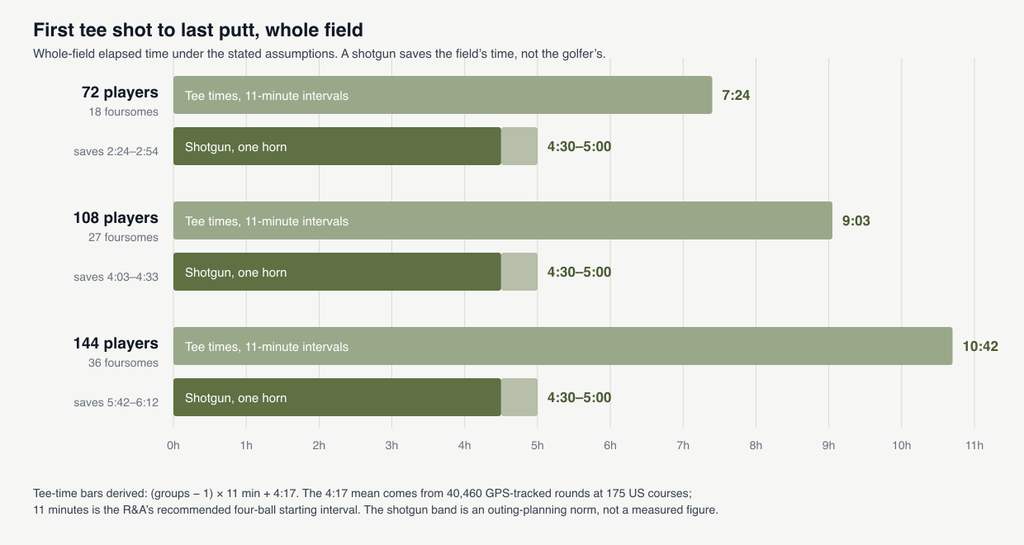
| Field | Groups | Tee times, first shot to last putt | Shotgun, same window | Saved |
|---|---|---|---|---|
| 72 players | 18 foursomes | 7:24 | 4:30–5:00 | 2:24–2:54 |
| 108 players | 27 foursomes | 9:03 | 4:30–5:00 | 4:03–4:33 |
| 144 players | 36 foursomes | 10:42 | 4:30–5:00 | 5:42–6:12 |
The tee-time column is pure arithmetic from the two cited figures. The shotgun column is an outing-planning band rather than a measured average, because no study located here isolates shotgun rounds from conventional ones — treat 4:30 as a disciplined single-loaded field and 5:00 as a heavily double-loaded one.
The saving belongs to the event. A 144-player field on tee times would keep somebody on the property for nearly eleven hours; a shotgun collapses that to roughly one round. Note what the two columns assume: the tee-time side uses the measured 4:17 mean, the shotgun side an outing band that starts at 4:30. A shotgun does not shorten your round, and a course full from minute one may add a few minutes to it. Every minute saved is saved at field level.
Does a shotgun start make your round faster?
No. It shortens the event and leaves your round roughly where it was. A shotgun puts the course at full occupancy from minute one: a 72-player tee-time field reaches that density gradually over about three hours, while a shotgun field is there before anyone has hit a shot. The two are not the same problem, and the R&A is specific about which one costs time — it calls overcrowding, meaning groups loaded too closely together, the most common cause of unnecessarily long rounds and waiting, and notes that loading groups too closely makes other pace measures futile. A single-loaded shotgun occupies every hole without overcrowding any of them. A heavily doubled one does both.
The Three/45 simulations found the same thing from the other direction: the slow group sets the pace, and variation between holes and between groups compounds rather than cancelling. On tee times, one slow group delays everyone behind it. On a shotgun, one slow group on a doubled hole delays its B group immediately, and the ripple has nowhere to dissipate because there is no empty stretch of course ahead.
Group size is the other lever, and it is the one with a published number attached. The Tiger and Ellerbrook coefficients put each additional player at 19.4 seconds per green and 27.5 seconds per tee box — about 14 minutes across 18 holes, and that figure counts only green and tee-box activity, so the true cost is higher. The R&A states the same thing without the coefficients: four players each playing their own ball are more likely to take longer than two or three, and restricting group size is a simple method of reducing the time it takes to play. A fivesome squeezed in to fit one more entrant costs the whole field more than the entry fee is worth.
The 18 first tees problem
The failure mode that goes unbudgeted falls straight out of the same study.
Tiger and Ellerbrook found that a golfer hitting another ball from the tee box — a mulligan or a re-hit — adds 58.1 seconds to that tee, and that 67% of the observed re-hits happened on the first hole. That concentration makes sense: the first swing of the day is the one people want back.
On tee times, a 36-group field spreads its opening holes across 385 minutes, so those re-hits arrive one at a time and the course absorbs them. A shotgun starts 18 groups on the horn and the 18 B groups follow within minutes of their A group clearing. The hole that attracts two-thirds of the re-hits is therefore being played on all 18 holes inside the same quarter of an hour, while the course is at its most congested.
The compound number matters before you sell mulligans as a fundraiser. A fivesome taking one re-hit on its opening tee occupies that teeing ground roughly 86 seconds longer than a foursome that plays one ball each — 27.5 seconds for the extra player plus 58.1 for the re-hit. Multiply by a field where mulligans were a $10 add-on and the reason the 4th green backed up at 8:20 stops being a mystery.
Two practical conclusions follow. Cap mulligans and say where they may be used. And if the event sells them, price the pace in: a disciplined field belongs at the 4:30 end of that planning band, and a mulligan-heavy one belongs at 5:00 or past it. Pace of play is set by field size and readiness far more than by the format on the sheet.
Shotgun vs modified shotgun vs double shotgun
Five terms get used loosely, and the differences are operational rather than defined in the Rules.
| Term | What it means | When a course picks it |
|---|---|---|
| Full shotgun | All 18 holes occupied, one signal, one wave | 72 to 144 players who need a common finish for a meal or prize giving |
| A/B or double-loaded shotgun | Two groups on selected holes, A first and B behind | 73 to 144 players in a single wave |
| Modified or partial shotgun | Simultaneous start on only part of the course | A field too small to justify closing all 18 holes |
| Double shotgun | Two separate full waves the same day, usually morning and afternoon | Fields too large for one wave, up to roughly 288 starts |
| Two-tee start | Groups go off successively from the 1st and 10th | Ordinary busy days, not outings — it is a tee-time variant |
The R&A treats the two-tee start and the shotgun as siblings: both create a morning wave and an afternoon wave, and in both cases the afternoon wave gets a fresh start that does not inherit the morning’s accumulated delay. A two-tee start still sends groups out successively, so it is a tee-time arrangement with two queues rather than a shotgun.
Starting on hole 14: what actually changes for you
Nothing about the strokes changes. Five things about the round do.
| What changes | Why it matters |
|---|---|
| Your opening hole may be a low stroke index | The R&A recommends allocating each nine’s lowest stroke index within its middle triad, so holes 4 to 6 and 13 to 15 are where stroke index 1 and 2 usually land |
| Your closing hole is not the 18th | The 13th is where the event ends for you, so a late lead has to survive a hole you would normally play with five to go |
| There is no easing-in stretch | On a normal round holes 1 and 2 let you find a rhythm. Here your opener is whatever the sheet says |
| Warm-up ends at the cart call, not the horn | Events commonly stage 15 to 20 minutes out, far holes first. Treat the cart call as the deadline |
| The card fills out of sequence | Your first score goes in the box marked 14. Every subsequent box is offset from the order you played |
The opening-hole point has a published basis. Appendix E of the Rules of Handicapping recommends splitting the 18 holes into six triads and applying each nine’s lowest stroke index — 1 or 2 — inside its middle triad, while spreading the allocations evenly so strokes get used before a match is decided. Holes 4 to 6 and 13 to 15 are therefore where stroke index 1 and 2 usually land. That is an allocation convention rather than a ranking of raw difficulty, but it is the number your net score runs off, and a shotgun can hand you one of those holes cold.
The warm-up point is the one that costs strokes. A shotgun start does not give you more time to prepare; it inserts travel time between the range and your first swing. If your cart is called at 7:40 for an 8:00 horn and your hole is the 14th, you may have fifteen minutes of sitting between your last range ball and the tee shot that opens your round. A proper warm-up routine has to survive that gap, which a first-tee start rarely imposes, and the pre-shot routine is what carries you across it.
On the card, write each score in the box for its real hole number rather than the next empty box. A card that cannot be matched to the right holes is a scoring problem for the Committee, and if the round is postable it is a handicap problem for you. Keeping score properly matters more when the sequence is scrambled.
Does a shotgun round count for your handicap?
The starting arrangement is a non-issue. Clarification 2.1/1 of the Rules of Handicapping is explicit: “provided the player has not been disqualified, a score is acceptable for handicap purposes even if the holes in a round have not been played in the order set by the Committee” (USGA Rule 2.1). It even names starting at an alternative hole for pace as an example.
The format is where scores get lost. The authorized formats table lists individual stroke play, Stableford, Par/Bogey, Maximum Score, four-ball stroke play, individual match play and four-ball match play. Scramble appears nowhere in it. So the classic charity shotgun scramble produces no postable score for anyone in the field — the 25/20/15/10 percentages the USGA publishes for scrambles are competition handicap allowances, not permission to post a team result. Best ball vs scramble has the full split, and Golf Handicap Explained covers the Course Handicap conversion those allowances apply to.
Two other requirements still bite. An 18-hole score needs at least 10 holes played, and the Committee should say up front who is posting scores and whether they carry the competition designation. Ask at registration rather than at the bar.
Why charity events run on shotguns
Because the money is made in the room after the round, and a shotgun is the starting method that gets the whole field into it at once. Roughly four out of five US golf facilities host at least one charitable event, and the game raised close to $4.6 billion for charity in a single year, over 90% of it through local events at ordinary courses (National Golf Foundation). The GCSAA summarises the same industry data as 15,945 facilities, 141,000 events and 25.6 million course participants.
Those figures cover all golf-related charitable activity rather than the shotgun subset, and no governing body publishes a percentage of events that use the format — treat the connection as directional. The meal, the auction, the sponsor presentation and the raffle are where a charity event’s revenue is made, and a tee-time field of 144 trickles into that room over six hours while a shotgun gets the whole field there inside the same short window.
Common shotgun mistakes
- Treating the horn as your deadline. The cart call is. On a big property you may need twenty minutes to reach your hole, and the far holes are dispatched first.
- Doubling the par 3s. They add 17.7 seconds per group on the tee before anything else, and hold the following group until the green clears. Load par 5s first.
- Selling unlimited mulligans. A re-hit costs 58.1 seconds on the tee box, and two-thirds of them land on the opening hole — which, in a shotgun, is every hole at once.
- Assuming a shotgun is faster for you. It compresses the field and puts the course at full occupancy immediately. Overcrowding, which the R&A names as the most common cause of unnecessary waiting, is what a heavily doubled field adds on top.
- Writing scores in the next empty box. Your opening score belongs under the hole number you played, or the card cannot be reconciled.
- Expecting a scramble score to post. Scramble is absent from the authorized-format table. The shotgun is fine; the format is what blocks it.
- Running a fivesome to fit one more entrant. Roughly 14 minutes across 18 holes on green and tee-box time alone, paid by everybody behind them.
Next step
A shotgun gives you no gentle opening hole and no second tee shot to settle into. Your first swing of the day happens on a hole you would normally reach thirteen holes warm, and a swing that needs a few holes to arrive does not get them.
Build a free practice plan around the shot you dread hitting cold. PracticeCaddie’s free-forever plan needs no credit card; AI-generated plans biased to your assessment leaks are a Pro feature with a 3-day free trial, and pricing has the rest. The driving range practice plan guide is the place to start if you want structure before the next outing.
Related reading
- Strokes Gained Explained for Amateurs — the framework for finding the leak a team format and a friendly scorecard covered up.
- Golf Scramble Rules and Strategy — the format most shotguns carry, with the 25/20/15/10 team allowance and the five procedures your sheet has to define.
- Best Ball vs Scramble — what separates the two team formats, and why only one of them produces a postable score.
- Golf Etiquette and Pace of Play — why The R&A ranks overcrowding above player behaviour, and the five-second audit that converts readiness into 26 minutes a round.
- Golf Handicap Explained — the USGA math behind the Index, and what your scoring spread says about where to practise.
- How to Keep Score in Golf — what goes in each box and the stroke-index arithmetic behind a net score, which is harder to hold in your head when the holes arrive out of order.
- Golf Warm-Up Routine — what to hit before a cold opening tee shot, and how long the effect lasts.
- Stableford Scoring Explained — a scoring method a shotgun can carry that also posts for handicap, unlike a scramble.
Key takeaways
- A shotgun start is a starting arrangement, not a scoring format. Clarification 5.3a/2 lets the Committee assign each group a different starting hole; the terms of the competition decide what is being scored.
- 72 players fills 18 holes one group per hole; 144 fills them two deep. 144 is the arithmetic ceiling of one wave rather than a Rules limit, and plenty of courses stop at 128 because their par 3s or cart paths will not take a second group.
- The saving is the event’s, not yours. A 144-player field takes 10:42 on 11-minute tee intervals against roughly 5:00 on a shotgun. A shotgun does not shorten the round you personally play.
- 4:17 is the measured mean across 40,460 GPS-tracked rounds at 175 US courses, with 36.5% over 4:30 and 10.4% over five hours.
- A shotgun fills the course from minute one. The R&A names overcrowding — groups loaded too closely — as the most common cause of unnecessary waiting, and a heavily doubled shotgun is one way to create it. Doubling the par 3s is the specific mistake.
- Mulligans concentrate. A tee re-hit costs 58.1 seconds and 67% of them happen on the opening hole — and a shotgun makes every hole an opening hole simultaneously.
- Each extra player in a group costs about 14 minutes over 18 holes on green and tee-box time alone, so a fivesome rarely pays for the delay it adds.
- Starting on the 14th does not affect your handicap posting. Playing a scramble does, because scramble is absent from the authorized-format table.
- Your warm-up ends at the cart call, not at the horn, and your opening hole is one you would normally reach well into the round.
Frequently asked questions
What is a shotgun start in golf?
A shotgun start is a way of beginning a tournament in which the whole field tees off at one signal from holes spread around the course. One group starts on the 1st, another on the 2nd, and so on; in fields above 72 players two groups share a hole and the second follows once the first is clear. Each group then plays forward and wraps around until it has completed 18 holes. It describes the starting arrangement rather than the scoring format, so a shotgun can run alongside stroke play, Stableford, four-ball or a scramble.
Why is it called a shotgun start?
The name is literal. The December 2004 issue of Golf Digest reported that in May 1956 Jim Russell, head professional at Walla Walla Country Club in Washington, fired a shotgun to signal the start of play to groups spread around the course. That is the commonly credited origin rather than a documented invention, since the account is retrospective. Modern events use a horn, a siren, a PA system or a synchronised clock time instead.
How many players can play in a shotgun start?
On 18 holes with one foursome per hole the field is 72 players. Adding a second group to each hole, shown on the sheet as 1A and 1B, takes one wave to 144. That ceiling is arithmetic rather than a Rules limit, and many courses cap lower at 128 or so because double-loading short holes creates an immediate queue. Beyond 144 the usual answers are a morning and an afternoon wave, a second course, or conventional tee times.
Does a shotgun start make the round faster?
It shortens the event, not your round. The whole field finishes within roughly the slowest group’s round instead of trailing the last tee time by hours, so a 144-player event that would run 10 hours 42 minutes on 11-minute tee intervals finishes in about five. Your own round is not shortened, and a double-loaded shotgun can lengthen it slightly, because it adds the overcrowding the R&A names as the most common cause of unnecessary waiting.
What hole do you finish on in a shotgun start?
The hole immediately before the one you started on. A group starting on the 14th plays 14, 15, 16, 17, 18, then 1 through 13, and finishes on the 13th green. That matters for two practical reasons: the hole you have mentally filed as a closing hole is now your opener, and the hole you think of as a mid-round breather is where the event ends for you. Check the pairing sheet for any crossover routing the Committee has published.
Does a shotgun start round count for handicap?
Starting somewhere other than the 1st tee does not affect it. Clarification 2.1/1 of the Rules of Handicapping states that a score stays acceptable even when the holes were not played in the order set by the Committee. What decides acceptability is the format: individual stroke play, Stableford, Par/Bogey, Maximum Score and four-ball appear in the authorized-format table, and scramble does not. So the shotgun is fine and the charity scramble played under it is still unpostable.
What is a modified shotgun start?
A modified or partial shotgun starts every group at once but occupies only part of the course, which suits a field too small to justify closing all 18 holes. Some facilities load backward from the 18th so the 1st tee reopens to regular play once the outing has passed through. A double shotgun is a different thing: two full waves on the same day, usually one in the morning and one in the afternoon, which can take a single course to roughly 288 starts.