
Four-Ball vs Foursomes: Two Balls or One, and What the Difference Costs
Four-ball plays two balls and counts the better one. Foursomes plays one, alternating. That second ball models at 7.5 strokes for a pair of 10 handicaps.
Quick answer
Four-ball is two partners each playing their own ball, with the lower score counting — Rule 23. Foursomes is two partners sharing one ball and alternating strokes — Rule 22. Every other difference follows from that one. Four-ball scored 5.31 strokes lower than foursomes at the 2023 Zurich Classic, and the handicap allowances are unrelated: 85% each in four-ball stroke play against 50% of the side’s combined figure in foursomes.
The two formats side by side
| Four-Ball (Rule 23) | Foursomes (Rule 22) | |
|---|---|---|
| Balls in play per side | Two, one each | One, shared |
| Side’s hole score | The lower of the two completed scores | The strokes made at the shared ball, plus penalties |
| Order of play within the side | Either partner, in whatever order the side prefers (Rule 23.6) | Strict alternation, every stroke (Rule 22.3) |
| Tee shots | Both partners tee off on every hole | One partner on all odd holes, the other on all even (Rule 22.3) |
| Can a partner pick up? | Yes — Rule 23.2a says the other partner need not hole out | No second ball exists to pick up |
| Stroke-play allowance | 85% of each player’s own Course Handicap | 50% of the side’s combined Course Handicaps |
| Match-play allowance | 90% of the difference from the lowest player | 50% of the difference between the two sides’ combined totals |
| American name | Better ball, best ball | Alternate shot |
| Ryder Cup sessions | Two, four matches each | Two, four matches each |
Both formats are fully specified by the Rules, which is the practical reason they run cleanly at every level from a club match to the Ryder Cup. Compare that to a scramble, where the Rules only permit a Committee to run one and leave the placement and putting procedures for the event to publish itself.
What Rule 23 and Rule 22 actually say
Rule 23.1 defines four-ball as two partners competing as a side, “with each player playing his or her own ball,” and the side’s score for a hole is the lower of the two. Rule 22.1 defines foursomes as two partners competing as a side “by playing one ball in alternating order on each hole.”
Everything golfers argue about on the first tee falls out of that. A four-ball side gets order-of-play freedom under Rule 23.6, because two balls are lying in two places and the side may play whichever it likes first. A foursomes side gets none, because there is one ball and the Rules fix whose turn it is. A four-ball partner may pick up under Rule 23.2a once their score can no longer help; a foursomes side has nothing to pick up.
The Rules treat a foursomes side the way they treat an individual player. Under Rule 22.2, either partner may mark, lift, drop, replace or place for the side regardless of whose turn is next, and a breach by either partner or either caddie applies to the side. Both formats cap the side at 14 clubs total if the partners share, under Rules 23.7 and 22.5 respectively.
The foursomes alternation rules people get wrong
Three details in Rule 22.3 account for most foursomes rulings.
The odd/even tee assignment is fixed for the round. One partner plays first from the teeing area on all odd-numbered holes and the other on all even-numbered holes. The assignment does not rotate, and it does not depend on who holed the ball on the previous hole.
A penalty stroke never changes the order. Rule 22.3 states that penalty strokes for the side do not affect the partners’ alternating order of play. A penalty stroke is added to the score but is not a stroke made at the ball. If A hits into a penalty area and the side takes relief, B still plays the next stroke.
A cancelled stroke goes back to the same partner. Where a Rule cancels a stroke and requires a replay, the partner who made it plays again. A provisional ball works the opposite way: it is played by whichever partner is next in the alternating order.
Playing out of order carries the general penalty. In stroke play the correct partner must replay from where the wrong-order stroke was made, that stroke and any that followed with the ball do not count, and failing to correct before teeing off at the next hole means disqualification. The rest of the ordinary rulings that show up in any format are covered in golf rules for beginners.
What the second ball is worth: the format gap modelled
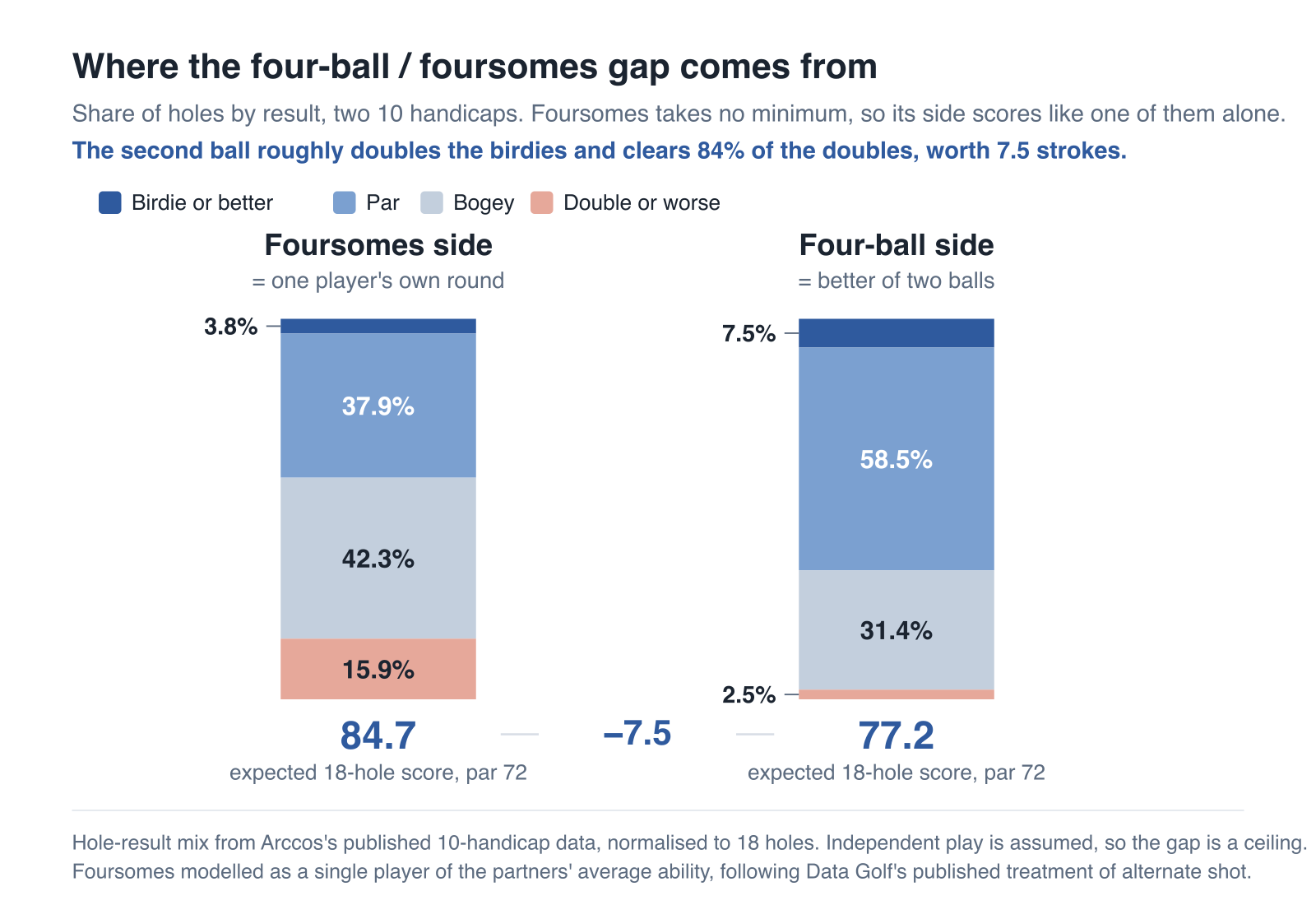
The scoring gap between the formats is the value of the second ball, because that is the only structural difference. Four-ball takes the minimum of two hole scores. Foursomes takes no minimum at all — Data Golf models an alternate-shot side as a singles-style scoring distribution based on the average ability of the two players, which for two equal partners is one of their own rounds.
Running that through Arccos’s published hole-result mix for its 10-handicap users gives a number you can hold onto.
| Pair of equal partners | Foursomes side | Four-ball side | Format gap |
|---|---|---|---|
| Two 5 handicaps | 80.4 | 73.3 | 7.0 |
| Two 10 handicaps | 84.7 | 77.2 | 7.5 |
The work happens at the bottom of the chart. Birdies barely move the total, because a 10 handicap makes so few of them that even doubling the rate from 3.8% to 7.5% of holes returns 0.67 strokes across 18. Doubles fall from 15.9% of holes to 2.5%, an 84% cut, because the side records a double only when both partners make one — and that single row is worth 4.8 of the 7.5 strokes. For a pair of 5 handicaps the double rate falls by 91%.
Two caveats keep this honest. The model assumes the partners play independently, and real partners share weather, pin positions and hole difficulty, so their bad holes correlate and the true four-ball gain is smaller than 7.5. Pulling the other way, foursomes in practice plays harder than the neutral average-ability baseline: Golf Digest’s analysis of Ryder Cup scoring since 2012 found foursomes sides averaged 1.2 under par at the point matches ended against 2.7 under for the same players in singles, making alternate shot about 1.5 strokes harder than playing your own ball.
The Zurich Classic is the cleanest professional read
The PGA Tour runs both formats at the same event in the same week, which is as close to a controlled comparison as golf offers.
| 2023 Zurich Classic, par 72 | First round in that format | Second round | Mean | To par |
|---|---|---|---|---|
| Four-ball | Thursday, 65.563 | Saturday, 64.971 | 65.267 | −6.73 |
| Foursomes | Friday, 70.188 | Sunday, 70.971 | 70.580 | −1.42 |
That is a 5.31-stroke gap for one extra ball among the best players alive. The comparison is imperfect — the weekend field is post-cut, and setup and conditions move between days — but it points the same way as the model and lands below it, which is what you would expect from players whose bad holes are rare enough that a second ball has less to discard.
The direction of that difference is the useful part for an amateur event. The worse your field, the more the format choice moves the scoreboard. A four-ball card from two 20 handicaps will look far more respectable than the same pair’s foursomes card, and neither number tells you much about either player. That is the case for keeping your own Strokes Gained picture separate from your team results.
Handicap allowances for four-ball and foursomes
This is where club events go wrong most often, because the two formats compute handicaps in structurally different ways rather than at different percentages of the same thing.
| Format | Allowance | How it is applied |
|---|---|---|
| Four-ball stroke play | 85% | Each player takes 85% of their own unrounded Course Handicap |
| Four-ball match play | 90% | Lowest player set to scratch; each other player takes 90% of their difference from it |
| Foursomes stroke play | 50% | The side takes 50% of the sum of both partners’ unrounded Course Handicaps |
| Foursomes match play | 50% | The two sides’ combined totals are subtracted; the higher side takes 50% of the difference |
Appendix C of the Rules of Handicapping describes all four as recommendations that a Committee may vary in the terms of the competition. Apply the percentage to unrounded Course Handicaps and round once, at the end.
The USGA’s own foursomes match-play example is worth copying onto your event sheet: combined totals of 25.688 and 32.378 give a difference of 6.690, half of which is 3.345, rounding to 3 strokes for the higher side. Note that four-ball hands strokes to individual players while foursomes hands them to a side, which is why you cannot convert one allowance into the other. If any of that arithmetic is unfamiliar, golf handicap explained walks through the Course Handicap conversion every one of these percentages is applied to.
How captains pair for each format
The formats reward opposite player profiles, and the reasoning is the same distribution argument the chart above makes.
Foursomes wants two reliable players. There is no second ball, so a wild drive becomes your partner’s problem rather than a discarded score. Joseph LaMagna’s captain’s guide at Fried Egg Golf argues for complementary full-swing skills — an elite driver with an elite iron player — and against anyone whose misses are severe.
Four-ball wants at least one birdie maker. A volatile player’s bogey often costs nothing because the partner made par, while their birdie wins the hole outright. Geoff and Graham Pollard’s Four Ball Best Ball 1 in the Journal of Sports Science & Medicine shows two pairs of equal golfers can differ in four-ball strength: in their Example 2 all four players have the same expected score on every hole, and the more variable pair still wins an 18-hole match with playoff 64.17% of the time. The official Ryder Cup preview of the 2025 Friday four-ball described Ben Griffin as the steady hand for Bryson DeChambeau’s aggression, which is the standard construction.
The golf ball is a foursomes problem only. Ryder Cup conditions have permitted a side to change ball model between holes since 2006. Golf Digest found that only 15 of 48 potential winning pairings across three Ryder Cups used the same model, and those pairings went 6–9, so ball matching is a consideration rather than a requirement.
Where the terminology goes wrong
A foursome is not Foursomes. The 1899 Rules of Golf put both halves in writing: Rule 1 says that “if two play against two, it is called ‘a foursome,’” and Rule 5 says the partners “shall strike off alternately from the teeing-grounds, and shall strike alternately during the play of the hole.” The word later picked up a looser meaning of any group of four golfers, and both meanings sit in the dictionary today. A Saturday group of four playing their own balls is a foursome; they are not playing Foursomes.
Four-ball is not the Rules’ Best-Ball. The USGA calls Four-Ball “commonly referred to as better ball,” so club usage is fine. The Rules also define a capitalised Best-Ball, in which one individual plays against a side of two or three partners each playing their own ball. Best ball vs scramble covers where the recreational versions of those formats land.
Alternate shot is the American name for foursomes. Rule 22’s own heading now carries both: “Foursomes (Also Known as Alternate Shot).”
Practise for the format you are about to play
Both formats punish something different, so the range session before an event should look different too. A foursomes match rewards keeping the ball in play, because your partner has to hit the next shot from wherever you left it — that is a session of full swings with a scoring club and a hard fairway target, not a driver bucket. A four-ball match rewards making birdies, so it earns time on approach wedges and putts inside 12 feet.
PracticeCaddie builds that session from the leaks in your own scoring rather than the team’s card, on a free forever plan with no credit card. AI-generated plans that bias toward a specific event are a Pro feature with a 3-day free trial; pricing has the details. The golf practice plan guide covers the structure if you would rather build it yourself.
Related reading
- Best Ball vs Scramble — the other pair of team formats, the selection-count argument behind the scoring gap, and the modelled ladder showing what the third and fourth balls add.
- Golf Scramble Rules and Strategy — the procedures a scramble sheet has to define itself, because the Rules do not define them for you.
- Match Play vs Stroke Play — the per-hole refund that decides how the Ryder Cup’s 28 matches are won, and the penalty and allowance splits between the two forms.
- Golf Handicap Explained — the Course Handicap conversion that every allowance in this post is applied to.
- Strokes Gained Explained for Amateurs — the framework for finding the leak a partner covered up.
- How to Keep Score in Golf — what goes in each box, and where the Arccos hole-result mix behind this post’s model comes from.
- Golf Skins Game Rules — the betting-format cousin, where a carryover changes what a hole is worth rather than who plays the ball.
- Stableford Scoring Explained — the other scoring method a Committee can run, and the strategy edge its zero-point floor creates.
Key takeaways
- The formats differ by one thing: how many balls. Four-ball is Rule 23 and plays two, counting the lower score. Foursomes is Rule 22 and plays one, alternating strokes.
- The second ball is worth 7.5 strokes to a pair of 10 handicaps and 7.0 to a pair of 5s, modelled on Arccos hole-result data. The gap grows with handicap because there is more bad golf to discard.
- Doubles do the work, not birdies. A 10-handicap pair’s double-bogey rate falls from 15.9% of holes to 2.5% in four-ball, an 84% cut, while the birdie rate only moves from 3.8% to 7.5%.
- The 2023 Zurich Classic field averaged 65.267 in four-ball and 70.580 in foursomes, a 5.31-stroke gap on the same par 72 in the same week.
- Alternate shot is harder than playing your own ball. Ryder Cup foursomes sides since 2012 averaged 1.2 under par against 2.7 under for the same players in singles.
- Penalty strokes never change the alternating order in foursomes, per Rule 22.3. A cancelled stroke is the exception, and goes back to the same partner.
- The allowances are structurally different. Four-ball gives each player 85% of their own Course Handicap in stroke play and 90% in match play; foursomes gives the side 50% of a combined figure.
- Pair for the format. Foursomes wants two players who keep the ball in play and agree on a golf ball; four-ball wants a birdie maker released by a steady partner.
Frequently asked questions
What is the difference between four-ball and foursomes?
Four-ball is two partners each playing their own ball, with the lower of the two scores counting as the side’s score for the hole. Foursomes is two partners sharing one ball and alternating strokes, so the side plays a single score. Four-ball is Rule 23 and foursomes is Rule 22 in the Rules of Golf. The whole difference is how many balls are in play, and everything else follows from that.
Is four-ball the same as best ball?
In ordinary American usage, yes. The USGA itself notes that Four-Ball is commonly referred to as better ball, and almost every club event using the phrase best ball is describing Rule 23. The Rules do define a separate capitalised Best-Ball, in which one individual plays against a side of two or three partners each playing their own ball. That formal version is rare, so read the mechanics on the event sheet rather than the name.
Why is it called foursomes when only two players are on a team?
The name counts the players in the contest, not the players on a side. The 1899 Rules of Golf put it directly: if two play against two, it is called a foursome, with partners striking alternately. The word later picked up a second, looser meaning of any group of four golfers, which is why a casual group can be a foursome without playing Foursomes. Americans mostly sidestep the collision by saying alternate shot.
In foursomes, does a penalty stroke change whose turn it is?
No. Rule 22.3 states that penalty strokes for the side do not affect the partners’ alternating order of play. A penalty stroke is added to the score but is not a stroke made at the ball, so whoever was next to play is still next. The exception runs the other way: when a Rule cancels a stroke and requires a replay, the same partner who made the cancelled stroke plays again.
What handicap allowance is used for foursomes?
Appendix C of the Rules of Handicapping recommends 50 percent for foursomes, and it is applied to the side’s combined Course Handicaps rather than to each player separately. In stroke play the side’s Playing Handicap is half of its combined total. In match play the two sides’ combined totals are subtracted and the higher-handicapped side gets 50 percent of the difference. Four-ball is structurally different at 85 percent in stroke play and 90 percent in match play.
Which format scores lower, four-ball or foursomes?
Four-ball, by a wide margin. At the 2023 Zurich Classic the field averaged 65.267 across the two four-ball rounds and 70.580 across the two foursomes rounds on the same par 72, a gap of 5.31 strokes. Modelling two 10 handicaps from Arccos hole-result data puts the amateur gap at 7.5 strokes, wider because amateurs have more bad holes for a second ball to discard.
How do you decide who tees off on the odd holes in foursomes?
Read the scorecard rather than flipping a coin. The odd and even assignment fixes who hits every par-3 tee shot, which driving holes each player faces, and roughly which approach yardages the other partner inherits, and it holds for the whole round under Rule 22.3. Data Golf’s Bethpage Black work found the odd-hole player faced driver on every par 4 and par 5 while the even-hole player’s approaches clustered at 150 to 210 yards.