
How to Hit a Flop Shot in Golf: Setup, Technique, and When to Risk It
The flop is golf's highest-variance greenside shot. Open the face, use the bounce, accelerate, and save it for when you're short-sided over trouble.

Quick answer
A flop shot is the highest, softest shot around the green, and the highest-variance one: maximum height, minimum roll. Open your lob wedge wide so the bounce slides under the ball, set up open with the ball forward, and make a long, accelerating swing that holds the face open. Save it for when you are short-sided over a bunker or hazard with little green to work with. The rest of the time, a lower, simpler shot scores better.
The around-the-green shot ladder
Read it top to bottom and stop at the first row that fits your ball. The higher rows are lower-risk, so the flop sits at the bottom as the shot of last resort.
| Situation around the green | Highest-percentage shot | Why it wins |
|---|---|---|
| On the green, or a clean fringe with a smooth path to roll over | Putt (Texas wedge) | No air time, lowest variance |
| Just off the green, clean lie, green to work with | Bump and run | Ball on the ground fast; slope and pace do the work |
| Must carry rough, a bunker, or an upslope, with green to stop on | Pitch | Carries the trouble, still lands with margin |
| Short-sided over a hazard, tight pin, little green, ball sitting up | Flop | The only shot that stops fast enough; accept the risk |
Why the flop is the highest-variance shot in golf
The flop trades control for height. A long, fast swing with a wide-open face and a sliding strike can finish a foot from a pin that no other shot could reach, and the same swing mishit a fraction early or late skulls the ball over the green or leaves it short in the same spot. That payoff curve, big upside and brutal downside, is what makes it high-variance, and the data says even the best players miss greenside up-and-downs far more often than amateurs expect.
PGA Tour pros get up and down roughly 60% of the time after missing a green, across all lies, according to Mark Broadie’s analysis of ShotLink data that built the modern strokes-gained framework. The leaders in the Tour’s scrambling stats push toward 67%. Those are the best short-game players alive, and they still fail to save par four times out of ten from around the green.
Amateurs sit well below that, and the gap is the whole argument for restraint. Shot Scope’s benchmark data, compiled from hundreds of thousands of tracked rounds, shows up-and-down rates and leave distances that fall off quickly as handicap rises.
| Player | Up-and-down inside 50 yards | Average leave distance |
|---|---|---|
| Scratch | 54% | 11 feet |
| 5-handicap | 47% | 14 feet |
| 10-handicap | 39% | 15 feet |
Those numbers cover every greenside shot a player hits, including the easy ones. The success rate on a specifically hard shot like a flop is lower still. A 10-handicap who saves par 39% of the time with all their normal chips and pitches has no statistical reason to expect a difficult high lob to beat that baseline, except in the rare spot where nothing simpler can reach the green.
The penalty for the bad miss is the part golfers underrate. Arccos data on greenside play shows that a “savvy” 10-handicap finishes inside 10 feet 42% of the time from 15 yards of rough but only 28% from a greenside bunker at the same distance, and that a 15-yard bunker shot averages about 0.66 strokes worse than simply facing a 45-foot putt on the green. A flop that comes up short and trickles back into the bunker, or flies long into trouble, hands you exactly that penalty. The shot is most tempting in the situations where its misses cost the most.
What a flop shot actually is
A flop is a chip or pitch pushed to its highest, softest extreme. Phil Mickelson, in his Callaway flop-shot lesson, describes the result as a “soft little lob” that flies steeply, lands close to the hole, and barely releases. The ball spends most of its trip in the air and almost none of it rolling, which is the opposite trade from the bump and run, the ground-game shot that keeps the ball low and lets it roll the majority of the way.
Think of greenside shots as a spectrum of carry-to-roll ratios. A bump and run might be 1 part carry to 4 or 5 parts roll. A standard pitch sits near 1 to 1.
A flop flips it the other way, often 4 or 5 parts carry to barely any roll at all. The further you push toward the carry-heavy end, the more the outcome depends on a precise strike and the less margin a small error leaves you.
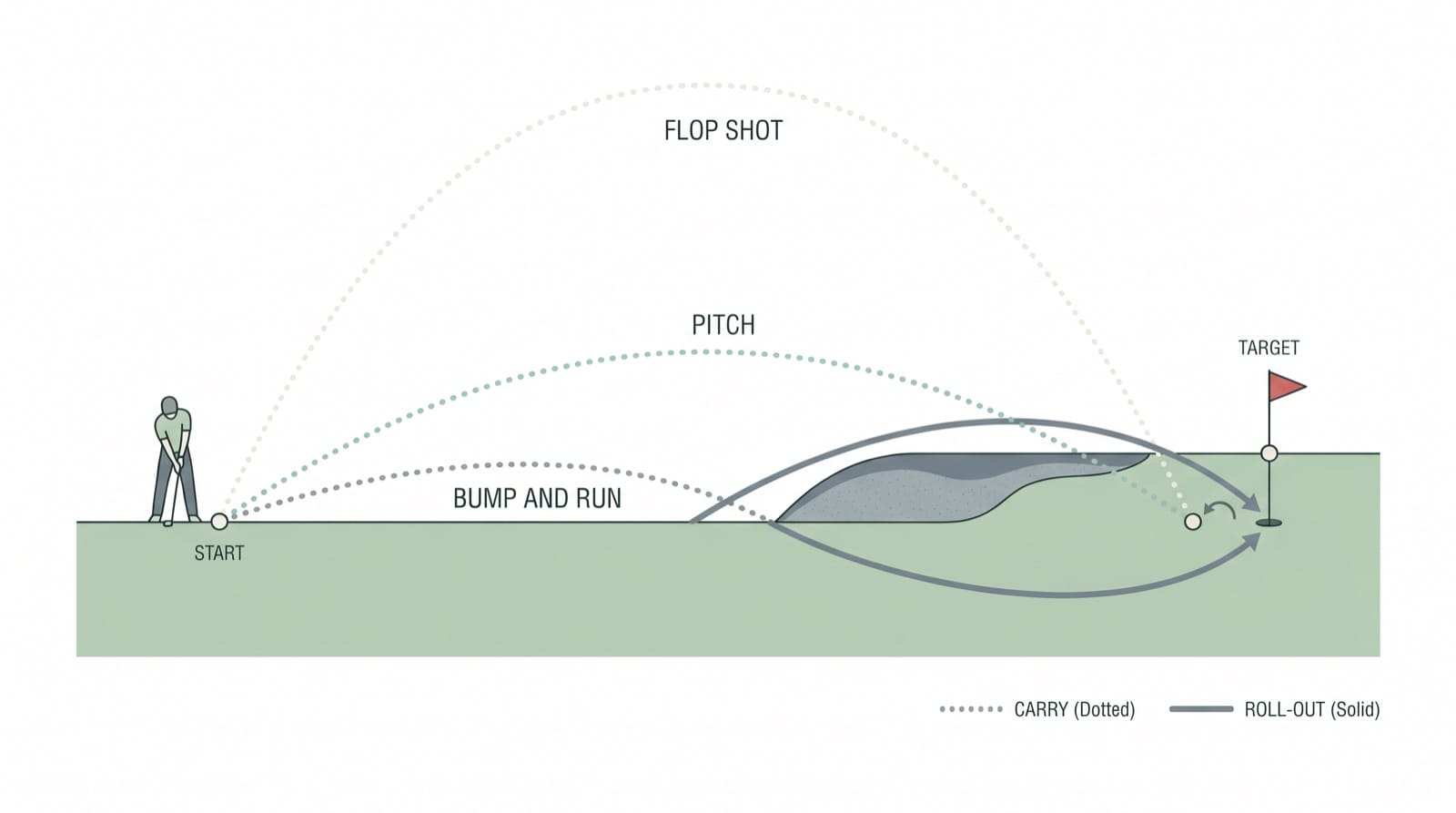
The shot is a product of modern equipment. Dave Pelz, demonstrating the basic lob, points out that sand wedges once topped out near 55 degrees of loft, which limited how high and soft a player could go. Lob wedges at 58 to 60 degrees, and specialty wedges up to 64, made the true flop accessible. Mickelson notes he uses a 60 degree wedge for the shot and reaches for a 64 only in extreme spots, and that the 60 is “just as effective” with the right technique.
The setup: open the face first, then build around it
Most of a good flop is built before the club moves, and the first move is the one most amateurs skip. Open the clubface to the sky before you take your grip, then set your hands on the club. Grip first and open second and the face squares itself back up the moment you start down. Five setup pieces close most of the predictable error.
| Fundamental | What good looks like | What most amateurs do | First fix |
|---|---|---|---|
| Clubface | Wide open, pointing well right of target, sole flat on ground | Square, or opened after gripping | Open the face fully, then take your grip |
| Stance / aim | Wider than a chip; feet and shoulders aimed left of target | Narrow and square | Widen the base, aim the body left to offset the face |
| Ball position | Forward of center | Centered or back | Move the ball up toward the lead foot |
| Shaft lean | Close to vertical, handle even with or behind the ball | Leaning hard toward the target | Stand the shaft up so the loft stays on the club |
| Weight | Balanced to slightly forward, level base | Hanging back to “help” the ball up | Keep weight centered and let the loft do the lifting |
The open face plus the leftward body aim is what makes the shot work. Laying the face open adds loft and points it right of the target, so you aim your stance and swing line left to compensate. The club then slides across the ball slightly, sending it high and straight at the flag. The single most common setup fault is leaning the shaft toward the target the way you would on a full wedge, which delofts the club and turns a flop back into a low runner.
James Sieckmann, in his wedge attack-angle lesson, teaches a “wide lean” base for high, soft shots: widen the stance, choke down, and set up to create a steep enough angle of attack that the club can pop the ball up cleanly. The width buys stability for a long swing, and the steep arc lets the bounce work under the ball.
The stroke: long, accelerating, and held open
The flop is a long swing at a short shot. The length is not optional. It buys the height and the soft landing, and it is the antidote to the deceleration that produces most bad flops. A short backswing forces you to either lunge at the ball or quit on it, and both miss.
Set the wrists early to steepen the arc, then swing down and let the bounce, the rounded back edge of the sole, brush the turf just under the ball. The leading edge never digs in. Titleist’s Vokey guide defines bounce as the angle between the leading edge and the sole that keeps the club from digging, and Bob Vokey’s summary is blunt: “bounce is your friend.” Opening the face exposes more of that sole to the ground, which is exactly what you want sliding under a flop.
Keep accelerating through impact and hold the face open into a full finish. Mickelson’s warning is the key feel: if you “let the club pass,” meaning the clubhead races ahead of the hands and the wrists flip, “the leading edge starts coming up off the ground” and you blade it. His hinge-and-hold method keeps the hands leading and the face stable so the loft stays put through the strike. From thick rough the acceleration matters even more, because tentative speed lets the grass grab the hosel and stop the club short.
The equipment: loft, bounce, and why the lie decides everything
A flop lives or dies on the lie, and the lie should drive both your club choice and your decision to play the shot at all. The wedge does two jobs here: it supplies the loft to launch the ball high, and it supplies the bounce to keep the sole from digging when it slides under.
Vokey’s bounce categories give the working ranges: low bounce is 4 to 6 degrees, mid bounce is 7 to 10, and high bounce is more than 10. Low-bounce wedges suit firm turf and shallow, sweeping swings, but they “tend to dig or cut into the turf” for steeper players. High-bounce wedges “glide through the turf and resist digging,” which is what you want from soft grass, a fluffy lie, or sand. For a flop, a 58 to 60 degree wedge with mid-to-high bounce is the forgiving baseline, and a wedge fitting is the honest way to match bounce to your swing and your home turf.
The lie sets the ceiling on the shot. A ball sitting up in light rough is the friendliest flop lie there is, because the grass cushions the strike and lets the bounce slide under cleanly. A tight, firm lie or hardpan is the most dangerous, because there is no cushion and the exposed bounce can skid the leading edge straight into the equator of the ball.
Mickelson plays the tight-lie flop only with weight forward and a precise strike, and he is the best in the world at it. For most golfers, a flop off a tight or bare lie is the shot to walk away from.
When to play it, and when to walk away
Reserve the flop for the spots where the safer shots genuinely cannot work. The ladder at the top of this post is the decision in order: putt when you can, bump and run when you cannot putt, pitch when you must carry something with green to stop on, and flop only when the situation forces maximum height and a fast stop. Four conditions point to the flop:
- You are short-sided over a hazard. A bunker or water sits between you and a pin cut tight to your edge of the green, with no room to land and release.
- The pin is cut close to your side with a slope or fringe that would kick a lower shot away from the hole.
- You must carry an upslope or thick rough to a flag with little green behind it, so a running shot would never stop in time.
- You face a steep downhill lie to a tight flag, where only a high, soft landing has any chance of holding.
Every one of those needs a clean or sitting-up lie to be playable. Take any of them away, give yourself a tight lie, room to roll the ball on, or a back pin with green to work with, and a chip, pitch, or bump and run becomes the higher-percentage play. The honest read of the data is that most amateurs reach for loft far more often than the situation calls for, leaving easy, lower-variance shots on the table and turning routine up-and-downs into double bogeys.
A simple self-test tells you whether the flop belongs in your bag at all. Drop ten balls on a good lie and try to land each inside a 10-foot circle around a tight pin over a bunker. Treat 4 of 10 as a working benchmark: miss it from a friendly range lie and the shot is not yet reliable enough to trust on the course, where your scorecard is better served by the safe shot and two putts. Earn the flop in practice before you spend it in a round.
Common mistakes
- Leaning the shaft forward. Setting the handle toward the target delofts the wedge and produces a low runner instead of a high lob. Stand the shaft up and keep the loft on the club.
- Gripping before you open the face. Open the face first, then take your grip. Reverse the order and the face squares itself the instant you start down.
- Decelerating into the ball. A short, tentative swing is the leading cause of chunks and skulls. Make the swing long and accelerate through, especially from rough.
- Flipping the hands closed. When the clubhead passes the hands, the leading edge rises and catches the ball’s equator for a screaming blade. Hold the face open into a full finish.
- Flopping off a tight or bare lie. Hardpan and tight lies remove the cushion the bounce needs, so the leading edge digs or skids into the ball. From those lies, choose a lower shot.
- Playing the flop when a simpler shot exists. The biggest mistake here is a strategic one: reaching for loft when a simpler shot is sitting right there. If there is green to roll the ball on, the lower shot scores better. Save the flop for when you are truly short-sided.
How to practice it
Two short sessions beat one long one, and a numeric target beats a vague one. Build the shot on friendly lies first, then add the variability that the course will throw at you, the same block-to-random progression that underlies all structured short-game practice.
- Sitting-up reps. Tee a few balls just above the grass or find fluffy lies, and groove the long, accelerating swing with a wide-open face. The forgiving lie lets you feel the bounce slide and the ball climb without punishing a small error. Hit 15 to 20 until the height and soft landing feel repeatable.
- The 10-foot circle test. From a good lie, hit ten flops to a tight pin and count how many finish inside a 10-foot circle. Target 4 of 10 to call the shot course-ready, and re-test it every few weeks. This is the gate that tells you whether to trust the shot or lay up to the safe shot in a round.
- Random lie and target. Once the first two feel reliable, throw balls into mixed lies, some sitting up, some down, some on a slope, and change the target every rep, the way Sieckmann practices wedge judgment. Performance dips at first, which is the contextual-interference effect doing its job: variable practice feels worse and transfers to the course far better than grooving one shot.
The progression from grooving the shot on a good lie to randomizing lie and target is the same pattern that builds every transferable short-game skill. PracticeCaddie’s plan builder bakes that sequence in: it rotates lie, target, and club across a session, sets a numeric success criterion per drill, and tracks your up-and-down rate across rounds so you can see whether the flop is actually saving strokes or quietly costing them.
Key takeaways
- The flop is the highest-variance shot around the green. Maximum height and minimum roll put the outcome in the air, where small strike errors become large misses. Treat it as the shot of last resort.
- Even the best miss greenside up-and-downs often. PGA Tour pros scramble around 60% (Broadie / ShotLink); a 10-handicap gets up and down 39% of the time from inside 50 yards (Shot Scope). The hard shot rarely beats that baseline.
- The bad miss is expensive. A 15-yard bunker shot averages about 0.66 strokes worse than a 45-foot putt for a 10-handicap (Arccos), and a mishit flop hands you exactly that kind of penalty.
- Open the face before you grip, then aim your body left to offset it. Grip first and the face squares back up on the way down.
- Stand the shaft up, swing long, and accelerate. Forward shaft lean delofts the club; a short, decelerating swing blades or chunks it. Hold the face open into a full finish.
- The lie decides the shot. A ball sitting up is the friendliest flop lie; a tight or bare lie removes the cushion the bounce needs. Walk away from the flop off hardpan.
- Use a 58 to 60 degree lob wedge with mid-to-high bounce. Per Vokey, high bounce (more than 10 degrees) glides through soft turf; opening the face exposes more of it.
- Earn the shot before you use it. If you cannot land 4 of 10 inside a 10-foot circle from a good lie, default to the lower, simpler shot on the course.
Frequently asked questions
What is a flop shot in golf?
A flop shot is a high, soft greenside shot that flies steeply, lands almost vertically, and stops with very little roll. You play it with your highest-lofted wedge, usually a 58 to 60 degree lob wedge, with the face laid wide open so the bounce slides under the ball. It is the highest-trajectory, highest-variance shot around the green, used mainly when you are short-sided over a bunker or have almost no green to work with and need the ball to stop fast.
How do you hit a flop shot?
Open the clubface wide before you take your grip, widen your stance, aim slightly left of the target, and play the ball forward of center with your weight balanced. Make a long, smooth, accelerating swing and let the bounce of the wedge slide under the ball instead of the leading edge digging in. Keep the clubface open through impact rather than flipping it closed, and finish full. The most common cause of a bladed flop is decelerating or stopping the hands, so keep accelerating through the ball.
What wedge should I use for a flop shot?
Use your highest-lofted wedge, typically a 58 or 60 degree lob wedge, ideally one with medium to high bounce. Per Titleist’s Vokey guide, low bounce is 4 to 6 degrees, mid bounce 7 to 10 degrees, and high bounce more than 10 degrees. Opening the face exposes more bounce, which helps the sole skid under the ball instead of digging. A higher-bounce lob wedge is more forgiving from soft turf and fluffy lies; a low-bounce wedge is safer on firm, tight ground.
When should you hit a flop shot instead of a chip or pitch?
Reserve the flop for when safer shots cannot work: you are short-sided over a bunker or hazard, the pin is cut close to your edge of the green, you must carry rough or an upslope with little green to stop on, or you face a steep downhill lie to a tight flag. The around-the-green order of preference is putt, then bump and run, then pitch, then flop. The lowest-lofted shot that clears the trouble is almost always the higher-percentage play.
Why do I keep blading or chunking my flop shots?
A bladed flop usually comes from the leading edge catching the equator of the ball, which happens when the hands stop and the clubhead flips past them, lifting the leading edge. A chunked flop comes from the club digging too far behind the ball, common on tight lies or when the swing decelerates. The fixes are to keep accelerating through impact, let the bounce rather than the leading edge contact the turf, and avoid the shot entirely from hardpan or very tight lies where there is no margin for error.
Is the flop shot worth the risk for amateurs?
For most amateurs, rarely. Shot Scope data shows the average 10-handicap gets up and down only 39% of the time from inside 50 yards, and the typical golfer saves par from a greenside bunker just 17% of the time. A mishit flop often finishes in a worse spot than where it started. Learn the shot so you have it when you are truly short-sided, but default to the lowest-lofted shot that reaches the green, because getting the ball onto the putting surface usually beats chasing a tight leave.
Related reading
- How to Hit a Bump and Run in Golf — the flop’s opposite number: the lowest-variance greenside shot, for when you have green to roll the ball on.
- 10 Golf Chipping Drills Tour Coaches Actually Use — the mid-spectrum short-game shots that should be your default before you ever reach for the flop.
- How to Hit a Bunker Shot in Golf — the open-face, slide-the-bounce technique is a close cousin of the flop, and the sand-save data drives the same restraint.
- 10 Golf Putting Drills That Move Strokes-Gained-Putting — most up-and-downs are saved by the putt, so green-reading and pace control finish the job the flop starts.
- 8 Lag Putting Drills That Cut Three-Putts — getting the ball safely onto the green, even far from the hole, is the play the data keeps rewarding over the risky flop.
- Block vs Random Practice in Golf — the motor-learning research behind the block-to-random practice progression in this post.
- Strokes Gained Explained for Amateurs — why getting on the green beats short-siding, and where the strokes you save with smart shot selection actually come from.
- 10 Golf Practice Drills Tour Coaches Actually Use — the parent drill catalog; the landing-circle and random-lie drills here follow its four-property frame.
- How to Grip a Golf Club — the cornerstone the whole short game is built on; how you take your grip on an open face decides whether the loft survives to impact.
- Chipping drills to lower your scores — the companion guide with proximity and up-and-down scoring criteria for the shots you should hit far more often than the flop.
- Putting drills that build pace control — the roll-out half of every greenside save, drilled directly.