How to Hit a Fairway Wood: Setup, Strike, and When to Bag the 3-Wood
Fairway woods reward a shallow, slightly-down strike with ball-then-turf contact. What the launch-monitor data says, and when to bag the 3-wood entirely.
Quick answer
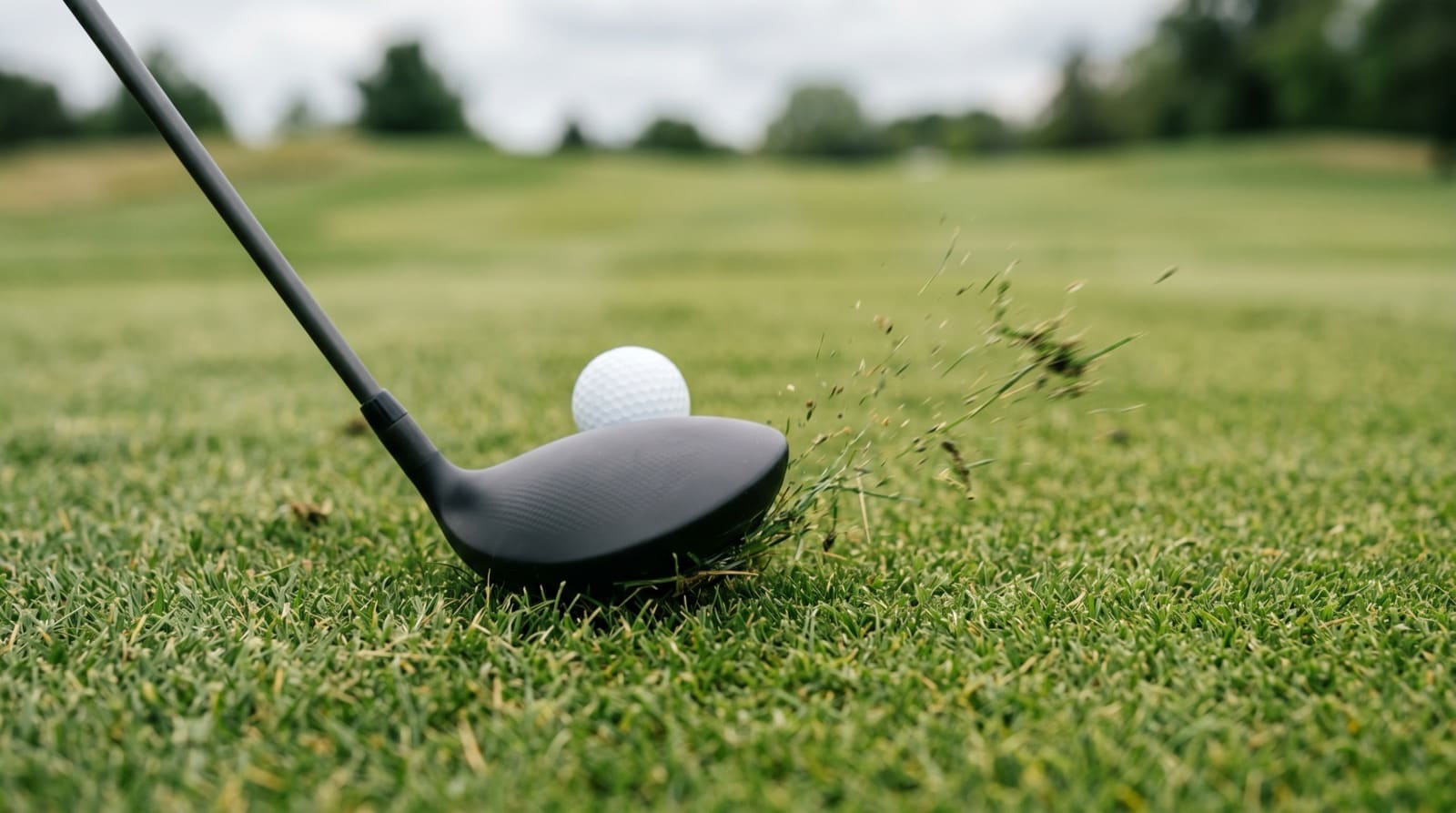
A fairway wood is struck with a shallow, slightly descending or level blow, with the club brushing the turf just after the ball and the swing’s low point in front of it. Play the ball forward of center but behind your driver position, set 55% of your weight on the lead side, and let the loft launch it. Trying to lift or sweep up is the cause of most topped and thin fairway woods. Below about 95 mph driver speed, a 5-wood usually beats a 3-wood.
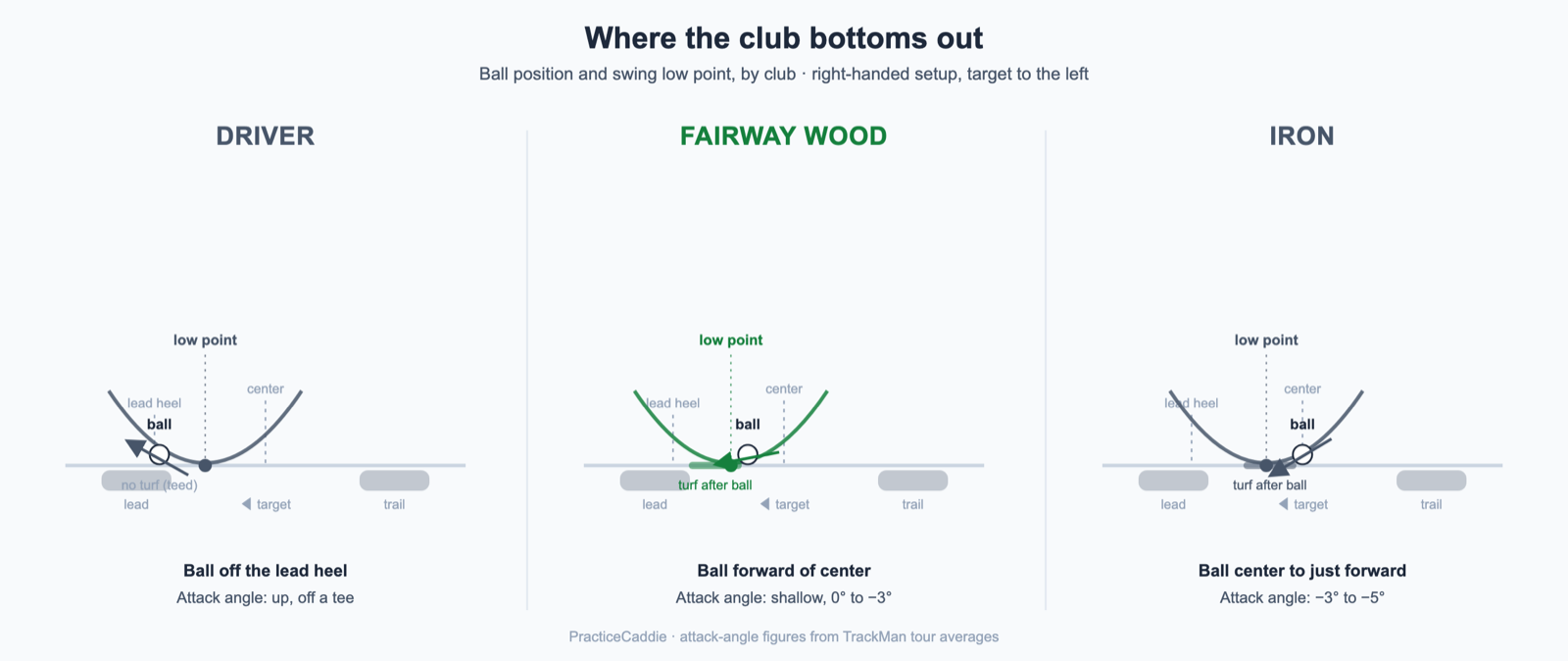
Driver, fairway wood, iron — where the club bottoms out
| Club | Ball position | Typical attack angle | Low point | What to feel |
|---|---|---|---|---|
| Driver | Off the lead heel | +3° up (LPGA) to −1° (PGA) | Before the ball | Sweep up off a tee, no turf |
| Fairway wood | Forward of center, 1–2 balls inside heel | About 0° to −3° | Just after the ball | Brush the turf after the ball |
| Mid-iron | Center to just forward | About −3° to −5° | Clearly after the ball | Ball first, then a divot |
Attack-angle figures from TrackMan’s attack-angle data and its published tour averages (compiled by TeeItUp RVA). The pattern is the load-bearing idea of the whole post: the fairway wood lives between the driver’s upward strike and the iron’s downward one.
Why fairway woods get used more than you think
Fairway woods earn far more use than their par-5 reputation suggests. They cover the long-approach and long-par-4 distances that decide whether you putt for birdie or scramble for par, so a reliable one moves the scorecard as much as a mid-iron does. Learning to strike them is one of the higher-value swings an amateur can groove.
The strokes-gained case is just as direct. Mark Broadie’s strokes-gained research shows that advancing the ball further down the hole, as long as it avoids penalty trouble, lowers expected score, because a shorter approach finishes closer to the pin. Shot Scope’s approach-proximity data confirms the chain: the closer you are to the green, the closer your next shot finishes, every time. A reliable fairway wood is how a mid-handicap turns an unreachable hole into a wedge third instead of a long-iron scramble. (For the full framework, see Strokes Gained explained for amateurs.)
Why fairway woods are the hardest clubs to strike off the ground
The difficulty is built into the equipment. A 3-wood pairs the lowest loft of any club you play off the turf (about 13–16°) with a shaft near 43 inches, second only to the driver. Low loft punishes any low-point error, and the long shaft makes the strike harder to control. Callaway’s fairway-wood guide frames the upside of modern designs honestly: fairway woods are “much easier to hit than long irons,” but only when the impact pattern is right.
That pattern is narrow. The ball sits on the ground, so the club has to descend enough to catch the ball before the turf, yet stay shallow enough that 15° of loft still launches it. Get steep and you smother it into a low, spinny knuckler. Get the low point behind the ball and you top or thin it. The window between those two misses is the whole skill.
The setup that puts you in the impact window
Most fairway-wood misses are setup misses wearing a swing-fault costume. Fix the geometry at address and the strike usually follows. Five fundamentals close most of the predictable error.
| Fundamental | What good looks like | What most amateurs do | First fix |
|---|---|---|---|
| Ball position | Forward of center, 1–2 balls inside the lead heel | Up by the lead heel, copied from driver | Move the ball back toward center one ball-width |
| Stance width | Just inside shoulder width, wider than a 7-iron | Same as the 7-iron stance | Widen one shoe-width for a stable base |
| Weight | 55% on the lead foot at address | 50/50 or hanging back on the trail side | Pre-set 55% forward and keep it through impact |
| Attack angle | Shallow, 0° to −3°, turf after the ball | Sweeping up, low point behind the ball | Throw the clubhead down to brush grass past the ball |
| Tempo | Same beat as the 7-iron, just a longer arc | Lashing at it harder than any other club | Count the 7-iron’s rhythm and match it |
Ball position: a forward band you calibrate
Ball position moves forward as the club gets longer, because the swing’s low point moves forward with a wider arc. For a 3-wood off the deck, most modern coaches and fitters land somewhere between just ahead of center and one to two balls inside the lead heel. A 5-wood plays about one ball inside center; a 7-wood just ahead of center.
PGA professional Georgia Ball warns specifically against copying the driver’s forward ball position, because for many amateurs that pushes the low point behind the ball and produces topped, skied contact. Start from the band, then move the ball a half-ball at a time while watching only contact quality, until the club consistently meets the ball at the bottom of its arc.
Weight forward, low point in front of the ball
Pre-setting 55% of your weight on the lead foot signals a ball-then-turf strike and pre-loads the forward low point that fairway woods need. The reference cue most coaches use is the lead shoulder: the bottom of the arc sits roughly under the lead shoulder, so your chest has to cover the ball through impact rather than hang back. When the upper body drifts away from the target, the low point stays behind the ball and the club is already rising at contact.
Angle of attack: shallow, slightly down, never lifting
The single idea that fixes the most fairway woods is this: even tour players hit down on them off the turf.
TrackMan’s attack-angle research puts it plainly:
“Golf shots hit off the ground (not off tees) should have a negative Attack Angle to optimize trajectory.”
The published tour numbers bear it out. On the PGA Tour averages, the 3-wood is delivered at about −2.9° of attack angle with a 1.48 smash factor and a 9.2° launch. The driver, by contrast, averages about −0.9° on the PGA Tour and +2.8° on the LPGA Tour, because it is struck off a tee. Fairway woods sit between the driver and the iron, closer to the iron.
The degree matters as much as the direction. A mid-iron tolerates a steeper strike, around −3.7° on the PGA Tour 6-iron per TrackMan, because it has 28–34° of loft to spare. A 15° 3-wood does not. Get that steep with a 3-wood and you strip its dynamic loft into the low teens, and it launches too low to carry. TrackMan’s six-number framework labels this with its “low point” reading: you want an “A” for after the ball, the same as an iron, so the turf contact starts at the ball and continues past it.
A useful image, taught by coaches like Danny Maude, is skimming a hand across water: the hand drops slightly to meet the surface, then glides along it. The sole of the fairway wood should do the same, thudding the turf just past the ball and gliding along the surface.
One honest caveat: there is little large-sample attack-angle data for amateur fairway woods specifically, so treat any single number as a flexible target. The reliable takeaway is the shape of the strike: shallow and slightly down.
What the launch-monitor data actually says
Tour numbers set the shape; they should not set your expectations for distance. The table below is the delivery profile of a good fairway-wood strike across two very different speed bands.
| Player / club | Clubhead speed | Attack angle | Smash | Launch | Carry |
|---|---|---|---|---|---|
| PGA Tour 3-wood | ~107 mph | −2.9° | 1.48 | 9.2° | ~249 yds |
| PGA Tour 5-wood | — | — | — | higher | ~236 yds |
| LPGA Tour 5-wood | ~88 mph | −1.8° | 1.47 | 12.1° | ~185 yds |
PGA Tour 3-wood delivery from TrackMan’s tour averages; carry distances from Golf Monthly’s tour-distance analysis; LPGA 5-wood from TrackMan’s LPGA averages.
Two things stand out. First, the LPGA 5-wood line is the more useful benchmark for most golfers, because 88 mph of clubhead speed and a −1.8° attack angle are within reach of a competent amateur. Second, a tour 3-wood smashes at 1.48, nearly driver-level efficiency. That efficiency comes from a centered strike, which depends on low-point control far more than raw speed.
SwingMan Golf’s analysis of TrackMan Combine data makes the point bluntly for the average male golfer: at 93.4 mph of driver speed, lifting strike quality up to tour-level efficiency would add more than 30 yards of driving distance without swinging any faster. The same lever applies to fairway woods, where a thin strike low on the face bleeds even more distance than it does with a driver. For amateurs, the biggest fairway-wood gain usually comes from strike quality.
3-wood off the deck vs off a tee
A 3-wood off the deck is one of the hardest shots in golf, and a teed 3-wood is one of the more forgiving. The difference is the turf.
Off a tee, set the ball about a quarter to a third of the ball above the crown of the club, per Bobby Walia’s tee-height guide, and play it just inside the lead heel. The tee removes the demand for a perfect low point and lets you launch it with a near-level or slightly upward strike. Off the deck, move the ball back toward center, lean into the lead side, and commit to brushing the turf after the ball.
Strategically, the 3-wood off the tee works best as a situational club. Arccos’s 3-wood-versus-driver study found driver and 3-wood land in the fairway at almost the same rate, 45.5% versus 46.4%, while the 3-wood gives up about 12 yards of median distance. MyGolfSpy’s read of Shot Scope’s data puts the distance gap as high as 30 yards and translates that into nearly 20% fewer greens hit, with Practical Golf’s analysis estimating a cost near a third of a stroke per hole. Hit driver unless it brings real trouble into play.
Fairway wood vs hybrid vs long iron
For the long-approach slot, the club you can launch and control beats the one that carries furthest on paper. Let the strike test pick it.
| Your driver speed | 3-wood off the turf on a launch monitor | Best longest-fairway-wood call |
|---|---|---|
| Under 85 mph | Launches under ~11°, scattered | Skip the 3-wood. Carry a 5-/7-wood and a hybrid. |
| 85–95 mph | Launches 11–13°, playable from fairway | A/B test 3-wood vs 5-wood for three sessions; keep the winner. |
| 85–95 mph | Low launch, thin/topped misses | 5-wood as the longest fairway wood; add a 7-wood or hybrid. |
| Above 95 mph | Launches 12°+ with a centered strike | 3-wood earns its slot, especially for tee shots and reachable par 5s. |
The data backs the conservative read for most golfers. Arccos’s 3-iron-versus-3-hybrid analysis shows that for 20-to-25-handicap players, a 3-wood’s extra loft and shaft length buy only 5–7 yards over a 3-hybrid, with worse dispersion and a harder strike off the deck. The same study notes only about 20% of PGA Tour players carry a non-utility 3-iron, and that the long iron is effectively gone from the LPGA. Higher-lofted fairway woods (the 7-, 9-, even 11-wood) launch higher and forgive more, which is why GolfWRX’s club test routes most high-handicaps toward them.
The drills that build clean contact
Pick three; do not rotate weekly. Each one gives external, numeric feedback on the low point, which is the variable that decides every fairway-wood strike.
1. The tee-up drill — establish clean contact first
Tee the ball about a quarter-inch off the turf and hit ten shots. The success criterion is binary: did the club brush the grass in front of where the ball sat, or scrape it behind? Most amateurs cannot strike a teed fairway wood without hitting the ground behind it, which is the same fault that tops it off the deck. The tee removes turf interaction so the underlying attack-angle pattern shows itself.
2. The towel-behind-the-ball drill — kill the steep, early low point
Place a folded towel about a hand-width behind the ball and hit shots without touching it. Catch the towel and your low point is behind the ball, the fat-shot fault. Titleist’s towel drill teaches the same move into the lead side that fairway woods need. Run ten reps, then move the towel an inch closer and run ten more.
3. The three-tee drill — see your low point
Push three tees into the turf: one where the ball sits, one a few inches in front, one a few inches behind. Place the ball on the middle tee, swing, and check which tees you clip. The goal, per Golf Sensei’s three-tee drill, is to clip the ball and the front tee while leaving the back one standing, the picture of a low point just past the ball. Success criterion: 8 of 10 with the back tee untouched.
4. The 7-iron tempo transfer — stop lashing at it
Hit a five-shot block alternating 7-iron and 3-wood, using the same tempo count on every swing. Most amateurs accelerate the 3-wood and lose their sequence; the longer shaft does the distance work when the rhythm holds. Tour-tempo research finds nearly all tour pros swing at a 3:1 backswing-to-downswing ratio regardless of club, and recreational golfers most often break it by getting quick from the top. For the full set, see golf tempo drills.
Common mistakes
- Trying to lift the ball. The loft launches it. Adding a scoop hangs you back and moves the low point behind the ball. The towel and three-tee drills fix it.
- Ball position copied from the driver. Up by the lead heel, the low point falls behind the ball. Move it back toward center one ball-width.
- Sweeping up off the turf. Even tour players deliver a fairway wood at a negative attack angle (TrackMan). Brush the turf after the ball.
- Lashing harder than the 7-iron. Tempo identical to the 7-iron is the consistency multiplier; extra effort costs the strike that makes the speed.
- Forcing a 3-wood the data says to bag. If you cannot launch it off the deck, a 5-wood that carries the same distance and finishes closer is the lower score.
When to drop the 3-wood (and what to carry instead)
For a large share of amateurs, the highest-leverage fairway-wood move is an equipment decision: dropping the 15° 3-wood.
Club fitters consistently report that below roughly 95 mph of driver speed, a 16–19° fairway wood launches more easily than a 15° 3-wood and often carries the same distance, because most fairway strikes catch the ball low on the face where loft preserves ball speed. Arccos’s data shows the scoring penalty for skipping the 3-wood is negligible for higher handicaps, while the strike and dispersion gains are real. The decision rule is simple: unless you can show on a launch monitor that you launch a 3-wood off the turf with acceptable carry and dispersion, start your fairway-wood lineup at a 4- or 5-wood and add a 7-wood or hybrid below it.
If your real problem at this distance is a long iron, the companion read is how to hit long irons in golf, which runs the same launch-monitor-driven decision for the 3- and 4-iron.
A four-week fairway-wood protocol
The drills work only when sequenced. Block practice in weeks 1–2 grooves the motor pattern; random practice in week 3 makes it survive the course. The sequence mirrors the howTo on this page and the motor-learning research in block vs random practice in golf.
- Week 0 — measure the baseline. Ten 3-wood and ten 5-wood shots on a launch monitor. Record clubhead speed, attack angle, low point, smash, carry. If the 3-wood launches under about 11° off the turf, the bag changes here.
- Week 1 — setup and ball position off a tee. Three 20-minute sessions, tee-up drill only. Groove forward ball position, 55% lead-foot weight, and a turf brush in front of the ball, without the turf as a variable.
- Week 2 — low-point control off the turf. Three 25-minute sessions. Towel drill and three-tee drill. Goal: 8 of 10 shots taking the ground at or just past the ball.
- Week 3 — random distance and club A/B test. Three 30-minute sessions. A 12-shot rotation alternating 3-wood, 5-wood, and hybrid at three targets. Track proximity per club. The data tells you which club stays.
- Week 4 — on-course transfer. Two range sessions plus one round. Log every fairway-wood shot. Compare your on-course strike rate against the range number.
- Maintenance — every six months. Re-run the Week 0 test. Strike and swing speed drift; the bag should move with them.
Key takeaways
- Fairway woods are hit with a shallow, slightly descending blow. PGA Tour 3-woods average about −2.9° attack angle (TrackMan); the turf contact starts at the ball and continues past it.
- Ball forward of center, behind the driver position. 3-wood one to two balls inside the lead heel, 5-wood about one ball inside center, 7-wood just ahead of center.
- Weight 55% on the lead side so the low point sits in front of the ball. Hanging back is the root of the topped shot.
- Loft does the lifting. The instinct to help the ball up is the most common fairway-wood fault; the towel and three-tee drills retrain it.
- Below ~95 mph driver speed, a 5-wood usually outscores a 3-wood (Arccos). The longest fairway wood is a data decision.
- Hit driver off the tee unless it brings trouble in. Driver and 3-wood find the fairway at nearly the same rate, and 30 lost yards costs close to a third of a stroke per hole (Practical Golf).
- Strike quality beats raw speed. A centered fairway-wood strike smashes near 1.48, almost driver-level, and that comes from low-point control.
Frequently asked questions
Where should the ball be in my stance for a fairway wood?
Play a fairway wood forward of center but well behind your driver position. A 3-wood sits roughly one to two balls inside your lead heel; a 5-wood about one ball inside center; a 7-wood just ahead of center. The longer and lower-lofted the club, the further forward the ball moves, because the swing’s low point sits further forward too. Too far forward, up by the lead heel like a driver, pushes the low point behind the ball and produces the topped, thin strikes fairway woods are known for.
What is the correct angle of attack for a fairway wood?
Off the turf, a fairway wood wants a shallow, slightly descending or near-level strike, roughly zero to minus three degrees, with the club brushing the grass just after the ball. PGA Tour players average about minus three degrees of attack angle with a 3-wood, shallower than a mid-iron, where the tour 6-iron averages about minus 3.7 degrees. Hitting up on a fairway wood like a driver is the most common cause of topped shots, because the low point ends up behind the ball.
Why do I keep topping my fairway woods?
A topped fairway wood means the club reached the bottom of its swing arc behind the ball and was already rising at impact, catching the ball’s equator. The usual causes are hanging back on the trail foot, a ball position copied too far forward from the driver, and the instinct to lift the ball into the air. The fix is to move your weight onto the lead side through impact so the low point shifts in front of the ball, and to trust the loft to do the lifting.
Is it harder to hit a 3-wood off the deck or off a tee?
Off the deck is far harder. A 3-wood has only about 13 to 16 degrees of loft and a 43-inch shaft, so striking it cleanly off the turf demands a near-perfect low point. Teeing it up, about a quarter to a third of the ball above the crown, removes the turf as a variable and launches it more easily. Many coaches argue that if you cannot reach a par-5 green in two from a good lie, laying up to a full wedge yardage scores better than gambling on a 3-wood off a marginal lie.
Should I hit 3-wood or driver off the tee?
For most players, driver is the better default. Shot-tracking data from Arccos and Shot Scope shows driver and 3-wood find the fairway at nearly the same rate, both around 46 to 47 percent, yet the 3-wood flies roughly 12 to 30 yards shorter. Practical Golf’s analysis of that shot-tracking data estimates that giving up 30 yards off the tee costs close to a third of a stroke per hole. Reserve the 3-wood off the tee for holes where driver brings water, out-of-bounds, or a dogleg into play.
Is a 5-wood or 7-wood easier to hit than a 3-wood?
For most amateurs, yes. A 5-wood (17 to 20 degrees) and a 7-wood (20 to 24 degrees) carry more loft and shorter shafts, so they launch higher and tolerate a less-than-perfect strike. Club fitters and Arccos data agree that below roughly 95 mph of driver speed, a 16 to 19 degree fairway wood often carries nearly as far as a 15 degree 3-wood while finishing closer to the target. Unless you can launch a 3-wood off the turf on a launch monitor with acceptable carry, start your fairway-wood lineup at a 4- or 5-wood.
How do I stop trying to lift the ball with a fairway wood?
Every club in the bag is built to be struck with a level or slightly descending blow; the loft launches the ball for you. To break the lifting habit, place a tee or a folded towel a few inches behind the ball and make swings that miss it, forcing ball-first contact. Then feel your chest and lead shoulder covering the ball through impact rather than hanging back. When the low point moves in front of the ball, the strike turns solid and the ball climbs on its own.
Related reading
- How to Hit Long Irons in Golf — the same launch-monitor-driven club decision, run for the 3- and 4-iron. Read it next if your trouble at 190 yards is an iron, not a wood.
- How to Stop Topping the Golf Ball — the topped fairway wood is a low-point fault; this is the dedicated fix for it across the bag.
- Golf Ball Position by Club — the setup fundamental underneath this whole post, mapped club by club.
- Strokes Gained: Approach, Explained — why advancing the ball to a shorter approach is worth training a fairway wood for.
- Golf Tempo Drills — the 3:1 ratio that keeps your fairway-wood swing from getting quick at the top.
- Ball Striking Drills for Golf — the parent catalog; the tee, towel, and three-tee drills belong to the same family.
- Driving range practice plan — the longer-form companion that drops this fairway-wood rotation into a full range session.
- How to Grip a Golf Club — the cornerstone every full-swing club is built on, fairway woods included.