
How to Hit a Bump and Run in Golf: Club, Setup, and When to Use It
The bump and run is golf's lowest-variance greenside shot: minimum air, maximum roll. Which club to take, how to set up, and when it beats a lofted chip.

Quick answer
A bump and run is the lowest-variance greenside shot in golf: a short carry and a long roll, played with a putting-style stroke and a club anywhere from a 7-iron to a wedge. Set up with the ball back, weight forward (60 to 70 percent on the lead side), and hands ahead, then let the ball roll out like a putt. Choose it whenever you have a clean lie, little to carry, and green to work with — the lowest-lofted shot that clears the trouble is the highest-percentage play.
Carry-to-roll club selector (the Rule of 12, a starting heuristic)
| Club | Carry : roll (flat lie, medium green) | Land it… |
|---|---|---|
| Sand wedge | 1 : 1 | halfway to the hole |
| Pitching wedge | 1 : 2 | a third of the way |
| 9-iron | 1 : 3 | a quarter of the way |
| 8-iron | 1 : 4 | a fifth of the way |
| 7-iron | 1 : 5 | a sixth of the way |
This mapping is a teaching heuristic, a rule of thumb to start from. It assumes a flat lie and a medium green speed near 9.5 to 10 on the Stimpmeter, so take one club less loft on slower or uphill greens, one club more on faster or downhill ones, then calibrate it on your home course.
Why the ground game is the higher-percentage play
The bump and run wins on math. Once the ball is rolling, its path is governed by the same slope and pace you already read on every putt, so a slightly off-center strike still finishes near the target. A high, spinning chip puts the outcome in the air, where small errors in contact and launch turn into large errors in carry. Lower trajectory means lower variance.
Shot-tracking data shows how forgiving the ground is. Arccos, which has logged hundreds of millions of real amateur shots, found that the average 10-handicap takes the same number of strokes to hole out from 12 yards in the rough as from 81 feet on the green. Being on the putting surface, even a long way from the hole, is one of the most forgiving positions in golf. The bump and run is the shot that gets you there with the least that can go wrong.
There is a strategic reason this matters for where you spend practice time. Mark Broadie’s strokes-gained research, the framework now standard across the PGA Tour, shows that approach play, especially shots from around 150 yards, explains more of the gap between amateurs and scratch than the short game does. As Golf Magazine’s profile of Broadie summarized his finding, “in a battle of importance, ball-striking reigns supreme.” The bump and run earns its keep precisely because it is simple: it stops the greenside bleeding with a low-effort, low-variance stroke, which frees your range time for the approach shots that move the needle more.
That greenside leak is still real, especially for higher handicaps. Lou Stagner’s Arccos data shows the gap between handicap tiers widens sharply close to the green, where higher handicaps give up the most ground to scratch and tour players. Shot Scope’s 90-million-shot dataset sharpens the point: scratch players hit only about 4 percent more fairways than 20-to-25 handicaps, so the scoring gap lives in approach precision and what happens when the approach misses the green. The bump and run is the cheapest fix for that last category.
What a bump and run actually is
A bump and run is a chip pushed to its low-trajectory, ground-biased extreme. Titleist staff instructor Skip Guss defines the stock version as a shot that “flies minimally and rolls the majority of the way to the hole” — minimum air time, maximum ground time. The ball carries just far enough to clear the fringe or rough between you and the green, lands early, and runs out like a putt.
The shot is older than the lob wedge. It grew up on the firm, wind-swept turf of links golf in Scotland, where slower, bouncy greens and constant wind rewarded a ball kept low to the ground. Masters of the short game built reputations on it. Seve Ballesteros used low runners to funnel the ball through the humps and hollows of Open Championship links, and two-time major champion Paul Runyan taught an entire greenside system around a low, putt-like stroke. Lee Trevino’s “hold” shot, a low runner played with the hands forward and the clubface held off through impact, is the same idea scaled up to longer range.
Think of the family of greenside shots as a spectrum of carry-to-roll ratios. A flop shot flies far and rolls little, maybe 4 parts air to 1 part ground. A standard pitch sits near 1 to 1. The bump and run lives at the other end, often 1 part carry to 3, 4, or 5 parts roll on firm greens. The further you sit toward the roll-heavy end, the less the shot depends on a perfect strike.
The setup: a putt with a lofted club
Most of a good bump and run is built at address, before the club ever moves. The setup creates a forward low point and a delofted, stable face, which is what produces a low launch and a predictable roll. Five fundamentals close most of the predictable error.
| Fundamental | What good looks like | What most amateurs do | First fix |
|---|---|---|---|
| Stance | Narrow, slightly inside shoulder width | Full-shot stance width | Bring the feet closer together |
| Ball position | Back of center, off the trail-foot instep | Centered or forward | Move the ball back toward the trail foot |
| Weight | 60 to 70 percent on the lead foot, set at address | 50/50 or hanging back | Pre-set the weight forward and keep it there |
| Hands | Ahead of the ball, shaft leaning at the target | Even with or behind the ball | Press the handle toward the lead thigh |
| Grip / length | Choke down; many players use the putting grip | Full grip, full length | Choke to the bottom of the grip |
The weight sits 60 to 70 percent on the lead foot, which moves the swing’s low point ahead of the ball and promotes ball-first contact. Two-time PGA Championship winner Paul Runyan, one of the most respected short-game teachers in the game’s history, built his greenside method around exactly this. In his short-game classic The Short Way to Lower Scoring, he sets roughly 70 percent of the weight on the lead foot with the ball back of center, so the low point sits clearly in front of the ball and the loft of the club, not a scooping motion, supplies the lift.
One detail separates a clean bump and run from a chunked one on tight lies: raise the handle so the club sits a touch toward its toe, with the heel slightly off the ground. That reduces the sole area dragging through the turf and makes a fat strike far less likely, which is why the move shows up in both Runyan’s toe-down setup and modern instruction. On a tight lie or a closely mown collar, that small adjustment is the difference between brushing the grass and digging into it.
The stroke: quiet wrists, shoulders, accelerate
The bump and run is powered by the shoulders and torso, with the wrists along for the ride. Runyan called his version a “one-lever” motion: the arms and the club move together as a single unit, and the wrists are never asked to supply lift or speed. Keeping the wrists quiet removes the moving part that opens or closes the face, so the ball comes off the same way every time.
The tempo is a putt’s tempo. Make the same length of stroke back and through, smooth and unhurried, and resist the urge to get quick or jerky at the top, which is what blades the shot across the green. Distance comes from the length of the stroke. A longer backswing rolls the ball farther; a shorter one rolls it less. The hands stay passive throughout.
Short-game coach James Sieckmann, who has worked with dozens of tour professionals, anchors the strike on the chest. In Your Short Game Solution he teaches players to set the sternum slightly ahead of the ball at address, because the sternum marks the low point of the swing. With the chest forward, the club bottoms out past the ball and brushes the turf on the way through, producing ball-then-turf contact instead of the scoop that thins or chunks the shot. His other key, picking a precise landing spot and letting the roll cover the rest, is the bridge from chipping to putting: commit to where the ball lands, then read what it does after that like any putt.
Accelerate through the ball. Deceleration, usually born from a fear of hitting the shot too far, is the single most common bump-and-run fault and the cause of most fat and thin strikes. The fix is mechanical and mental: keep your weight forward, commit to a landing spot, and let the club keep moving past the ball.
Club selection: how the Rule of 12 works
The carry-to-roll table at the top of this post is a version of the Rule of 12, a long-standing teaching shortcut for matching club to shot. The idea is simple: walk off the distance from your landing spot on the green to the hole, compare it to the carry you need to reach that spot, and let the ratio pick the club. Land everything on the same spot just onto the green and let loft do the rest.
In practice it looks like this. If your landing spot is a third of the way to the hole, the ball needs to roll about twice as far as it carries, which points to a pitching wedge. A quarter of the way calls for a 9-iron; a fifth, an 8-iron; a sixth, a 7-iron. The stroke stays identical across all of them. Only the club changes, which is the whole appeal: one repeatable motion, with club selection doing the distance work.
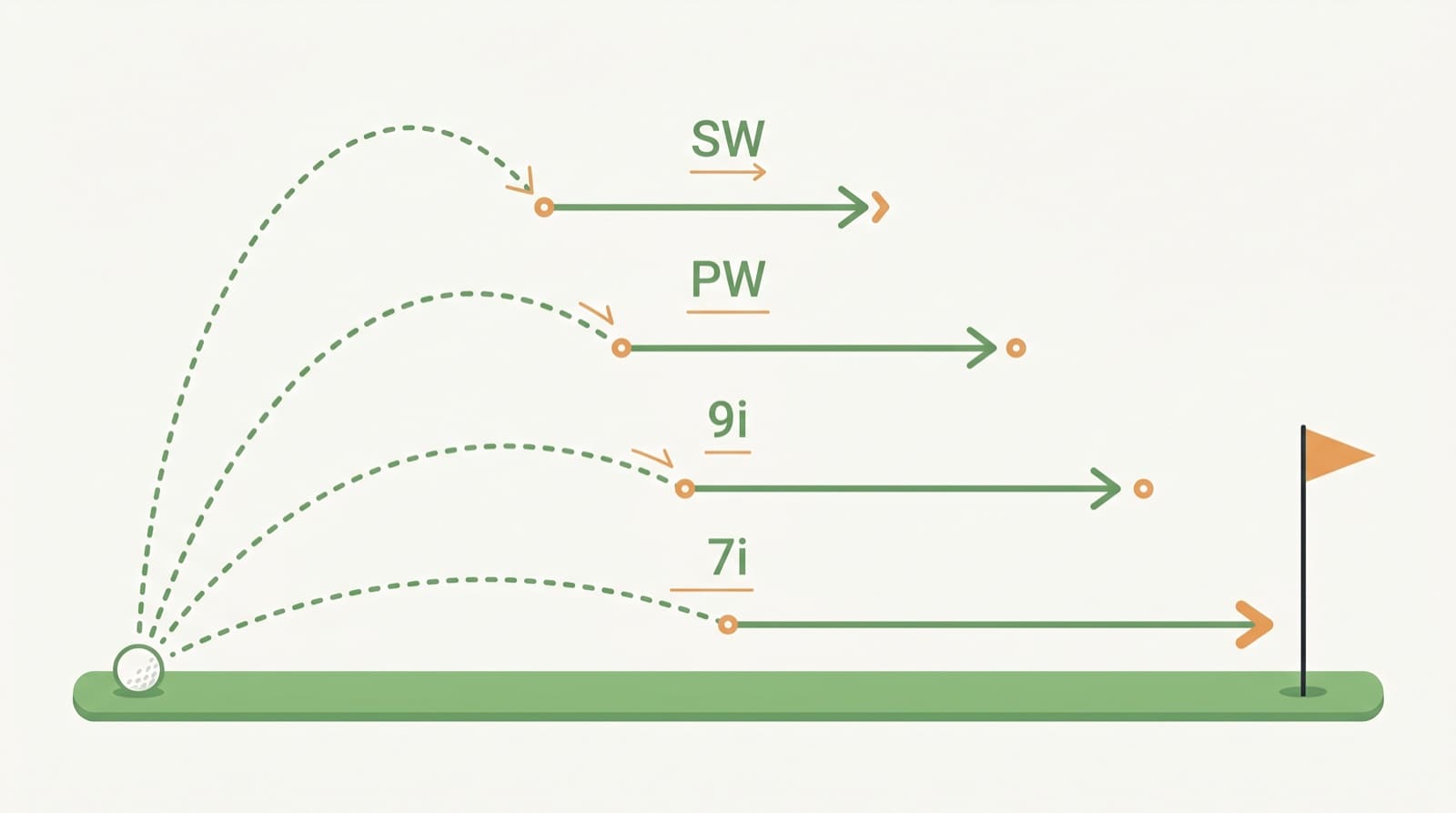
Treat the numbers as a scaffold to calibrate against. The Rule of 12 is a teaching heuristic built from coaching observation rather than launch-monitor testing, and it assumes a flat lie on a green running near 9.5 to 10 on the Stimpmeter. On slower greens, shift down a club or two of loft for the same carry-to-roll; on faster or downhill greens, add loft to shorten the roll. Once you have hit a few dozen bump and runs from your home greens, your own calibrated feel will beat the formula. The formula’s real value is the mental habit it builds: think in carry versus roll, and pick the lowest loft that still lands the ball safely on the green.
When to play it: the around-the-green decision
The bump and run is the smart default around the green, and knowing its limits is half the skill. The reliable hierarchy is putt when you can, bump and run when you cannot putt, and pitch or flop only when you must. The decision comes down to three questions: the lie of the ball, what you have to carry, and where the flag sits. A good lie with little to carry and plenty of green calls for the bump and run; a tight pin behind a bunker is when the flop earns its risk.
The table below operationalizes that hierarchy. Read it top to bottom and stop at the first row that fits your situation; the higher rows are lower-risk.
| Situation | Highest-percentage shot |
|---|---|
| On the green, or a clean fringe with a smooth path to roll over | Putt (Texas wedge) |
| Just off the green, clean or tight lie, green to work with | Bump and run |
| Must carry rough, a bunker, or an upslope, with green to stop on | Pitch |
| Short-sided over a hazard, little green, good lie | Flop |
Course conditions tilt the decision. Firm turf, tight lies, fast greens, and wind all favor the ground game, which is why links golfers lean on it so heavily; a low runner is barely touched by a gust that would balloon a flop offline. Soft greens, thick rough between you and the putting surface, or a steep downslope that would send a runner past the hole all push you up the loft ladder. When the green slopes uphill toward the pin, the bump and run gets even better, because the slope brakes the ball for you. The honest read: most amateurs reach for loft far more often than the situation calls for, leaving easy ground-game shots on the table.
Common mistakes
- Picking too much loft. The default reach for a 56 or 60 degree wedge turns a simple roller into a carry-dependent chip. When there is green to use, take the lower-lofted club and let the ball run.
- Decelerating into the ball. Fear of going long produces a slowing club, fat or thin contact, and a shot short of the hole anyway. Commit to the landing spot and accelerate through with even tempo.
- Active wrists. Hinging and flipping the wrists changes the loft and face angle at impact and reintroduces the variance the shot is built to avoid. Power the stroke with the shoulders and keep the hands quiet.
- Ball too far forward. A centered or forward ball moves the low point behind the ball and invites a thin or chunked strike. Play it back of center with the weight forward.
- Aiming at the hole instead of a landing spot. The roll-out is most of the shot, so a vague target produces vague distance control. Pick a specific dimple-sized landing spot and read the roll from there like a putt.
- Ignoring the lie. Deep rough can grab the hosel and kill a low runner. From a buried lie, a more lofted pitch that flies the ball onto the green is the safer call.
How to practice it
Two short sessions beat one long one, and a landing spot beats a vague target. Set up three simple drills and log a number every time, the same way the chipping drills in the pillar post are scored.
- Landing-spot ladder. Drop a towel just onto the green as a landing zone and hit ten bump and runs trying to land the ball on the towel, not at the hole. Score a point per landing-zone hit. Target 6 of 10, then move the towel and repeat. This trains the carry-to-roll habit the Rule of 12 is built on.
- One-club, three-distances. With a single 8-iron or 9-iron, play to three different cups using only stroke length to change distance. The goal is calibrating feel for one club before you add others, so 7 of 10 finish inside a putter-length.
- Random club, random target. Once the first two feel reliable, rotate club and target every rep, no two the same in a row. Performance dips at first, which is the contextual-interference effect doing its job: variable practice feels worse but transfers to the course far better than grooving one shot.
The progression from grooving one shot to randomizing club and target is the same block-to-random pattern that underlies all structured short-game practice. PracticeCaddie’s plan builder bakes that sequence in: it rotates club, target, and lie across a session, sets a numeric success criterion per drill, and tracks your up-and-down rate across rounds so you can see whether the bump and run is actually saving strokes.
Key takeaways
- The bump and run is the lowest-variance shot around the green. A short carry and a long roll put the outcome on the ground, where slope and pace are predictable, instead of in the air.
- Being on the green is forgiving. The average 10-handicap holes out in the same strokes from 12 yards in the rough as from 81 feet on the green (Arccos). The bump and run gets you there with the least that can go wrong.
- Match club to carry-to-roll. Sand wedge rolls about as far as it carries; a 7-iron rolls roughly five times its carry. The Rule of 12 is a heuristic to calibrate against your own greens.
- Set up like a putt with a lofted club. Narrow stance, ball back, 60 to 70 percent of weight on the lead foot, hands ahead, choked down.
- Quiet wrists, shoulders, accelerate. Power it with the torso, keep the hands passive, and never decelerate into the ball.
- Use the hierarchy: putt, bump and run, pitch, flop. The lowest-lofted shot that clears the trouble is the highest-percentage play whenever the lie and the green allow it.
- Spend the practice you save wisely. Broadie’s strokes-gained data shows approach play moves scores more than the short game (Golf Magazine); the bump and run’s simplicity is what lets you bank greenside strokes cheaply.
Frequently asked questions
What is a bump and run in golf?
A bump and run is a low greenside shot that carries a short distance through the air and rolls the majority of the way to the hole, like a putt with a lofted club. The principle is minimum air time, maximum ground time. You play it with anything from a 7-iron to a wedge using a quiet, putting-style stroke. Because the ball spends most of its trip rolling on the ground, the outcome is more predictable than a high, spinning chip.
What club should I use for a bump and run?
Match the club to how much you must carry versus roll. A sand wedge rolls roughly as far as it carries, a pitching wedge about twice its carry, a 9-iron about three times, an 8-iron four times, and a 7-iron about five times, landing each just onto the green on a flat, medium-speed surface. This mapping is the Rule of 12, a teaching heuristic rather than measured physics, so calibrate it on your own greens and take less loft on slower or uphill surfaces.
When should I hit a bump and run instead of a chip or flop?
Play the bump and run whenever the lie is clean, there is little to carry, and there is green to roll across. The order of preference around the green is putt when you can, bump and run when you cannot putt, and pitch or flop only when you must carry rough, a bunker, or an upslope with little green to stop on. The lowest-lofted shot that clears the trouble is usually the highest-percentage play because it relies less on perfect contact.
How do you hit a bump and run?
Set up like a putt with a lofted club: narrow stance, ball back of center, 60 to 70 percent of your weight on the lead foot, and hands ahead of the ball so the shaft leans toward the target. Choke down for control. Make a putting-style stroke powered by the shoulders with quiet wrists, accelerate so the club brushes the turf at or just past the ball, and let the loft lift it. Then read the roll like a putt.
Is a bump and run easier than a chip?
For most amateurs, yes. The bump and run uses a short, putting-style motion with minimal wrist hinge, which removes the moving parts that cause fat and thin chips. Because the ball is on the ground quickly, small contact errors still tend to leave it rolling toward the hole instead of flying long or short. Motor-learning research shows that reducing the degrees of freedom in a movement makes it more repeatable under pressure, which is exactly what the quiet, putt-like stroke does.
Can you use a hybrid or putter for a bump and run?
Yes. From a tight lie or a closely mown collar, a hybrid played with a putting stroke pops the ball over the fringe and runs it out like a long putt; the wide sole resists digging and forgives slightly fat contact. When the ground between you and the green is smooth, a putter from off the green, the Texas wedge, is often the safest option of all because it removes air time entirely. Choose the lowest-risk tool the surface allows.
Why do my bump and runs come up short?
The usual cause is deceleration: slowing the club into the ball out of fear of hitting it too far, which produces fat or thin contact and a shot that finishes short anyway. The fixes are to commit to a specific landing spot, keep your weight forward, and accelerate smoothly through the ball with the same tempo back and through. Picking too much loft also costs roll, so take a lower-lofted club and let the ball run to the hole.
Related reading
- 10 Golf Chipping Drills Tour Coaches Actually Use — the partner short-game post; the bump and run is the lowest-loft member of the chipping family covered there.
- How to Hit a Bunker Shot in Golf — the other greenside shot every amateur leaks strokes on; setup and acceleration carry straight over.
- 10 Golf Putting Drills That Move Strokes-Gained-Putting — the bump and run finishes as a putt, so green-reading and pace control are half the shot.
- 8 Lag Putting Drills That Cut Three-Putts — distance control on long rolls, which is exactly what a bump and run becomes once it lands.
- Block vs Random Practice in Golf — the motor-learning research behind the block-to-random practice progression above.
- Strokes Gained Explained for Amateurs — why the lowest-variance greenside shot, and where you spend the practice it saves, both matter to your scoring.
- 10 Golf Practice Drills Tour Coaches Actually Use — the parent drill catalog; the landing-spot and random-rotation drills here follow its four-property frame.
- How to Grip a Golf Club — the cornerstone the whole short game is built on; a calm, neutral grip keeps the bump-and-run face stable.
- Chipping drills to lower your scores — the companion guide with proximity and up-and-down scoring criteria.
- Putting drills that build pace control — the roll half of the bump and run, drilled directly.