
How to Clean Golf Clubs: The Method, and What Dirt Costs You
Three launch-monitor tests measured what a dirty or wet clubface costs: 2,093 to 3,464 rpm of backspin. That is more than 125 rounds of groove wear takes.
Quick answer
Warm water, mild soap, a soft nylon brush, and dry every groove immediately. Keep the waterline below the ferrule and keep the grips out of it. Three published tests found a dirty or wet clubface lost 2,093 to 3,464 rpm of backspin against its own clean baseline. That is more spin than 125 rounds of groove wear takes off a wedge.
Warm water, mild soap, a soft nylon brush, and dry every groove immediately. Keep the waterline below the ferrule and keep the grips out of it. Three published tests found a dirty or wet clubface lost 2,093 to 3,464 rpm of backspin against its own clean baseline. That is more spin than 125 rounds of groove wear takes off a wedge.
How to clean golf clubs in six steps
| Step | What to do | The part people get wrong |
|---|---|---|
| 1. Mix | Warm tap water, a small amount of mild dish soap | Hot water. Heat is what club builders use to break epoxy |
| 2. Wipe | Loose sand, soil and grass off with a damp cloth | Brushing grit straight across a soft forged face |
| 3. Soak | Solid heads only, waterline under the ferrule, a few minutes | Hollow and multi-material heads, which get a cloth instead |
| 4. Brush | Soft nylon brush across the grooves, light pressure | Wire brushes and groove sharpeners |
| 5. Dry | Every groove, the hosel and the ferrule, straight away | Skipping it, then bagging a damp club |
| 6. Grips | Warm water and a soft brush — except Winn, water only | Soap and a brush on a polymer grip |
Ten minutes for a full set. The steps are ordinary. The amount of spin they recover is larger than most golfers assume, and larger than what the worn wedge they are thinking about replacing would give back.
What a dirty clubface actually costs
Grooves give water, grass and mud somewhere to go at impact so the ball can grip the face directly. Fill them and that escape route closes, and whatever is left between ball and face behaves like a lubricant.
Rice’s 2017 test included a control shot that makes the point from the other end. A grooveless clubface, clean and dry off a tee, spun 5,837 rpm against 6,246 rpm for the same clean dry face with grooves. Removing the grooves altogether cost 409 rpm, about 6.5%. Wetting that same grooved face cost 3,464 rpm. Grooves earn their keep against contamination, which is why blocking them is expensive and why a clean dry range mat hides the whole effect.
Three independent tests measured it, each against its own clean baseline:
| Test | Club and setup | Clean | Contaminated | Lost |
|---|---|---|---|---|
| Today’s Golfer | Ping i210 7-iron, Foresight GCQuad, mud-packed face | 5,399 rpm | 2,566 rpm | 2,833 rpm (52.5%) |
| Andrew Rice, 2012 | Vokey SM4 54°, three pros, 10 shots each, 50 yards off a lie board | 6,501 rpm | 4,408 rpm | 2,093 rpm (32.2%) |
| Andrew Rice, 2017 | 50-yard wedge off a tee, loft delivery held to 44.3–45.3° | 6,246 rpm | 2,782 rpm | 3,464 rpm (55.5%) |
The percentages are PracticeCaddie’s arithmetic on each test’s own pair, not a figure any of the three publishes. Expressing the loss as a share of that test’s clean-face number is what makes a 7-iron on a launch monitor comparable to a 54-degree wedge hit by tour pros off a lie board.
The dirty club in the Today’s Golfer run went three yards further. It also lost 7 mph of ball speed, dropped 20% of its peak height and came in 16.3% flatter. What dirt takes is the descent angle and the spin that make a ball stop, which is the entire job of an approach shot.
Is it worth cleaning your clubs, or replacing the wedge?
Cleaning advice and wedge-replacement advice are written by different people and never meet. Put them on one axis and the ranking is not what the buying decision assumes.
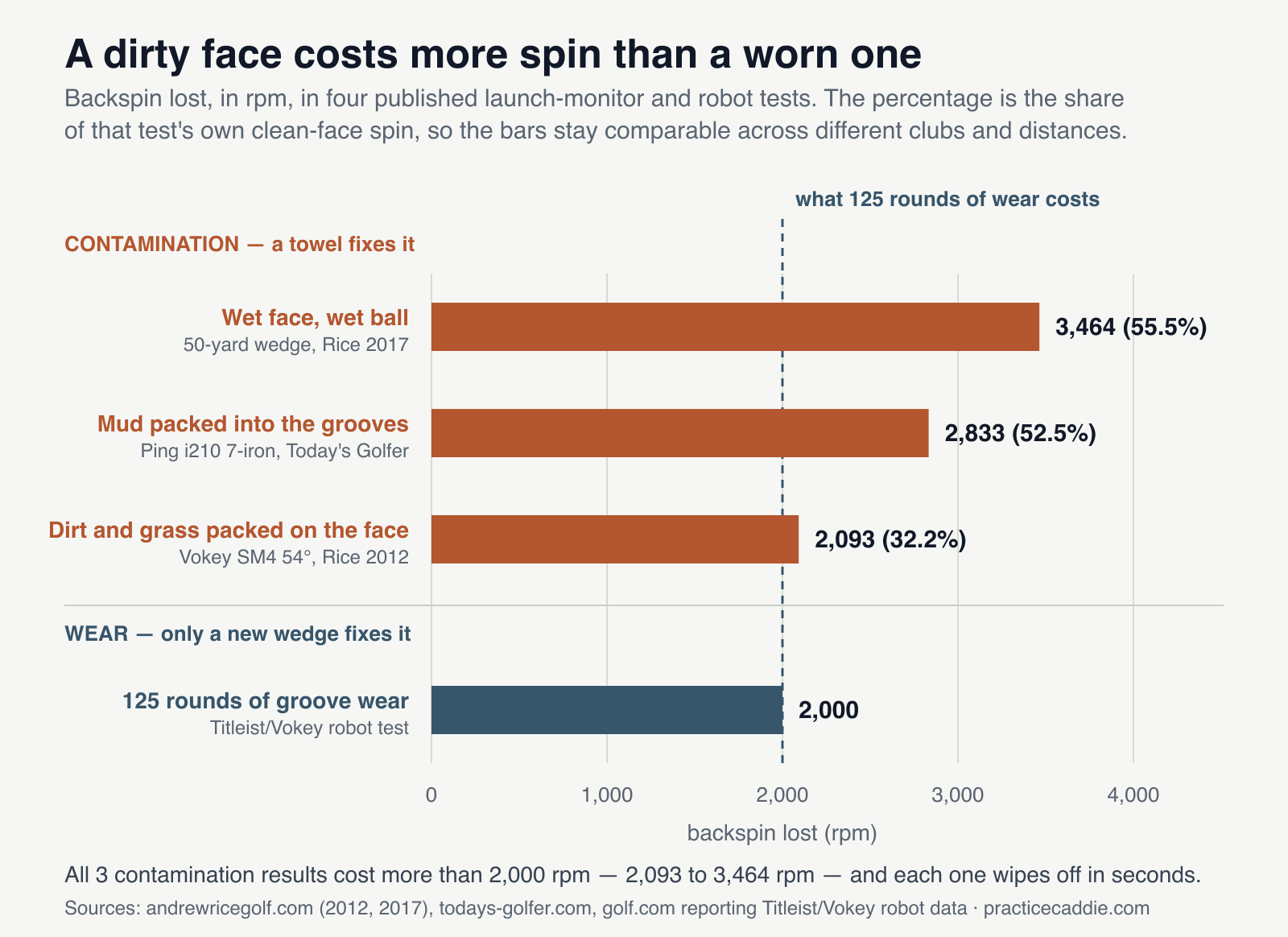
Titleist’s robot testing of worn Vokey wedges, reported by GOLF.com, found that wedges used for roughly 125 rounds “produced 2,000 less RPMs compared to new wedges with fresh grooves on similar swings, leading to nearly 2.5 times more rollout once the ball hits the green.” GOLF.com puts that in putting terms: a 25-footer where you had a makeable 10-footer.
Now compare the columns. The smallest of the three contamination losses — 2,093 rpm — is still larger than what 125 rounds of wear takes off. The weakest result in the set clears the wear bar on its own, with no averaging required to get it there.
Which means a golfer four years into a set of wedges, wondering whether worn grooves are why the ball keeps running through the green, may be looking at the wrong club. If that same face has mud in it on a wet Saturday, the dirt is costing at least as much as every round of wear underneath it, and the dirt comes off with a towel.
Groove wear is permanent, and it is the smaller and slower of the two problems. It is also the one that costs the price of a new wedge to fix.
Dirt or wear? A test that separates them
Both faults look identical from the fairway. The ball lands, skips, and finishes past the flag instead of checking. Five shots on a short-game green separate them.
- Wash the wedge properly — the full six steps above, not a wipe. Dry every groove.
- Hit five shots from 50 yards onto a green you can walk to, with a clean, dry ball each time.
- Pace the rollout from pitch mark to ball, and write down the five numbers.
- Read the result. Consistent short rollout means your problem was dirt, and it is now solved for free. Long rollout on a face you just cleaned points at the grooves.
- Count your rounds before you buy anything. The 125-round figure is measured in rounds played. At 30 rounds a year that is roughly four years; at 60 rounds a year it is two.
Two things will corrupt the test. A wet ball reads like a dirty face, which is exactly what Rice’s 2017 numbers show, so use a dry one. And practising out of a bunker wears grooves far faster than hitting off grass, so a wedge that lives in the sand hits the wear point sooner than the round count suggests. If you are grinding bunker shots every week, inspect earlier.
For the spin side of this in more detail — what actually produces backspin and how much of it comes from the face rather than the strike — our guide to putting backspin on a golf ball covers the four levers, and launch monitor numbers explained covers what a spin figure on a screen is and is not telling you.
What not to do when cleaning golf clubs
The failure modes here damage clubs rather than merely wasting time, and most of them come from treating a golf club like kitchenware.
| Don’t | Why |
|---|---|
| Boiling or very hot water | Heat is the tool club builders use. GolfWorks’ re-shafting instructions warm the ferrule “slightly to soften it”, then torch the hosel for 30 seconds to release the epoxy. There is no cleaning benefit to offset that |
| The dishwasher | High heat, strong alkaline detergent, a long cycle and pressurised spray, applied to ferrules, epoxy, paint fill, badges and inserts at once |
| Soaking above the ferrule | Water reaches the hosel joint and the inside of the shaft. Prolonged immersion can discolour or loosen the ferrule itself |
| Soaking a graphite shaft | The finish is a coating. Wipe it with a damp cloth and dry it; do not saturate it or attack it with solvents |
| Steel wire brushes | They scratch forged heads, chrome, PVD and paint fill. Nylon lifts dirt without removing metal, and brass is as far up as it is worth going |
| Groove sharpeners | A rules problem before it is a finish problem — see the last section |
| Harsh chemicals and buffing wheels | They strip oil-can, black, PVD and raw finishes, and the change is not reversible |
| Bagging a club still damp | Titleist’s warranty page warns that storing clubs in wet headcovers causes rust and corrosion |
The soaking rule has one modern wrinkle. A solid forged iron is happy standing in warm water for a few minutes; a hollow-body or multi-material head is a sealed assembly with a face insert, and Titleist’s club care guidance is to clean those with a damp cloth rather than running water over them. If you cannot tell which yours is, the cloth is the safe default and costs you nothing.
How to clean golf grips (and the one brand that says no soap)
Grips get the least attention and touch you on every swing. The standard method is warm water, a couple of drops of mild detergent, a soft brush or pad, a rinse, and a prompt towel-dry. Golf Pride and Lamkin both publish that, and Lamkin says it helps restore surface tack.
Then there is Winn, whose grips are an absorbent polymer rather than rubber, and whose official care page contradicts the universal advice outright:
Never use a brush and soapy water to clean a Winn grip because it may damage the top surface and destroy the tackiness and slip-resistance of the grip. DO NOT immerse Winn grips in a bucket of water to clean them.
Winn’s method is a small amount of plain water on a soft towel, rubbed gently, with the towel not saturated. That distinction is the reason the generic “how to clean your clubs” listicle is a poor guide to grips: the correct answer depends on what the grip is made of, and the wrong answer permanently ruins the surface you were trying to restore.
Cleaning also has a ceiling. It lifts hand oil and dirt off the surface and recovers the texture that is still there. It cannot reverse rubber that has hardened, cracked or worn smooth. Golf Pride’s own guidance is to regrip at least once a year, adjusted for how much you play. If the grips are slick after a wash, they are worn rather than dirty.
Grip diameter is a separate question from grip condition, and worth checking at the same time — the grip size chart covers how to measure yours and what the fitting data actually supports. How you hold the club matters more than either, which is where the grip itself starts.
How to remove rust from golf clubs without stripping the finish
Rust divides cleanly by finish, and the correct treatment for one is the wrong treatment for the other.
Chrome, satin and PVD. Mild soap, warm water, a soft nylon brush and immediate drying. Stop there. Steel wool and abrasive pads can haze or breach the plating, and rust appearing through chrome usually means the plating is already compromised, which polishing at home will not repair. Harsh chemicals change these finishes rather than clean them.
Raw and unplated wedges. Rust is the design. Titleist’s position on raw Vokeys is that the rust is expected, and its own guidance is against buffing the finish out because doing so can damage the wedge. Callaway is more permissive with its raw and vintage-finish wedges, allowing a synthetic scouring pad and noting that a lubricant-cleaner helps prevent rust on non-plated surfaces (Callaway FAQ). Note “synthetic” — the specified pad, not steel wool substituted for it.
Vinegar and WD-40. Both work on bare metal and both are risky on a finish. Vinegar dissolves rust and will also strip an intentional oil-can or black treatment. If you use a lubricant-cleaner, put it on the cloth rather than flooding the club, and wipe it completely out of the grooves before you play, because a film on the face is the opposite of what the grooves are for.
Rust adds no spin. MyGolfSpy’s testing found differences of only 100 to 200 rpm between rusty and clean conditions, with the clean face slightly ahead, and the manufacturers it surveyed said the same. Any spin story about a rusty wedge is a story about its grooves.
How to clean golf shoes and a golf bag
Both take five minutes and neither needs a product.
- Shoes. FootJoy recommends cleaning after each round with shoe cleaner or mild soap and water, then air-drying at room temperature with the laces and removable insoles out. No direct sun, no hair dryer, no radiator — external heat is what cracks and shrinks the upper. Soaked shoes get stuffed with crumpled newspaper for 8 to 10 hours, then cedar trees.
- Bag. Empty it completely, shake or vacuum out the debris that has collected in the base, and spot-clean the fabric with water and mild detergent. Wipe leather trim with a damp cloth. Do not soak the bag.
Wet-weather rounds are where all of this compounds, and the towel discipline matters more than the post-round wash — playing golf in bad weather covers the on-course side.
What the Rules actually say about grooves
Cleaning is unambiguously legal. Rule 4.1a distinguishes cleaning a clubface from applying a foreign substance intended to affect performance: the first is fine, the second is not. Wipe away.
Altering grooves is where it gets restrictive. The USGA’s equipment rules cap groove width at 0.035 inches and depth at 0.020 inches, require separation of at least three times the width and at least 0.075 inches, and for clubs of 25 degrees or more of loft, require an effective edge radius between 0.010 and 0.020 inches. Grooves may not have sharp edges or raised lips. The additional area and edge-radius requirements apply to models made on or after 1 January 2010, and to any face purposely altered by re-grooving.
That last clause is the trap. A club that conformed when new stays conforming through normal wear — the USGA says so explicitly. Deliberately alter the grooves and they are treated as new grooves, tested against the current specifications rather than the ones the club was built to. A consumer sharpener can change width, depth, symmetry and edge radius in a single pass, so legality is not something you can assume without measuring. Sharpening during a round is separately prohibited under Rule 4.1a, which bars deliberately changing a club’s playing characteristics mid-round.
A brush is not covered by any of this. It removes dirt rather than metal, and a club is not altered by being clean.
Where this fits in a practice week
The cleaning itself is ten minutes. What it needs is a trigger, because the failure mode is forgetting until the grooves are packed. Two habits cover it:
- After every iron shot, wipe the face with the wet side of the towel, then the dry side. That is where the 2,093-to-3,464 rpm number is won, in the middle of a round, before the mud sets.
- After every round, run the six steps. Put it next to something you already do, like emptying the bag.
The wedge check is the one with a real interval. Count your rounds against the 125-round figure and run the rollout test above once a season rather than guessing. A structured practice week gives that a home — PracticeCaddie’s AI-generated plans build short-game blocks around the skill you are actually losing shots to, and they can bias toward wedges when your assessment says that is the leak. Start with a free forever plan, no credit card, or see what Pro includes.
Related reading
- How to Grip a Golf Club — the pillar for everything you hold and every spec you hold it by; the hand positions, the pressure, and how each one changes the face at impact.
- How to Put Backspin on a Golf Ball — the other half of this post; the four levers of backspin, with friction and a clean strike as two of them, and the real rpm figures by club.
- Wedge Bounce Explained — the sole spec that decides how the wedge you just cleaned interacts with turf and sand, and a two-lie test that scores outcomes rather than feel.
- Wedge Loft Chart — what each wedge in the bag is for, and the arithmetic that says how many belong under a modern pitching wedge.
- Golf Grip Size Chart — how to measure the grips you just washed, and what PING’s own testing found about diameter.
- Launch Monitor Numbers Explained — how to read the spin figure this whole post is about, and which numbers on the screen are measured rather than modelled.
- How to Read Your Divots — free feedback from the turf your grooves have been collecting, and what depth and direction each prove.
- Golf Practice Drills — the companion guide, if the rollout test told you the problem is the strike rather than the club.
Key takeaways
- Warm water, mild soap, soft nylon brush, dry every groove. Waterline below the ferrule, grips out of it, nothing hot.
- A dirty or wet face cost 2,093 to 3,464 rpm across three published tests, measured against each test’s own clean baseline.
- That beats 125 rounds of groove wear, which Titleist’s robot testing puts at 2,000 rpm and nearly 2.5 times the rollout. Even the smallest contamination result is larger.
- What dirt takes is control. Today’s Golfer’s dirty 7-iron flew three yards further while losing 20% of its height and 16.3% of its descent angle.
- Separate the two faults with a rollout test. Wash the wedge, hit five from 50 yards with a dry ball, pace the run-out. Still running means grooves; checking means it was dirt.
- Grip cleaning depends on the material. Soap and a brush for rubber and cord; plain water on a towel for Winn polymer, which explicitly forbids the standard method.
- Rust treatment depends on the finish. Soap and drying on chrome and PVD. Callaway permits a synthetic pad on its raw wedges; Titleist advises against buffing a raw Vokey. Rust adds no spin — 100 to 200 rpm, favouring clean.
- Cleaning is legal, sharpening is not simple. Deliberately altered grooves get re-tested against current specifications, and Rule 4.1a bars altering a club mid-round.
Frequently asked questions
How do you clean golf clubs?
Fill a bowl with warm water and a little mild dish soap. Stand the irons in it so the water sits below the ferrule, the plastic collar where the head meets the shaft, and leave them a few minutes if the dirt is baked on. Scrub the face, grooves and sole with a soft nylon brush or an old toothbrush. Rinse, then dry every groove immediately with a towel. Wipe the shafts and grips separately and never put a damp club back in the bag.
Can you soak golf clubs in water?
A solid, one-piece iron or wedge head can sit in warm soapy water for a few minutes, as long as the waterline stays below the ferrule. Modern hollow-body and multi-material irons are a different case, and Titleist advises cleaning those with a damp cloth rather than submerging them, because water can work into the head. Never soak a grip, and never leave any club standing in water long enough to reach the hosel.
Does cleaning your clubs actually add spin?
Cleaning stops you losing spin you already had. Grooves are channels that let water, grass and mud escape at impact so the ball can grip the face. When they are packed, that escape route is gone and whatever remains between ball and face behaves like a lubricant. Three published tests measured losses of 2,093, 2,833 and 3,464 rpm between a clean face and a contaminated one. Treat the clean figure as your baseline.
Can you use a wire brush on golf clubs?
Steel wire is unnecessary and it scratches soft forged heads, chrome plating, black PVD coatings and paint fill. A soft nylon brush removes dirt without removing metal, which is why club brushes sold for wedges and irons pair a nylon side with a softer brass one rather than a steel one. Brass is the middle case and a light pass is survivable on a plated iron. What you must avoid is anything that changes the shape of the groove, which is a rules question as well as a finish question.
How do you clean golf grips?
For rubber and corded grips, warm water, a couple of drops of mild detergent and a soft brush or pad, then rinse and towel-dry promptly. Golf Pride and Lamkin both publish that method, and Lamkin says it helps restore surface tack. Winn is the exception and says the opposite: use plain water on a soft towel only, never a brush, never soap, and never immerse them, because that treatment damages the top layer of a Winn polymer grip.
How do you get rust off golf irons?
Start with mild soap, warm water, a soft nylon brush and immediate drying, which handles most surface staining. Beyond that the answer depends on the finish. On a raw or unplated wedge, Callaway permits a synthetic scouring pad and a lubricant-cleaner. On chrome, satin or PVD, skip the abrasives entirely, because steel wool and harsh chemicals can breach plating and strip an intentional finish, and rust coming through chrome usually means the plating is already damaged.
Is it legal to sharpen the grooves on your clubs?
A groove sharpener is not banned outright, but the club it produces still has to conform, and once you deliberately alter grooves they are tested against the current specifications rather than the ones the club was built to. Consumer tools can easily change width, depth, symmetry or edge radius, so you cannot assume the result is legal without measuring it. Sharpening grooves during a round is separately prohibited, because Rule 4.1a bars deliberately altering a club’s playing characteristics mid-round.