
Playing Golf in Bad Weather: The Rain and Wind Adjustments That Hold Up
A 10 mph headwind adds about 10 yards of playing distance. In robot testing a wet ball lost 15 yards of driver total and gained 5 with a 5-iron. Why both.
Quick answer
Start from carry, not total. Add about 1 yard of playing distance per mph of headwind, half that downwind, then 1.5% of the shot per 20°F below your measurement temperature. A wet ball cut wedge spin 20–30% and raised launch 4–6° in published tests, varying widely by wedge. Wedges play short, mid-irons fly hot, a driver loses 15 yards of total distance. Across 108,492 Tour rounds, wind is what tracks with higher scores.
The four weather effects, and what each one is worth
| Effect | Direction | Published size | Source |
|---|---|---|---|
| Headwind | Plays longer | ~1 yard of playing distance per mph | Rice / Broadie via Golf Digest |
| Tailwind | Plays shorter | ~0.5 yard per mph; a headwind hurts almost 2× what a tailwind helps at 20 mph | Rice / Broadie; TrackMan |
| Crosswind | Pushes sideways | ~27 yards on a 153-yard 6-iron in a 20 mph cross, in one modelled example | TrackMan-based worked example |
| Cold | Plays longer | 1.5% per 20°F, or ~1.5–2 yards per 10°F | Titleist; TrackMan |
| Humid air | Plays fractionally shorter to hit | 1–2 yards across the full 0–100% humidity range | TrackMan normalization webinar |
| Wet ball or face (wedge) | Shorter, higher, less spin | −7 yards carry, −31% spin, +5.4° launch | GOLF.com / Cameron McCormick 5-shot test |
| Wet ball (mid-iron) | Longer, wilder | +5.5 yards total; dispersion 2 → 7.6 yards | Golf Laboratories robot test |
| Wet ball (driver) | Shorter | −15.4 yards total at 95 mph | Golf Laboratories robot test |
| Soft ground | Removes rollout | No published figure; treat carry as the whole shot | — |
Six of those nine push the same shot in different directions on the same afternoon. That is why a single “add a club in bad weather” instinct misfires so often.
Wind is the only weather the scoring data clearly punishes
A 2025 study in the International Journal of Golf Science regressed 108,492 PGA Tour rounds from the 2017 through 2023 seasons against the atmospheric conditions they were played in. Average wind speed carried a coefficient of +0.1133 strokes per mph, significant at p < 0.001. Gust speed added another +0.0226 strokes per mph on top. A two-standard-deviation increase in average wind, 8.60 mph, was worth roughly 1.15 extra strokes per round to the best players on earth.
The precipitation coefficient went the other way: −0.1468 strokes per additional inch, also significant. Wetter days produced marginally lower scores. Read that as softening rather than as rain making anyone play better. Soft greens hold shots that firm greens reject, and a course that defends itself with firmness loses that defence in a downpour.
Nothing in the paper identifies a wind speed at which scoring suddenly breaks. The effect is continuous. The familiar coaching bands, 10 to 15 mph where adjustments become obvious and 20 mph where the round becomes a different game, are practical conventions rather than statistical thresholds.
The 1-and-a-half rule, and what it actually claims
The most useful wind heuristic in circulation comes from Andrew Rice and Mark Broadie, reported by Golf Digest: for a golfer swinging the driver around 80 to 95 mph, add the headwind speed in mph as yards of playing distance, and subtract half of it downwind. A 10 mph headwind makes a 150-yard shot play 160. The same wind at your back makes it play 145.
Two qualifications keep the rule honest.
The first is that it describes a club-selection adjustment rather than a literal carry-loss law. Nobody has published a rule saying the ball physically sheds exactly one yard of carry per mph. Wind force and time aloft both scale with the shot, so a 100-yard wedge, a 150-yard iron and a 250-yard drive do not surrender the same yardage in the same breeze. TrackMan states plainly that wind effects are non-linear and that different launch conditions produce different outcomes.
The second is the asymmetry. In TrackMan’s modelling of a constant 20 mph wind, the headwind hurts almost twice as much as the identical tailwind helps. A headwind raises the apex and steepens the landing angle, which costs carry and roll together. A tailwind flattens the trajectory, which adds a little of both. Golfers routinely give downwind shots a full club of credit and then air-mail the green.
A headwind does not add spin to your ball
This is the most widely repeated piece of wrong physics in golf, and TrackMan’s own article kills it in six words: “The ball DOES NOT spin more when hit into a headwind.”
What changes is relative airflow. Spin generates lift and drag, and both scale with the speed of the air moving past the ball. Add 20 mph of oncoming wind and the ball’s existing 2,500 rpm behaves the way 5,000 rpm behaves in calm air: it climbs, it hangs, it falls short and steep. The rpm stamped on the launch monitor never moved. Classic wind-tunnel work by Davies (1949) established the underlying relationship, testing balls to 8,000 rpm in a 105 ft/s airflow and finding lift rising with rotation.
The practical consequence matters more than the vocabulary. Since the wind is magnifying spin you already produced, the shot that survives is the one that arrives with less of it. That is a delivery problem, solved before impact.
The wind shot: more club, lower delivered loft, controlled speed
TrackMan defines spin loft as the three-dimensional angle between where the clubhead is moving and where the face is pointing, roughly dynamic loft minus attack angle in the vertical plane. Higher spin loft, more spin. PGA Tour averages sit near 14.7° with a driver and 24.3° with a 6-iron.
Butch Harmon’s windy-day prescription lines up with that mechanism: two extra clubs, a swing at about 75%, the ball roughly an inch back of normal, and a three-quarter finish. The longer club brings less loft to the ball. The shorter, slower swing keeps the strike centred and the apex down.
One warning the physics adds and the tip does not. Swinging soft carries its own failure mode: add dynamic loft at the last moment, catch the ball low on the face, or steepen the attack angle, and rpm can hold steady or climb even as clubhead speed drops. The delivery is what governs spin, so the instruction that works is more club, a controlled centred strike, and lower loft arriving at the ball. Deceleration on its own buys none of that.
Mark Blackburn’s pre-round wind protocol is the calibration step most amateurs skip: hit the warm-up shots into the actual wind with a launch monitor running, and compare what the number says with what the shot felt like. He notes that a 9-iron can finish 30 yards short of its calm-air yardage in enough wind. The mechanics of the low shot itself live in the punch shot and, for the extreme version, the stinger.
Crosswind: drift is real, sidespin amplification is a myth
A crosswind pushes the ball sideways for as long as it is airborne, and the effect is large. In a TrackMan-based worked example published by coach Philippe Bonfanti, an 80 mph 6-iron carrying 153 yards in calm air finishes 81 feet, about 27 yards, offline in a 20 mph crosswind. That works out near 1.35 lateral yards per mph for that specific shot. Treat it as one modelled example rather than a general rate; no published TrackMan or FlightScope table gives a universal crosswind sensitivity.
Your spin axis, meanwhile, stays exactly where you put it. TrackMan is explicit that spin axis is set at impact and holds through the flight: an axis between −2° and +2° counts as straight, and on a well-struck 150-yard shot ±2° produces about 2.2 yards of curvature while ±10° produces about 11. At 200 yards those become roughly 3 and 15 yards. The wind moves the whole trajectory; your curvature is separate arithmetic layered on top of it. Whether the two add or cancel is what decides the final ground track, which is exactly why a deliberately shaped fade or draw is such a useful crosswind tool.
Rain is three separate effects that point different ways
Lumping rain into one distance adjustment is where most weather advice goes wrong. Three mechanisms operate independently.
Airborne rain and damp air are almost irrelevant. TrackMan’s normalization work puts the entire span from 0% to 100% relative humidity at 1 to 2 yards of carry, and humid air is very slightly less dense than dry air, so it marginally helps. The folk belief that heavy air costs you distance has the sign backwards and the magnitude wrong.
Water at impact is where the yardage goes. Anything between the face and the ball, water included, cuts the friction that generates spin, which commonly lowers rpm and raises launch. How much depends heavily on the club, the ball and the face treatment.
Soft ground removes the run. A saturated fairway takes most of the bounce and rollout out of the shot, which means a carry number is the whole shot rather than most of it.
Only the second and third are worth arithmetic.
The wet-ball effect changes sign depending on the club
Three separate measured tests, taken together, say something none of them says alone: the measured distance response to a wet ball flips direction depending on the club.
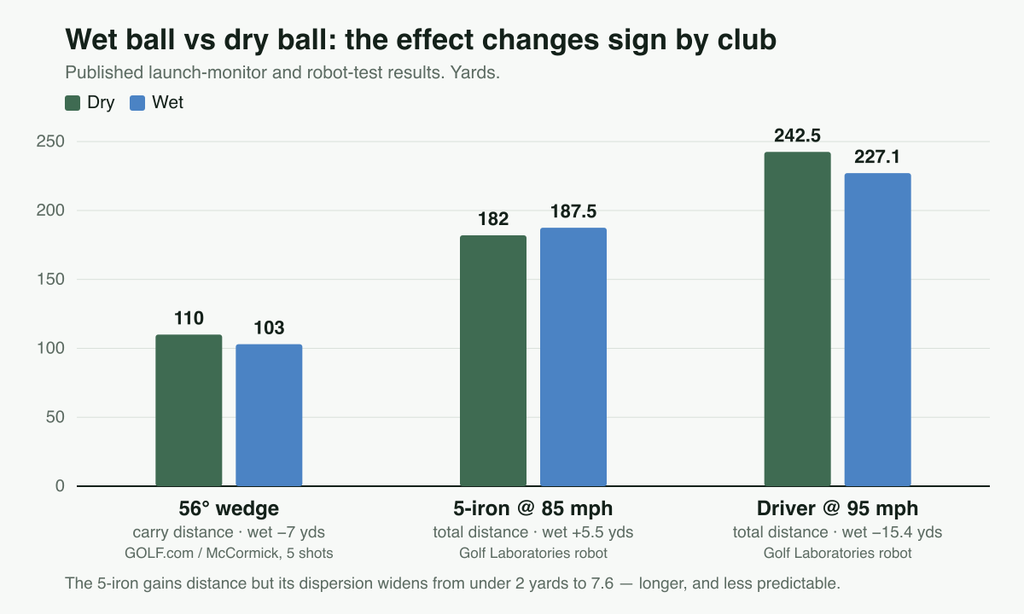
- Wedge, shorter. A five-shot TrackMan comparison run for GOLF.com by Cameron McCormick had wet 56° shots carrying 103 yards at 7,162 rpm and 32° launch, against 110 yards at 10,430 rpm and 26.6° dry. Seven yards shorter, 31% less spin, 5.4° higher.
- Mid-iron, longer and wilder. A Golf Laboratories robot test published by Golf Digest fired a 5-iron at 85 mph and found the wet ball going 187.5 yards total against 182 dry, while dispersion widened from under 2 yards to 7.6. Spin loss turned it into a flyer.
- Driver, shorter. The same robot at 95 mph with a 10.5° driver sent the wet ball 227.1 yards total against 242.5 dry, a 15.4-yard, 6.4% loss. A wet fade lost about 14 yards and a wet draw more than 17.
The mechanism is consistent even though the outcomes are not. Less spin means less lift. On a wedge, where spin is doing the work of holding the ball up and stopping it, losing it costs carry and all stopping power. On a mid-iron, where the trajectory is already efficient, losing spin flattens the flight into a longer, hotter, less predictable one. On a driver, launched with a small spin budget to begin with, water pushes it below the window that keeps it airborne.
Andrew Rice’s 2013 wedge test isolated where the water sits. A 54° wedge with a dry face and dry ball launched 25.4° at 6,603 rpm. Wetting only the face gave 27.8° and 5,463 rpm. Wetting only the ball gave 30.1° and 5,291 rpm. The ball matters more than the face, which is the argument for drying it whenever the Rules let you.
Equipment variation is wide enough to be worth naming. MyGolfSpy’s 20-player wet wedge testing found median launch rising nearly 4° in wet conditions, with some wedges losing close to 50% of their spin and others losing essentially none. Their 2022 follow-up ranged from a PING Glide 4.0 gaining 174 rpm to a Vokey SM9 losing 504. Groove geometry and face treatment are doing real work here, so treat the percentages above as a range your own gear sits somewhere inside.
The wet rough version has its own trap. Light wet rough lubricates the collision and produces the classic flyer, but deep saturated rough can grab the hosel hard enough to slow the club and leave the shot short. The same lie description covers both outcomes, which is why lie assessment beats a fixed flyer allowance. The full friction story sits in how to put backspin on a golf ball.
Wet greens are receptive because the surface is soft
The two claims golfers make about wet greens are that they are slower and that they hold shots better. The second is broadly true. The first is far less reliable than it sounds.
USGA Green Section agronomy reports that root-zone moisture on its own may have negligible effect on green speed. What shortens roll is surface water, dew and wet leaf blades creating a sticky surface. Mowing height, rolling, grass species and rainfall intensity all outrank the binary label of wet. There is no supported Stimpmeter deduction for a wet green, and the widely traded “a 10 becomes a 7” line has no measurement behind it.
Scale matters here too: USGA-cited research found the average golfer cannot reliably detect a Stimpmeter difference below about 6 inches. A lot of what feels like a dramatically slower green is inside the noise floor of human perception, with the visible water and the awkward stance doing the rest.
Receptiveness is the real change. Softer soil means a shallower first bounce and less rollout, which is why a wet green holds an approach that a firm one would have rejected. The surface is doing the stopping, and it does so while the ball is arriving with less spin than usual, which is the part golfers get backwards when they credit the check to extra bite. Your green-reading process still applies; the routine for reading break and speed does not change because the grass is wet, but the first putt of the day should be treated as a calibration putt rather than a make attempt.
The plays-like ledger
Each published coefficient above comes from a different test measuring a different thing, and no source combines them. Stacking them in a fixed order is what turns a pile of numbers into one club decision. Four lines, applied to one shot.
- Start from carry, not total. The wind and temperature coefficients act on the ball in the air, so the base number has to be a carry yardage. Pull it from a launch-monitor session or from the handicap-banded benchmarks, and keep it where you can read it in the rain.
- Apply the wind, then the temperature. Add about one yard per mph into the wind, subtract about half a yard per mph downwind. Then take Titleist’s temperature figure as a percentage of the shot rather than a flat yardage: 1.5% per 20°F below your measurement temperature, which is about 2 yards on a 150-yard shot and 3 on a 200-yard one. The wind rule is calibrated near a normal mid-iron approach, so scale it down for a wedge and up for a driver.
- Apply the wet-ball correction only where a carry figure exists. The wedge test measured carry, so its 7-yard loss drops straight into the ledger. The 5-iron and driver robot results are total distance, which cannot be subtracted from a carry number without double-counting the rollout you are about to remove in step 4. Carry them as warnings instead: the wet mid-iron flies hotter with roughly four times the dispersion and will not stop, and the wet driver is measurably shorter.
- Take the rollout out, then commit. On soft ground the carry is the whole shot, so add nothing back for release. Write the final number down, pick the club that carries it with a controlled swing, and stop recalculating over the ball.
A worked example. A 150-yard carry 7-iron, into 12 mph, at 55°F when the numbers were measured at 75°F, with a wet ball on a soaked fairway. Wind adds 12. Temperature adds about 2, being 1.5% of 150. No wet-ball yardage adjustment applies, because the only mid-iron measurement available is a total-distance figure on firm ground. The number is roughly 164 yards of carry with no rollout coming, which is a 6-iron or a 5-iron struck at three-quarter speed rather than a 7-iron thrashed. The wet-ball warning still applies to the shot after it: expect it to release rather than check.
The ledger’s value is that it forces the effects to be counted separately, and that it refuses to mix a carry figure with a total-distance one. Golfers who eyeball it almost always take one club and stop, which handles the wind and ignores everything else.
Dry hands beat every other rain skill
Grip pressure is the first casualty of rain, and it is the one with a measured cost. In a five-shot launch-monitor comparison filmed by a single golfer, a 5-iron struck wearing a rain glove produced roughly 123 mph ball speed and 176 yards of carry, against 112 mph and 155 yards in a soaked leather glove and 114 mph and 159 yards in an all-weather glove. Average offline was about 3 yards with the rain glove and 12 to 14 yards with the alternatives. One player and five shots per condition, so treat the specific numbers as anecdotal. The direction of the result lines up with the routine the tour caddies below describe.
MyGolfSpy’s rain-glove testing protocol is worth knowing because of what it assumes: gloves are evaluated damp, after five sprays, and soaked, after 10 seconds submerged, with five 7-iron swings in each state. Wet is the condition they are built and graded for, so the towel’s job is your grips and your bare hand rather than the glove.
PGA Tour caddies interviewed about wet-weather routine converge on the same system: several spare dry towels, one hung underneath the umbrella where it stays dry, a bag rain hood on before the first drop rather than after, and grips kept covered until the moment of the shot. Run two towels with fixed jobs. One lives under the umbrella and touches only hands and grips. The other hangs outside and takes the clubheads, the mud and the ball. The moment they swap roles, both are wet and you have nothing.
Rule 4.3 permits all of it: rain gloves, drying a grip with a towel, wrapping a towel around a grip, and grip powder. You may hold your own umbrella while making a stroke.
The rulings that only show up when it rains
Four come up almost every wet round, and knowing them cold is worth strokes.
Temporary water, Rule 16.1. The current term for casual water. It counts if the water is visible before or after you take a normal stance without excessively pressing down. Outside a penalty area, relief is free at the nearest point of complete relief no nearer the hole, with a one club-length relief area. On the putting green the ball is placed at the nearest point of complete relief rather than dropped. Bunkers carry extra restrictions.
Embedded ball, Rule 16.3. Free relief when the ball is embedded in its own pitch-mark in the general area, dropped within one club-length of the spot immediately behind it, no nearer the hole. The exception is a ball embedded in sand in an area not cut to fairway height or less. Some committees restrict this to fairway-height areas by Local Rule, so read the notice.
Preferred lies, Model Local Rule E-3. Lift, clean and place is not automatic because the course is wet. It requires the committee to have adopted MLR E-3, which defines the eligible area and the placement distance, commonly 6 inches, a scorecard length or a club-length. The ball is placed, not dropped, and must stay in the general area and no nearer the hole. Check the board before you touch anything.
Stopping play, Rule 5.7. You may stop on your own when you reasonably believe lightning presents a danger, provided you report it to the committee as soon as possible. The rest of the rulings that quietly cost shots are collected in golf rules for beginners.
Lightning: when to walk in
The National Weather Service’s guidance for outdoor sport has replaced the old counting exercise with one sentence: when thunder roars, go indoors. Thunder means the storm is already within striking range. Do not wait for rain and do not wait for a 30-second count.
The historical 30-30 rule — a flash-to-bang interval of 30 seconds or less indicating lightning within about 6 miles, then 30 minutes of shelter after the last thunder — survives in the second half. Wait at least 30 minutes after the last thunder before going back out, and restart the clock every time you hear it again.
Shelter has to be a substantial enclosed building or a fully enclosed hard-topped vehicle. An open golf cart is not one. Neither is a small on-course rain shelter, an isolated tree, a hilltop or anything near a wire fence. In competition, the USGA’s signal for immediate suspension because of imminent danger is one prolonged horn note, and play must stop before the next stroke.
Common mistakes
- Adjusting a total-distance number. Every coefficient in this post acts on the ball in the air. Applying them to a summer total distance, then playing a soft fairway that gives no roll, double-counts yardage you are not getting.
- Giving downwind shots a full club of credit. The tailwind is worth about half the headwind, which is why the long miss happens downwind and the short miss happens into.
- Swinging softer without taking more club. Deceleration alone can leave spin unchanged or higher. The club change is what lowers delivered loft.
- Treating a wet lie as one thing. Light wet rough flies. Deep saturated rough comes up short. The lie decides, not the weather report.
- Assuming a wet green is slow. Under 6 inches of Stimpmeter difference is undetectable to most golfers, and root-zone moisture alone may change nothing. The first putt is a calibration.
- Drying the rain glove. Rain gloves are built and tested wet, soaked before the swings that grade them. The towel’s job is the grip and your bare hand.
- Assuming lift, clean and place applies. It needs Model Local Rule E-3 to be in force. Touching the ball without it is a penalty.
Build the numbers before the weather arrives
Every adjustment above multiplies a carry number you either have or you don’t. Most golfers have a total distance from a firm summer fairway and nothing else, which makes the whole ledger unusable on the day it matters. One range session fixes it. Measure carry, club by club, and write it somewhere you’ll still have it in the rain.
The rest of the weather skill set is decision-making under a shorter clock, which is the same thing course management trains in good conditions. PracticeCaddie builds sessions around the leaks your own scoring record shows, gapping included. Build a free practice plan in 30 seconds and the plays-like ledger becomes arithmetic you already trust.
Related reading
- Strokes Gained Explained for Amateurs — the framework that says which part of your game is actually costing shots, and the pillar this post spokes into.
- Golf Course Management Tips — the five highest-cost amateur decisions in normal conditions, which are the same decisions weather makes harder.
- How to Hit a Punch Shot — the mechanics of the low wind shot: more club, ball back, hands ahead, low finish.
- How to Hit a Stinger — the extreme low-spin version, and when it beats a punch.
- Average Golf Club Distances — the carry benchmarks by handicap that every adjustment in this post multiplies.
- How to Read Greens in Golf — break, speed and a repeatable routine that survives a wet first green.
- How to Put Backspin on a Golf Ball — the friction story behind why water at impact removes spin.
- Golf Rules for Beginners — the 12 rulings that arrive every round, alongside the wet-weather four above.
- Golf Practice Plan — the weekly structure that has room for a gapping session.
Key takeaways
- Wind is the weather the data punishes. 108,492 PGA Tour rounds put average wind at +0.1133 strokes per mph, so a 10 mph difference is worth about 1.1 strokes a round.
- Add 1 yard of playing distance per mph into the wind, subtract half that downwind. TrackMan’s modelling agrees on the asymmetry: at 20 mph a headwind hurts almost twice what the same tailwind helps.
- A headwind does not add spin. It increases relative airflow, so existing spin makes more lift and drag. TrackMan: “The ball DOES NOT spin more when hit into a headwind.”
- The wind shot is more club, a centred strike and lower delivered loft. Harmon’s version is two extra clubs at about 75% with the ball an inch back.
- The wet-ball effect changes sign by club. Measured: wedge −7 yards carry, 5-iron +5.5 yards total with dispersion widening from 2 to 7.6 yards, driver −15.4 yards total.
- Damp air is worth 1–2 yards across the whole humidity range, and humid air is slightly less dense, so it helps rather than hurts.
- Cold costs about 1.5–2 yards per 10°F, per Titleist’s 1.5%-per-20°F figure and TrackMan’s normalization range.
- Wet greens are receptive; their speed barely moves. No Stimpmeter deduction is supported, and golfers cannot detect a difference under about 6 inches.
- Lift, clean and place needs Model Local Rule E-3. Temporary water relief under Rule 16.1 and embedded-ball relief under Rule 16.3 are always available; preferred lies are not.
- When thunder roars, go indoors, and wait 30 minutes after the last thunder. An open golf cart is not shelter.
Frequently asked questions
How much does wind affect a golf ball?
The working rule from Andrew Rice and Mark Broadie, aimed at golfers with roughly 80 to 95 mph driver speed, is to add the headwind speed in mph as yards of playing distance and subtract half of it downwind. A 10 mph headwind plays about 10 yards longer; a 10 mph tailwind plays about 5 yards shorter. TrackMan’s modelling agrees on the asymmetry, finding that in a constant 20 mph wind a headwind hurts almost twice as much as the same tailwind helps. Both are club-selection heuristics rather than physical constants.
Do you lose distance playing golf in the rain?
Usually, though the size and even the direction depend on the club. In a Golf Laboratories robot test, a wet ball struck with a 10.5-degree driver at 95 mph travelled 227.1 yards total against 242.5 dry, a loss of 15.4 yards. The same test found a wet 5-iron went 5.5 yards further than dry because reduced spin turned it into a flyer, while dispersion widened from under 2 yards to 7.6. A five-shot wedge test lost 7 yards of carry when wet. Damp air itself is worth only a yard or two.
Should you swing easier in the wind?
Take more club and make a controlled, centred strike with lower delivered loft. Butch Harmon’s version is two extra clubs, a swing at about 75%, the ball roughly an inch back and a three-quarter finish. The physics behind it is spin loft, which TrackMan defines as the angle between where the clubhead is moving and where the face points. Simply decelerating does not work: if you add dynamic loft, strike low on the face or steepen the attack angle, spin can stay high or rise even at slower speed.
Are golf greens slower when wet?
Often barely, and no standard Stimpmeter deduction is supported. USGA Green Section agronomy points out that root-zone moisture by itself may barely change speed, while surface water, dew and wet leaf blades create the sticky conditions that shorten roll. Mowing, rolling, grass species and rainfall intensity all matter more than the label wet. USGA-cited research also found the average golfer cannot reliably detect a Stimpmeter difference smaller than about 6 inches, so small moisture-driven changes are below the threshold you can feel.
Can you get free relief from puddles on a golf course?
Yes. Standing water is called temporary water under Rule 16.1, and it counts if it is visible before or after you take a normal stance without excessively pressing down. Outside a penalty area, relief is free: find the nearest point of complete relief no nearer the hole, then drop within one club-length of it. On the putting green the ball is placed at the nearest point of complete relief instead. Bunkers carry their own restrictions. Lift, clean and place is separate and only applies if the committee has adopted Model Local Rule E-3.
When should you stop playing golf because of lightning?
As soon as you hear thunder. The National Weather Service’s guidance for outdoor sport is that thunder means lightning is already close enough to strike, so head immediately for a substantial enclosed building or a fully enclosed hard-topped vehicle. Wait at least 30 minutes after the last thunder before resuming, restarting the clock if you hear it again. Rule 5.7 lets you stop play on your own when you reasonably believe lightning is dangerous, provided you report it to the committee as soon as you can.
Does rain actually make you score worse?
The wind does; the rain itself is less clear. A peer-reviewed study of 108,492 PGA Tour rounds from 2017 to 2023 found average wind speed added about 0.1133 strokes per mph, so a 10 mph difference is worth roughly 1.1 strokes a round. The precipitation coefficient came out at minus 0.1468 strokes per inch, meaning scores were slightly lower on wetter days. That is observational rather than causal: rain softens greens and fairways, which makes a hard course more forgiving.