Golf Swing Weight Explained: What D2 Actually Means
D2 means 217 ounce-inches about a point 14 inches down the grip. Work from that and you can price a strip of lead tape in points on any club in the bag.
Quick answer
Swingweight is the balance of a club about a point 14 inches from the butt of the grip. D2 means 217.00 ounce-inches on that scale, and each point is a fixed 1.75 ounce-inch step. Because a point is a fixed moment, the grams it takes to move one change with club length: 1.56 g on a driver, 2.31 g on a 9-iron.
Golf swing weight chart: what each reading means
| Reading | Moment about the 14-inch fulcrum | Where you normally see it |
|---|---|---|
| B0 | 178.50 oz-in | Junior and ultralight builds |
| C0 | 196.00 oz-in | Light women’s and senior assemblies |
| C3 | 201.25 oz-in | PING’s stock G Le4 women’s driver |
| D0 | 213.50 oz-in | PING’s stock G440 irons, 4-iron through 8 |
| D2 | 217.00 oz-in | The default men’s iron build |
| D3 | 218.75 oz-in | TaylorMade’s stock Qi35 driver at 45.75 inches |
| D5 | 222.25 oz-in | Rory McIlroy’s 2026 Masters driver |
| E0 | 231.00 oz-in | Rory McIlroy’s putter |
Two of those moments are published measurements and the rest follow from the step size. Dave Tutelman’s conversion table puts C-0 at 196.00 inch-ounces and D-0 at 213.50, with each point worth 1.75 inch-ounces, or roughly 50 inch-grams. Ten points separate one letter from the next, so the whole scale unrolls from those two anchors.
The club specs come from the makers: PING lists the G440 irons at D0 from the 4-iron through the 8, the G Le4 driver at C3, and TaylorMade’s Qi35 sheet gives D3 at 45.75 inches with a note worth reading twice: “Stated swingweight targets represent stock build configurations only.” McIlroy’s numbers are from GOLF.com’s 2026 Masters bag breakdown.
What swing weight actually measures
Swingweight measures a moment. Put the club on a fulcrum 14 inches from the butt of the grip, and swingweight is the turning force the head end exerts about that point. Total weight in ounces times the distance from the fulcrum to the club’s balance point. That is the whole definition.
The GolfWorks states it in one line in its swingweight chapter: “Swingweight can be defined as the weight relationship of a golf club about a fixed fulcrum point.” Everything behind the 14-inch mark counts against the reading and everything in front of it counts toward it. As that document puts it, “all of a club’s weight in front of the fulcrum point will be considered as head weight, while all behind the 14” mark will act as grip weight.”
The scale itself is arbitrary. Robert W. Adams was granted US Patent 1,953,916 in April 1934 for an “Apparatus for Measuring Moments of Golf Clubs and the Like,” and its first claim specifies positioning the club “with its handle end at a distance of approximately fourteen inches from said pivot.”
The Lorythmic letter-number labels were laid over the resulting ounce-inch readings afterward. Nothing in physics nominates 14 inches or picks D2. It is a repeatable production reference that the industry standardized on and then kept.
So the two questions golfers run together have separate answers. A club is heavier because it has more mass. A club posts a higher swingweight because more of its mass sits farther from that one arbitrary point.
The one number that replaces four rules of thumb
Every clubmaking table you will find lists separate rules for head weight, grip weight, length and shaft weight. All four fall out of a single constant.
A swingweight point is 1.75 ounce-inches. An ounce is 28.3495 grams, so a point is 49.61 gram-inches. Divide that by the moment arm, meaning the distance from the 14-inch fulcrum out to wherever you are adding mass, and you get the grams it takes to move the reading one point at that spot:
grams per point = 49.61 ÷ (distance from the butt − 14)
It reproduces the published charts. The GolfWorks names the exact length at which the folk rule is true: “To be exact, a club that was 38 3/4” long would require 2 grams for a 1 swingweight change.” Put the added head mass at the club’s own length and the formula returns 2.00 grams at 38.75 inches.
Put it at a grip’s center of mass, roughly 5 inches up from the butt, and it returns 5.5 grams against The GolfWorks’ published 5-gram grip rule. Put it in a butt counterweight an inch or two from the end and it returns about 4 grams, which is the figure clubmakers use for counterweighting.
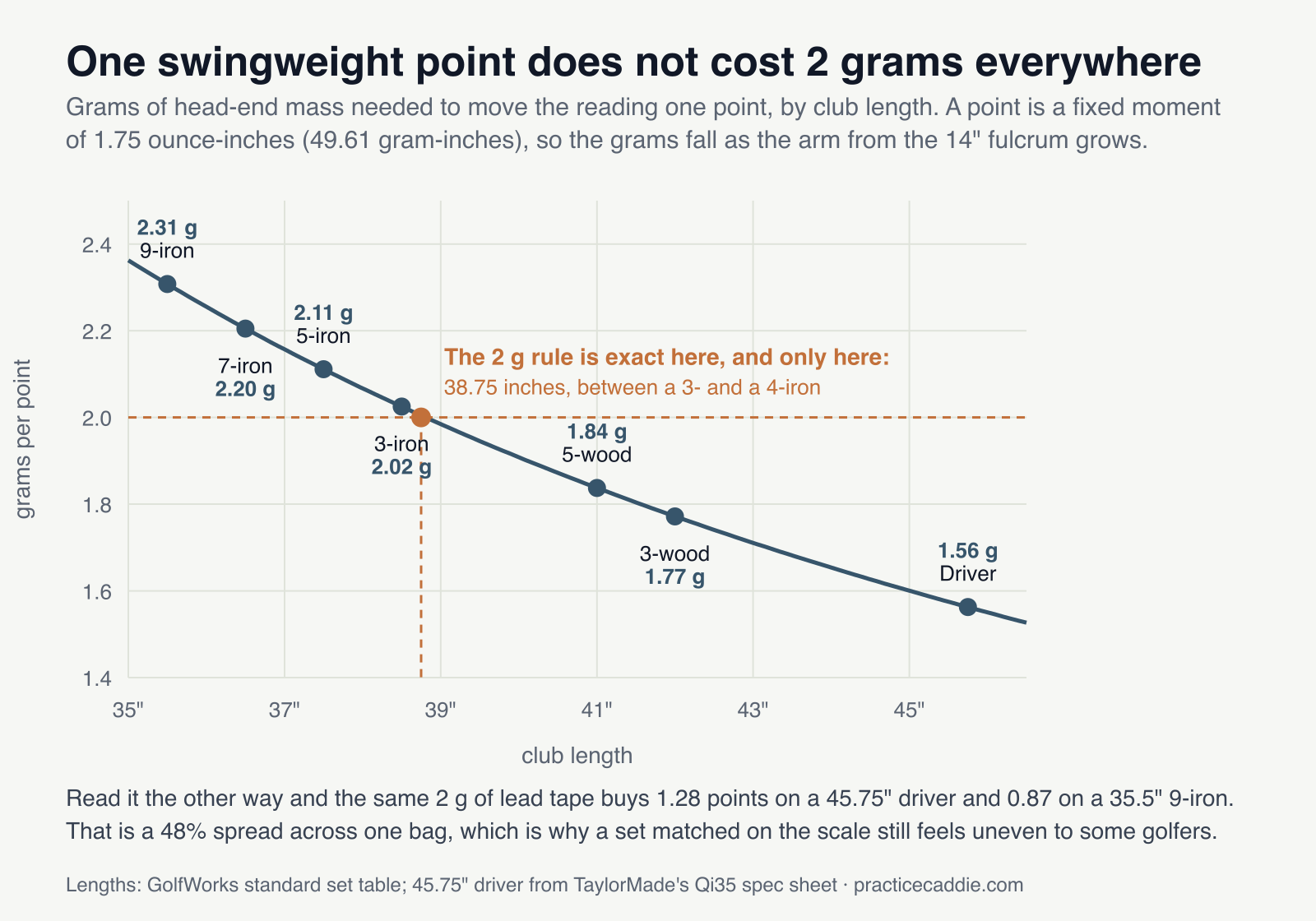
Read the curve the other direction. Two grams of lead tape moves a 45.75-inch driver about 1.28 points and a 35.5-inch 9-iron about 0.87. Same tape, same hands, 48 percent difference in what it buys. A clubmaker matching a whole set to D2 is applying a different physical change at every station, which is the strongest argument the MOI-matching camp has.
The rules of thumb, and where they came from
| Change | Direction | The published rule |
|---|---|---|
| Add 2 g at the clubhead | Heavier | +1 point, exact at 38.75 inches |
| Add 1/2 inch of length | Heavier | +3 points |
| Add 5 g of grip | Lighter | −1 point |
| Add 9 g of shaft | Heavier | +1 point, flagged as approximate |
| 4 inches of 1/2-inch lead tape | Heavier | +1 point on a mid-iron |
| 3 wraps of masking build-up tape | Lighter | −1 point |
Every row is from The GolfWorks’ swingweight chapter. The shaft row carries its own footnote in the original: “Unlike the other three factors, as shaft weight changes its effect on swingweight changes at a disproportionate rate.” Balance point is why.
That document’s own example runs a standard-length club at D0 with a parallel steel shaft, then swaps shafts without touching anything else: a tip-heavy graphite shaft leaves it near D0, while a butt-heavy graphite shaft drops it to somewhere between C4 and C7. Two graphite shafts, similar weights, three to six points apart. The steel versus graphite comparison covers what that does to the rest of the club.
Swing weight chart by club and player type
| Category | Typical reading | Source |
|---|---|---|
| Men’s stock driver | D0–D3 | Mitchell Golf; TaylorMade lists Qi35 at D3 |
| Men’s stock steel irons | D2–D4 on the chart, D0 on the shelf | Mitchell Golf; PING lists G440 at D0 through the 8-iron |
| The same irons in graphite | 2–3 points lighter | PING’s own spec note |
| Women’s stock clubs | C4–C9 on the chart, C3 on the shelf | Mitchell Golf; PING lists G Le4 at C3 |
| Tour irons | D2–D5 | Mitchell Golf; McIlroy at D4 |
| Tour wedges | D4–D6 | Mitchell Golf; McIlroy at D4–D5 |
Mitchell Golf’s reference supplies the generalized bands, and the OEM pages supply the checks. One of those checks is worth pulling out on its own: PING’s G440 page states that “Standard swingweights for graphite-shafted clubs are 2 to 3 points lighter than shown.” The same head, the same length, the same target, and the number moves three points because the shaft got lighter in front of the fulcrum.
Tour drivers break the generalized band in both directions, which is the honest read on how much the number means. Mitchell puts tour drivers at D1 to D3. Golf Digest reported in July 2025 that Emiliano Grillo plays a C4 driver built around a head of about 180 grams and a 53-gram shaft, while McIlroy’s Masters driver was listed at D5. That is an eleven-point span between two players on the same tour.
What the research says about whether it matters
The only peer-reviewed study built specifically to answer this question found less than the industry hoped.
Harper, Roberts and Jones published “Driver swingweighting: A worthwhile process?” in the Proceedings of the Institution of Mechanical Engineers, Part B in 2005. Thirty skilled golfers hit ten tee shots each with four differently weighted drivers, with clubhead mass varied by screwed inserts of known mass.
Their conclusion, from the paper’s own abstract: “Changes to golf club weight distribution, measured using the swingweight concept, were found to have little effect on player performance and, in general, golfers were unable to perceive small changes in club swingweight.” They went further and suggested manufacturing tolerances could be relaxed.
The field testing is messier and more useful. Plugged In Golf ran six golfers from scratch to low teens through one 6-iron at D0, D3, D6 and D9, five shots per condition on a Trackman. Five of six lost club speed moving from D0 to D9, an average of 2.75 mph, and five lost ball speed, averaging 2.2 mph.
The accuracy result is the one to sit with: one player was most accurate at D0, two at D3, two at D6 and one at D9. Every condition they tested won for somebody.
That is a small sample with five shots per cell and no inferential statistics, so treat it as directionally useful rather than settled. It agrees with Harper on the important half, though. Speed drifts down as head mass goes up, and the best number is personal.
Two named fitters bracket the practical range. Avery Reed of Fairhope Golf Works told Golf Digest that at “D5 and above, the head feels very heavy in transition, like swinging a sledgehammer,” and that “a really light swingweight — C7 and below — makes it very difficult for the player to feel the head.”
From the other side, Kris McCormack of True Spec Golf argued in July 2025 that the spec is the most overhyped in the bag: “as someone who’s been fitting and building clubs for over two decades, let me tell you… I can’t” feel the difference between D1 and D2. His framing is that “your body doesn’t care about the number. It cares about feel. And performance.”
Both can be true. A three-point change is worth testing and a one-point change is production noise.
Swing weight vs total weight vs MOI
Three specs get conflated constantly, and separating them explains most of the confusion.
- Total weight is what the club weighs on a kitchen scale, head plus shaft plus grip plus epoxy. It is the spec your body actually has to accelerate.
- Swingweight is the balance about the 14-inch point. It says where the mass sits, and nothing about how much there is.
- Whole-club MOI is rotational inertia, measured in kg·cm², and it weights distance squared rather than linearly.
The gap between the second and the third is the standing critique of swingweight. Two clubs of different lengths can post the same D2 and still take different effort to swing, because MOI grows with the square of the distance while swingweight grows linearly. That is the case Tom Wishon has made for MOI matching for years.
Evidence that MOI-matched sets outplay swingweight-matched sets is thinner than the argument for them, so the honest position is that swingweight is an imperfect production reference with a century of installed base, and the alternative has not yet cleared the bar. The gap between the first and second specs is easier to demonstrate, and the grip size chart has the cleanest example: a heavier grip lowers the swingweight reading while raising the club’s total mass, so the number moves in the opposite direction from the club in your hands.
How to test it without buying a scale
The protocol in this post’s steps runs on lead tape and foot spray. Three points is the smallest interval worth testing, which is about 6.6 grams on a 7-iron or 4.7 grams on a driver. Score the strike pattern first, because reading your divots and your face marks gives you the same outcome variable Harper measured, without a launch monitor. If you do have one, the numbers worth watching are club speed and dispersion width rather than a single carry average.
Two cautions from the source material. The GolfWorks recommends adding no more than 5 swingweight points, about 10 grams, inside a steel shaft, and no more than 6 grams by tip pin in graphite, because more than that starts to move the head’s center of gravity. And lead tape adds mass without steering the ball: “It would require nearly 50” of tape to have even a slight effect on ball flight.”
Common mistakes
- Restoring D2 after a grip change. A midsize grip already added 10 to 15 grams to the club. Adding head weight to put the scale back where it was makes the club heavier twice.
- Comparing a driver’s swingweight to a wedge’s. They are readings on the same scale from very different moment arms. A D4 wedge and a D4 driver have almost nothing in common.
- Chasing a one-point difference. The people who sell the scales call one point nearly imperceptible. Two to three points is where testing starts.
- Reading a shaft’s gram weight as a swingweight prediction. Balance point is what moves it, which is how a butt-heavy graphite shaft can read up to six points lighter than a tip-heavy one of similar mass.
- Treating the OEM spec as your club’s spec. TaylorMade’s own sheet says stated swingweight targets represent stock builds only. Your length, grip and shaft all moved it.
- Assuming heavier is more consistent. In the only six-golfer test with published per-player data, the most accurate condition ran the full range from D0 to D9.
For deeper dives
- Golf Shaft Flex Chart: What Swing Speed Actually Tells You — the spec directly above this one, and why nine shafts recommended for the same golfer measured 23 CPM apart.
- Steel vs Graphite Iron Shafts — the 46.5-gram window both materials share, which is where most of your swingweight surprises come from.
- Golf Grip Size Chart — the other end of the club, and the study that separated grip diameter from grip weight.
- Cavity Back vs Blade Irons — the head this whole measurement is weighing.
- How to Measure Putter Length — the one club measured along a different axis, and why its swingweights run so high.
- How to Grip a Golf Club — the fundamentals hub that every equipment spec here hangs off.
- Launch Monitor Numbers Explained — which readings to watch when you do test a spec change with data.
- The driving range practice plan — the session structure that makes a two-condition test worth running.
Key takeaways
- D2 is 217.00 ounce-inches about a fulcrum 14 inches from the butt. D0 is 213.50, and every point is a fixed 1.75 ounce-inch step.
- A point costs 49.61 gram-inches, so divide 49.61 by your club’s length minus 14 to get the grams. That single constant reproduces the 2-gram head rule, the 5-gram grip rule and the 4-gram counterweight rule.
- The 2-gram rule is exact at 38.75 inches and nowhere else. The same 2 grams buys 1.28 points on a 45.75-inch driver and 0.87 on a 35.5-inch 9-iron.
- A heavier grip lowers the reading and raises the club’s actual weight. Roughly 5 grams at the grip end moves it one point in the lighter direction.
- Thirty skilled golfers could not perceive small swingweight changes in the only peer-reviewed study built to test it, and the same paper found little effect on performance.
- The best number is personal. Across six testers at D0, D3, D6 and D9, every condition was somebody’s most accurate.
- Test in 2- to 3-point steps with lead tape, score the strike pattern before the feel, and put the finished club on a real scale.
Frequently asked questions
What is swing weight in golf?
Swingweight is the balance of a club about a fixed point 14 inches from the butt of the grip, reported on a letter-number scale from A0 up to E9. It measures how head-heavy the club reads on a scale, expressed as a moment in ounce-inches rather than as a weight in grams. Two clubs with very different total masses can post the same swingweight, and two clubs at the same swingweight can weigh quite different amounts.
What does D2 swing weight mean?
D2 means the club balances at 217.00 ounce-inches about the 14-inch fulcrum. Dave Tutelman’s conversion table puts D0 at 213.50 ounce-inches, and every step up the scale adds exactly 1.75, so D1 is 215.25 and D2 is 217.00. The letter is a band of ten points and the digit is the step inside it. D2 carries no claim about head weight, total weight or performance; it is a coordinate on a 1930s balance scale.
How much does 2 grams change swing weight?
It depends entirely on club length, because a point is a fixed moment and the moment arm grows with the club. The GolfWorks states the 2-gram rule is exact at 38.75 inches, roughly between a 3-iron and a 4-iron. Run the same arithmetic across the bag and 2 grams buys about 1.28 points on a 45.75-inch driver and about 0.87 on a 35.5-inch 9-iron, a 48 percent spread inside one set.
Does a heavier grip lower swing weight?
Yes, and it raises total club weight at the same time. Mass behind the 14-inch fulcrum counts against the reading, so The GolfWorks puts roughly 5 grams at the grip end at one swingweight point in the lighter direction. Its own worked example swaps a 50.8-gram Golf Pride Tour Velvet for a 68-gram Jumbo Victory and moves a D2 club to a bit above C8. The scale went down; the club in your hands got heavier.
Is a higher swing weight better?
The published testing says the best number is personal. Plugged In Golf ran six golfers at D0, D3, D6 and D9 on one 6-iron: five of six lost club speed going from D0 to D9, an average of 2.75 mph, yet the most accurate condition was D0 for one player, D3 for two, D6 for two and D9 for one. Every swingweight tested was somebody’s best. There is no population answer to inherit.
What swing weight do tour players use?
Published bags run wider than the generalized charts suggest. Mitchell Golf’s tour bands are D1 to D3 for drivers, D2 to D5 for irons and D4 to D6 for wedges. Individual builds break those edges in both directions: Emiliano Grillo has played a C4 driver with a roughly 180-gram head, while Rory McIlroy’s 2026 Masters bag listed a D5 driver, D4 irons, D4 to D5 wedges and an E0 putter.
Can you feel a one-point swing weight difference?
Probably not, and the sources that sell swingweight scales say so themselves. The GolfWorks calls a single point nearly imperceptible, puts an accomplished player at about 2 points and most average players at about 3. Harper, Roberts and Jones tested 30 skilled golfers over ten drives each with four differently weighted drivers and reported that golfers were generally unable to perceive small changes. Test in 2- to 3-point steps or you are testing nothing.