
Putting Practice at Home: What a Carpet Can and Can't Train
A 10-foot putt leaves 0.21 inches of daylight each side of the ball, one foot out. Build that gate and a carpet trains start line. Speed waits for a green.
What putting practice at home is good for
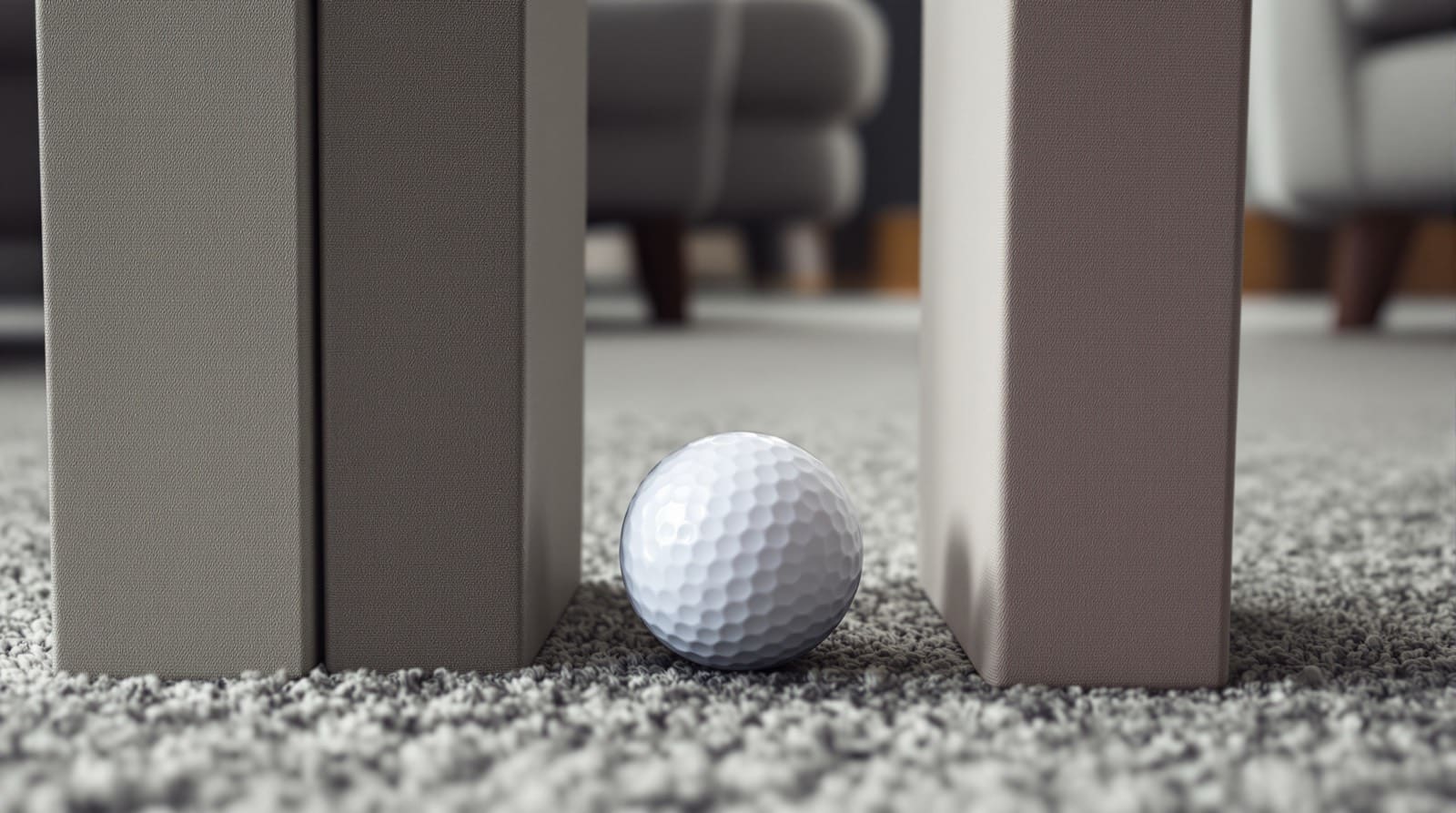
Putting practice at home trains start line and aim. Speed and green reading stay on the course. Household carpet has been measured at anything from Stimp 5 to past 20, so pace learned on it will not match a course. Start line does carry over, and it can be tested with a ruler: a gate 2 1/8 inches wide, set 12 inches ahead of the ball, is the window of a straight 10-foot putt.
Short putts are lost at the start line
Face angle decides where a putt starts. Karlsen, Smith and Nilsson (2008) recorded 1,301 putts from 71 elite golfers in the Journal of Sports Sciences and split direction consistency into its parts. Face angle accounted for 80%, putter path for 17% and where the ball met the face for 3%.
Start line is also where handicaps separate on the putts that should go in. Shot Scope’s amateur database has scratch golfers holing 92.8% from inside 6 feet and 25-handicaps holing 82.5%. From 6 to 12 feet the same two groups make 42.8% and 35.0%.
Inside 6 feet there is less break to read and less pace to judge than anywhere else on the green. The honest read is that a good share of that 10-point gap is the ball leaving the face on the wrong line, and start line is the one putting skill a living-room floor can test.
Carpet speed runs from Stimp 5 to past 20
Pace learned on carpet belongs to that carpet. Golf Digest’s David Owen borrowed a Stimpmeter from his club’s superintendent and measured his own house. The living-room rug read almost 15, a cheap level-loop carpet in the basement read over 20, and a loose cut-pile remnant at a carpet shop read 5.
Owen’s own verdict was that nearly every room in his house was too fast to host a PGA Tour event. For a second reference, the purpose-built putting green in a 2016 World Scientific Congress of Golf study by Sheppard, Hurrion and Collinson read Stimp 11. One house can hold surfaces close to twice as fast and half as fast as that.
A mat narrows the range without closing it. PuttOUT says its medium mat reads 10 on the Stimpmeter, and the putting carpet in the Sheppard study read 10.5. Those are flat, uniform strips with no grain and no slope, which is why the routine below asks nothing of the floor except that the ball rolls straight for a foot.
The gate that turns a carpet into a 10-foot putt
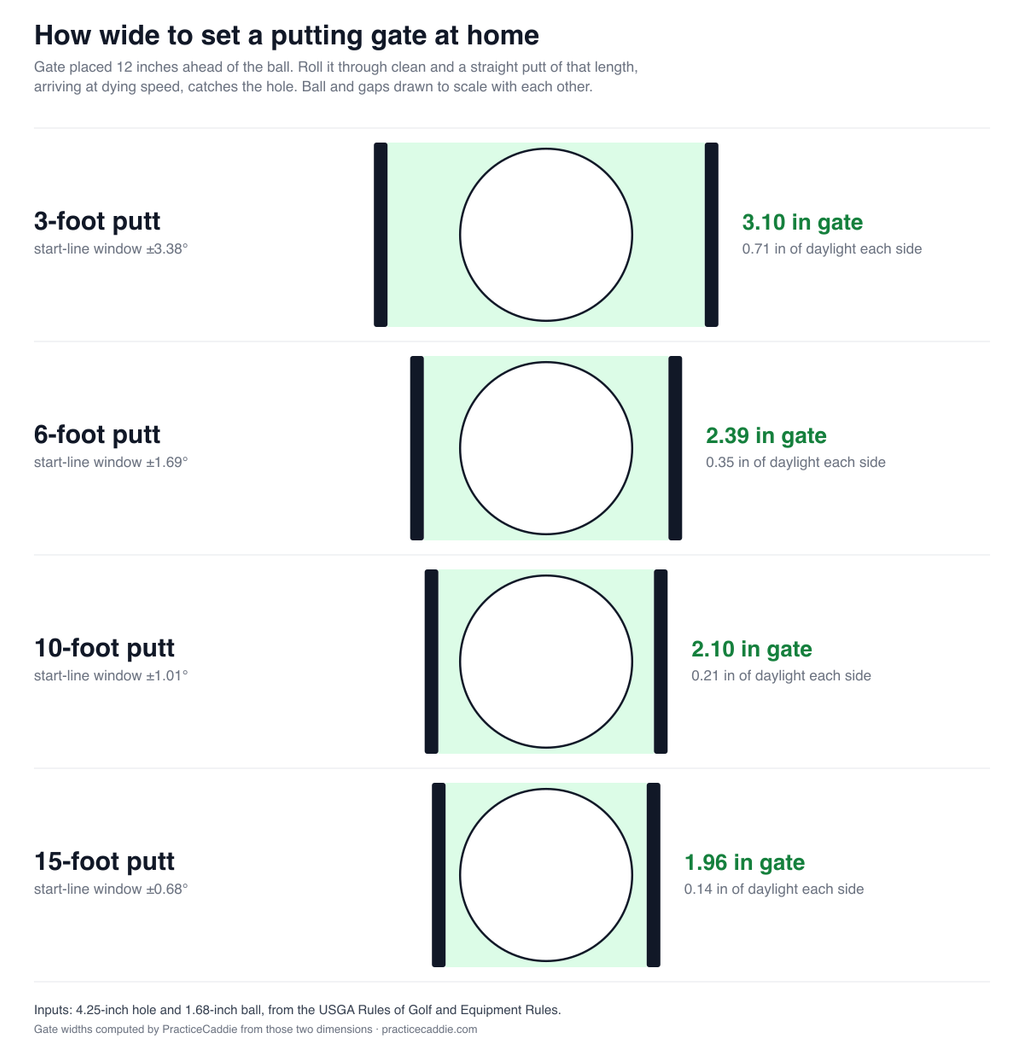
A gate one foot ahead of the ball can stand in for a hole 10 feet away. Under the Rules of Golf a hole is 4.25 inches in diameter, and the Equipment Rules set a ball at no less than 1.68 inches. A straight putt arriving at dying speed drops when the ball’s centre crosses any part of the hole, so the centre can miss the middle by up to 2.125 inches.
Scale that allowance back to a point 12 inches ahead of the ball and it shrinks in proportion. On a 10-foot putt, 2.125 inches at 120 inches becomes 0.21 inches at 12. Add the ball’s own 1.68 inches and the gate is 2.10 inches wide.
Gate widths by putt length
| Putt length | Start-line window | Daylight each side | Gate width | Nearest 1/8 inch |
|---|---|---|---|---|
| 3 feet | ±3.38° | 0.71 in | 3.10 in | 3 1/8 |
| 4 feet | ±2.53° | 0.53 in | 2.74 in | 2 3/4 |
| 5 feet | ±2.03° | 0.43 in | 2.53 in | 2 1/2 |
| 6 feet | ±1.69° | 0.35 in | 2.39 in | 2 3/8 |
| 8 feet | ±1.27° | 0.27 in | 2.21 in | 2 1/4 |
| 10 feet | ±1.01° | 0.21 in | 2.10 in | 2 1/8 |
| 15 feet | ±0.68° | 0.14 in | 1.96 in | 2 |
The table is PracticeCaddie’s arithmetic from those two published dimensions, with the gate fixed at 12 inches. Each figure is rounded after the calculation, so a width can sit 0.01 inches off the ball plus two gaps.
Phil Kenyon’s at-home programme for the DP World Tour lands in the same place from the other direction. He fixes the gate at 5 centimetres and moves it: 20 centimetres ahead of the ball for 1 degree of error, 28 for 0.75 and 43 for 0.5. The same geometry returns 1.05, 0.75 and 0.49 degrees for those three positions.
Treat every row as a ceiling. The window assumes a flat, straight putt that dies at the hole, and a firmer putt needs a tighter line. A sensible margin is to practise one row down: use the 10-foot gate to prepare for 6-footers.
A 10-minute daily putting routine at home
Short sessions on separate days are the better schedule. Dail and Christina (2004) had participants learn putting on a distributed or a massed schedule, and the distributed group putted better during practice and again on retention tests at 1, 7 and 28 days. The routine below is at least 43 putts and takes roughly 10 minutes.
The order inside the session matters too. Porter and Magill (2010) compared blocked, random and gradually increasing schedules for putting. Novices who started blocked, moved to a fixed rotation and finished random had the best retention scores of the three groups.
- Build the 6-foot gate. Lay a yardstick from the ball to a coin, stand two books on that line 12 inches ahead of the ball with 2 3/8 inches between them, then lift the yardstick away. Stan Utley told Golf Digest he practises at home between rails made from alignment sticks or rulers, and the same straight edges work here.
- Two blocked sets of 10. Ten putts through the 6-foot gate, then slide the books in to 2 1/8 inches and hit ten more. Count clean passes. A touch is a miss.
- Fixed order, three distances. Set three coins beyond the gate at different distances. Putt near, middle, far, three times through.
- Shuffled order. Nine more putts to the same coins in no planned order. Stroke length changes on every putt while the gate stays 2 1/8 inches wide.
- Closer. Five clean passes in a row, back to zero on any touch. Then write the scores down.
A workable standard is 8 clean passes out of 10 before narrowing the gate, the same bar the two-tee gate drill uses on grass. Clipping the same book again and again points to face angle at impact, or to aim at address. Check how the putter sits in your hands before rebuilding the stroke.
Adding quiet eye to the closer
The closer is the place to rehearse where your eyes go. Vine, Moore and Wilson (2011) trained elite golfers to hold a final fixation on the back of the ball for 2 to 3 seconds before the stroke began. On 10-foot putts under pressure the trained group holed 60% and the control group 36%.
That study used an artificial green and elite players, so the size of the effect may not carry to a 15-handicap on a rug. The habit costs nothing to copy, and it gives the last five putts of the session a job beyond counting.
What to save for the practice green
For elite players, the stroke is a small part of why putts miss. Karlsen’s group measured a European Tour player’s stroke direction varying by 0.39 degrees, which is tight enough to hole about 95% of putts from 4 metres. Top professionals hole about 17% from that distance in tournaments.
The 78 points between those figures sit outside the stroke, in what the paper lists as green reading, aim and inconsistencies in the green. A carpet has no slope to read.
Capture speed is a green-only skill for the same reason. The Pelz Institute’s testing concluded in 1991 that a putt rolling 17 inches past the hole is the optimum, and the Sheppard study shows why one number cannot cover every putt. On a 3-degree slope, a putt hit to finish one foot past shrank the effective hole by about 25% going uphill and about 5% going downhill.
Take those to grass. The lag putting drills cover pace with leave-distance targets, and how to read greens covers break. Both get easier to judge once you trust the ball to start where you aimed.
Does a putting mat beat carpet?
A mat buys a consistent roll, which is all this routine needs from a floor. Any floor where a ball rolls straight for 12 inches will test start line. Thick or patterned carpet can nudge a slow ball off line inside that first foot, and a mat or a strip of low-pile carpet removes that doubt.
A mat does not make home pace match your course. The mat-maker’s Stimp figure describes one strip on one floor, and your greens change with the season and the mower. Buy one for a true roll and a target.
Where this fits in a putting plan
- 10 Golf Practice Drills Tour Coaches Actually Use — the drill pillar this sits under; the gate here is the at-home version of its start-line work.
- 10 Golf Putting Drills That Move Strokes-Gained-Putting — the on-green catalog, including the two-tee gate and the 20-in-a-row pressure drill.
- Golf Practice at Home — the full indoor session, with chipping and swing-rehearsal stations around this putting block.
- Putting Drills — the companion guide, organized by the skill each drill trains.
- Strokes Gained Putting — how to tell whether short putts or lag putts are costing you more.
- Block vs Random Practice in Golf — the research behind steps 3 and 4 of the routine.
Frequently asked questions
What can you use as a hole when putting at home?
A coin works, and it is a harder target than the real thing. A regulation hole is 4.25 inches across under the Rules of Golf, and a coin is a fraction of that, so stopping a ball on one demands tighter line and pace than holing out does. A drinking glass on its side or a second golf ball also works. The target matters less than the gate in front of the ball, because on a floor with no break a putt that clears a correctly sized gate was started on line.
Does putting on carpet ruin your feel for green speed?
No study was found that tests this directly, so treat any firm answer with suspicion. What is measured is the mismatch: Golf Digest’s David Owen put a Stimpmeter on his own floors and read almost 15 on a living-room rug and 5 on a loose cut-pile carpet, while the purpose-built putting green in one 2016 study read 11. The sensible habit is to use the floor for start line only, and to roll a few long putts on the practice green before every round to reset pace.