
Golf Glove Size Chart: What the Brands Actually Publish
Nike's own men's chart puts a hand of 3.21 and 8.25 inches into five of its six sizes. Three brands measure three different things, so the glove decides.
Quick answer
Measure the circumference around your knuckles and the length of your middle finger, on the hand that wears the glove. Then treat the size chart as a shortlist. Nike’s published men’s ranges overlap so heavily that one hand qualifies for five of its six sizes, Callaway’s entire men’s range spans 0.79 inch, and Mizuno publishes glove dimensions rather than hand dimensions. The fit test on the glove is what settles it.
What each brand publishes
| Brand | What the chart measures | Units | Men’s sizes covered |
|---|---|---|---|
| Nike | Hand circumference and middle-finger length, as ranges | inches | S, M, M/L, L, XL, XXL |
| Callaway | Overall hand length, one approximate value per size | centimetres | S, M, M/L, L, XL |
| Mizuno | The finished glove’s width and length, not your hand | millimetres | S, M, M/L, L, XL |
| Titleist | No numeric chart on current product pages | — | Regular S–XXL; cadet S–XL |
| Srixon | No numeric chart on current product pages | — | varies by model |
Charts read 17 September 2026 from Nike’s golf glove size chart, Callaway’s glove chart PDF, Mizuno’s EMEA size guide, and the Titleist Players men’s glove and Srixon glove product pages.
Three brands, three quantities, no conversion between them
Golf glove sizing has no governing standard, and the charts prove it in the plainest way available: they are not measuring the same object. Nike measures your hand two ways. Callaway measures your hand one way, in different units, and prints a single point rather than a range. Mizuno measures the glove. MyGolfSpy puts the practical consequence in one line — “glove sizing is not standardized across manufacturers” — and a medium in one brand tells you nothing about a medium in another.
Glove fit decides more than comfort. In MyGolfSpy’s 2025 glove test, fit was the largest single factor in how a glove performed, ahead of material and construction. The spec that matters most is the one nobody publishes consistently.
Nike’s chart fits one hand into five of six sizes
Nike is the only one of the five brands publishing both hand measurements as numbered ranges, which makes it the only chart you can audit.
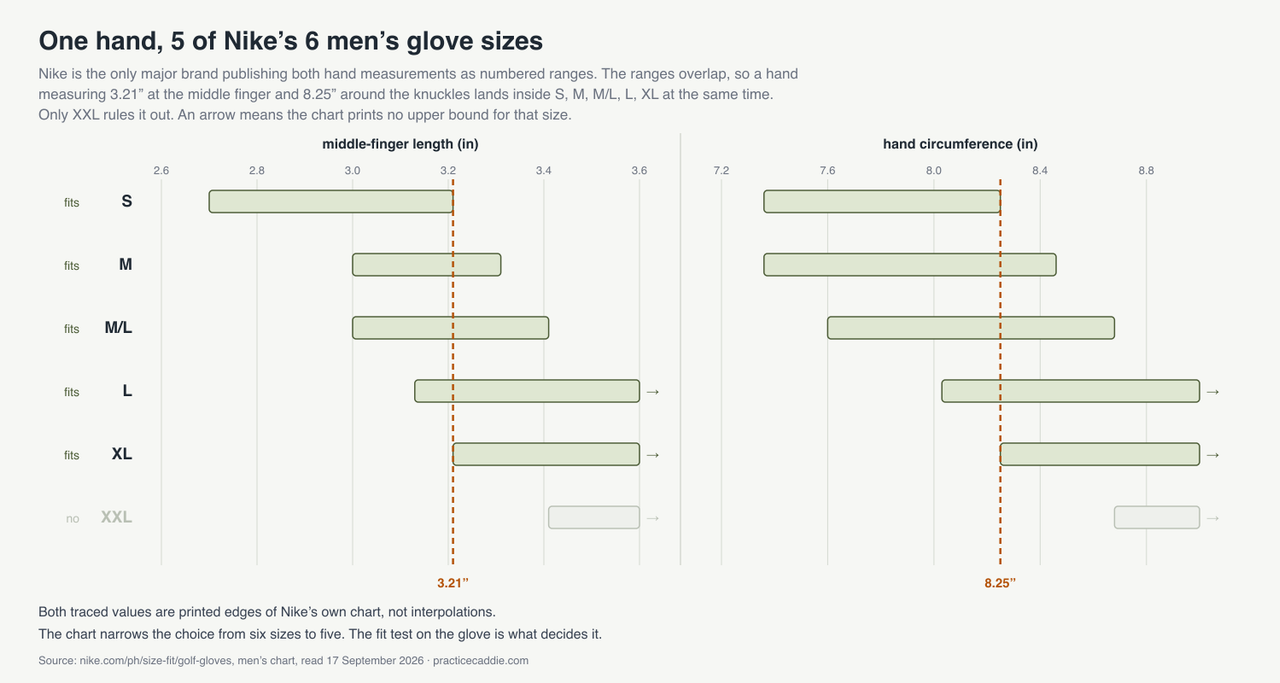
A hand measuring 3.21 inches at the middle finger and 8.25 inches around the knuckles satisfies Nike’s printed range for small, medium, medium-large, large and extra-large at the same time. Only XXL rules it out. Both traced values are printed edges of Nike’s own chart rather than numbers anyone interpolated.
The overlap is structural, not a rounding artifact. Nike’s medium spans 1.10 inch of hand circumference and its medium-large spans 1.08 inch, on a men’s range that runs from 7.36 inches to an open-ended 8.9 and above. Three of the six sizes carry no upper bound at all, printed as “3.5+” and “8.9+”. Stack ranges that wide on a hand-sized quantity and they cannot help but swallow each other.
Nike men’s golf glove size chart
| Size | Middle-finger length | Hand circumference |
|---|---|---|
| S | 2.7–3.21” | 7.36–8.25” |
| M | 3–3.31” | 7.36–8.46” |
| M/L | 3–3.41” | 7.6–8.68” |
| L | 3.13–3.5”+ | 8.03–8.9”+ |
| XL | 3.21–3.5”+ | 8.25–8.9”+ |
| XXL | 3.41–3.5”+ | 8.68–8.9”+ |
Callaway’s entire men’s range is under an inch wide
Callaway takes the opposite approach and lands somewhere equally unhelpful. Its chart is a printable diagram you lay your hand on, marked with one approximate hand length per size: small 19.5 cm, medium 20, medium-large 20.5, large 21, extra-large 21.5.
Five sizes, 0.5 cm apart. The whole men’s range spans 2.0 cm, which is 0.79 inch from the smallest men’s glove Callaway makes to the largest, with each step about 0.2 inch. Callaway’s own footnote says the measurements “are approximate and only meant to help guide you in your size choice.” A 0.2-inch step measured by eye off a printed sheet is a coin flip, and the brand says as much.
Women’s golf glove size chart
Women’s sizing is thinner everywhere, in both range and published detail. Callaway’s women’s chart runs small 17.5 cm, medium 18 and large 18.5 — three sizes across 1 cm, half the span of its men’s range. Nike publishes four women’s sizes with the same two measurements it gives men:
| Size | Middle-finger length | Hand circumference |
|---|---|---|
| S | 2.56–2.7” | 6.93” |
| M | 2.56–2.85” | 6.93–7.15” |
| M/L | 2.56–3.21” | 6.93–7.82” |
| L | 2.56–3.31” | 6.93–7.82” |
Every one of those four sizes starts at the same 2.56-inch finger length, and Nike’s women’s large and medium-large share an identical circumference range of 6.93 to 7.82 inches. Between them only the top of the finger range separates the two: anything from 2.56 through 3.21 inches qualifies for both, and only above 3.21 does large stand alone. Mizuno’s women’s gloves stop at large where its men’s run to extra-large, and cadet cuts in women’s sizes are close to unobtainable — the fit test carries even more of the load here than it does in men’s.
Mizuno’s sizes drift inside Mizuno
Mizuno publishes something different again: the finished glove’s width and length in millimetres, with no instruction on what to measure on your hand. That is honest in its way, since it describes the product rather than guessing at you. It also exposes a drift that a hand-based chart would hide.
| Mizuno men’s regular | S | M | M/L | L | XL |
|---|---|---|---|---|---|
| Tour — width | 89 mm | 92 mm | 96 mm | 99 mm | 102 mm |
| Elite — width | 93 mm | 96 mm | 100 mm | 103 mm | 106 mm |
| Comp — width | 88 mm | 90 mm | 93 mm | 96 mm | 100 mm |
Read the columns and the labels stop meaning much. Mizuno’s Elite small is 93 mm wide, which is exactly its Comp medium-large — two size labels apart, same brand, same page, same units. The Elite medium at 96 mm matches the Tour medium-large at 96 mm. At large, the three models measure 96, 99 and 103 mm, a 7 mm spread inside one size label.
Nothing here is a mistake. Different gloves are cut differently, and Mizuno publishing the real numbers is better practice than the brands publishing nothing. The lesson is that “men’s large” is a name on a package, and the number under it moves even when the brand does not.
What the research actually says about glove fit
No controlled study establishes that a correctly fitted glove improves your golf. That gap is worth stating plainly, because the internet is full of confident percentages that have no study behind them.
What does exist is adjacent. Komi, Roberts and Rothberg measured grip force during tee shots using thin-film sensors mounted on gloves, and found grip-force signatures that were specific to each golfer. The gloves were sensor carriers. Glove size was never the variable. The same is true of the hand-pressure mapping work that followed. Nobody has randomized golfers into correctly fitted, oversized and undersized gloves and then measured clubface delivery or dispersion.
So the defensible claim is mechanical rather than measured. A loose glove puts a layer of movement between your hand and the club, and both manufacturers and independent testers treat that movement as something to remove. MyGolfSpy lists what a loose glove produces: slipping during the swing, extra friction at the thumb and palm, accelerated wear, and a tendency to squeeze harder to compensate. The last one is the expensive item. Grip pressure that climbs to fight a sliding glove is the same grip pressure that wrecks the release and tightens the forearms through impact.
Treat “my glove fits” as removing a variable, not as adding yards. Anyone quoting you a dispersion figure for glove fit is quoting a number that does not exist.
The fit test that settles what the chart cannot
Since the charts disagree and several publish nothing, the glove itself is the instrument. Four checks, in order:
- Palm tension. The palm should be taut like a drum head, with no material anywhere you can pinch or fold. Loose material in the palm is the single most common fit failure and the one that drives the grip-pressure problem above.
- Fingertips. Your fingers should reach the ends of the finger stalls. Spare fabric standing empty at the tips means the glove is long for you, which is a different problem from being big for you.
- Back of the hand. Close the fastener and look for gaps or bunching across the back. Neither should be there.
- Make a fist, then extend. You should be able to do both without the leather wrinkling into the palm on extension or tightening painfully on the fist.
Two rules sit behind those checks. Between sizes, take the smaller one. And a new cabretta glove should feel tight, because cabretta stretches slightly in the first rounds and molds to the hand. A leather glove that feels comfortable in the shop is going to feel loose by the fourth round.
Cadet vs regular golf gloves: shorter fingers, wider palm
Cadet settles more fits than the chart does, and it is the part most guides get wrong. A cadet glove keeps the size label and changes the shape. Against a regular glove carrying the same label, a cadet shortens each finger slightly and widens the palm.
That shape exists because plenty of hands are not built to the proportions a standard glove assumes. Broad palm, shorter fingers is a common build, and on a regular cut it produces a specific and recognizable failure.
You probably need a cadet if:
- The fingers bunch or gather excess material at the tips while the palm feels correct or tight.
- Sizing down fixes the fingers and makes the palm too small, so neither size works.
- You adjust the glove repeatedly during a round.
- You wear through the thumb or heel pad unusually fast.
- No glove in your size ever feels right in any brand.
FootJoy, Callaway and PING all offer cadet cuts, and Titleist’s current men’s tables carry cadet in small through extra-large with no cadet XXL. Availability thins out badly in women’s sizes and in the smaller men’s sizes, which is a stocking problem rather than a fitting one.
The honest read: if you have bought six gloves in the same size across three brands and none of them felt right, the variable you have never changed is the cut.
How long a glove lasts
Nobody will give you a number, and the reason is sound. FootJoy senior product manager DJ Zabkar told GOLF that there are just too many external factors to put a hard figure on it, listing glove material — delicate cabretta against thicker synthetic — and how the glove is treated. The estimates that circulate on golf forums span two rounds to 20, which is a range wide enough to be useless as guidance.
Replace on condition instead of on a count:
- The palm or thumb has gone smooth and slick.
- Holes or visible thinning have appeared.
- The glove stays stretched and wrinkled after it dries.
- The closure no longer holds a snug fit.
Two habits extend the life of both gloves you own: rotate them so each gets a full day to dry, and dry a wet one flat rather than balled in a pocket. A damp glove left compressed is how a glove that fitted correctly stops fitting.
Leather against synthetic
Cabretta gives the best feel and tack, stretches slightly, and molds to the hand over the first several rounds. Synthetics generally handle moisture and abrasion better and do not mold the same way. What does not hold up is the blanket advice that you should always size down for leather — stretch panels and knitted synthetics vary enough between constructions that the rule breaks. Buy the closest snug, unrestricted fit in whatever material, and let the smaller-of-two rule handle the edge case.
When the glove is not the problem
Plenty of good players wear none. Lucas Glover has four PGA Tour wins and has never worn one: “Never, ever wore one.” Told as a kid by instructor Dick Harmon to try one with the fingers cut out, Glover’s answer was “I can’t really feel the club,” and Harmon’s reply was “if that’s the case, let’s not do that when it matters.” Glover plays full cord grips for tackiness instead, and jokes that he is “a solid 10-handicap with a glove.”
Fred Couples plays bare-handed too, for a reason that has nothing to do with feel — he ruined too many expensive gloves as a kid in rainy Seattle, his parents could not keep replacing them, and he learned the game without one.
A glove is a grip aid, which means slipping hands are a three-variable problem and the glove is only one of them. The other two are grip size and grip condition, and a set of slick five-year-old grips will defeat a perfectly fitted glove every time. Grip condition costs nothing to check. Start there.
Related reading
- How to Grip a Golf Club — the pillar this sits under; the glove is the interface, the grip is what the interface is for.
- Golf Grip Size Chart — the other half of the hand-to-club connection, and the spec with actual gauge numbers behind it. Check this before you blame the glove.
- How to Release the Golf Club — where excess grip pressure does its damage, which is the mechanism a loose glove feeds.
- Playing Golf in Bad Weather — rain gloves are a different product with different sizing logic, built and graded wet.
- Golf Shaft Flex Chart — the same pattern one spec up the club: published bands that overlap and disagree between brands.
- Wedge Bounce Explained — three published charts that label the same wedge three different ways, which is this post’s problem in a different part of the bag.
- Golf Practice Drills — once the equipment audit is done, this is where the shots come from.
Key takeaways
- Measure two things on the lead hand: circumference around the knuckles with the thumb excluded, and middle-finger length. A right-handed golfer measures the left hand.
- The chart is a shortlist, not an answer. A hand of 3.21 inches and 8.25 inches satisfies five of Nike’s six published men’s sizes at once.
- Callaway’s entire men’s range spans 0.79 inch across five sizes, in steps of about 0.2 inch, and Callaway labels its own figures approximate.
- Mizuno publishes the glove, not your hand, and its Elite small measures 93 mm wide — identical to its Comp medium-large, two labels away.
- Titleist and Srixon publish no numeric chart at all, so for those brands the fit test is the only instrument you have.
- Cadet means shorter fingers and a wider palm, not a smaller glove. Bunched fingertips over a tight palm is the signature.
- No study links glove fit to dispersion. The honest case for fit is mechanical: a loose glove invites the grip pressure that costs you the release.
- Replace on condition, not on a count. The industry declines to publish a round number, and forum estimates span two to 20.
Frequently asked questions
What size golf glove do I need?
Measure the hand that wears the glove, which is the left hand for a right-handed golfer. Take the circumference around your knuckles with the thumb excluded, and the length of your middle finger. Then read the chart belonging to the brand you are buying, because sizing is not standardized between manufacturers. Expect several sizes to qualify. Nike’s published men’s ranges overlap enough that one hand can fall inside five of its six sizes, so the fit test on the glove itself decides.
How should a golf glove fit?
Like a second skin. The palm should feel taut with no material loose enough to pinch or fold, your fingers should reach the ends of the finger stalls with no spare fabric at the tips, and the back of the hand should show no gaps or bunching. A new cabretta leather glove should feel tight, because leather stretches slightly with use. MyGolfSpy’s guidance is to take the smaller size when you fall between two, and its 2025 glove test rated fit the single biggest factor in how a glove performed.
What is a cadet golf glove?
A cadet glove is cut for hands with shorter fingers relative to a wider palm. Compared to a regular glove carrying the same size label, a cadet shortens each finger slightly and widens the palm. It is a different shape rather than a different size. The tell is a glove whose palm feels correct or tight while the fingers bunch or gather excess material at the tips, and a size down fixes the fingers but makes the palm too small. FootJoy, Callaway and PING all publish cadet cuts.
Are golf glove sizes the same across brands?
No, and the brands do not even publish the same measurement. Nike prints hand circumference and middle-finger length in inches. Callaway prints a single approximate hand length in centimetres per size and calls it a guide. Mizuno prints the finished glove’s width and length in millimetres rather than any hand measurement. Titleist and Srixon publish no numeric chart at all on their current product pages. There is no conversion between these, so a medium in one brand tells you nothing about a medium in another.
Which hand does a golf glove go on?
The lead hand, which is the hand at the top of the grip. A right-handed golfer wears the glove on the left hand and a left-handed golfer wears it on the right. That hand carries most of the friction and twisting load during the swing, so the glove adds grip security and protects against blisters and calluses there. Product listings labelled left or right refer to the hand the glove goes on, not the golfer’s handedness, which is a common ordering mistake.
Does a golf glove that fits properly improve your shots?
There is no controlled study that answers this. No peer-reviewed research was found that puts golfers in correctly fitted, oversized and undersized gloves and then measures grip pressure, clubface delivery or dispersion. Grip-force research exists, but it uses gloves as sensor mounts rather than testing glove size as a variable. The defensible claim is mechanical rather than measured: a loose glove lets your hand move against the club, and manufacturers and independent testers both treat that movement as something to remove.
How long does a golf glove last?
There is no published number, and the industry avoids giving one. FootJoy senior product manager DJ Zabkar told GOLF that there are just too many external factors to put a hard figure on it, naming glove material and how the glove is treated. Estimates circulating on golf forums span two rounds to 20. Replace yours when the palm or thumb goes smooth and slick, when holes or thinning appear, or when the closure can no longer hold a snug fit. Rotating two gloves so each dries out extends both.