
Golf Caddie Test: What's on the Exam and How to Pass
No universal caddie license exists. What the WGA exam and club quizzes actually test, the B-A-Honor rank ladder, published pay by rank, and the Evans path.

Quick answer
There is no national caddie license. A golf caddie test is a club-specific quiz built on the Western Golf Association’s training model: etiquette, basic rules, terminology, yardage math, and course duties, followed by a shadow loop. The current WGA exam runs 20 questions plus a hole-labeling exercise. Clubs rank caddies B, A, Honor with pay rising by rank ($15-$80 per bag on published sheets), and two years of caddying opens the Evans Scholarship door.
What the test covers at a glance
| Section | What’s tested | Example |
|---|---|---|
| Duties | Bag handling, 14-club count, watching every shot | Count clubs before the round; player carries max 14 clubs |
| Course care | Divots, bunker raking, entering bunkers low-side | Rake exits toward the low side, replace or fill divots |
| Green work | Flagstick tending, line of putt, where to stand | Never step on a player’s line; tend on request |
| Yardage math | Pacing from plates and sprinkler heads | 10 paces inside the 200 marker plays 190 |
| Etiquette | Pace, positioning, phone policy, quiet windows | Phones away; stand still and silent during swings |
| Rules basics | What a caddie may and may not do | One caddie per player under Rule 10.3 |
| Signals | Forecaddie outcome signals | Arms up means fairway; see the signal guide |
| Local knowledge | The club’s own plates, holes, and policies | Western G&CC asks its own plate yardages |
Caddying is one of the few golf jobs a 14-year-old can walk into, and clubs still staff real programs: the Western Golf Association’s Evans Scholars pipeline alone supports 1,260 current college scholars who started as loopers. The test at the front of that pipeline is deliberately passable. It exists to prove you can keep a loop moving, protect the course, and stay invisible at the right moments.
There is no universal caddie test
The WGA’s caddie playbook recommends that every new caddie read its manual, watch the orientation video, and pass its exam before working, and most Midwest and East Coast club programs train from that template. But the WGA is a template, not a licensing body: each club controls its own exam, promotion standards, ratings, and pay. Services like ClubUp manage scheduling and loop assignments for club programs; certification still happens club by club, as at Lake Forest Country Club in Ohio, where caddies test after classroom and on-course training. Junior-tour programs run their own lightweight versions, like the Southern Texas PGA’s 25-question caddie quiz with an 80% pass mark.
So “the caddie test” you should study for is the WGA exam plus your club’s local sheet. Expect both.
What the WGA exam covers
The current WGA exam (August 2025 form) runs 20 multiple-choice, select-all, and true-false questions plus an eight-part exercise labeling the features of a golf hole. The question list maps straight onto the manual’s curriculum: the caddie’s primary job, attitude and teamwork, equipment handling, pre-round preparation, the 14-club limit, tee positioning, divots, ball identification, fairway yardage duties, bunker entry, putting-green and flagstick work, bag placement, post-round duties, line of putt, phone use, and terminology. An earlier version of the exam was a 30-minute, 100-point test requiring 85% to pass; the current form does not publish a passing score, so ask your caddie master what the club requires.
Study the manual, then walk a hole in your head: tee (where do you stand?), fairway (yardage, divot), bunker (enter low, rake out), green (mark the low side, tend the stick, clear the line). The exam is that walk, written down.
The yardage math section
Yardage is the one section with actual arithmetic. The method, straight from the Olympia Fields caddie handbook: find the nearest marked point (fairway plate or sprinkler head), pace the distance from the ball to it in one-yard steps, then add or subtract from the marker’s number. Ten paces inside the 200-yard plate: the shot plays 190. Ten paces behind the 150: it plays 160. Clubs test their own reference system, so learn the local plate colors cold; Western Golf and Country Club’s exam asks for the exact yardages its blue, white, and red plates represent.
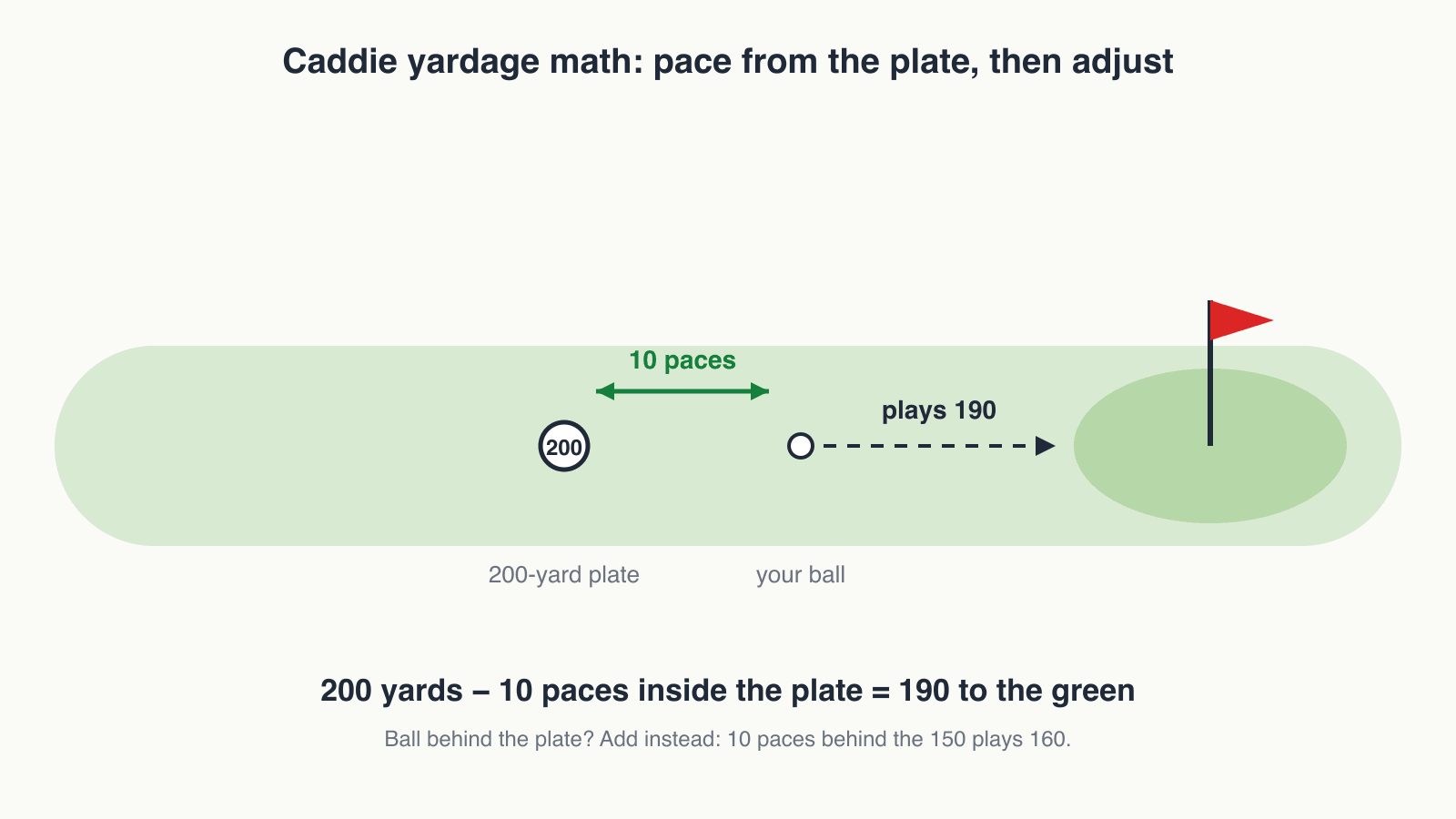
Two refinements separate an A caddie’s number from a B caddie’s. First, the number is to the green’s center unless the club marks to the front; know which. Second, the raw number gets adjusted for pin position, uphill or downhill, and wind before it reaches the player, the same adjustments covered in the club distance chart guide.
The rank ladder: B, A, Honor
The WGA playbook defines the standard three-rank ladder, and clubs publish their own promotion gates. The pattern across published manuals:
| Club (published manual) | B (entry) | A | Honor |
|---|---|---|---|
| Olympia Fields | New caddies start here | 2+ months, 20 loops, 15 excellent ratings, none poor in last 20, forecaddie holes memorized | 4 years at the club, both courses cold, any golfer |
| Pine Lake | Training + quiz passed | 4+ months, 20 loops, 15 excellent, none poor in last 20 | 2+ years, regular loops, top-25 ranking |
| La Grange | General knowledge, one bag | Experienced, may double-bag | Expert, doubles, member requests |
The through-line: promotion runs on golfer evaluations, not test scores. Fifteen “excellent” ratings is the recurring bar, which means rank is earned one loop at a time over a season. The duties that draw those ratings are specific: yardages before the player asks, the right signal from the forecaddie position, clean greens work, and pace, the same fundamentals covered in the etiquette guide.
What caddies actually get paid
No national rate exists; clubs publish their own sheets, per bag, before tips. From published club documents: La Grange pays B/A/Honor $24/$32/$40 per 18-hole bag; Kemper Lakes lists $15/$20/$25 with a recommended $20-per-bag tip; Olympia Fields runs $25 to $45 walking rates; Aurora Country Club lists $30/$40/$50. The Milwaukee district’s club directory shows the high end: Blue Mound at $45-$60 plus tip and Milwaukee Country Club at $80 for Honor caddies. Read those as an observed range from named clubs, roughly $15-$50 per bag for most programs with strong markets reaching $60-$80, and remember a double loop is two bags.
The real financial upside sits elsewhere: the Evans Scholarship.
The Evans Scholarship
The Evans Scholarship is a full four-year tuition and housing award for caddies, which the WGA valued at more than $125,000 over four years for the fall 2026 cohort. Four eligibility pillars: at least two years of regular caddying at a sponsoring club (and continued caddying in the application year), above a B average in college-prep coursework, demonstrated financial need, and outstanding character and leadership. The scale is real: 1,260 current scholars at 27 universities, with 1,060 applicants and 380 awards for the 2026-27 academic year, per the WGA’s FAQ.
The timeline rewards starting young. Applications open August 1 of senior year, with materials due by September 30 and finalist decisions by April 1. Two years of loops must already be on the books by then, which means the caddie test you take at 14 or 15 is, quietly, the first step of a six-figure scholarship application.
The tour caddie path
There is no tour caddie exam. The PGA Tour’s player handbook and caddie regulations govern registration, bibs, conduct, and course care once a player hires you, but employment is the player’s private decision, and credentials issue at the player’s request. Working caddies describe the route as relationship-based: build a resume at a strong club or in amateur golf, master yardage books, green reading, and rules situations, then find a bag on a developmental tour and move up with the player. Published estimates put the arrangement near $2,000-$3,000 per week plus 5% of winnings for a made cut, 7% for a top-10, and 10% for a win, conventions rather than mandated rates.
The skills that carry a tour bag are the club skills at higher resolution: exact numbers, wind calls, and course-management judgment under pressure.
How to prepare (a one-week plan)
- Days 1-2: read the WGA manual twice. First pass for the shape, second pass taking notes on duties and terminology.
- Day 3: learn the hand signals and the etiquette rules: where to stand, when to be silent, phone policy.
- Day 4: drill yardage math. Pace a known distance until your step is a reliable yard, then run plate arithmetic until it’s automatic.
- Day 5: rules basics. What a caddie may do under Rule 10.3, plus the situations from the beginner rules guide: OB, penalty areas, provisionals.
- Day 6: walk a course or a range mentally, tee to green, narrating your duties at each stage. The exam’s hole-labeling exercise is exactly this.
- Day 7: take the club’s practice materials or the WGA exam form cold, then re-read whatever you missed.
Common mistakes
- Studying rules trivia instead of duties. The exam weights bag handling, course care, and etiquette far heavier than rules edge cases.
- Ignoring the local sheet. Clubs test their own plates, forecaddie holes, and policies. The WGA manual alone leaves those questions blank.
- Sloppy pacing. A pace that drifts between 0.8 and 1.2 yards makes every number a guess. Calibrate on a marked 50 yards.
- Treating the test as the finish line. Rank and pay run on golfer evaluations across a season; the exam only opens the door.
- Missing the Evans clock. Two years of regular loops must be banked before senior-year fall. Starting at 16 is late.
Key takeaways
- No universal caddie license exists. The WGA supplies the standard training model; each club owns its exam, promotions, and pay.
- The current WGA exam is 20 questions plus a hole-labeling exercise; an earlier form ran 100 points with an 85% pass mark, so expect clubs to set their own bar.
- Yardage math is pacing plus arithmetic: 10 paces inside the 200 plate plays 190. Calibrate your pace first.
- Ranks run B, A, Honor, promoted on evaluations; 20 loops with 15 excellent ratings is a published bar at multiple clubs.
- Published pay runs about $15-$50 per bag by rank, with strong markets reaching $60-$80, per club rate sheets. Doubles double it.
- Two years of caddying opens the Evans Scholarship: full tuition and housing, valued over $125,000, with 380 awards for 2026-27.
- Tour caddying has no exam. It runs on experience and relationships, at roughly $2,000-$3,000 a week plus a winnings percentage.
Frequently asked questions
What is on a golf caddie test?
A club-specific written quiz on etiquette, basic Rules of Golf, golf terminology, yardage calculation, and everyday duties, usually followed by on-course training or a shadow loop. The Western Golf Association’s current exam runs 20 questions plus an eight-part hole-labeling exercise covering the 14-club limit, divots, bunker raking, flagstick work, ball identification, and fairway yardage duties. Clubs add local material: Western Golf and Country Club’s test asks for the yardages of its own colored fairway plates. There is no universal national caddie exam.
What are the caddie ranks, and how do you move up?
Most U.S. club programs use three ranks: B for first-year caddies handling basic duties, A for experienced caddies with advanced course knowledge who may carry two bags, and Honor for the top tier, which adds leadership and training duties. Promotion standards are set by each club and lean on evaluations, not just a test. Olympia Fields, for example, requires at least two months, 20 loops, and 15 excellent ratings with none poor in the last 20 before a caddie reaches A rank.
How much do club caddies make per round?
Published club rate sheets run roughly $15 to $50 per bag for an 18-hole loop depending on rank, before tips. La Grange Country Club lists B at $24, A at $32, and Honor at $40 per bag; Kemper Lakes lists $15/$20/$25 with a recommended $20 tip per bag; Aurora Country Club lists $30/$40/$50. High-end markets go further, with Milwaukee Country Club publishing an $80 Honor fee. Rates are per bag, so a double loop roughly doubles the day.
What is the Evans Scholarship and who qualifies?
The Evans Scholarship is a full four-year tuition and housing award for caddies, valued by the Western Golf Association at more than $125,000 over four years for recent cohorts. Eligibility has four pillars: at least two years of regular caddying at a sponsoring club, a strong academic record (above a B average in college-prep courses), demonstrated financial need, and outstanding character and leadership. The WGA reported 1,260 current Evans Scholars across 27 universities, with 380 scholarships awarded for the 2026-27 academic year.
Do you need a license or exam to become a PGA Tour caddie?
No. The PGA Tour’s published regulations set conduct, registration, and uniform requirements for caddies once a player hires them, but there is no open certification test that qualifies you for tour work. A player employs the caddie directly, and credentials are issued at the player’s request. The working route is experience: caddie at a good club or in amateur events, master yardage books and rules situations, then network toward developmental tours. Published estimates put tour caddie pay near $2,000 to $3,000 per week plus a percentage of winnings.
How do caddies calculate yardage without a rangefinder?
Pace from the nearest marked reference point and add or subtract. Sprinkler heads and fairway plates give a known number to the green; the caddie walks the distance from the ball to that mark in one-yard paces and adjusts. Olympia Fields teaches the standard version: a ball ten paces inside the 200-yard marker plays 190. Good caddies then layer in the day’s conditions, pin position, and elevation before handing the player a final number. The math is simple; the discipline is doing it before the player asks.
Related reading
- Golf Hand Signals: What Forecaddies, Spotters, and Marshals Mean — the signal section of the caddie test, with the WGA, USGA, and MGA sets decoded.
- Golf Etiquette and Pace of Play — the etiquette material every caddie exam draws from.
- Golf Rules for Beginners — OB, penalty areas, and provisionals: the rules situations a caddie sees weekly.
- Golf Club Distance Chart — the distance knowledge behind good yardage calls, by club and skill level.
- Golf Course Management Tips — the strategic judgment that separates an Honor caddie’s advice from a number-reader’s.
- How to Keep Score in Golf — scoring formats a caddie is expected to follow without asking.