
Golf Hand Signals: What Forecaddies, Spotters, and Marshals Mean
Forecaddie signals are club conventions, not one universal code. The safe, fairway, bunker, and OB signals from the WGA, USGA, and MGA manuals, decoded.
Quick answer
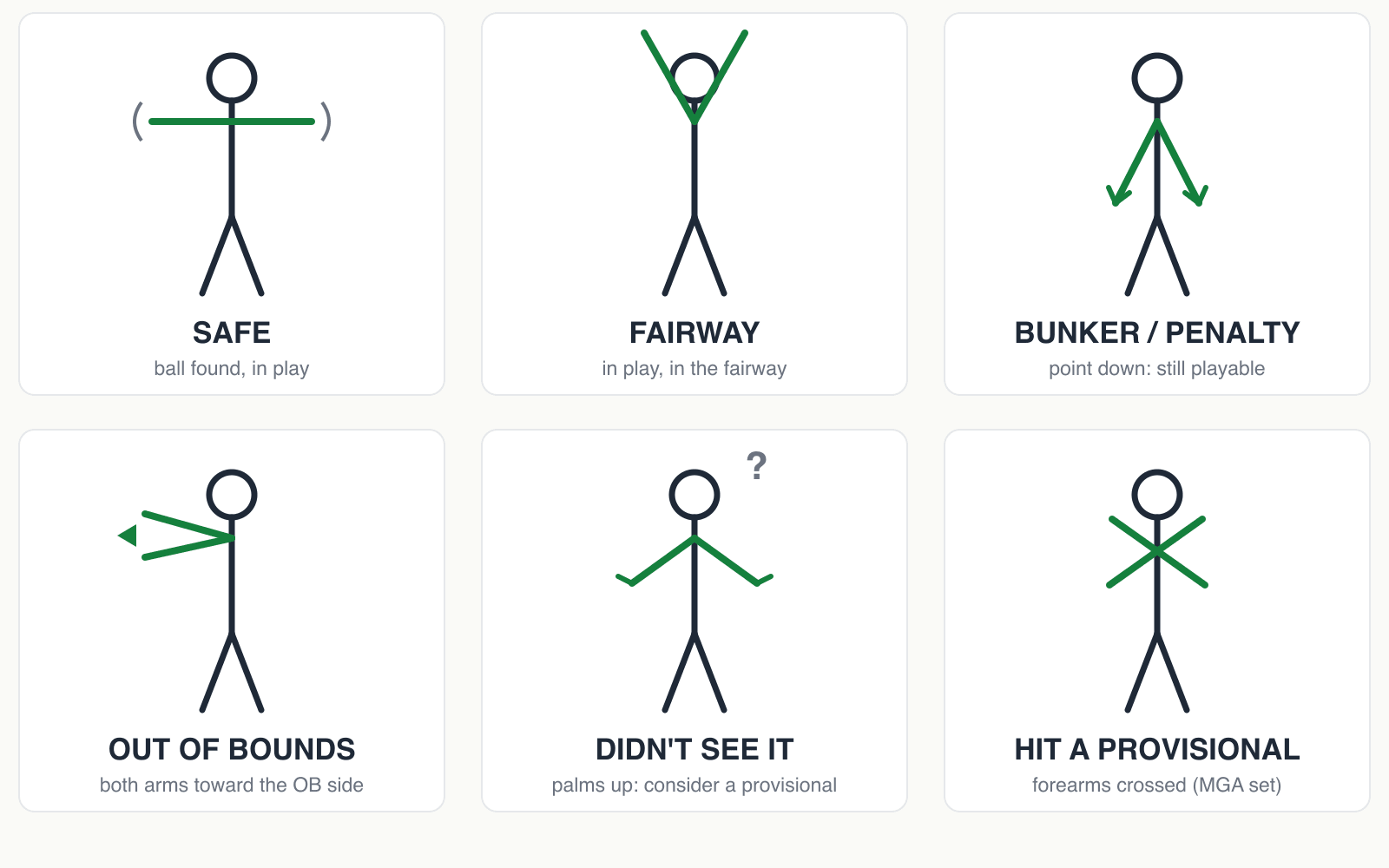
Golf hand signals come from caddie and tournament manuals. The WGA set supplies the common gestures: a baseball-style safe sweep for a found ball in play, both arms straight up for fairway, hands pointed down for a bunker or penalty area, both arms waved toward one side for out of bounds; the USGA’s adds palms up for did not see it. Meanings drift between clubs, so the host’s chart wins. A signal that only reports where a ball sits is not advice under Rule 10.2.
The signal set at a glance
| Signal | How it looks | What it means | Documented in |
|---|---|---|---|
| Safe | Arms sweep apart at chest height, umpire-style | Ball found, in bounds, in play | WGA caddie manual |
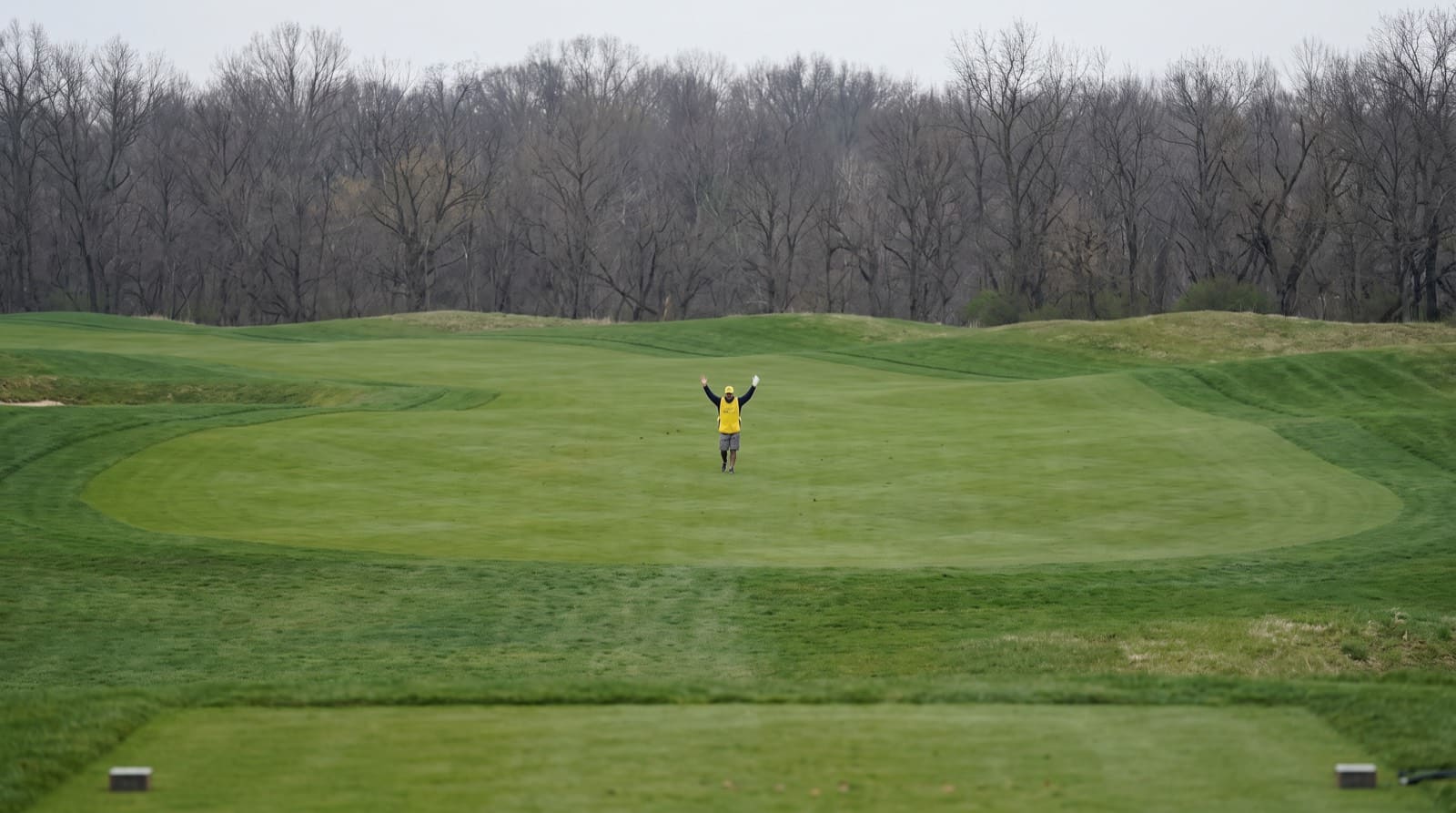
| Fairway | Both arms straight up, field-goal style | Ball in play and in the fairway | WGA caddie manual |
| Bunker / penalty area | One or both hands pointed at the ground | Ball in sand or a penalty area, still playable | WGA, GAP manual |
| Out of bounds | Both arms waved or pointed toward the boundary side | Ball believed out of bounds, in that direction | WGA, USGA competition manual |
| Did not see it | Arms out, palms up, shoulders shrugged | Flight not observed; consider a provisional | USGA competition manual |
| Hit a provisional | Forearms crossed in an X at the chest | Original may be lost or OB; play a provisional | MGA official signals |
| Stop, not clear | Both hands raised, palms toward the tee | Landing area occupied; do not hit | WGA caddie manual |
| Play away | One arm or a towel waved overhead | Landing area clear; hit when ready | WGA, GAP manual |
Signals exist because a fairway is a bad place for a conversation. A forecaddie standing 250 yards away has about three seconds to tell four players what happened to a tee shot, and a clear gesture beats a shouted sentence into the wind every time. The Western Golf Association’s caddie manual, the training document behind the Evans Scholars caddie programs, treats signaling as a core caddie skill for exactly that reason: a group that knows the outcome before leaving the tee never burns a ball-search on a hole where the answer was already known.
The eight forecaddie signals
The table above is the working set. Three of them carry details worth knowing before you rely on them.
Safe has two dialects. The WGA teaches the baseball umpire sweep. The USGA’s competition-administration manual shows a palms-down, side-to-side wave for the same message. Both mean found and in play, and neither says anything about the lie. A safe ball can be sitting down in four-inch rough.
Fairway outranks safe. The WGA set distinguishes the generic safe call from the two-arms-up field-goal signal, which adds one fact: the ball finished in the short grass. A forecaddie who uses both gives the player a head start on club and shot planning before the walk even starts.
Direction rides along with OB. The wave toward the boundary side reports left or right at the same time as the outcome, which matters because the player’s reload strategy changes with the miss side. The Golf Association of Philadelphia’s caddie manual teaches the same point-the-direction convention.
Where the manuals disagree
No governing body owns golf’s hand signals, and the published sets contradict each other in two spots. The crossed-arms X means hit a provisional in the Metropolitan Golf Association’s official eight-signal set, while at least one club forecaddie sheet in Europe uses crossed arms overhead for a ball that looks out of bounds or was never seen. The safe call splits between the umpire sweep and the palms-down wave, depending on whether the club trained from the WGA manual or the USGA one.
The practical rule: the host’s chart controls. Before a tournament round with volunteer spotters, or a caddie loop at an unfamiliar club, ask which set is in use. The MGA set adds a discipline worth copying even at a casual level: it reserves the safe, OB, and penalty-area signals for outcomes the spotter is virtually certain about, and routes everything else through the did-not-see shrug. A confident wrong signal costs a player stroke and distance; an honest shrug costs a provisional ball.
Marshal and spotter signals at tour events
Tournament galleries run on the same idea at bigger scale. The PGA Tour’s gallery-marshal duties sheet from the World Golf Championships lists “locate and protect bad shots” among a marshal’s four core objectives: flag the ball’s position for ShotLink, stand over an errant ball so nobody touches it, and freeze the gallery with both arms above the head and a “stand please” while a player hits. The warning call is standardized with direction built in: “fore, on the right” or “fore, on the left.”
Spotter charts at amateur tournaments mirror the forecaddie set. The CSRA Women’s Golf Association spotter sheet uses the baseball-style safe sweep for a found ball, arms overhead pointing toward the boundary for a definite OB, and the palms-out shrug whenever there is any doubt. At a penalty area, the spotter’s real job is noting where the ball last crossed the edge, which becomes the player’s reference point for relief.
Two constraints keep the system honest. Both documents bar volunteers from rulings: the marshal sheet reserves them for PGA Tour officials, and the spotter sheet says flatly that spotters neither advise nor rule. And under Rule 19.1 only the player may decide a ball is unplayable.
Signals between playing partners
Three gestures cover almost everything a weekend group needs.
- The wave-up on a par 3. Formally a call-up: the group on the green marks, steps to a safe spot, and waves the tee group to play. The R&A’s pace-of-play manual lists call-up procedures on long par 3s and reachable par 4s and 5s as a committee tool for cutting round times. Use it where the course posts it, and make the wave unmistakable.
- The play-through wave. Eye contact plus a clear beckoning wave invites a faster group to pass. Ambiguity is the failure mode: a half-wave from 200 yards reads as anything from “play up” to “hello.” Point at the group, then sweep the arm through toward the hole.
- Fore. A verbal signal, not a hand signal, and the one with no optional dialect. The R&A’s Spirit of the Game guidance expects an immediate shout toward the danger area whenever a ball might reach people. Add the direction when you know it.
Do hand signals count as advice under the rules?
Location is public information. The definition of advice in the Rules of Golf covers comments or actions intended to influence club choice, the making of a stroke, or how to play a hole, and it explicitly excludes facts anyone could observe: where the hole is cut, where penalty areas and bunkers sit, and where a ball came to rest. A forecaddie signaling safe, bunker, or out of bounds is reporting a fact under Rule 10.2, so anyone can give it to anyone.
The line sits at influence. A spotter who mimes a punch shot, holds up seven fingers for a 7-iron, or points at the smart bailout line has crossed from information into advice, and in a competition only your caddie, your partner, or your partner’s caddie may give you that. The Oregon Golf Association’s plain-English walkthrough of the advice rule is a good five-minute read before you caddie or spot for the first time.
Common mistakes
- Calling OB without virtual certainty. The MGA set restricts the OB signal to balls clearly seen finishing out. If you lost the flight, give the palms-up shrug so the player hits a provisional instead of walking 250 yards on a wrong call.
- Reading safe as a good lie. Safe reports in-bounds and findable. Club selection still waits until you see the ball.
- Signaling before the ball stops. A ball trickling toward a hazard line makes a liar of an early signal. Watch it finish, then signal once, big and slow.
- Assuming the X means the same thing everywhere. Provisional in the MGA set, OB-or-unseen in others. Ask before the round.
- Waving up without a posted call-up policy. On a course without the procedure, a wave-up surprises the group behind and parks two groups on one hole. Check the scorecard or starter first.
- Whispering fore. The shout is a safety device. Volume and direction, every time.
Key takeaways
- The WGA manual supplies the working set (safe sweep, arms-up fairway, hands-down bunker, arms-toward-the-side OB); the palms-up did-not-see comes from the USGA’s competition manual.
- No single body standardizes them. The MGA publishes eight official signals; clubs and events adapt them. The host’s chart controls.
- Fairway is a stronger call than safe. Two arms straight up adds the short-grass fact and saves the player a club decision on the walk.
- Certainty gates the big calls. OB and penalty signals are for outcomes you saw finish; everything else gets the shrug and a provisional.
- Location is never advice. Rule 10.2’s advice definition excludes public information, so outcome signals are legal from anyone; club and target suggestions are not.
- Marshals observe, players rule. The PGA Tour marshal sheet reserves rulings for officials; unplayable is the player’s call alone under Rule 19.1.
Frequently asked questions
What does the safe signal mean in golf?
The safe signal, both arms extended in front at chest height and swept apart like a baseball umpire’s safe call, means the ball has been found and is in bounds and in play. The Western Golf Association caddie manual and several club caddie handbooks document it as the standard found-ball signal. It says nothing about the lie: a ball can be safe and sitting in thick rough. Some sets, including the USGA’s competition manual, use a palms-down side-to-side wave for the same message.
What is a forecaddie in golf?
A forecaddie is a caddie who walks ahead of the group and stands near the landing zone instead of carrying a bag. Their job is to watch every tee shot, find balls fast, and signal the outcome back to the players: safe, fairway, bunker, penalty area, or out of bounds. Clubs use forecaddies in cart-path-only situations and big outings such as scrambles, where four tee shots fly at once. A good forecaddie saves a group several minutes per hole in ball searches.
What do crossed arms mean in golf?
It depends on whose signal chart you are under, which is exactly why the gesture causes confusion. In the Metropolitan Golf Association’s official eight-signal set, forearms crossed in an X tell the player to hit a provisional ball because the original may be lost or out of bounds. At least one European club’s forecaddie sheet uses crossed arms overhead for a ball that appears out of bounds or was not seen. Confirm the meaning with the host club or event before the round.
Are a caddie’s hand signals considered advice under the rules?
Signals that only report facts are fine. Under the USGA’s definition of advice in Rule 10.2, information about the location of a ball, a penalty area, a bunker, or the fairway is public information, so a forecaddie signaling safe or out of bounds breaks no rule. The line is influence: a gesture that recommends a club, a target line, or how to play the shot is advice, and in a competition only your caddie, your partner, or your partner’s caddie may give you that.
What does waving up mean on a par 3?
Waving up, formally a call-up, is when the group on the green of a par 3 signals the group on the tee to play before the green clears, then holes out after the tee shots land. The R&A’s pace-of-play manual lists call-up procedures on long par 3s and reachable par 4s and 5s as a legitimate committee tool for cutting round time. Use it when the course posts it as policy, everyone on the green is standing in a safe spot, and the waving gesture is unmistakable.
How do you signal that a ball is out of bounds?
The Western Golf Association manual teaches facing the boundary and waving both arms together toward the side where the ball crossed, which reports the outcome and the direction in one motion. The USGA’s competition manual has the spotter point both hands over the head toward the out-of-bounds side. Signal it only when you are virtually certain: the Metropolitan Golf Association’s signal set reserves the OB call for balls you clearly saw finish out, and an uncertain spotter should give the palms-up did-not-see signal instead.
Related reading
- Golf Caddie Test: What’s on It and How to Pass — the signals above are one section of a caddie training program; this covers the rest of the exam.
- Golf Etiquette and Pace of Play — the unwritten-rules companion: where signals, call-ups, and playing through fit into a four-hour round.
- Golf Rules for Beginners — the penalty situations the signals report: OB, penalty areas, provisionals, and unplayable lies.
- Golf Scramble Rules and Strategy — the format where amateur golfers most often meet a forecaddie.
- Golf Course Management Tips — what to do with the information once the signal comes back: reload strategy, bailouts, and when to take the provisional.