
Best Golf Coaching Apps in 2026: Remote Lessons, AI, and Video
Golf coaching apps do three jobs: remote lessons with a real coach, AI swing capture, or a video curriculum. Verified 2026 pricing plus what the research says.
Quick answer
Golf coaching apps do three different jobs. Remote-coach platforms (Skillest, CoachNow) put a real instructor on your video. Swing-analysis tools (V1 Golf, Sportsbox AI, HackMotion, Rapsodo) measure the motion and leave the diagnosis to you. Curriculum apps (Me And My Golf, GolfPass, SwingU Pro, GolfForever) sell pre-recorded instruction. Almost none of them structure the practice between lessons, which is where a swing change sticks or dies.
The 10 coaching apps at a glance
| App | Job it does | Price (2026) | Free tier | Best for |
|---|---|---|---|---|
| Skillest | Remote lessons, real coach | Coach-set; elite profiles list into the hundreds | Browse only | One-on-one video coaching at a distance |
| V1 Golf | Self swing analysis | Free; V1 GOLF+ $9.99/mo or $69.99/yr | Yes | DIY frame-by-frame review |
| Sportsbox AI 3D Golf | Markerless 3D capture | Subscription; bundle w/ tripod $169 (reg. $235) | Not verified | Measuring body motion from a phone |
| HackMotion Core | Wrist-angle sensor + app | Hardware only, no subscription | N/A (device) | Face control and wrist mechanics |
| Rapsodo MLM2PRO | Launch monitor + app | Premium $199.99/yr, $329.99/2yr, $599.99 lifetime | 45-day Premium trial | Ball and club numbers at home |
| CoachNow | Coach↔player platform | Free; CoachNow+ $24.99/mo billed yearly | Yes (5 Spaces, 5 GB) | Coaches running remote students |
| Me And My Golf | Video coaching programs | Subscription; yearly option | 7-day trial, no card | Following a structured curriculum |
| GolfPass | Instruction video library | ~$99 first year, ~$119 renewal | No | Watching tour-pro instruction |
| SwingU Pro | Stats + strokes gained + video tips | Pro $24.99/mo or $99.99/yr; Plus $59.99/yr | Yes (GPS + scorecard) | Turning round data into drills |
| GolfForever | Golf fitness programming | App $24.99/mo or $199/yr; trainer $199.99 | 30-day trial w/ trainer | Mobility and strength for the swing |
Pricing is drawn from each company’s own pages except CoachNow (via G2, last updated October 2024) and GolfForever (via an independent BreakingEighty review). Prices in this category move, so confirm on the company’s site before you buy.
What a coaching app has to do that a swing camera doesn’t
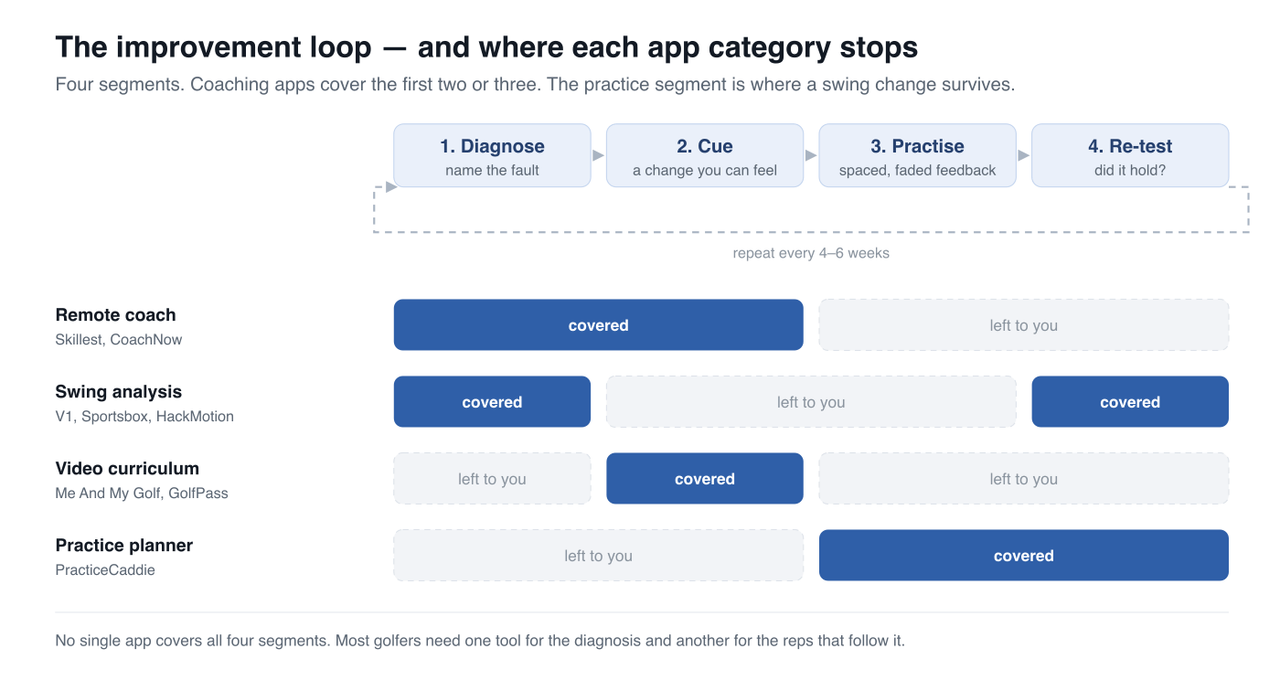
Improvement runs on a loop with four segments: diagnose the fault, get a cue that changes it, practise the cue enough times for it to survive without conscious thought, then re-test to see whether it held. Every app in the table covers part of that loop. Very few cover the practice segment, and that is the segment where most swing changes die.
The research is unusually clear on what good feedback looks like, and it is not what most apps ship. A 2022 trial-sequential meta-analysis of 15 studies by Han and colleagues found feedback improved motor-skill learning with a standardised mean difference of 0.47 against no-feedback controls. Break it down by type and the picture sharpens: visual feedback, self-model video, and expert-model video each produced significant gains, while “verbal, evaluative, and informational feedback did not produce changes in motor skill learning.”
Read that as a subgroup result. Within the meta-analysis the visual subgroups cleared significance and the verbal ones fell short of it, across studies that each compared one feedback type against a control. Take it as a solid argument for the video half of any coaching app and a thin one for the paragraph of text that comes with it.
Online golf lesson apps: a real coach on your video
These put a certified human on your actual swing. The app is the delivery mechanism; the coaching is the product.
Skillest
Skillest is a marketplace. You film a swing, upload it, and a coach you picked annotates the video, prescribes drills, and keeps a message thread running between sessions. Pricing is set by each coach rather than by the platform, so the range is wide — Skillest’s own guide to lesson costs puts many online coaching subscriptions under $200 a month, with individual lessons in the $50–$150 range, while a marquee name like Sean Foley carries a listed price of $460 on his coach profile. Browsing coach profiles costs nothing; every form of coaching is paid.
What Skillest gets right is the asynchronous loop. You are not paying for an hour of someone’s attention in one block; you are paying for a cycle of film, feedback, drill, refilm. That maps onto how skill consolidates far better than a single Saturday lesson does.
CoachNow
CoachNow sits on the coach’s side of the relationship. It is a cross-sport platform — video analysis tools, shared “Spaces” per athlete, messaging, a media library — that a golf professional uses to run remote students. The free plan covers five media-enabled Spaces and 5 GB of storage; CoachNow+ is $24.99 a month billed annually and lifts the Space limit and storage to 150 GB.
Most golfers will never buy CoachNow directly. It shows up here because if your local pro offers “online follow-up between lessons,” this is often the software behind it, and knowing that helps you judge whether the follow-up is real coaching or a video dump.
AI and video swing analysis apps
These give you data. What you do with it is your problem, which is the honest trade for the price.
V1 Golf
V1 GOLF+ is $9.99 a month or $69.99 a year above a free base app, and it adds the full drawing and measurement toolkit, an on-demand drill library, and a model-swing library for side-by-side comparison. That comparison feature has research behind it: the Han meta-analysis found expert-model observation, alongside self-model observation, significantly improved skill learning.
The cheapest useful coaching subscription on this list. It rewards a golfer who can already name their fault and wants to watch whether it is moving.
Sportsbox AI 3D Golf
Sportsbox converts ordinary phone video into a rotatable 3D avatar and reports kinematics — pelvic rotation, sway, thrust, shoulder turn — without markers or sensors. It sells on a subscription, commonly bundled with a tripod: the Mobile Bundle of a GPOD Travel tripod plus an annual 3D Player licence and a swing analysis lists at $235 and sells around $169.
The honest caveat, and it matters: no peer-reviewed validation of Sportsbox against marker-based laboratory capture, with published error figures, could be found. The metrics are useful for tracking your own change over weeks. Treat an absolute number as a reading from an uncalibrated instrument until someone publishes the comparison.
HackMotion Core
HackMotion Core is a wrist sensor that measures flexion, extension, and deviation through the swing and feeds them to the app in real time. Its pricing is the outlier here: the sensor purchase carries a lifetime licence with free app updates and no weekly, monthly, or annual fee.
Wrist angle is the mechanism behind clubface control, which makes this the most targeted tool on the list for anyone working through the slice fix or a two-way miss.
Rapsodo MLM2PRO
The MLM2PRO Premium membership runs $199.99 for a year, $329.99 for two, or $599.99 for lifetime, and new device owners get a 45-day free trial when they register. Premium adds course simulation across 30,000+ courses, cloud session storage, spin metrics, speed training, and the enhanced video tools.
This is a launch monitor with a coaching layer bolted on. If you are buying it, buy it for ball and club numbers; the instruction is the bonus.
Video curriculum apps: pre-recorded instruction
These ship a fixed library of lessons. The instruction is one-way — your own swing stays unseen.
Me And My Golf runs structured programs — swing fundamentals, specific fault fixes, break-90 and break-80 series — on a subscription with a seven-day free trial and no payment collected at signup. GolfPass bundles a tour-pro instruction library with tee-time credits and a Peacock subscription at roughly $99 for a first year against a $119 rate. SwingU Pro at $24.99 a month or $99.99 a year is the interesting hybrid: it adds strokes-gained analysis of your rounds and then suggests drills for the weak category, on top of a free-forever GPS and scorecard base.
GolfForever is the fitness entry — $24.99 a month or $199 a year for the app, $199.99 for the Swing Trainer bar, with bundles in the $349–$454 range. It coaches your body rather than your swing, which is the right purchase for a specific kind of player and the wrong one for everybody else.
The four-question feedback audit
Marketing pages in this category all say the same four things. Here is a framework for cutting through them, built from what the motor-learning literature actually rewards rather than from any app’s feature list. Score an app out of four before you subscribe.
| Question | What the research says | What to look for |
|---|---|---|
| Who controls when you see the feedback? | Self-controlled video beat yoked video on a transfer test, with written cues available but no instruction directing attention to specific movements (Aiken et al. 2012) | On-demand replay you pull up, rather than an auto-report pushed after every swing |
| Do the cues point at the club or your body? | External focus beat internal focus in practice and next-day retention on a golf pitch shot (Wulf et al. 1999) | Drill language about clubhead, ball, target — not “rotate your left hip” |
| Is the feedback faded or constant? | 50% knowledge of results beat 100% for retention, despite worse practice performance (Winstein & Schmidt 1990) | The ability to turn the numbers off and hit blind reps |
| Does it structure the days between sessions? | Practice distributed across days retains better than the same volume massed (Cepeda et al. 2006) | A rep count, a schedule, and a log you fill in between sessions |
Most apps in the table score 2. A few score 1. None of them scored 4 in this review, and the reason is always the fourth row: the software stops when the lesson ends.
The third row deserves a note, because it runs against the instinct of anyone who has just paid for a launch monitor. Salmoni, Schmidt and Walter’s 1984 review argued that very high feedback frequencies build dependence — you learn to hit the shot with the number in front of you, then lose it when the number goes away. Winstein and Schmidt’s experiment put an edge on that: the group given feedback on half its trials performed worse during practice and better on a delayed retention test than the group given feedback on every trial. An app that reports a number after every single swing is training the wrong half of that trade.
How much golf lessons cost, and what an app replaces
App subscriptions in this category run roughly $70 to $200 a year. In-person instruction, per TeachMe.to’s pricing breakdown drawing on Golf.com’s survey and PGA of America guidelines, averages $50–$60 for a 30-to-45-minute lesson, with entry-level instruction at $25–$45, mid-range at $50–$75, and premium instruction at $100–$150 and up. PGA professionals typically charge $50–$150 an hour, and nationally known instructors $300 and up. GOLFTEC lists a 60-minute introductory lesson at $99 against a $150 regular value.
So a year of V1 GOLF+ costs about what one mid-range lesson costs. A year of Rapsodo Premium costs about three. That maths favours the app right up until you need a diagnosis, and diagnosis is the one thing on the loop that software still does worse than a competent human.
The sensible split for most amateurs: buy the lesson for the diagnosis, buy the app for the reps.
What has not been proven
Three claims float around this category with no verifiable evidence behind them, and a buyer’s guide that omitted them would be doing the same job as the marketing pages.
No published validation exists for smartphone markerless 3D capture against lab motion capture in golf. Sportsbox and similar tools produce plausible, internally consistent kinematics. Whether a reported 42° of pelvic rotation is 42° in a Vicon lab is an open question with no published answer.
No independent study shows lessons lower handicaps. The numbers in circulation are provider-reported. GOLFTEC states its Game Plans shave an average of 7 strokes off students’ scores. That is a company claim published without a control group, a sample size, or an audit. The direction is plausible; the magnitude is marketing.
No open figure exists for how many golfers take lessons. The National Golf Foundation and Golf Datatech collect this, but the public pages do not publish a lesson-taking rate, and the syndicated reports that would are sold to industry. Any article quoting a precise percentage here is repeating something it cannot source.
Where PracticeCaddie fits
PracticeCaddie owns the fourth row of the audit table, and only the fourth row. It takes the fault you already know about — from a lesson, from an app on this list, from your own ball-flight diagnosis — and builds the range session that trains it, drill by drill, with a timer, a rep count, and made/missed logging per rep. Filming, coaching, and wrist measurement all live elsewhere on this list.
The plan structure follows the block-to-random progression the contextual-interference research supports, and re-weights as your logged results change. That is the segment of the loop the coaching apps leave open.
The free tier covers the Skills Assessment, starter plans, the full drill library, timers, and logging, with no credit card. Pro is $4.99 a month or $19.99 a year and adds unlimited AI-generated plans built from your last five sessions, the AI Coach diagnosis after each assessment, and 8 pressure-mode Skills Games. AI plan generation is a Pro feature with a 3-day free trial. If you want the practice-app category rather than the coaching category, the companion guide to practice apps covers Arccos, 18Birdies, Hole19, and DECADE alongside this list, and the side-by-side comparison breaks out the practice-planning job specifically.
How to choose a golf coaching app
- Decide whether you need a human or a mirror. A remote coach diagnoses; an analysis app measures. If you cannot name your own fault, pay for the human. If you know the fault and want to watch it move, the mirror is a tenth of the price.
- Check who controls when you see the feedback. On-demand replay beat pushed replay on a transfer test in Aiken’s study. Prefer the app you pull the video up in.
- Check whether the cues point at the club or your body. Wulf’s golf group told to focus on the club swing outplayed the group told to focus on the arm swing, in practice and a day later. Read the drill library before you subscribe.
- Check whether it plans the days between lessons. The lesson is an hour; the change lives in the practice. If the app stops at the video, budget separately for a practice structure.
Common mistakes when buying a coaching app
- Buying measurement when you needed diagnosis. A 3D avatar showing 8° of sway does nothing if you cannot say whether 8° is your problem. The first purchase for most golfers is a human, once.
- Subscribing to three apps that do the same job. V1, Sportsbox, and a launch monitor all measure. One is plenty until you have exhausted it.
- Chasing the provider’s improvement stat. “Average 7 strokes” is a company figure with no control group. Read it as an ambition.
- Taking phone-based 3D numbers as absolute. They are useful for tracking your own change. Their agreement with lab capture is unpublished.
- Leaving feedback on for every rep. Reduced-frequency feedback retained better than constant feedback in Winstein and Schmidt’s experiment. Turn the numbers off for the last third of the session.
- Stopping at the lesson. The most common failure in this whole category is a good diagnosis followed by no structured practice. The weekly practice plan is what converts one into the other.
Key takeaways
- Coaching apps do three jobs. Remote human lessons, swing measurement, or a pre-recorded curriculum. Pick the job before the app.
- Video is the part with research behind it. Han’s 2022 meta-analysis put feedback at SMD 0.47, with visual self-model and expert-model both significant and verbal or evaluative feedback showing no effect.
- Cheapest useful subscription is V1 GOLF+ at $9.99 a month or $69.99 a year, roughly the price of one mid-range lesson per year.
- HackMotion is the only no-subscription option — the sensor purchase carries a lifetime app licence.
- Lessons cost $50–$60 for 30–45 minutes on average, $100–$150+ at the premium end, and $99 for a GOLFTEC 60-minute intro.
- Three claims in this category are unproven: smartphone 3D capture has no published lab validation, no independent study shows lessons lower handicaps, and no public figure exists for how many golfers take lessons.
- Every app on the list leaves the practice segment open. Diagnosis is an hour; the change takes weeks of structured reps.
Frequently asked questions
What is the best golf coaching app?
It depends on whether you need a human. Skillest is the strongest pick for real remote lessons, because a certified coach watches your actual swing and prescribes drills. V1 Golf at $9.99 a month is the best value for self-analysis if you already know your fault. Sportsbox AI 3D Golf gives the most detailed measurement from a phone. Me And My Golf and GolfPass sell a video curriculum rather than personal feedback. Pick the category first, then the app.
How much does a golf coaching app cost compared to a lesson?
Coaching apps run roughly $70 to $200 a year. V1 GOLF+ is $9.99 a month or $69.99 a year, SwingU Pro is $99.99 a year, GolfPass is about $119 a year, and Rapsodo’s MLM2PRO Premium membership is $199.99 a year on top of the hardware. A single in-person lesson typically costs $50 to $60 for 30 to 45 minutes, and GOLFTEC lists a 60-minute introductory lesson at $99. A year of a coaching app therefore runs from about one mid-range lesson at the cheap end to about three at the top.
Are golf coaching apps as good as a real lesson?
A coach still wins on diagnosis: seeing the fault, feeling your grip pressure, and moving you into a position are things software cannot do. Apps hold their own on everything after that. A 2022 meta-analysis of feedback in physical education found visual feedback, including watching your own swing and watching an expert model, significantly improved motor-skill learning, while purely verbal and evaluative feedback did not. The sensible pattern is a lesson for the diagnosis and an app for the reps.
Do any golf coaching apps have a free tier?
Yes, though the free tiers are thinner than in the GPS category. SwingU’s base app is free forever with GPS, a scorecard, and basic stats. V1 Golf has a free version below the Golf+ subscription. CoachNow’s free plan gives a coach five media-enabled Spaces and 5 GB of storage. Me And My Golf has a seven-day free trial with no payment at signup, and Rapsodo includes a 45-day Premium trial with an MLM2PRO. PracticeCaddie has a free-forever plan for the practice side.
Is Sportsbox AI 3D Golf accurate?
No peer-reviewed validation of Sportsbox AI 3D Golf against marker-based laboratory motion capture, with published error figures in degrees or centimetres, could be located. The technology reconstructs a 3D avatar from ordinary phone video and reports metrics like pelvic rotation and sway, and it is used in real coaching studios. Treat the numbers as internally consistent and useful for tracking change over time in yourself, rather than as lab-grade absolute measurements, until a validation study is published.
Do golf lessons actually lower your handicap?
No independent longitudinal study comparing golfers who take lessons against a matched control group appears to exist. The available numbers come from providers reporting on their own students. GOLFTEC states that its Game Plans shave an average of 7 strokes off students’ scores, published without a sample size, a control group, or an audit. That is a company claim rather than controlled research. Treat it as marketing with a plausible direction rather than as a measured effect size, and expect your own result to depend on how much you practise between sessions.
Are online golf lessons worth it?
For most amateurs, yes, on one condition: the loop has to keep running. An online lesson on Skillest gives you film, feedback, a drill, and a refilm, which matches how skill consolidates better than a single lesson does. The catch is that the coach never sees your grip pressure or your ball flight in person, so the first diagnosis is harder to get right remotely. A useful pattern is one in-person lesson to establish the fault, then remote follow-up to track whether the change is holding.
Related reading
- Block vs Random Practice in Golf: What the Research Actually Says — the motor-learning evidence underneath the feedback audit above, and why in-session performance is a bad proxy for learning.
- Best Golf Practice Apps in 2026: What Each One Actually Does — the sister post covering trackers and practice planners: Arccos, 18Birdies, Hole19, DECADE, GolfPass.
- Golf Practice Plan: The Weekly Schedule That Lowers Handicaps — the allocation math for the practice segment every coaching app leaves open.
- Golf Practice Schedule: 2, 3, and 5-Day Weekly Templates — the spaced calendar that Cepeda’s distributed-practice finding argues for, with a printable template pack.
- Golf Ball Flight Laws Explained — the free self-diagnosis that tells you whether you need a coach or just a plan.
- How to Fix a Slice in Golf — a worked example of the full loop: diagnose, cue, four weeks of structured practice, re-test.
- PracticeCaddie vs 18Birdies, Arccos, and DECADE — the head-to-head table for the practice-planning job specifically.
- Golf practice plan: the complete guide — 30, 60, and 90-minute session templates to run between lessons.