
Best Golf Practice Apps in 2026: What Each One Actually Does
A field guide to golf apps by the job each one does — track rounds, coach your swing, teach strategy, or plan your practice — with verified 2026 pricing.
Quick answer
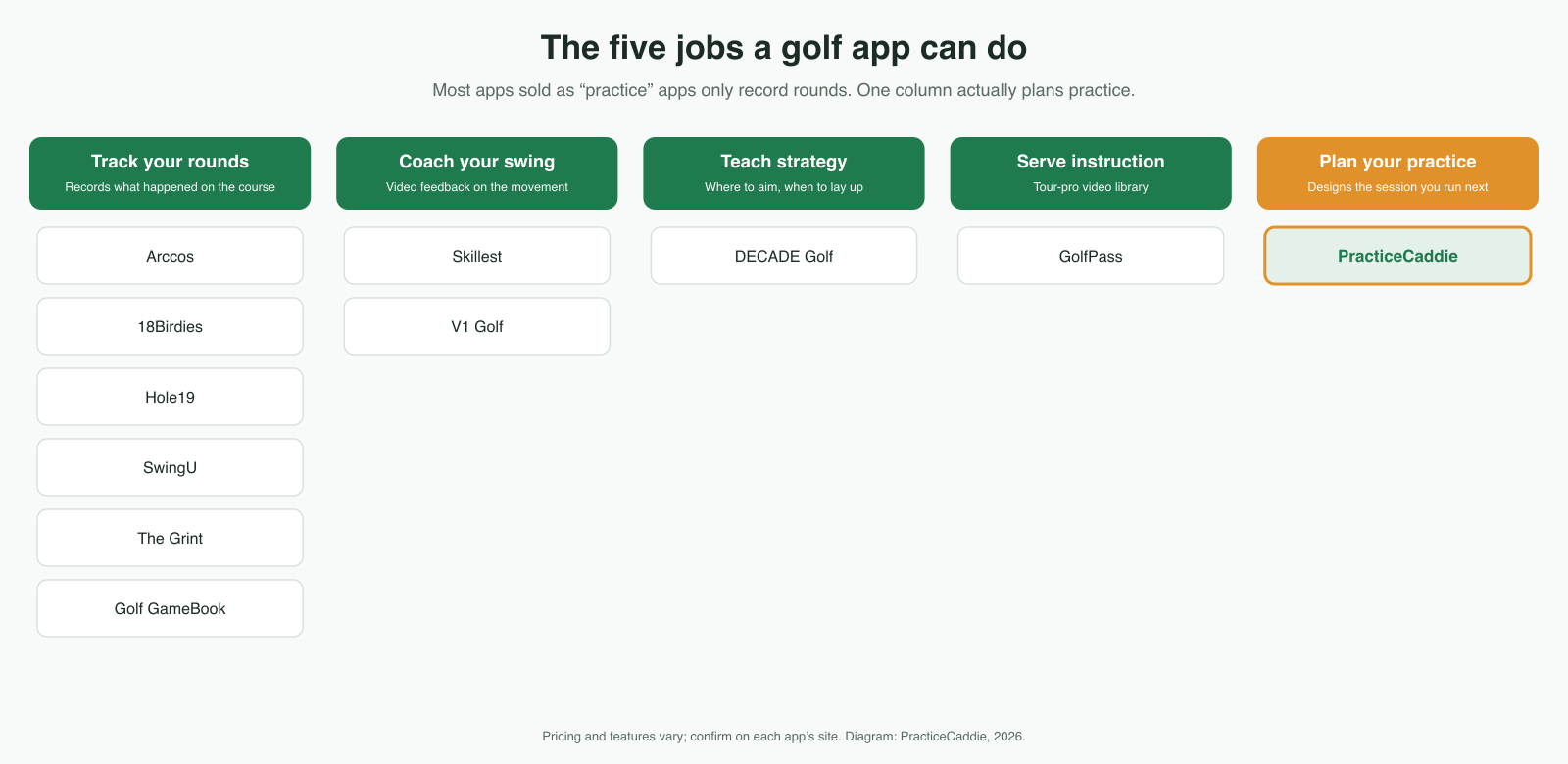
“Best golf app” is really five different questions. Apps split into five jobs: track your rounds (Arccos, 18Birdies, Hole19), coach your swing (Skillest, V1 Golf), teach strategy (DECADE), serve instruction video (GolfPass), and plan your practice (PracticeCaddie). Most apps sold as “practice” apps actually record rounds. Only a couple decide what you do at the range next. Pick by the job you need, then match the price to how often you’ll use it.
The 11 apps at a glance
| App | Job it does | Price (2026) | Platform | Best for |
|---|---|---|---|---|
| PracticeCaddie | Plans your practice | Free; Pro $4.99/mo or $19.99/yr | Web (phone) | Structured, tracked range sessions |
| Arccos | Tracks rounds + strokes gained | Sensor bundle from $424.98 (1yr app incl.); membership after | iOS, Android | Data-obsessed on-course players |
| 18Birdies | GPS + scoring + social | Free; Premium $19.99/mo or $99.99/yr | iOS, Android | Casual score tracking and games |
| Hole19 | GPS + score tracking | Free; Premium $14.99/mo or $69.99/yr | iOS, Android | Year-round on-course stats |
| SwingU | GPS + stats + instruction | Free; Pro $99.99/yr | iOS, Android | All-in-one GPS plus video tips |
| The Grint | Handicap + stat tracking | Free tier + paid (confirm current) | iOS, Android | USGA-style handicap upkeep |
| Golf GameBook | Scoring + social competitions | Free; Gold €4.99/mo yearly (€59.99/yr) or €19.99/mo | iOS, Android | League and group scoring |
| Skillest | Remote swing coaching | Coach-set; online plans often under $200/mo | iOS, web | One-on-one remote lessons |
| V1 Golf | Swing video analysis | Free; V1 GOLF+ $9.99/mo or $69.99/yr | iOS, Android | DIY swing filming and review |
| DECADE Golf | Course-management strategy | Elite $325, then $19.95/mo | iOS | Better on-course decisions |
| GolfPass | Instruction video library | GolfPass+ $119/yr (+ Peacock) | Web, iOS | Watching tour-pro instruction |
Pricing and platform details are drawn from each company’s public pages as of July 2026 and change often — confirm on the app’s own site before you buy.
Why “golf practice app” is a confusing search
Type “best golf practice app” into any store and you get a pile of GPS rangefinders, score trackers, and swing cameras. Almost none of them plan your practice. They record your rounds, map the course, or film your swing. Useful jobs, but different ones.
Here’s the split that actually matters. Recording what happened on Saturday is one job. Deciding what you hit at the range on Tuesday is another. The first is measurement; the second is design. A tracker hands you a number — 41% greens in regulation, 1.9 putts per hole. It does not tell you the 18 shots to hit next, in what order, with what success criterion. That gap is where most improvement stalls.
The research backs the design job over the measurement job. Motor-learning studies on deliberate practice, associated with K. Anders Ericsson’s work on expert performance, show that skill grows from structured tasks with clear goals and feedback. Repetition on its own tends to stall. Shea and Morgan’s 1979 contextual-interference study found that random, varied practice feels worse in the moment but retains far better than hitting the same club over and over — and a golf-specific putting replication confirmed it directly. A bucket of range balls, hit without a plan, is the opposite of what the evidence rewards.
Apps that track your rounds
These capture on-course data and, in the best cases, translate it into strokes gained. They tell you where you lose shots. They do not build the practice that fixes it.
Arccos
Arccos is the deepest on-course tracker here. Sensors screw into every grip, and the app records each shot’s location and club automatically as you play, then reports strokes gained off the tee, on approach, around the green, and putting. The Air + Smart Sensors bundle lists around $424.98 including a year of app access, and it needs an ongoing membership after that first year. Arccos says new members average a 5.71-stroke improvement in year one — the company’s own number, worth reading as marketing rather than an independent study. Best for players who will genuinely carry their phone and sensor-track every round.
18Birdies and Hole19
These are the mainstream GPS-and-scoring apps. Both keep a genuine free tier — 18Birdies states the app is free “and always will be” with no card required — and layer analytics on paid plans. 18Birdies Premium runs $19.99 a month or $99.99 a year with a 7-day trial. Hole19 Premium is cheaper at $14.99 a month or $69.99 a year, and the company claims Premium users cut around three shots. For casual players who want distances, a digital scorecard, and season-long trends, either works. Neither plans a practice session.
SwingU, The Grint, and Golf GameBook
Three more in the tracker family. SwingU Pro bundles GPS, stats, and instruction video for $99.99 a year on top of a free base app. The Grint handles USGA-style handicaps and stat tracking with a free tier and paid upgrades — its current pricing was not verifiable at publication, so confirm it on their site. Golf GameBook’s Gold membership targets group and league play at €4.99 a month billed yearly (€59.99 a year, 14-day trial) or €19.99 monthly. All three record; none plan.
Apps that coach your swing
These give you technical feedback on the movement itself, which trackers never touch.
Skillest
Skillest is a marketplace that connects you to a real coach for asynchronous, video-based lessons. You film a swing, the coach annotates it and prescribes drills, and you repeat the loop — which maps neatly onto the deliberate-practice model of goals plus fast feedback. Pricing is coach-set rather than a fixed tier; Skillest’s own guide puts many online coaching subscriptions under $200 a month, with individual lessons in the $50–$150 range. Best when your problem is mechanical and you want a human eye on it.
V1 Golf
V1 is the DIY version of the same idea. You film your swing, draw angles and lines, and compare against pro models frame by frame. V1 GOLF+ unlocks the full analysis toolkit and coaching drills for $9.99 a month or $69.99 a year, above a free base app. It gives you knowledge of performance — what your body actually did, frame by frame — where a tracker only shows you the ball flight. Best for players comfortable self-diagnosing, or working with a coach who uses V1.
Apps that teach strategy or serve instruction
DECADE Golf
DECADE, built by Scott Fawcett, trains on-course decision-making: where to aim, when to lay up, how to avoid the big number. It uses shot-dispersion patterns and strokes-gained math to guide those calls, so you stop bleeding shots to hero attempts and penalties. DECADE Elite runs $325 up front, then auto-renews at $19.95 a month. Best for the player who strikes it well enough but bleeds shots through bad decisions. It pairs naturally with a tracker like Arccos that quantifies the dispersion DECADE asks you to respect.
GolfPass
GolfPass is a content library — tour-pro instruction series, original shows, plus tee-time credits and a Peacock subscription bundled in. GolfPass+ is $119 a year plus tax. It works as a curriculum you build a session around: it supplies drills and ideas, and you impose the structure yourself. Best as a source of instruction you then build a real session around.
Where PracticeCaddie fits
PracticeCaddie does the job almost nothing else on this list does: it plans and structures the practice itself. You log a quick baseline or Skills Assessment, and it builds a range session drill by drill, weighted toward where you actually lose strokes, with a live timer and per-drill made/missed logging. The plans rotate on the block-to-random progression the contextual-interference research supports, and re-weight as your logged results change.
Honest scope, because that matters more than a sales line: PracticeCaddie has no GPS and no on-course shot tracking. It does not film your swing or replace a coach. If you want on-course data, pair it with a tracker; if you want swing diagnosis, pair it with a coach or V1. What it owns is the range session — the part the trackers measure around but never build.
The free tier covers the Skills Assessment, starter plans, the full drill library, per-drill timers, and made/missed logging, with no credit card. Pro is $4.99 a month or $19.99 a year and adds unlimited AI-generated plans personalized from your last five sessions, the AI Coach diagnosis after each assessment, and 8 pressure-mode Skills Games. AI plan generation is a Pro feature with a 3-day free trial — the free-forever plan handles logging and browsing. See the full side-by-side comparison for how it stacks against 18Birdies, Arccos, and DECADE.
What Strokes Gained says about where to point any app
Whichever tracker you pick, the data is only useful if you read it the way Mark Broadie’s Every Shot Counts taught the game to. Broadie’s strokes-gained work showed that the old “drive for show, putt for dough” instinct is backward for most amateurs: approach play and the long game usually open the biggest scoring gap between you and better players, while putting differences matter less than most golfers assume. So when Arccos or Hole19 flags a weakness, weight your practice toward the category costing the most strokes — commonly approach shots, even when the three-footers you remember missing feel like the real problem. A tracker that points you at the wrong practice is worse than no tracker. The strokes-gained framework for amateurs is the lens that keeps the data honest.
How to choose a golf app that actually improves your game
- Name the job you need done. Track rounds, coach your swing, teach strategy, serve instruction, or plan practice — pick one. Most golfers buy a tracker and then wonder why their range time never changes.
- Check whether it plans practice or just records it. A GPS app measures the round you played. A practice app designs the session you have not run. If aimless range time is the problem, a tracker will not fix it.
- Match the price to how often you’ll use it. Divide the yearly price by the sessions you honestly expect. A $4.99 planner used weekly beats a $19.99 GPS app opened twice a month.
- Start on the free tier. Nearly every app here has one. Run it two or three weeks, then pay only for the one that earned a place in your routine.
Common mistakes when picking a golf app
- Buying a tracker and calling it practice. Recording Saturday’s round does not design Tuesday’s session. They are different jobs; you often need one of each.
- Paying for three overlapping GPS apps. One tracker is plenty. A second and third just pile on cost while telling you the same thing.
- Chasing the company’s improvement stat. “Average member improves X strokes” is marketing, not a controlled study. Treat Arccos’s 5.71 and Hole19’s three shots as claims, not guarantees.
- Skipping the free tier. Most of these apps are free to try. Paying before you know you’ll open the app is how the subscriptions pile up.
- Letting the app pick the wrong practice. Trackers surface the miss you remember, not always the one that costs the most. Point practice at the biggest strokes-gained leak, per Broadie, not the most annoying one.
- Expecting one app to do everything. Tracking, coaching, strategy, and planning are four jobs. No single app owns all four well; the honest ones own one.
Key takeaways
- “Best golf app” is really five questions. Track rounds, coach your swing, teach strategy, serve instruction, or plan practice — decide the job first.
- Most “practice” apps actually record rounds. Only a couple, PracticeCaddie among them, plan the session you run next.
- Free tiers are real. 18Birdies, Hole19, SwingU, V1 Golf, and PracticeCaddie all start free with no card.
- Cheapest paths that change your game: PracticeCaddie Pro at $4.99/mo or V1 GOLF+ at $9.99/mo, both above a free tier, and both cheaper per use than a $19.99/mo GPS app you open twice a month.
- Arccos is the deepest tracker at $424.98-plus with sensors, but it measures rounds; it does not build practice.
- Read any tracker through Strokes Gained. Broadie showed approach and long game usually cost amateurs more than putting — point practice there.
- Two apps beat five. One tracker, one planner, maybe a coach. Overlapping subscriptions are wasted money.
Frequently asked questions
What is the best golf practice app?
It depends on the job you need done. For structured, planned range sessions with per-drill tracking, PracticeCaddie is the strongest pick and starts free. For on-course shot analytics, Arccos leads but needs sensors on every club. For remote swing coaching, Skillest connects you to a real instructor. For course strategy, DECADE Golf teaches statistical decision-making. Most golfers confuse a round-tracker for a practice app — the two solve different problems, and only a couple of apps actually plan what you do at the range.
What is the difference between a golf practice app and a golf GPS app?
A GPS app like 18Birdies or Hole19 records what happens during a round — distances, scores, fairways and greens hit. A practice app decides what you do at the range afterward. The GPS app looks backward at the round you played; the practice app looks forward at the session you have not run yet. Both are useful, but if your problem is unstructured, goal-less range time, a tracker will not fix it. It measures the round; it does not build the practice.
Are any golf practice apps free?
Yes. 18Birdies, Hole19, SwingU, V1 Golf, and PracticeCaddie all have genuine free tiers with no credit card required. The free versions cover the basics — GPS and scoring for the trackers, video capture for V1, and starter practice plans plus the full drill library for PracticeCaddie. Paid tiers add advanced analytics, unlimited AI-built plans, or premium instruction. Start free, use the app for a few weeks, and upgrade only the one that earns a spot in your routine.
Is Arccos worth it?
Arccos is worth it if you want shot-by-shot on-course analytics and you are willing to put a sensor in every club and carry your phone every round. The bundle starts around $424.98 including the first year of app access, and it needs an ongoing membership after that. Arccos says new members improve by an average of 5.71 strokes in their first year, which is the company’s own figure. It is the deepest on-course data tool here, but it tracks rounds — it does not plan your practice.
Do you need more than one golf app?
Many serious amateurs run two: one to track rounds and one to plan practice, because those are separate jobs. A common pairing is a GPS or shot-tracking app for on-course data plus a structured-practice app that turns those weaknesses into range sessions. What you do not need is three overlapping GPS apps. Pick one tracker, one planner, and a coach if you can afford one. Paying for several apps that all do the same job is the most common way golfers waste money in this category.
What is the cheapest golf app that actually helps you improve?
Among apps that plan or coach your practice, PracticeCaddie’s Pro tier at $4.99 per month (or $19.99 per year) and V1 Golf’s plus tier at $9.99 per month are the lowest-cost picks, and both have free tiers to start. GPS trackers like Hole19 ($69.99 per year) are cheaper than premium coaching but solve a different problem. The cheapest path that changes your game is usually a free practice planner you actually run each week; a paid tracker you open twice a month does less for your score than that.
Related reading
- Best Golf Coaching Apps in 2026: Remote Lessons, AI, and Video — the sister post for the coaching job specifically: Skillest, V1 Golf, Sportsbox AI, HackMotion, Rapsodo, and what a lesson costs by comparison.
- Block vs Random Practice in Golf: What the Research Actually Says — the motor-learning science behind why a planned, varied session beats a bucket of balls, and what any practice app should encode.
- Golf Practice Plan: The Weekly Schedule That Lowers Handicaps — the allocation math a planner runs: how much time each skill gets by handicap, and why.
- Golf Practice Schedule: 2, 3, and 5-Day Weekly Templates — the calendar that holds those sessions, plus a free printable template pack.
- Strokes Gained Explained for Amateurs — the framework that keeps any tracker’s data pointed at the right practice.
- How to Actually Improve at Golf — the baseline-assess-reweight loop that sits above every app on this list.
- PracticeCaddie vs 18Birdies, Arccos, and DECADE — the head-to-head comparison table for the practice-planning job specifically.
- Golf practice plan: the complete guide — 30, 60, and 90-minute session templates you can run with or without an app.