
Golf Practice Schedule: 2, 3, and 5-Day Weekly Templates (Free PDF)
Three printable weekly golf practice schedules — 2, 3, and 5 days — spaced the way motor-learning research says, plus a free 4-page PDF template pack.
Quick answer
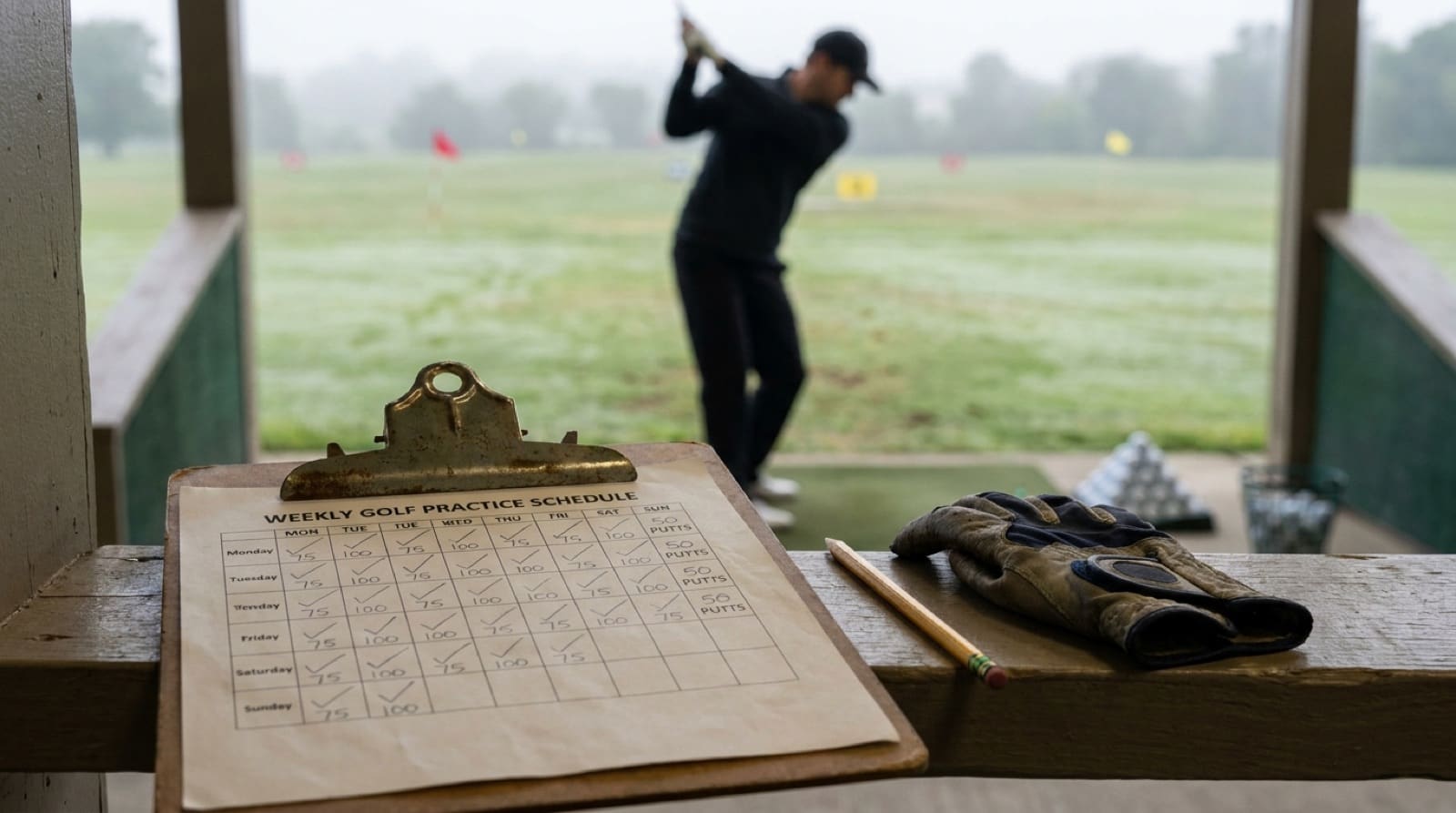
A golf practice schedule is the calendar itself — which days you practice, how far apart, and what each day emphasizes. The evidence-backed shape: 45-minute sessions on non-adjacent days, spaced 48–72 hours apart, one emphasis per day, run in 4-week cycles that end with an on-course assessment. Below are three ready-to-print weekly templates — 2-day, 3-day, and 5-day — plus a free 4-page PDF pack with a blank fill-in week.
The three schedules at a glance
| Element | 2-day week | 3-day week | 5-day week |
|---|---|---|---|
| Sessions per week | 2 | 3 | 5 (2 range + 2 home + 1 course) |
| Minutes per session | 45 | 45 | 45 range / 20 home / 75 course |
| Total weekly time | 90 min | 135 min | 175–205 min |
| Day pattern | Tue + Sat | Tue / Thu / Sat | Mon / Tue / Thu / Fri / Sat |
| Gap between sessions | 72+ hours | 48 hours | 48 h between full sessions; 2 rest days |
| Day emphasis | Short game, then irons | Putting → approach → pressure | One skill per touch |
| Block : random split | ~70 : 30 | ~50 : 50 | ~30 : 70 |
| Assessment round | 1 per 4 weeks | 1 per 3 weeks | 1 per 2 weeks |
| Best for | 15–25 handicaps | 8–18 handicaps | Single digits, competitors |
All three templates — with per-block drills, pass criteria, and write-in log lines — are in the free PDF:
Download the printable golf practice schedule template pack (PDF, 4 pages) — the 2-day, 3-day, and 5-day weeks plus a blank fill-in template with a 4-week cycle tracker and baseline box. Direct download — no email gate.
A quick distinction, because the two words get used interchangeably: a practice plan decides what you work on and how much time each skill gets — the allocation. A practice schedule decides when — which days, how far apart, what each day emphasizes. This post is the schedule; the allocation math by handicap lives in the golf practice plan post, and the two are designed to be used together.
Why the calendar beats the hour count
Two golfers each practice 135 minutes a week. One spends it in a single Saturday range session; the other splits it across Tuesday, Thursday, and Saturday. Same drills, same total time — and the second golfer improves faster, because learning consolidates between sessions.
The spacing effect behind that claim is among the most replicated findings in learning science. Cepeda et al.’s 2006 meta-analysis in Psychological Bulletin — 317 experiments across 184 articles, mostly verbal-recall tasks — found spaced practice reliably beat massed practice on final-test retention. Motor skills follow the same pattern: a motor-sequence learning study in the Journal of Physical Therapy Science found practice distributed across 12-hour gaps, including an overnight interval, produced better skill acquisition than the same trials massed 10 minutes apart. The likely mechanism is consolidation between sessions — work that runs while you rest, and that no extra bucket of balls can substitute for.
There’s a second, less famous spacing finding that matters for season planning. Cepeda et al.’s 2008 follow-up in Psychological Science mapped a “temporal ridgeline”: the ideal gap between study sessions grows with how far out you need the material to hold. The study measured fact retention rather than golf swings, so treat the transfer as a directional read — but the direction is useful. Preparing for a club championship next week? Practice densely this week. Building a swing change for November? Wider gaps between touches cost less than the dense-week instinct suggests.
The practical translation, echoed in The Golf Practice’s summary of the frequency research: sessions land best 48–72 hours apart, which is exactly the Tuesday / Thursday / Saturday rhythm. That number is a coaching heuristic built on the spacing literature rather than a lab-derived constant, but it is the right default for a weekly calendar.
Availability is the honest constraint underneath all of it. Golfity’s analysis of amateur practice habits puts the average amateur at roughly two practice hours per week — an applied estimate, not a formal survey, but it matches what any range regular observes. The templates below are built for that reality: 90 to 205 minutes, scheduled where they return the most.
The 2-day schedule (90 minutes per week)
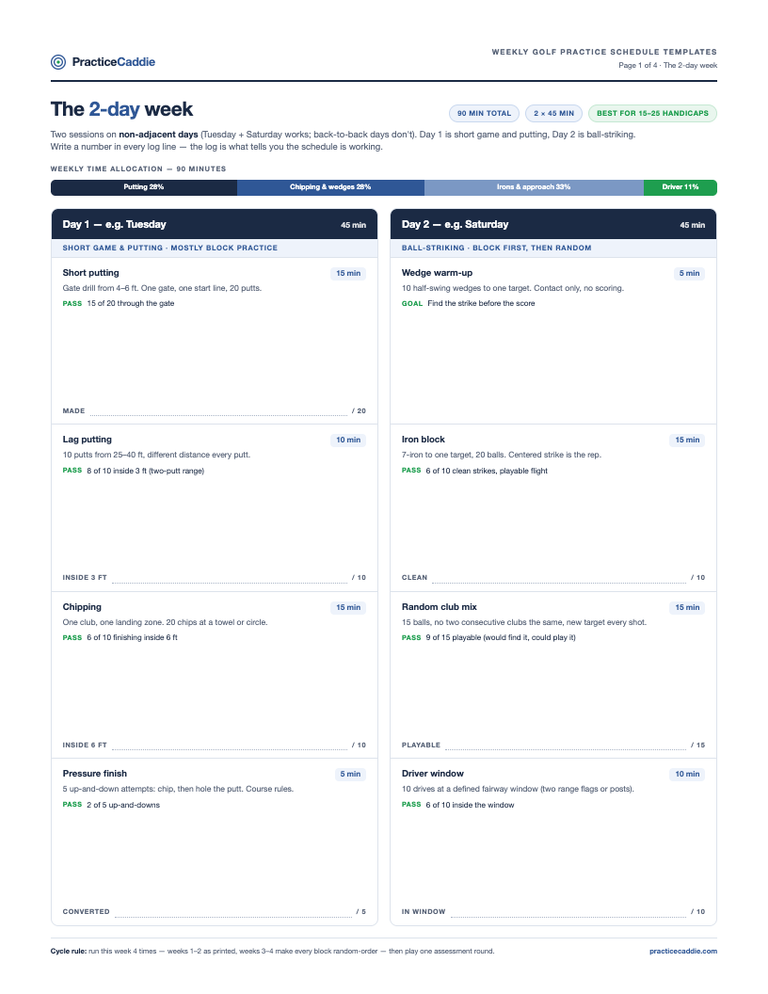
Two 45-minute sessions on non-adjacent days — Tuesday and Saturday is the canonical pattern, because the 72-hour gap gives consolidation two overnight cycles between touches. Back-to-back days waste the schedule’s one structural advantage.
Day 1 is short game and putting: 15 minutes of gate-drill work from 4–6 feet, 10 minutes of lag putting from 25–40 feet, 15 minutes of one-club chipping to a single landing zone, and a 5-minute pressure finish of five up-and-down attempts. Day 2 is ball-striking: a 5-minute wedge warm-up, 15 minutes of blocked 7-iron work, 15 minutes of random club mix with no two consecutive clubs the same, and 10 minutes of driver at a defined fairway window.
Every block carries a numeric pass criterion (15 of 20 through the gate, 6 of 10 clean strikes) and a log line. The short-game weighting follows the same leak math as the weekly practice plan — at 15–25 handicap, contact and the scoring zone are where the strokes are. If 90 minutes is genuinely all the week holds, this schedule kept for 8 weeks will outperform a more ambitious one kept for 2.
The 3-day schedule (135 minutes per week)
The 3-day week is the strongest default in this pack: Tuesday, Thursday, Saturday — 48 hours between every touch, every skill covered twice across the week, and each session still small enough to stay sharp for all 45 minutes.
Each day carries one emphasis. Tuesday is putting and wedges (gate drill, lag ladder, 50/75/100-yard wedge rotation, a pressure-putt finisher). Thursday is approach play with a random-order emphasis — including a 20-minute “9-hole simulation” where you play your home course’s first nine tee shots and approaches on the range, full routine, new club every shot. Saturday is full-bag pressure: chip-and-pitch mix, a 12-shot approach test with a pass line of 7 of 12, a driver 2-ball game, and a 9-hole putting course. Thursday and Saturday swap emphasis on alternating weeks so the month covers approach and short game evenly.
The 5-day schedule (175–205 minutes per week)
Five touches, but only two of them are range sessions. Monday and Friday are 20-minute home blocks — putting-mat work and speed-or-mirror work — and Saturday alternates between a 9-hole course assessment and a range pressure session. At this tier, frequency of contact matters more than any single session’s volume, so the schedule bends the non-adjacency rule deliberately: the three full-length sessions (Tuesday, Thursday, Saturday) keep their 48-hour spacing, while the Monday and Friday home blocks are low-load touches short enough not to interfere with it. Wednesday and Sunday stay empty on purpose.
Tuesday is a 45-minute approach session with a random emphasis. Thursday is 45 minutes of wedge-distance and greenside work. Saturday is the differentiator: a 9-hole on-course assessment played under normal scoring rules, alternating weekly with a range pressure session where every drill is pass/fail. The assessment cadence is tighter here (every 2 weeks) because the gap between range performance and course performance widens as handicaps drop — the course is the only honest test left.
The structure borrows from how tour players shape a week. A published profile of Rory McIlroy’s off-week routine describes 4–5 hours of deliberate practice per day split into a morning technical block and an afternoon short-game or on-course block — discrete sessions with different emphases, never one continuous grind — tapering to a 30-minute tune-up during tournament weeks. Hold the exact hours loosely (it’s an aggregator profile, and primary sources with time logs are rare); the shape — separated blocks, one emphasis each, taper before competition — is consistently reported and scales down cleanly.
Fitting the schedule around rounds
Most club golfers play more than they practice. The NCG Club Golf Survey found 38.6% of respondents play 6–10 rounds in a typical month and another 23.6% play 11–15. If that’s your calendar, rounds are already claiming one or two weekend slots, and the schedule adapts around them with two rules.
First, technical work moves early in the week, away from competition. A Saturday-round golfer runs the 3-day template as Tuesday / Wednesday-or-Thursday / post-round Saturday short-game block, and introduces nothing new on Friday. Second, rounds become data. An assessment round already lives in every template above; a regular Saturday fourball can do that job for free if you log fairways, greens, up-and-downs, and putts. Every 10 rounds or so, re-read the numbers and re-weight the schedule toward the biggest leak — the strokes-gained framework is the cleanest lens for that read, and Mark Broadie’s Every Shot Counts is its source.
Off-season scheduling flips the ridgeline logic: with no rounds for months, wider session gaps cost little, so winter weeks can drop to the 2-day template with one home putting block. Retention across wider gaps is what the spacing literature predicts holds up best — keep the log lines honest, and the spring re-baseline tells you how much survived.
What the research actually says about schedule structure
Three findings shape every template above.
-
Spaced beats massed on equal time. Cepeda et al. (2006) across 317 experiments in the verbal-recall literature, plus an overnight-gap advantage in motor-sequence learning. This is why every template spaces its full-length sessions apart before it says anything about drills.
-
Random-order practice retains better than blocked — including in golf. Shea & Morgan (1979) established the contextual-interference effect: worse in-session performance, better retention. A golf-specific putting study replicated it directly — random-practice golfers putted worse during acquisition, then retained better and developed mental representations of the stroke closer to skilled players’. The templates encode this as the week 1–2 block, week 3–4 random cycle.
-
Difficulty is the mechanism. Bjork & Bjork’s desirable-difficulties framework ties spacing, interleaving, and retrieval together: conditions that feel harder during practice produce more durable skill. A schedule that feels comfortable every session is worth re-examining against that finding.
One honest flag, because this topic is full of recycled numbers: the claim that “65% of golf shots happen inside 100 yards” (and its 70% and 80% cousins) circulates in nearly every practice-scheduling article, and no publicly verifiable primary source supports any specific version of it. The short-game weighting in these templates rests on strokes-gained leak data by handicap — covered with sources in the practice plan post — plus the simple arithmetic that putting alone is roughly a third to half of total strokes. Skip the slogan; keep the weighting.
Common scheduling mistakes
- Stacking sessions on adjacent days. Friday-plus-Saturday practice forfeits the consolidation gap that makes a 2-day schedule work at all. Non-adjacent days, always.
- Scheduling the aspirational week. A 5-day template attempted by a 2-day life produces zero completed weeks and a quiet sense of failure. Count your real days first; every template here has a smaller honest version.
- Treating rest days as skipped days. The empty Wednesday is load-bearing — consolidation and recovery are scheduled, the same way tour practice weeks schedule them.
- Covering every skill every session. Sampling putting, chipping, irons, and driver in one 45-minute session gives each block 11 unfocused minutes. One emphasis per day; the week covers the game.
- No assessment on the calendar. Without a scheduled course test, the only feedback is range feel — and random practice reliably feels worse while retaining better, so feel will steer you back to comfortable blocked reps.
- Swing changes the day before a round. Taper instead: technical work early-week, tune-up only before competition. A pre-round warm-up wakes the swing up; it does not rebuild it.
Key takeaways
- Schedule shape beats hour count. Three 45-minute sessions out-learn one 135-minute session on identical time (the spacing effect, Cepeda et al. 2006; overnight gaps improved motor-sequence learning in a controlled comparison).
- 48–72 hours between sessions is the working gap — Tuesday / Thursday / Saturday for 3 days, Tuesday + Saturday for 2.
- One emphasis per day, 2–4 blocks per session, every block with a numeric pass criterion and a log line.
- The 3-day template is the strongest default: every skill twice a week, every session fully focused, 135 total minutes.
- Rest days are scheduled, silent work. Consolidation runs between sessions; back-to-back days waste it.
- Run 4-week cycles — two weeks as printed, two weeks in random order, then an assessment round against your baseline.
- The free PDF pack carries all three templates plus a blank fill-in week: download it here.
Frequently asked questions
What is the best weekly golf practice schedule?
The best golf practice schedule puts 45-minute sessions on non-adjacent days — 2, 3, or 5 days depending on your availability — with one emphasis per day and 48 to 72 hours between sessions. A 3-day pattern (Tuesday, Thursday, Saturday) is the strongest default: short game one day, ball-striking the next, full-bag pressure work on the third. Spacing research shows distributed sessions out-learn one long session on identical total time, so the calendar shape matters more than the hour count.
How many days a week should I practice golf?
Two to three days per week is the working range for most amateurs, with sessions spaced 48 to 72 hours apart. Motor-learning research on distributed practice shows overnight gaps between sessions improve skill acquisition compared to massing the same work together. Five days suits single-digit players and competitors, but two of those five should be short 20-minute home blocks, and at least two full rest days stay on the calendar. Consistency across weeks beats day count within any single week.
Is it better to practice golf every day or a few times a week?
A few times a week, for almost every amateur. Motor consolidation runs between sessions — a study of motor sequence learning found practice distributed across overnight gaps produced better acquisition than the same trials massed 10 minutes apart. Daily practice also invites tired, low-quality reps. The exception is short home putting blocks, which can run more frequently because they are low-fatigue. If daily volume is available, the 5-day template caps range sessions at three.
How long should each golf practice session be?
30 to 60 minutes, with 45 as the default. Quality tends to drop past the hour mark for most amateurs — a coaching rule of thumb rather than a lab number — and the spacing effect favors a second 45-minute session on another day over a second hour on the same day. Inside each session, 2 to 4 blocks with a numeric pass criterion per block beats one long unstructured block. The 20-minute home putting blocks in the 5-day template are deliberately short — they exist for frequency, not volume.
What should I practice on each day of the week?
Give each day one emphasis rather than sampling everything daily. In the 3-day template: Day 1 is putting and wedges, Day 2 is approach play with a random-order emphasis, Day 3 is full-bag pressure blocks. The week covers every skill twice while each session stays focused. Weight the emphasis toward where you actually lose strokes — for most amateurs that means at least half of total weekly time on short game and putting until logged stats argue otherwise.
Should I practice the day before a round?
Lightly, if at all. Tour practice weeks model the principle: heavy technical work happens early in the week and tapers to short tune-ups before competition — published profiles of Rory McIlroy’s tournament weeks describe practice dropping to a 30-minute range tune-up plus warm-ups. For an amateur playing Saturday, that means technical practice on Tuesday and Thursday and nothing new on Friday. A pre-round warm-up wakes up rhythm and contact; it is not a practice session and should not introduce swing changes.
Related reading
- Golf Practice Plan: The Weekly Schedule That Lowers Handicaps — the allocation math this schedule assumes: how much time each skill gets by handicap, and why.
- Block vs Random Practice in Golf: What the Research Actually Says — the contextual-interference science behind the week 1–2 block, week 3–4 random cycle.
- Driving Range Practice Routine: 3 Plans by Handicap — single-session range routines that drop straight into these weekly slots.
- How to Actually Improve at Golf — the wider improvement playbook: baseline, assess, re-weight.
- Golf Warm-Up Routine — the pre-round companion; a warm-up is not a practice session, and this is the line between them.
- Golf practice plan: the complete guide (2026) — 30, 60, and 90-minute single-session templates that fit inside any of the three weeks.
- 30-minute golf practice — the time-boxed session for weeks when 45 minutes isn’t there.