
Aerated Greens: Why Courses Punch Them, and How to Putt on Them
One coring pass touches between 1.23% and 30.68% of a green, and ball roll drops about 7% for 14 days. The tine and its spacing decide which end you get.
Quick answer
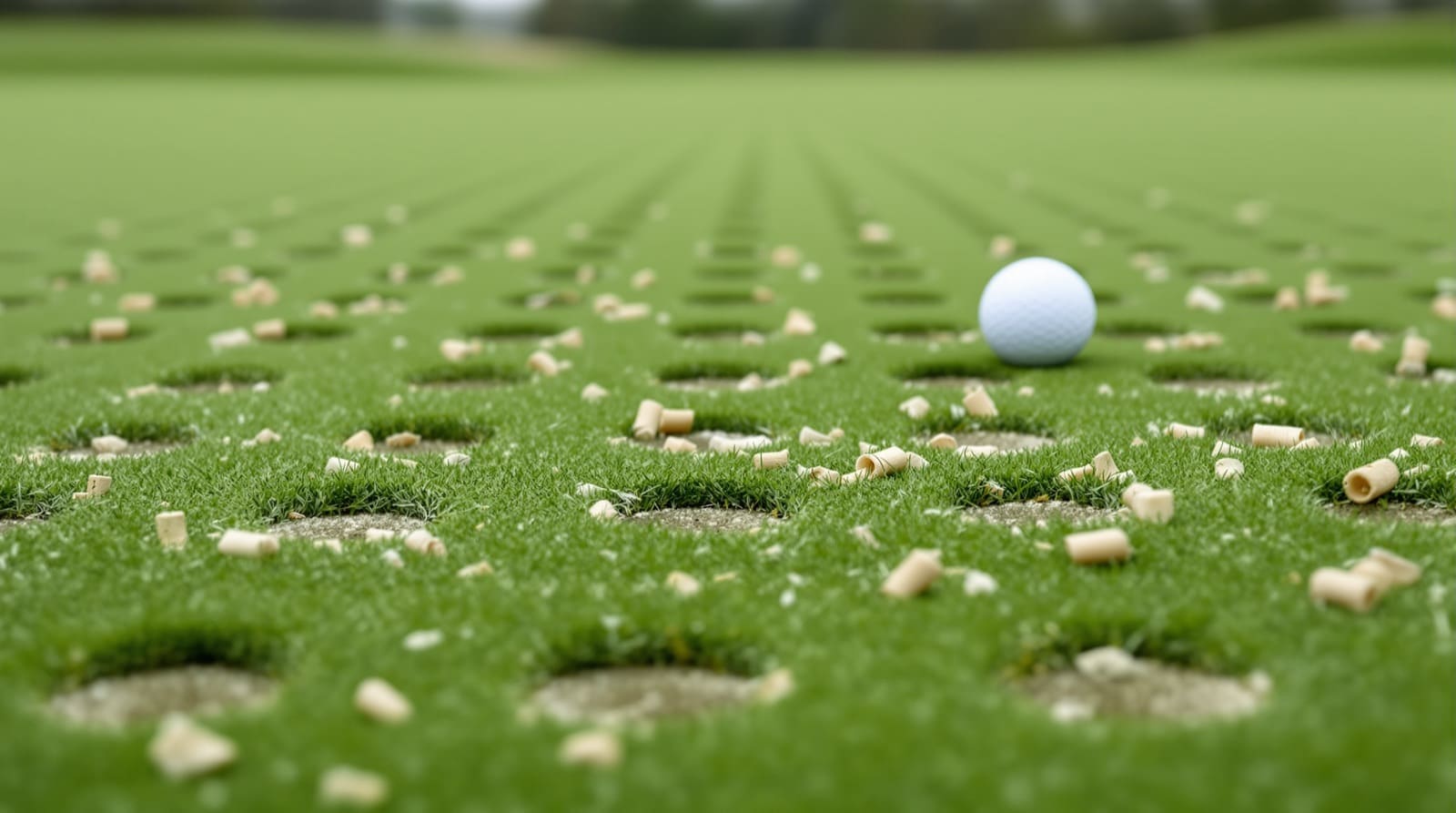
Courses punch greens to pull organic matter out of the top inch and replace it with sand. One pass affects 1.23% to 30.68% of the surface depending on tine size and spacing, and the USGA target is 15 to 20% a year. Expect ball roll about 7% shorter for 14 days. Lengthen the stroke rather than hitting harder.
What one coring pass actually costs, by tine and spacing
| Tine diameter | Spacing | Holes per ft² | Surface per pass | Two passes a year | Passes to reach 20% |
|---|---|---|---|---|---|
| 1/4 in | 2 × 2 in | 36 | 1.23% | 2.5% | 16.3 |
| 3/8 in | 2 × 2 in | 36 | 2.76% | 5.5% | 7.2 |
| 1/2 in | 2 × 2 in | 36 | 4.91% | 9.8% | 4.1 |
| 5/8 in | 2 × 2 in | 36 | 7.67% | 15.3% | 2.6 |
| 1/2 in | 1 × 2 in | 72 | 9.82% | 19.6% | 2.0 |
| 3/8 in | 1 × 1 in | 144 | 11.04% | 22.1% | 1.8 |
| 5/8 in | 1 × 1 in | 144 | 30.68% | 61.4% | 0.7 |
Hole counts, surface percentages and the passes column are lifted from Table 1 of Core Aeration by the Numbers, by USGA agronomists Chris Hartwiger and Patrick O’Brien. The “two passes a year” column is ours, and it prices the schedule golfers picture when they hear aeration: spring and fall, half-inch tines on two-inch centres, which gets a course to 9.8% a year. That is about two-thirds of the low end of the target, and half the high end.
Why golf courses aerate greens
A putting green is a sand profile slowly filling up with dead grass.
Roots grow, die and plug the large pores they grew through. Dr. Robert Carrow’s mid-1990s research, summarised by O’Brien and Hartwiger in the Green Section Record, found that once organic matter in a sand-based green reaches 3 to 4% by weight, macropore space starts to drop. Three things follow: oxygen stops diffusing into the rootzone, water stops infiltrating and puddles instead, and moisture climbs in the upper profile so the surface goes soft. Past that point a green becomes vulnerable to disease, wet wilt, black layer and heat injury.
Coring and verticutting are the two common practices that physically export that material, and the 2001 table covers both — its last two rows are a Graden vertical mower at 14.10% and 7.8% of the surface. Solid tines make a channel and improve gas exchange, but nothing leaves the green. The GCSAA’s own agronomy briefing puts compaction relief alongside it, and compaction is a real second reason. Organic matter is what sets the calendar.
The same USGA paper attaches a sand figure to the target: 40 to 50 cubic feet of sand per 1,000 square feet per year, counting both hole-filling and routine topdressing, to hold organic matter under 3 to 4%. O’Brien and Hartwiger advise against reaching it on topdressing alone. They work it out at roughly 25 applications a year, one every two weeks, which they call far too stressful in summer and hard to work into the canopy in winter.
Both numbers have held up. Adam Moeller and Todd Lowe revisited them for the Green Section Record in 2016 and wrote that the 15 to 20% and 40 to 50 cubic feet figures “are still relevant,” with the caveat that grass species, rootzone, fertility, traffic and climate move the target. Their regional split is the useful part for a golfer: southern courses with ultradwarf bermudagrass or bentgrass “often try to impact 20 percent or more,” while northern bentgrass and Poa annua greens “commonly target 15-20 percent.”
Tine size and spacing set how much of the green one pass touches
Look again at the table. Changing from a quarter-inch tine to a half-inch tine on the same spacing multiplies the affected surface by four, because area scales with the square of the diameter. That is the whole tradeoff a superintendent is working with.
Small tines are gentle and slow. Quarter-inch tines at two-inch centres would need 16.3 passes to reach 20% of the surface in a year. Sixteen closures is not a calendar any course runs. Big tines get there in two or three events, at the cost of holes you can see and feel for a fortnight.
There is a third route, and Moeller and Lowe name it: small tines on 1.0 to 1.5 inch centres “can impact the same or more surface area than larger tines at a wider spacing.” Read the table’s spacing column and you can see it happen — 3/8-inch tines at 1 × 1 affect 11.04% a pass, more than 5/8-inch tines at 2 × 2. The cost is heaving risk, which is why tight spacing needs good equipment.
That tradeoff shows up in ball roll. A two-year Clemson University study on a 14-year-old bentgrass research green — Hubbard, McCarty, Quisenberry and Bridges (2022) — cored plots with 0.6 cm, 0.9 cm and 1.2 cm inside-diameter tines and measured ball roll weekly. One week after the first spring treatment, the 0.6 cm plots rolled 15 to 22% longer than every other treatment. By week three there was no detectable difference between any of them. The four programs vary in spacing and frequency as well as diameter, so read that gap as a whole-program result.
The gentle program costs the golfer too. It spreads a smaller disruption across more of the year.
How much slower is a punched green, and for how long
The published number is a 7% reduction in ball roll distance for 14 days, with no detectable difference by day 21.
That figure comes from McCarty and colleagues, reported in the Clemson review above, following four annual hollow-tine treatments with 6.4 mm and 15.8 mm inside-diameter tines. An independent Oklahoma State trial by Naba Amgain and Charles Fontanier, written up in GCM, found the same 14-day shape: hollow-tine cultivation with 0.5-inch tines on 2 × 2 inch spacing reduced ball roll for up to 14 days, while sand injection and air injection did not measurably reduce it at all. At 21 days the cored plots were 87% visually recovered against 92% for sand injection.
A Stimpmeter reading is a ball roll distance, so the translation is direct. An 11-foot green putts like about 10.2 feet during that window. A 9-foot green putts like 8.4.
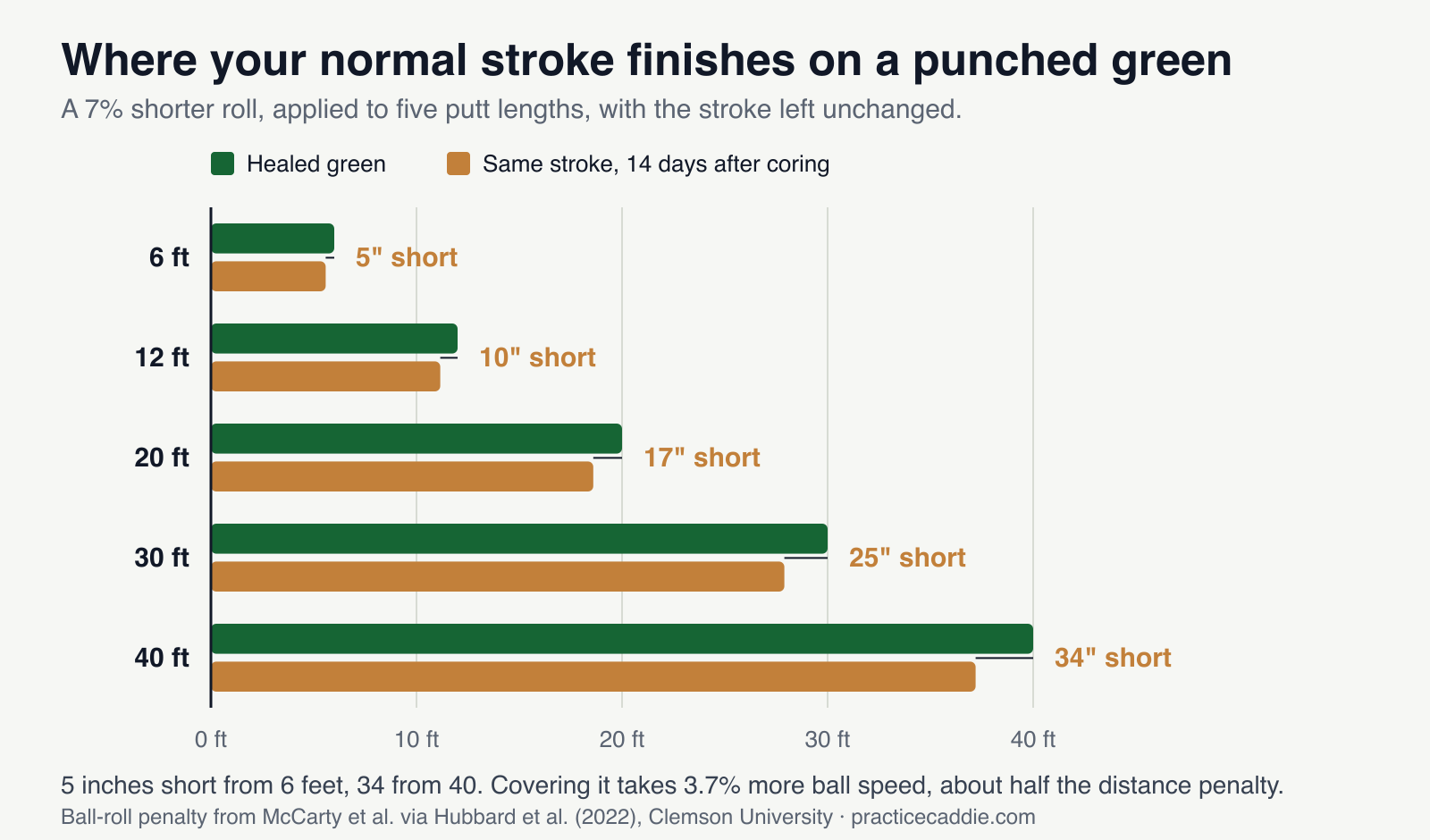
The chart is the same 7% applied to five putt lengths, which is where the practical instruction comes from. The penalty is proportional, so it is invisible on a tap-in and worth almost three feet on a lag. And the correction is smaller than the penalty: under the constant-deceleration model the Stimpmeter itself assumes, roll distance rises with the square of launch speed, so restoring a 7% shorter roll takes about 3.7% more ball speed. A slightly longer stroke covers it. Hitting at the ball overshoots it.
What tour-level teachers actually change
GOLF.com put the question to five of its Top 100 Teachers, and the useful part is where they agree and where they split.
They agree on calibration. Tim Cooke of The Sea Pines Resort and Andrew Rice of The Club at Savannah Harbor both send you to the practice green for a handful of 20-footers in several directions before the round. Rice’s framing is to stop calculating how much harder to hit each putt, because your brain has that figured out already.
They agree on stroke length over stroke force. Michael Hunt of the Jim McLean Golf School wants a longer stroke rather than a harder hit. Lou Guzzi wants the putt struck a bit firmer, because most aerated greens run slower. Those are the same instruction from two directions, and the 3.7% figure above says the change required is small.
They agree the sand matters more than the holes. Carol Preisinger of the Kiawah Island Club says a green whose holes are filled completely with sand should roll smooth and normal. Her adjustment is for the rest of them: putt firmer in the morning while the moist sand is still slowing the ball, and expect higher temperatures and more wind later to speed the greens up. Guzzi adds that some greens carry more sand than others, which makes those faster still. Both are describing the topdressing rather than the holes. USGA agronomists note that greens more often slow down over the course of a day, so read the sand on each green instead of assuming which way it will go.
They split on break. Guzzi plays less of it, because the greens are running slower. Hunt plays more, because of the bounces: a ball above the hole can catch a bump and fall in. Both are right about their own mechanism, which is the honest read: the gravitational component of the break shrinks with pace, and the random component is not predictable at all. Calibrate the first, and stop trying to solve the second.
Overseeding is the autumn disruption people confuse with aeration
Warm-season courses run a second autumn project, and golfers routinely blame the greens for it. Overseeding sows a cool-season grass into bermudagrass ahead of dormancy so the surface stays green and playable through winter. UGA Extension gives the golf-course and athletic-field rate as 8 to 12 pounds of perennial ryegrass per 1,000 square feet, and times it by soil temperature at 4 inches approaching 75°F, nights consistently in the 50s, midday below 70°F, or 2 to 4 weeks before the average first killing frost.
The speed penalty golfers expect from overseeding did not show up. A two-year Auburn University study on a TifEagle green overseeded with Poa trivialis — Bruner (2013) — found “no differences in ball roll between overseed and non-overseeded plots” in either year, and the author flags the result as surprising, since denser overseed growth was expected to add friction. Traffic shifted ball roll on a single date in each year, which the thesis itself calls inconsistent. The overseed never shifted it at all.
So when a bermudagrass course putts slowly in October, the coring is the likelier culprit.
What the research does not say
No published study puts a strokes-gained number on aerated greens. That is worth stating plainly, because the internet is full of confident figures for what punched greens cost a round, and none of them trace to a measurement.
What exists is a mechanism and a magnitude: roll distance about 7% shorter for two weeks, plus added surface roughness that makes short putts less repeatable. Both plausibly cost strokes. Neither has been converted into a per-round number by anyone whose method you can read.
The practical consequence lands on expectation. If you track your own Strokes Gained: Putting, a fortnight of punched greens will drag the number down and it will recover on its own. Do not re-tool a putting stroke on two weeks of temporary data.
The rule you can use, and the one you cannot
Model Local Rule E-4 covers aeration holes, and its scope is narrower than most golfers assume. From the R&A’s Committee Procedures:
If a player’s ball lies in or touches an aeration hole: (a) Ball in General Area. The player may take relief under Rule 16.1b. If the ball comes to rest in another aeration hole the player may take relief again under this Local Rule. (b) Ball on Putting Green. The player may take relief under Rule 16.1d. But interference does not exist if the aeration hole only interferes with the player’s stance or area of intended swing or, on the putting green, on the player’s line of play.
Two things follow. Relief exists only when the ball is in or touching a hole. A hole on your line, however cruelly placed, is not interference. And E-4 is a Local Rule, so it applies only where the Committee has adopted it.
Scoring is separate again. The USGA’s Rule 3.3 of the Rules of Handicapping requires a most likely score, capped at net double bogey, on any hole started but not holed out for a valid reason. Two of the teachers above use automatic two-putts on punched greens, and for a friendly game that is fine. For a posted score, write down the most likely score.
What to practise while the greens are punched
Aeration only ruins the sessions that depend on a stable surface.
- Skip it for speed-control work. The whole point of lag practice is calibrating a known surface. Two weeks of a moving target teaches nothing you can keep. Our lag putting drills assume a stable green.
- Skip it for green-reading practice. Random deflection is noise on top of the signal you are trying to learn. Come back for reading greens when the dots have grown over.
- Keep playing for scoring and routine work. A bumpy green is a good pressure test for a pre-shot routine and for accepting outcomes you did not cause, which is the same skill weather demands in bad conditions.
- Ask the pro shop which pass it was. A quarter-inch venting pass and a five-eighths coring are different fortnights. The table at the top tells you which one you are walking onto.
Related reading
- Strokes Gained Explained for Amateurs — the framework that tells you whether a bad fortnight of putting was the greens or you, and where your strokes go.
- Strokes Gained: Putting Explained — the Tour make-rate data by distance, and the two places amateurs leak putting strokes.
- Lag Putting Drills — distance-control work for a surface that is holding still, which is exactly what aeration takes away.
- How to Read Greens in Golf — the read itself, once the random deflection is gone.
- Golf Putting Drills — the full catalog, including the short-putt blocks worth doing indoors during aeration.
- Playing Golf in Bad Weather — the other condition that changes how far the ball goes, with the coefficients that survive testing.
- The putting drills guide — the longer companion, with the practice structure behind the drills.
Key takeaways
- Organic matter sets the calendar. Once it reaches 3 to 4% by weight in a sand green, macropores collapse and the surface softens. Coring and verticutting export it; solid tines and topdressing dilute it.
- One pass ranges from 1.23% to 30.68% of the surface. Tine diameter and spacing decide which, and area scales with the square of the diameter.
- Two passes a year with half-inch tines on 2 × 2 centres reaches 9.8%. The USGA target is 15 to 20%, so most courses need bigger tines, tighter spacing, or more events.
- Ball roll drops about 7% for 14 days, with no detectable difference by day 21 in the published work.
- The pace correction is 3.7%, roughly half the distance penalty. Roll distance rises with the square of launch speed, so a slightly longer stroke covers the gap and a harder hit overshoots it.
- A 20-footer finishes about 17 inches short on an unchanged stroke, and a 40-footer about 34 inches short.
- Relief needs the ball in or touching the hole. Model Local Rule E-4 gives nothing for a hole on your line, and only applies where the Committee has adopted it.
- No strokes-gained study exists comparing punched greens with healed ones. Any per-round cost you see quoted is an estimate.
Frequently asked questions
Why do golf courses aerate their greens?
To pull organic matter out of the top inch of the rootzone and replace it with sand. Research by Dr. Robert Carrow, summarised in the USGA Green Section Record, found that once organic matter in a sand-based green reaches 3 to 4% by weight, soil macropores start to disappear. Oxygen diffusion drops, water stops infiltrating and the surface goes soft. Coring removes plugs of that material, and filling the columns with sand keeps them open. Compaction relief and gas exchange come along with it, and organic-matter dilution is what sets the calendar.
How long do aerated greens take to heal?
Roughly two to four weeks, and hole size and the season move the number most. A Clemson University study on creeping bentgrass found that plots on the gentlest program, 0.6 cm tines, rolled 15 to 22% longer than the heavier programs one week after treatment, with the gap gone by week three. A separate Oklahoma State trial measured reduced ball roll for up to 14 days after 0.5-inch coring. Cold soil, dormant turf, weak grass and sand that bridges instead of filling all stretch that window.
Are aerated greens slower?
Yes, temporarily, and the published figure is about 7%. Work by McCarty and colleagues, reported in a 2022 Clemson review, measured roughly a 7% reduction in ball roll distance for 14 days after hollow-tine aerification, with no detectable difference by day 21. Because a Stimpmeter reading is a ball roll distance, an 11-foot green putts like about 10.2 feet during that window. The surface also gets bumpier, which matters more on short putts than the speed loss does.
How should you putt on aerated greens?
Roll six 20-footers before the round, two in each direction, and note how far short your normal stroke finishes. Then lengthen the backstroke rather than hitting harder. A 7% shorter roll needs only about 3.7% more ball speed to cover, because roll distance rises with the square of launch speed, so a small unhurried change does it. Check the sand: moist morning sand slows the roll, and heat and wind later in the day can speed the greens back up. On short putts, favour a firm roll through the imperfections.
Can you get relief from an aeration hole?
Only if your ball lies in or touches one, and only if the Committee has adopted Model Local Rule E-4. Under E-4 a ball on the putting green gets relief under Rule 16.1d, and a ball in the general area under Rule 16.1b. The Rule states plainly that interference does not exist if the aeration hole only affects your stance, your area of intended swing, or your line of play on the green. A hole sitting between your ball and the cup stays exactly where it is.
Do aerated greens cost you strokes?
Almost certainly some, but no published strokes-gained study compares punched greens with healed ones. The measurable effects are a roll distance about 7% shorter for two weeks and a bumpier surface that adds random deflection. Both make distance control and short-putt conversion more variable. Any specific figure you see quoted for what aeration costs a round is an estimate rather than a measurement, so treat the two-week window as a reason to lower expectations while you keep posting scores.
Why can’t courses just use smaller tines?
Because small tines at the usual wide spacing cannot reach the annual target. The USGA’s own table shows quarter-inch tines on 2 by 2 inch spacing affect 1.23% of the surface per pass, so reaching the 20% annual figure would take 16.3 passes. Half-inch tines on the same spacing affect 4.91%, which still only reaches 9.8% across two events a year. Tightening the spacing is the way out: 3/8-inch tines on 1 by 1 inch centres affect 11.04% a pass. That trades hole size for hole count, and raises the risk of turf heaving.