
Are Golf Simulators Accurate? What Gets Measured and What Gets Modelled
Garmin files carry distance under 'calculated by algorithm', not 'measured by radar'. An indoor bay watches 2% of the flight. Here is how to audit the rest.
Quick answer
Modern launch monitors measure launch conditions and model distance. Indoors, a TrackMan 4 bay at its optimal setup watches 12 feet of ball flight — about 2% of a 204-yard drive — and computes the rest. Garmin publishes this split outright, filing carry distance under “calculated by algorithm”. Audit ball speed, launch angle and spin first, because a carry disagreement with matching launch numbers points at the software rather than the sensor.
What the accuracy evidence actually shows
| Metric | Who watches it indoors | Best published agreement | Worst published disagreement |
|---|---|---|---|
| Ball speed | Radar or camera, directly | r = 0.99 across three devices (Donahue et al., 2025) | Over 4% on the least accurate units (MyGolfSpy) |
| Club speed | Radar directly; some camera units need a sticker | r = 0.92 or better (Brennan et al., 2024) | r = 0.78 between radar brands (Donahue et al., 2025) |
| Launch angle | Radar or camera, directly | Within 1° on a well-aligned unit (Garmin) | 12.19% low on one indoor driver comparison (MyGolfSpy) |
| Spin rate | Camera optically; radar only with a marked ball | 92.3 rpm deviation indoors (MyGolfSpy) | Mean bias to 1,238 rpm, limits of agreement −2,628 to +5,103 (Brennan et al., 2024) |
| Carry distance | No sensor. It is computed. | 0.2 yards indoors against a reference (MyGolfSpy) | 19.2 yards, 8.41% short, driver (MyGolfSpy) |
The spread in that last row is the reason this question keeps getting asked. The same class of device can land inside a yard or outside twenty, and the number on the screen looks identical either way.
Which launch monitor numbers are measured, and which are calculated
Speed and launch angle are measured. Carry, apex and face angle on a radar unit are calculated. Of the makers checked here, only Garmin prints that division in plain text, and it is the cheapest of them.
Most launch-monitor companies publish a parameter list and a technology description instead. TrackMan’s technical specifications page describes dual radar, optically enhanced tracking and a 4,600 fps camera, and carries no per-metric tolerance anywhere on it. Foresight and Bushnell follow the same pattern. That absence is a publishing convention rather than evidence of weakness, but it does leave the buyer guessing.
Garmin breaks the convention. Its Approach R10 accuracy page splits the readings into two headed groups:
- Measured by Radar — club head speed ±3 mph, ball speed ±1 mph, launch angle ±1°, launch direction ±1°.
- Calculated by Algorithm — club face angle ±2°, apex height ±5 feet, carry distance ±5 yards.
Carry sits on the calculated side. So does face angle, which is the number a lot of golfers use to diagnose a slice. The page adds three limits that matter more than the tolerances: spin is not measured when the ball is seen for less than 20 metres, spin is not measured below 90 mph of ball speed, and indoors the R10 computes spin from a machine-learned model built on the metrics it did measure, unless a Titleist RCT ball lets it measure spin directly.
Read that list next to a top-tier system and the gap in method is smaller than the gap in price. Every indoor setup, at every price, is doing the same thing: watching the first fraction of the shot and modelling the rest.
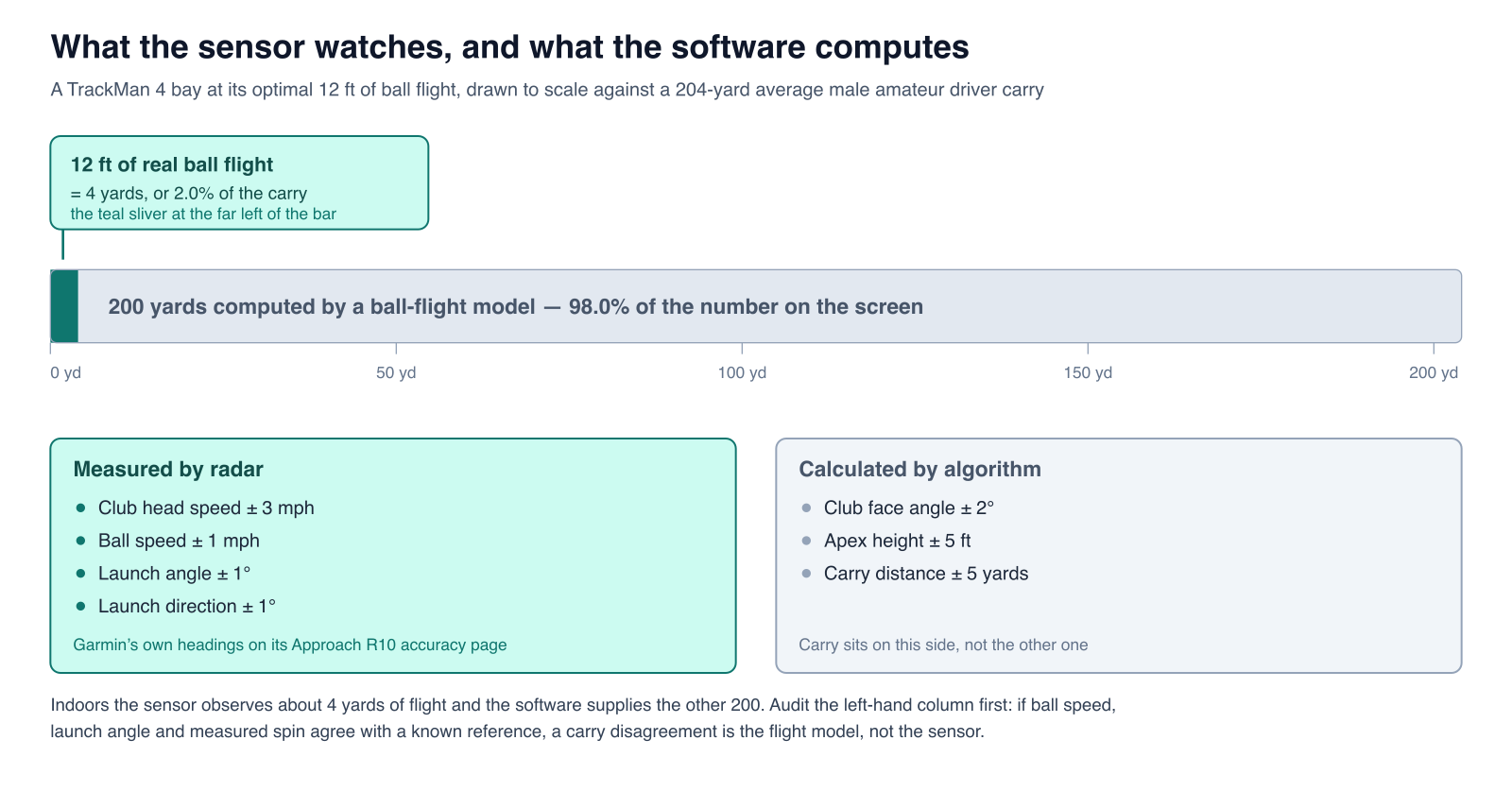
The proportion in that figure is arithmetic on two published numbers. TrackMan’s room requirements put the optimal hitting-area-to-screen distance at 12 feet, minimum 10. TrackMan’s own profile of the average male amateur puts that golfer at 93.4 mph of club speed, 132.6 mph of ball speed and a 204-yard driver carry — a figure TrackMan itself labels normalised.
Twelve feet is 4 yards. Four yards of 204 is 2.0%.
What the peer-reviewed comparisons found
Two studies published in the last three years compared devices head to head, and they agree on the ranking.
Brennan and colleagues (2024) put a FlightScope Mevo+ against a TrackMan 4 in an indoor biomechanics laboratory, with 29 youth golfers hitting 10 shots each with a driver and a 6-iron. Published in the Journal of Strength and Conditioning Research — with Mark Broadie, author of Every Shot Counts, among the co-authors — the paper reports correlations ranging from 0.254 to 0.985 across eight metrics.
Club speed and ball speed sat at 0.92 or better, and smash factor showed near-perfect agreement with a mean bias of 0.016 or less. Spin rate was the worst metric in the study: a mean bias up to 1,238 rpm, with 95% limits of agreement running from −2,628 to +5,103 rpm.
Donahue and colleagues (2025) ran three devices concurrently outdoors — a TrackMan against two FlightScope models — with 13 female NCAA Division I golfers hitting five drivers each. Published in Proceedings of the Institution of Mechanical Engineers, Part P, it found statistically significant differences on all six metrics tested.
Ball speed correlated at 0.99 and club speed ran 0.78 to 0.89. Carry distance, the number everyone quotes, correlated at only 0.61 to 0.66. Spin again finished last, with mean bias between 73.67 and 641.90 rpm depending on the pairing.
A strong correlation is not the same as agreement. Two devices can rank a fast swing above a slow one perfectly while holding a systematic 600 rpm spin offset between them the entire time.
That distinction is what makes cross-device comparison so unreliable. Both papers end on the same practical note: be cautious about coaching a golfer on spin, launch angle or attack angle when the number came off a different machine than last time.
What independent testing found against a reference device
Laboratory studies establish the ranking. Field tests put yardages on it.
MyGolfSpy’s 2024 accuracy testing, published in January 2025, measured every device against a reference system indoors and outdoors. The Bushnell Launch Pro finished with a 1.14% total indoor average deviation: 0.36% on ball speed, 2.82% on backspin (92.3 rpm) and 0.23% on carry (0.2 yards). Outdoors the same unit ran 0.19% on ball speed, 1.27% on backspin (46.5 rpm) and 3.29% on carry (6.0 yards). The write-up notes that the least accurate models in the same test showed outdoor ball-speed variances above 4% and backspin deviations as high as 40%.
Carl’s Place tested the Foresight GC3 against reality rather than against another launch monitor. Twenty shots each with a driver, 6-iron and pitching wedge on a range, with a second person marking each landing spot and a rangefinder measuring the actual distance. Mean absolute error came out at 4.4 yards (2.03%) with the driver, 2.3 yards (1.29%) with the 6-iron and 1.75 yards (1.44%) with the pitching wedge — with individual driver shots missing by as much as 18 yards inside that average.
Two things fall out of that GC3 result. The error grows with club length, which is what you would expect from a model extrapolating a longer flight from the same observed window. And a good average hides a wide spread, so a single shot is never the test.
What makes a golf simulator inaccurate: seven causes
Sensor quality is one input among several, and rarely the largest. These are the others, in rough order of how much damage they do.
- Ball flight distance. TrackMan 4 wants 12 feet to the screen and 7 feet behind the ball; it will run at 10 and 6. FlightScope’s published space requirements put the Mevo+ sensor 7 to 9 feet behind the tee and call for a minimum of 8 feet of ball flight in limited-flight mode. Under-space a radar unit and spin is the first casualty.
- Whether spin is measured or estimated. Titleist states plainly that with an unmarked ball you cannot measure spin rate indoors, and that its RCT ball lifts indoor spin capture above 99% on TrackMan. TrackMan italicises the number when it is estimated. An estimated spin figure then feeds the carry calculation, so one guess becomes two.
- Environment settings. TrackMan’s normalisation feature defaults to 77°F at sea level with no wind. Its support documentation confirms that Shot Analysis and Virtual Golf use different assumptions, so the same shot yields two carry numbers on the same machine depending on which screen you read.
- Ball conversion. Normalisation assumes a premium ball. Hit a range ball and TrackMan’s Ball Conversion adjusts speed, launch and spin to a premium-ball equivalent before calculating anything, which makes the displayed distance longer than the shot you hit.
- Camera calibration and lighting. Photometric units read dimples and club stickers. Flicker, glare, a dirty lens or a sensor sitting a few degrees off level corrupts launch direction and club path before any physics is applied.
- Radar interference. Fans, fluorescent ballasts, heaters, projectors and a second radar unit nearby all generate false returns. Two rear-mounted radar units placed side by side is the setup most likely to produce them, which is why side-by-side radar comparisons are the hardest ones to run cleanly.
- The mat. A mat lets the club skid instead of digging, so a fat strike indoors produces a better number than the same swing would off turf. The sensor is honest here; the impact it watched was a different impact. See how to read your divots for what a real strike leaves behind.
The launch-conditions-first audit
Most golfers audit a simulator by comparing its carry to their outdoor yardages, which tests the last thing in the chain and blames the first. This five-step version, developed for PracticeCaddie’s indoor-baseline sessions, works the other way round.
- Write down the environment settings before you hit anything. Altitude, temperature, ball type, and which screen you are reading. A comparison run against unknown settings proves nothing.
- Hit ten shots with one mid-iron and log ball speed, launch angle and spin. Include the bad ones and report the median plus the spread. A 6-iron or 7-iron beats a driver here, because driver spin is the hardest reading to capture in a short bay.
- Establish whether your spin number is measured or estimated. Check for italics on TrackMan, check the 20-metre and 90 mph thresholds on an R10, check whether your FlightScope has a sticker or an RCT ball in play.
- Compare those three launch numbers against a reference before you look at carry. The same club, outdoors or on a second device. If ball speed, launch angle and spin agree and carry does not, the gap lives in the flight model or the settings.
- Log a per-club offset rather than one global correction. The GC3 field test above moved from 1.75 yards of error with a wedge to 4.4 with a driver. Retest after any firmware or settings change, and re-baseline every six to eight weeks.
Which number disagrees, and what it means
| The number that disagrees | Most likely cause | What to do about it |
|---|---|---|
| Ball speed | Sensor alignment, or a ball-only device inferring it | Re-level and re-aim the unit; confirm ball speed is read directly, not derived from club speed |
| Club speed | Missing club sticker on a camera unit, or a radar sitting too close | Check sticker placement; move a radar unit back to its specified setback |
| Spin rate | Estimated rather than measured | Add a metallic dot or an RCT ball; give a radar unit more flight distance |
| Launch angle | Sensor tilt, or mat height entered wrong in software | Recalibrate; enter the actual mat and tee height |
| Carry only, with launch numbers matching | Flight model, altitude, temperature or ball conversion | Match the environment settings to your home course and re-read the same screen every time |
| Everything, on one shot only | Sample size | Ignore it. Compare medians across ten shots, never single shots |
How accurate does a golf simulator need to be?
Less accurate than most buyers assume, and the threshold changes with the job you are doing.
Gapping and club fitting need the launch column, not the carry column. Relative differences between clubs survive a systematic model offset. If every club reads 4% long, your gaps are still correct. Pair the session with a club distance chart built from tracked on-course data rather than from a screen.
Technique work needs measured metrics only. Ball speed and smash factor tell you about strike quality and are the two readings both peer-reviewed studies rated highest. Face angle on a budget radar unit is calculated, so rebuilding a grip around it is a poor bet. Launch monitor numbers explained covers which readings to watch per session.
On-course yardages need a per-club offset and a real reference. Carry indoors is the least portable number in the building. Take the offset outdoors once, write it down per club, and stop re-deriving it every session.
Practice quality does not need any of this. The research on block versus random practice applies indoors exactly as it does on a range, and a simulator’s biggest practical advantage — unlimited targets, instant randomisation — has nothing to do with its yardage model.
Common mistakes
- Comparing simulator carry against tour averages instead of against your own outdoor shots. A tour chart is not a reference device.
- Treating one session as a verdict. Bishop and colleagues’ indoor TrackMan 4 repeatability study put between-session reliability for spin rate as low as an intraclass correlation of 0.02, against 0.99 for club speed, on the same machine with the same golfers.
- Blaming the sensor for a settings difference. Altitude, temperature and ball type will move a carry number further than most hardware gaps.
- Trusting an italicised spin number. That formatting is the software telling you it guessed.
- Reading Shot Analysis one week and Virtual Golf the next, then wondering why the same swing lost 8 yards.
- Buying on a headline accuracy claim. “99.9% accurate” has no unit attached to it and cannot be checked.
Key takeaways
- Indoors, carry is computed on every system at every price. A TrackMan 4 bay at its optimal 12 feet of ball flight observes 4 yards of a 204-yard drive — 2.0% of it.
- Garmin publishes the split where TrackMan, Foresight and Bushnell publish no per-metric tolerance at all, filing club speed, ball speed, launch angle and launch direction as measured and carry, apex and face angle as calculated at ±5 yards, ±5 feet and ±2°.
- Ball speed is the most trustworthy number in the room, correlating at 0.99 across three devices in the 2025 comparison and at 0.92 or better in the 2024 one.
- Spin is the least trustworthy, with mean bias reaching 1,238 rpm and 95% limits of agreement spanning more than 7,700 rpm in the Mevo+ validation.
- A good average hides a wide spread. The GC3 averaged 4.4 yards of driver error against a rangefinder with individual shots missing by 18.
- No universal long or short bias exists. Published tests show both directions, driven by settings, ball conversion and flight-model differences as much as by hardware.
- Audit launch conditions before carry. If ball speed, launch angle and measured spin agree with a reference and carry does not, the disagreement is software.
Frequently asked questions
Are golf simulators accurate?
For launch conditions, usually yes. Ball speed is the most repeatable reading on almost any properly aligned unit, and independent testing shows premium systems agreeing within about 1% on it. Carry distance is a different question, because indoors it is computed rather than watched. MyGolfSpy’s 2024 testing put the Bushnell Launch Pro at 0.23% carry deviation indoors against a reference system, while the same test noted that the least accurate models showed backspin deviations as high as 40%.
Do golf simulators read long or short?
Neither direction is universal, and any blanket claim should be treated as marketing. Short readings tend to come from under-read ball speed, over-read spin, low launch readings or a conservative flight algorithm. Long readings tend to come from normalisation settings, premium-ball conversion, underestimated spin or an altitude and temperature default that does not match your course. MyGolfSpy measured the SkyTrak+ driver carry 8.41% shorter than a GCQuad reference indoors, while other outdoor field tests have shown simulated carry running longer than the observed landing point.
Is simulator carry distance measured or calculated?
Calculated, indoors, on every system. Garmin says so explicitly: its Approach R10 accuracy page lists club head speed, ball speed, launch angle and launch direction under “Measured by Radar”, and puts club face angle, apex height and carry distance under “Calculated by Algorithm” with a plus or minus 5 yard tolerance. A TrackMan 4 bay at its optimal 12 feet of ball flight watches 4 yards of a 204-yard drive. The software supplies the other 200.
Do I need a Titleist RCT ball indoors?
For a radar unit, it changes spin from an estimate into a measurement. Titleist states that with a standard unmarked ball you cannot measure spin rate indoors at all, and that RCT balls raise indoor spin capture above 99% on TrackMan. FlightScope accepts either a metallic sticker or an RCT ball for indoor spin. Camera-based units such as the GCQuad or SkyTrak+ read spin optically and do not need one. If your unit italicises spin or hides it, that is the tell.
How much room do you need for an accurate indoor launch monitor?
It depends on the sensor type, and radar needs the most. TrackMan 4 specifies 10 feet minimum and 12 feet optimal from hitting area to impact screen, plus 6 feet minimum and 7 feet optimal from the unit to the ball, with a 9-foot minimum ceiling. FlightScope publishes 7 to 9 feet of sensor-to-tee distance for the Mevo+ with a minimum of 8 feet of ball flight in limited-flight mode, and requires aluminium dots or a Titleist RCT ball for accurate indoor spin. Camera units need far less.
Which launch monitor numbers should I trust indoors?
Ball speed first, then club speed on a radar unit, then launch angle. Two peer-reviewed comparisons agree on the ranking: Brennan and colleagues found ball speed and club speed correlating at r of 0.92 or better between a Mevo+ and a TrackMan 4, and Donahue and colleagues measured a near-perfect ball-speed correlation of 0.99 across three devices. Both found spin rate the worst-agreeing metric of all. Treat carry, apex and descent angle as trends rather than measurements.
Related reading
- Launch Monitor Numbers Explained — smash factor, spin loft and attack angle decoded from TrackMan’s own tables, and which readings to watch in a single session.
- Strokes Gained Explained for Amateurs — the framework that decides which of your numbers is worth practising against in the first place.
- Block vs Random Practice in Golf — why a simulator’s real advantage is target variety rather than yardage precision.
- Average Golf Club Distances — tracked on-course yardages by handicap, the reference your indoor gapping session should be checked against.
- Driving Range Practice Routine — the outdoor session structure to run when you take the per-club offset outside.
- Best Golf Practice Apps — what to log a session into once the numbers are trustworthy.
- Golf Practice at Home — the companion guide for building indoor practice around what your space can measure.
- Driving Range Practice Plan — a structured outdoor plan for the reference session in step 4 of the audit.