
AI Golf Caddie Apps: What They Do and What the Rules Allow
AI caddies pair GPS with your shot history to suggest clubs and targets. The vendor improvement numbers, the Rule 4.3a limits, and where the advice breaks down.
Quick answer
An AI golf caddie combines GPS course maps, your recorded club distances, and models trained on billions of aggregated shots to recommend clubs, targets, and hole strategies. Vendor data associates shot tracking with real handicap drops (Arccos reports 5.71 strokes in year one for members playing 10+ rounds), but it is observational, not a controlled trial. During competition rounds, Rule 4.3a allows straight distances and blocks club recommendations, slope, and AI target lines.
The AI caddie landscape at a glance
| System | Recommendation basis | Advice unlocks after | Headline vendor claim |
|---|---|---|---|
| Arccos | Smart Distances + model trained on 1.5B+ shots, elevation, weather | ~90 holes (about 5 rounds) | 5.71-stroke average first-year handicap drop |
| 18Birdies | True Distance: last 10 tracked shots, minus the 2 longest and 2 shortest | ~10 tracked shots per club | Plays-like adjustments for wind, slope, temperature, altitude |
| Golfshot | Smart Club Distances excluding duffs and off-target shots | Equipment entered + a few rounds | Club recommendations in 3-D hole flyovers |
| Shot Scope | Post-round strokes-gained analytics, 100+ stats | 30 rounds for its benchmark claim | Users save 4.1 shots on average after 30 recorded rounds |
The category matters because course strategy is a real scoring lever that most amateurs never touch. Mark Broadie’s strokes-gained work showed that shot quality and shot selection, not putting heroics, separate handicap tiers, and an AI caddie is the first tool that puts tour-style expected-value thinking on an amateur’s wrist. Whether it delivers depends on data quality, and on knowing what the rules let you actually use mid-round.
What an AI caddie actually does
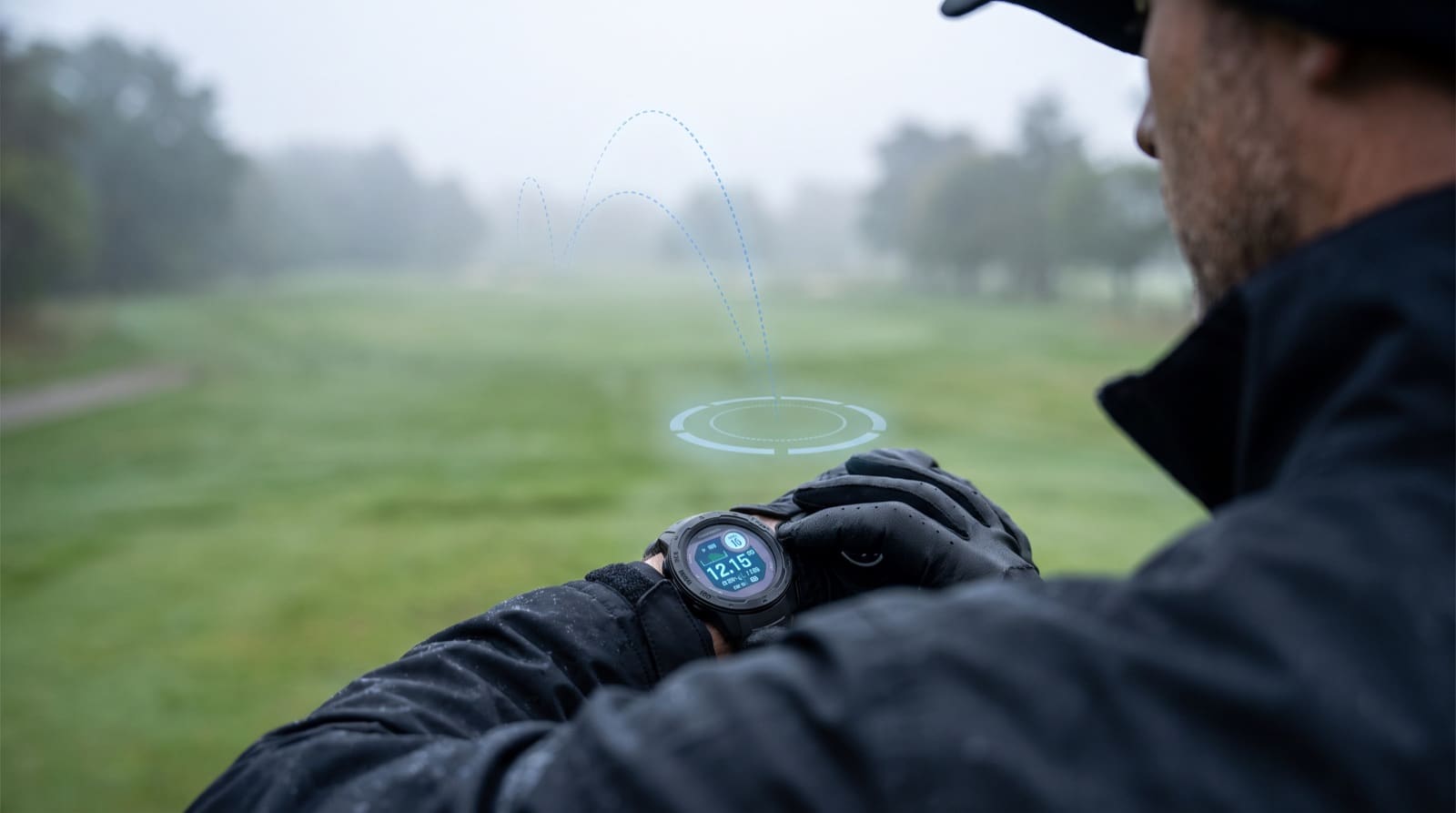
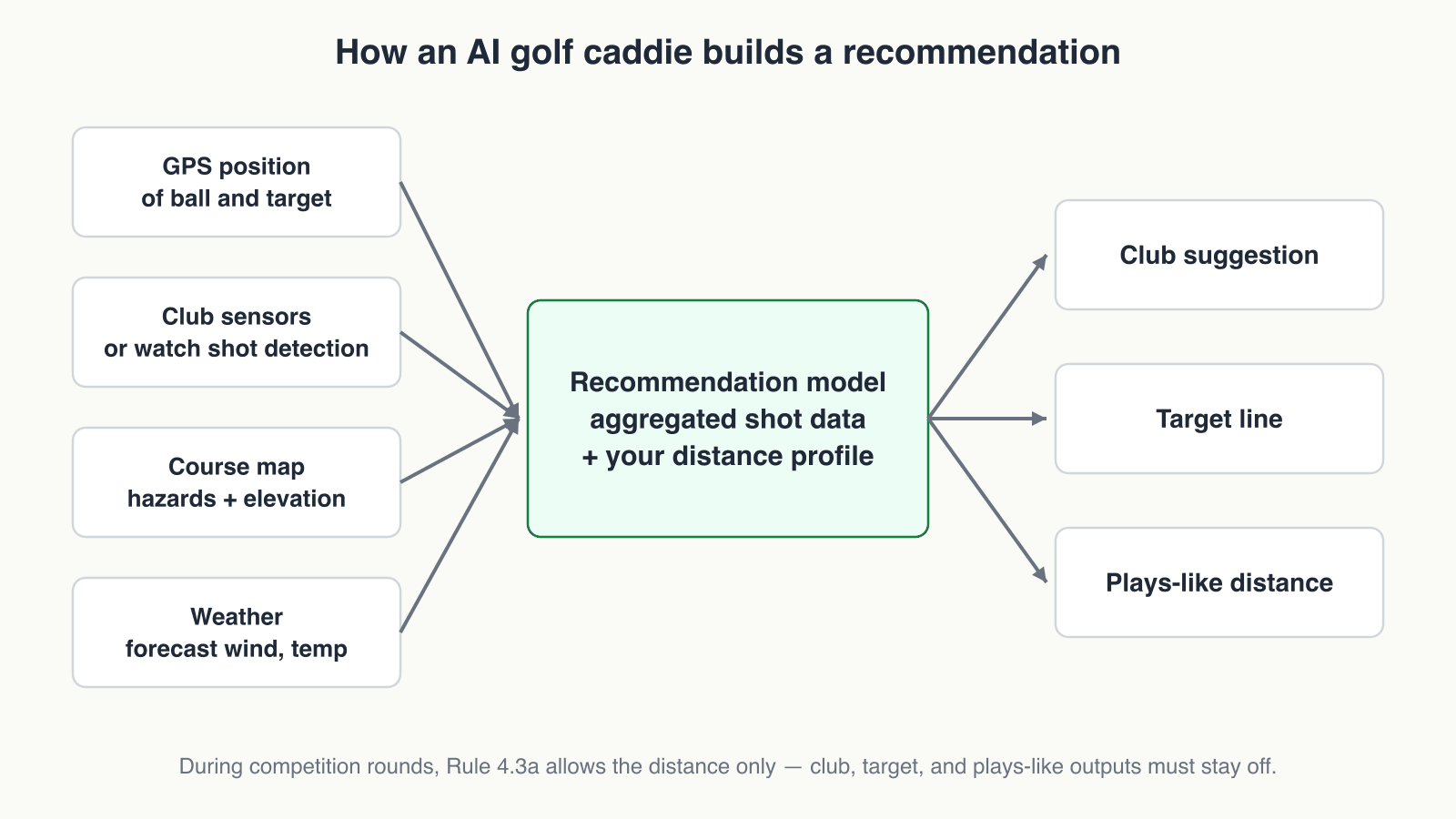
The stack is the same across vendors. Sensors or a watch detect each shot; GPS records where it started and ended; the app overlays those points on a mapped course. From that history the system builds per-club distance profiles, then a recommendation layer combines your profile with the course map, elevation, and weather to suggest a club and target. Arccos describes the pipeline as club sensors plus phone or watch GPS feeding a model that also draws on its aggregated community shot database.
Two details separate marketing from mechanics. First, the personal sample is small: 18Birdies’ True Distance uses your latest 10 tracked shots per club and discards the two longest and two shortest, and Arccos gates full Caddie Advice behind about 90 holes. Until then, the advice leans on aggregate models. Second, every vendor filters outliers: Golfshot excludes duffs and off-target shots from its Smart Club Distances. Filtering produces a usable “normal” number, and it also quietly assumes your contact is more consistent than a 20-handicap’s actually is.
What the improvement data actually says
The honest read: the numbers are real, large, and vendor-reported. Arccos has published a 5.71-stroke average first-year handicap improvement for new members who played at least 10 rounds, and a breakdown by starting handicap: 1.07 strokes for 0-5 handicaps, 2.76 for 5-10, 4.31 for 10-15, 5.96 for 15-20, and 8.56 for 20-plus. An earlier Arccos audit of 725,000 rounds reported a 2.77-stroke average drop with 86% of users improving. Shot Scope reports 4.1 shots saved on average after 30 recorded rounds across 200,000+ users.
None of it is a controlled trial. Golfers who record 10 to 30 rounds are the engaged ones; lessons, practice, new clubs, and regression to the mean are all mixed into the result. A year-long independent test by Golf Monthly found the tracking excellent at exposing weaknesses (a 12.4 short-game handicap hiding inside a mid-handicapper’s game) but published no before-and-after scoring change. The defensible conclusion: tracking plus acting on what it shows is associated with meaningful improvement, and the by-handicap table says higher handicaps have the most to gain.
The three layers: caddie, analytics, coach
Sorting the market into layers makes the buying decision easier. Each layer answers one question.
- On-course AI caddie answers “what should I hit right now?” Inputs are your position, the map, your distance profile, and weather; outputs are club, target, and expected outcomes. Arccos Caddie, 18Birdies recommendations, and Golfshot live here.
- Post-round analytics answers “where do I lose strokes?” Strokes-gained breakdowns by driving, approach, short game, and putting, from Arccos or Shot Scope. This is the bridge layer: it converts tracked rounds into a practice priority. The strokes-gained primer covers how to read these numbers.
- AI practice and coaching tools answer “how do I fix it?” Video swing analyzers such as Sportsbox AI measure body motion in 3-D from phone video, and practice-plan systems turn a diagnosed leak into structured drill work. This is the layer PracticeCaddie occupies: AI-generated practice plans built from your assessment, with drills, success criteria, and progression.
The layers compound rather than compete. A caddie app saves you the strokes your decisions were donating; the analytics tell you which skill to rebuild; the practice layer rebuilds it. A golfer who only buys layer one keeps the same swing with better targets.
What the rules allow during a round
Rule 4.3a draws a sharp line through every feature list. Legal during a competition round: straight-line distance and direction from GPS or laser, forecast weather including forecast wind, and any information you gathered before the round, including precomputed club recommendations. Prohibited while the round is running: measuring elevation changes, slope-adjusted plays-like distances, club recommendations based on your ball’s current location, AI target lines, and measuring wind on-site. The USGA’s equipment FAQ confirms you may carry a device with prohibited functions as long as you never access them.
The penalty structure has teeth: the general penalty (two strokes, or loss of hole in match play) for a first breach, disqualification for a second. Apps know this, which is why 18Birdies ships a Tournament Mode that strips slope, weather adjustments, and club recommendations. Two extra wrinkles: a committee can prohibit distance devices entirely through a local rule, and the restriction travels with the Rules of Golf themselves, so a casual round you post for handicap should also keep the advice features off. Purely recreational, unposted golf is where the full feature set belongs. Check the competition’s hard card before you tee it up with advice turned on.
Where the advice breaks down
- Cold start. Before ~90 holes (Arccos) or ~10 tracked shots per club (18Birdies), recommendations lean on aggregate models and typed-in distances. Treat month one as calibration.
- GPS error. 18Birdies puts normal phone GPS at 5-10 yards of error, enough to misclassify a shot’s lie category or shift an inferred carry by a club.
- The lie is invisible. GPS infers fairway, rough, or bunker from the map. It cannot see a ball sitting down, hardpan, mud, or a stance problem; 18Birdies asks you to enter the lie manually. A recommendation built on a clean-lie assumption is wrong exactly when the shot is hardest.
- Wind is a forecast. Apps adjust for forecast wind, which says little about a sheltered green, wind above the trees, or the gust during your swing. This is the human caddie’s remaining edge.
- Missed and mislabeled shots. Arccos acknowledges practice-swing false positives and imperfect club identification; the Breaking Eighty review measured sensorless club ID at 60-70% over four rounds. Bad inputs become bad distance profiles become bad advice.
- The output is an expected-value play with no guarantee attached. It knows nothing about your confidence, fatigue, match situation, or the draw you refuse to hit off that tee.
Who should buy one (and who should practice first)
For a 15-plus handicap whose scorecard leaks come from doubles, penalty balls, and short-siding, an AI caddie is a strong first purchase: strategy fixes are free strokes that need no swing change, and Arccos’s own by-handicap table shows the biggest reported gains right there. The course-management principles it pushes (center-of-green targets, punch-out discipline, club up) work even before the data matures.
For a golfer whose leak is contact or a two-way miss, the caddie layer mostly documents the problem. Better targets do little for a swing that misses the face. That golfer’s money goes further on the coaching layer: a diagnosed fault, a structured practice plan, and range sessions designed for transfer rather than comfort. The how-to-actually-improve framework walks through sequencing the two. PracticeCaddie’s AI plans are built for that side of the split: they take your assessment leaks and generate drill blocks with success criteria. AI plan generation is a Pro feature with a 3-day free trial; the free-forever plan covers structured practice logging, no credit card required. Start with the free plan.
Common mistakes
- Trusting week-one advice. The distance profile is mostly aggregate model until dozens of tracked shots accumulate per club. Audit and correct your first rounds.
- Running advice features in a competition. Two strokes the first time, disqualification the second. Flip on tournament mode and confirm what it hides.
- Reading vendor improvement stats as guarantees. They are averages among engaged, self-selected users, dominated by high handicaps with room to fall.
- Buying the caddie layer to fix a technique problem. A club recommendation cannot move your low point. Diagnose which layer your strokes are leaking from first.
- Letting filtered distances flatter you. Outlier removal assumes decent contact. If two of ten 7-irons are thin, your real on-course 7-iron is shorter than the app’s number.
Key takeaways
- An AI caddie is GPS + your shot history + an aggregate model, producing club and target recommendations. Arccos trains on 1.5B+ shots and needs ~90 holes of your data for full advice.
- The improvement numbers are vendor-observational: 5.71 strokes reported by Arccos in year one (10+ rounds), 4.1 shots by Shot Scope after 30 rounds. Association, not a controlled trial.
- Gains scale with handicap: Arccos reports 1.07 strokes for 0-5 handicaps versus 8.56 for 20-plus.
- Rule 4.3a splits the feature list: straight distance is legal in competition; slope, club recommendations, and AI target lines are not while the round runs. Two strokes, then DQ.
- The advice’s blind spots are the lie, real wind, and your sample size. GPS error alone runs 5-10 yards on a phone.
- Caddie, analytics, coach are three different purchases. Strategy tools manage the game you have; practice systems change it. Sequence them by where your strokes actually leak.
Frequently asked questions
What is an AI golf caddie?
An AI golf caddie is an app or device that combines GPS course maps, your recorded club distances, and models trained on aggregated shot data to recommend clubs, targets, and hole strategies. Arccos, the largest, says its strategy model is trained on more than 1.5 billion shots and personalizes advice with your own history, elevation, and weather. The category also includes 18Birdies club recommendations and Golfshot’s caddie features. It advises decisions; it does not change your swing.
Do AI caddie apps actually lower your handicap?
The published numbers are encouraging but come from the vendors’ own user data, with no control group. Arccos reports new members who played at least 10 rounds cut their handicap by an average of 5.71 strokes in year one, with bigger drops for higher handicaps: 1.07 strokes for 0-5 handicaps versus 8.56 for 20-plus. Shot Scope reports users save 4.1 shots on average after 30 recorded rounds. Read these as association among engaged users, since lessons, practice, and self-selection are all mixed in.
Are AI caddies legal in tournament rounds?
Partly. Under Rule 4.3a you may get straight distance and direction from a GPS or rangefinder, but you may not access slope-adjusted plays-like distances, club recommendations, or an AI-generated target line based on your ball’s location during a round. The penalty is two strokes in stroke play for a first breach and disqualification for a second. Most apps ship a tournament mode that hides the prohibited outputs, and a committee can also ban distance devices entirely with Model Local Rule G-5.
What is the difference between an AI caddie and an AI golf coach?
An AI caddie answers an on-course question: with your current game, this location, and this weather, which club and target give the best expected result. An AI coach answers a development question: which weakness costs you the most strokes and what practice fixes it. Caddie advice manages the game you already have. Video swing analyzers, strokes-gained analytics, and AI practice-plan tools like PracticeCaddie work on changing that game between rounds. Most improving golfers eventually want both layers.
How many rounds does an AI caddie need before its advice is reliable?
More than most golfers expect. Arccos withholds its full Caddie Advice until you have recorded about 90 holes, roughly five rounds, and 18Birdies bases its True Distance on your latest 10 tracked shots per club after discarding the two longest and two shortest. Golfshot likewise says recommendations need your equipment entered and a few rounds played. Early recommendations lean on aggregate models and typed-in yardages, so treat the first month of advice as calibration, and check that your tracked distances look sane.
Do AI caddie apps work without club sensors?
They run, but the data quality drops. An independent Breaking Eighty review estimated Arccos shot detection at roughly 90 to 95 percent with screw-in club sensors, and about 60 to 70 percent correct club identification in sensorless mode over four test rounds. Missed shots, false detections from practice swings, and misidentified clubs then flow straight into the distance averages the advice is built on. If you go sensorless, audit your rounds afterward and correct the errors before trusting the club recommendations.
Related reading
- Strokes Gained, Explained for Amateurs — the framework every AI caddie and analytics app is built on, and how to read your own numbers.
- Golf Course Management Tips — the strategy principles the AI is encoding: center-of-green targets, punch-out discipline, tee-shot placement.
- How to Actually Improve at Golf — sequencing measurement, strategy, and practice so the three layers compound.
- Best Golf Practice Apps — the coaching-layer companion roundup, including where PracticeCaddie fits.
- Best Golf Coaching Apps — video-analysis and lesson apps for the swing side of the split.
- Block vs Random Practice in Golf — the motor-learning research that decides whether practice transfers to the course.